High Reps vs Low Reps: Which is Best for Hypertrophy?
High Reps vs Low Reps: Which is Best for Hypertrophy?

📋 TL;DR
The question of high reps vs low reps which is best for hypertrophy has a nuanced answer: both are effective, but they target different muscle fibers . Research consistently shows that muscle growth can occur across a wide spectrum of loading zones, from 5 to 50+ reps, provided sets are taken close to failure . Low reps (1-5) with heavy loads maximize mechanical tension and are superior for strength, while also recruiting fast-twitch (Type II) fibers—the ones with the greatest growth potential . High reps (15-30) with lighter loads create metabolic stress and the "pump," which can drive growth in slow-twitch (Type I) fibers . The sweet spot for most lifters is the 6-12 rep range, which balances both mechanisms, but the ultimate conclusion is that a varied approach using multiple rep ranges optimizes overall muscle development .
1. The Great Rep Range Debate
Walk into any gym, and you'll hear conflicting advice. "Go heavy or go home," says one camp. "High reps for the burn," insists another. For decades, lifters have argued about high reps vs low reps which is best for hypertrophy. The truth, as science now reveals, is far more interesting than either extreme.
Early beliefs followed the "strength-endurance continuum," which held that low reps built strength, moderate reps built muscle, and high reps built endurance . But this model oversimplified the complex physiology of muscle growth. Modern research, including landmark meta-analyses by Dr. Brad Schoenfeld and colleagues, has fundamentally changed our understanding .
This guide will explore the science, the practical applications, and the nutritional strategies to help you answer the question: high reps vs low reps which is best for hypertrophy for your specific goals.
2. The Science: What the Research Actually Says
2.1. The 2016 Meta-Analysis That Changed Everything
A seminal 2016 meta-analysis by Schoenfeld et al. reviewed 21 studies comparing low-load (≤60% 1RM) versus high-load (>60% 1RM) resistance training. The conclusion was clear: muscle hypertrophy can be equally achieved across a spectrum of loading ranges . In other words, when sets are taken to failure, both heavy weights for low reps and light weights for high reps stimulate muscle growth, shedding light on high reps vs low reps which is best for hypertrophy .
However, the same analysis found that gains in maximal strength (1RM) were significantly greater with heavy loading—a finding consistent with the principle of specificity .
2.2. The Trained Lifters Study
Critics argued that earlier research used untrained subjects, where any stimulus produces growth. Dr. Schoenfeld's lab addressed this in a 2015 study on experienced lifters (average 3+ years training). One group trained with 8-12RM (heavy), another with 25-35RM (light). After 8 weeks, both groups showed similar muscle growth in biceps, triceps, and quads. However, the heavy group gained significantly more strength, while the light group improved muscular endurance, contributing to the high reps vs low reps which is best for hypertrophy debate .
2.3. The Role of Training to Failure
The common thread in all effective hypertrophy protocols is proximity to failure. A 2016 study in the Journal of Applied Physiology found that when trained men performed sets to failure with either 20-25 reps (light) or 8-12 reps (heavy), hypertrophy was similar between groups . The researchers concluded that "training to failure is the most important variable for skeletal muscle hypertrophy gains" .
3. Rep Range Breakdown: Pros, Cons, and Mechanisms
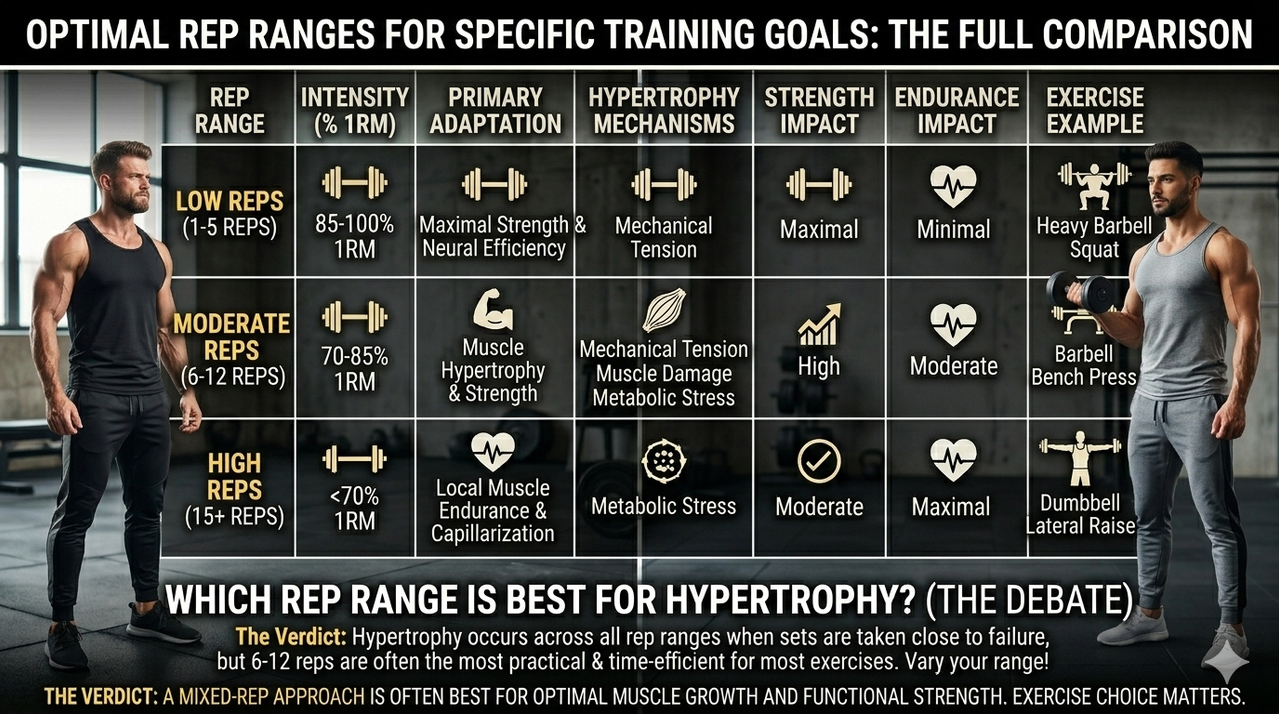
3.1. Low Reps (1-5) – Strength Focus
Low Reps (1-5, 80-100% 1RM)
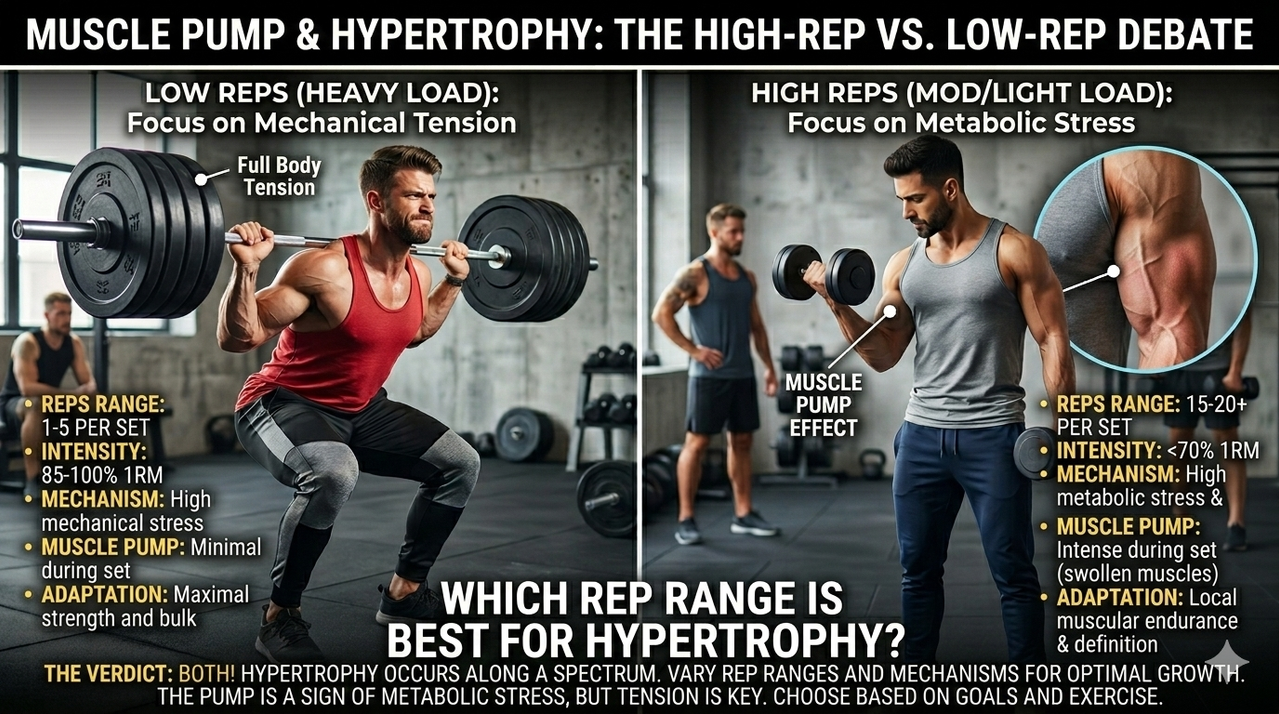
Maximal StrengthPrimary mechanism: Mechanical tension. Heavy loads create immense tension within muscle fibers, activating fast-twitch (Type II) fibers that have the greatest growth potential, key to understanding high reps vs low reps which is best for hypertrophy .
Pros: Superior strength gains, time-efficient, recruits high-threshold motor units .
Cons: Higher injury risk, increased joint stress, limited metabolic stress .
Best for: Compound lifts (squats, deadlifts, bench press) and building a strength foundation .
3.2. Moderate Reps (6-12) – The Hypertrophy Sweet Spot
Moderate Reps (6-12, 65-85% 1RM)
Traditional HypertrophyPrimary mechanism: Balance of mechanical tension and metabolic stress. This range effectively recruits both Type I and Type II fibers, addressing high reps vs low reps which is best for hypertrophy .
Pros: Excellent hypertrophy stimulus, well-tolerated by most lifters, versatile for all exercises .
Cons: Neither maximizes strength nor endurance exclusively.
Best for: Most bodybuilding movements and overall muscle development .
3.3. High Reps (15-30) – Metabolic Stress and Endurance
High Reps (15-30, <60% 1RM)
Metabolic ConditioningPrimary mechanism: Metabolic stress. The buildup of metabolites (lactate, hydrogen ions) and the "pump" from blood flow can drive hypertrophy, particularly in Type I fibers, contributing to high reps vs low reps which is best for hypertrophy .
Pros: Joint-friendly, lower injury risk, improves muscular endurance, creates intense pump .
Cons: Mentally taxing (the burn is real), difficult to gauge proximity to failure .
Best for: Isolation exercises, deload weeks, rehab, and targeting slow-twitch fibers .
4. Muscle Fiber Specificity: The Real Answer
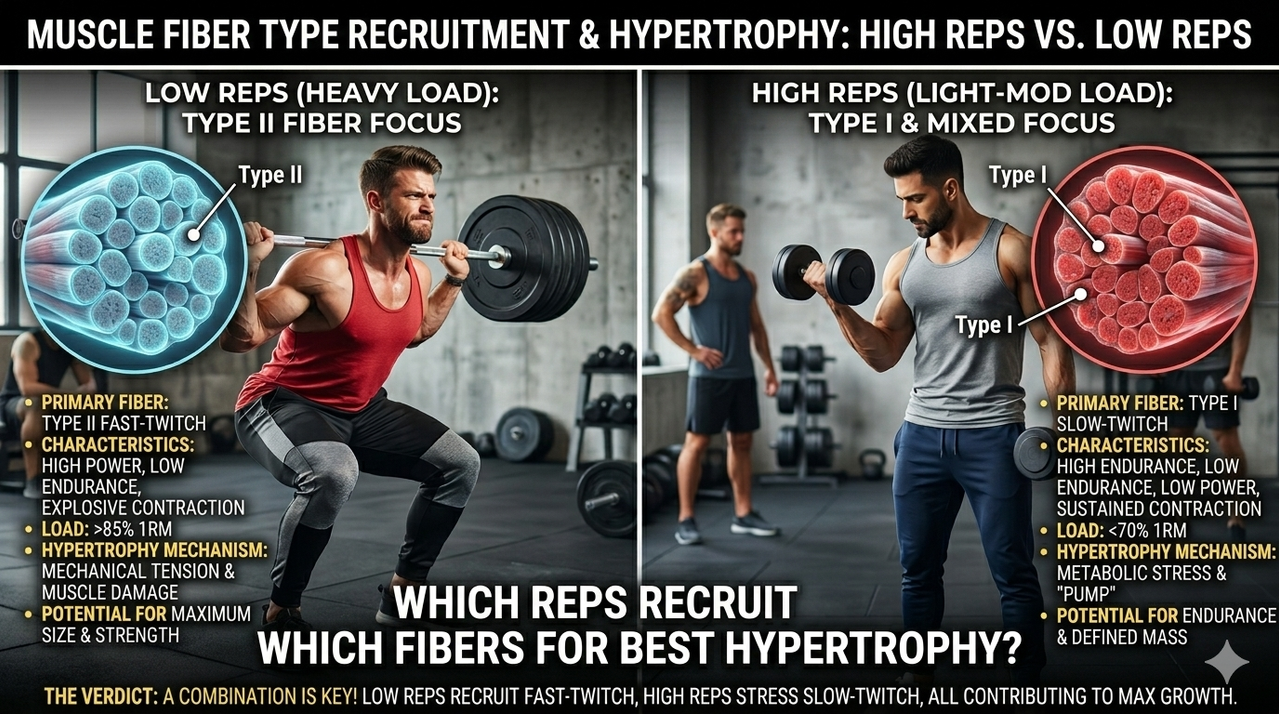
The most sophisticated understanding of high reps vs low reps which is best for hypertrophy comes from examining muscle fiber types. Emerging research suggests that heavy and light loads target different fibers .
| Fiber Type | Characteristics | Preferred Stimulus |
|---|---|---|
| Type I (Slow-Twitch) | Endurance-oriented, smaller growth potential, fatigue-resistant | High reps (20-30+) with lighter loads |
| Type IIa (Fast-Twitch) | Intermediate, high growth potential, moderately fatigable | Moderate reps (8-12) with moderate loads |
| Type IIx (Fast-Twitch) | Largest growth potential, easily fatigued, recruited for maximal force | Low reps (1-5) with heavy loads |
Russian research cited by Dr. Schoenfeld indicates that light loads promote greater gains in Type I fibers while heavy loads increase Type II fiber hypertrophy to a greater extent . The logical conclusion: to maximize overall muscle growth, you should train across the spectrum of loading zones .
5. Practical Programming: How to Combine Rep Ranges
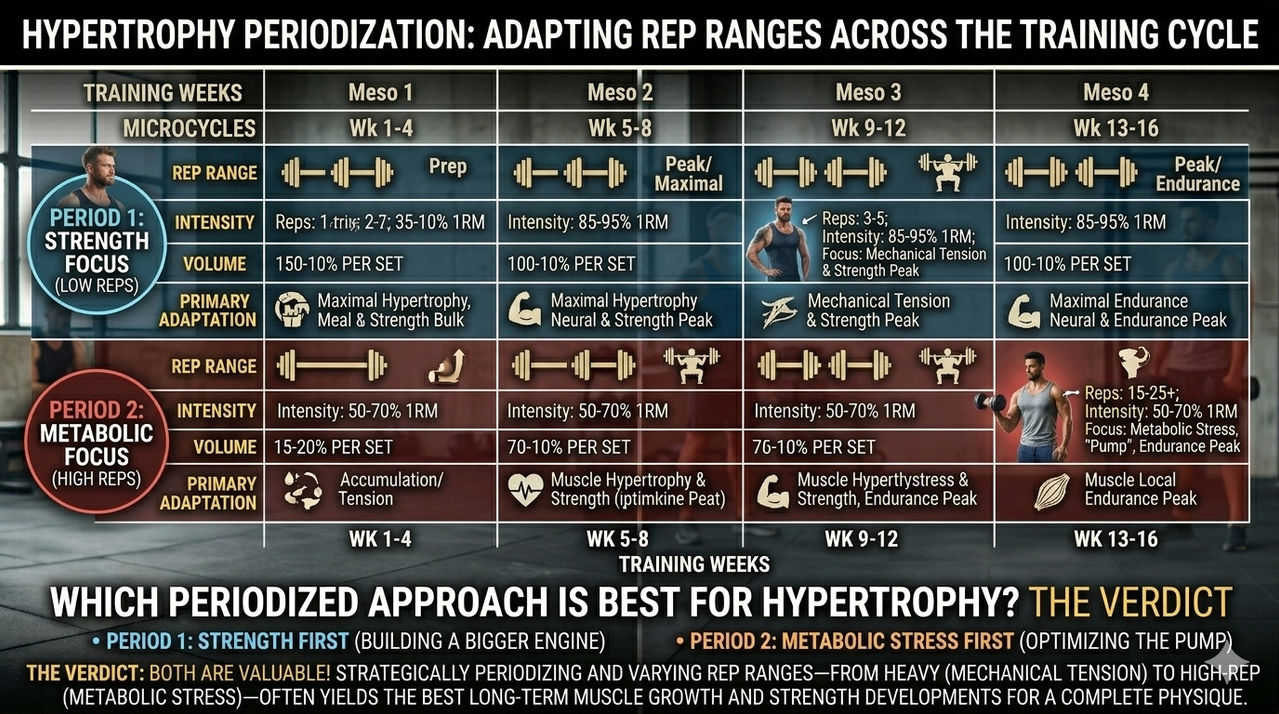
5.1. Periodization Approaches
- Linear Periodization: Start with higher reps (12-15) early in your training cycle, gradually progress to lower reps (4-6) as you peak .
- Daily Undulating Periodization (DUP): Vary rep ranges within the same week. For example: Monday heavy (5 reps), Wednesday moderate (10 reps), Friday light (15-20 reps) .
- Exercise-Based Variation: Use low reps for compound lifts (squats, deadlifts) and higher reps for isolation exercises (curls, lateral raises) .
5.2. Sample Weekly Split
| Day | Exercise | Reps | Load |
|---|---|---|---|
| Monday (Heavy) | Squat, Bench Press, Rows | 4-6 | 80-90% 1RM |
| Wednesday (Moderate) | Incline Press, Lunges, Pulldowns | 8-12 | 65-80% 1RM |
| Friday (Light) | Isolation: Curls, Extensions, Raises | 15-25 | 40-60% 1RM |
6. Nutrition: Fueling Growth Across Rep Ranges
6.1. Protein Requirements
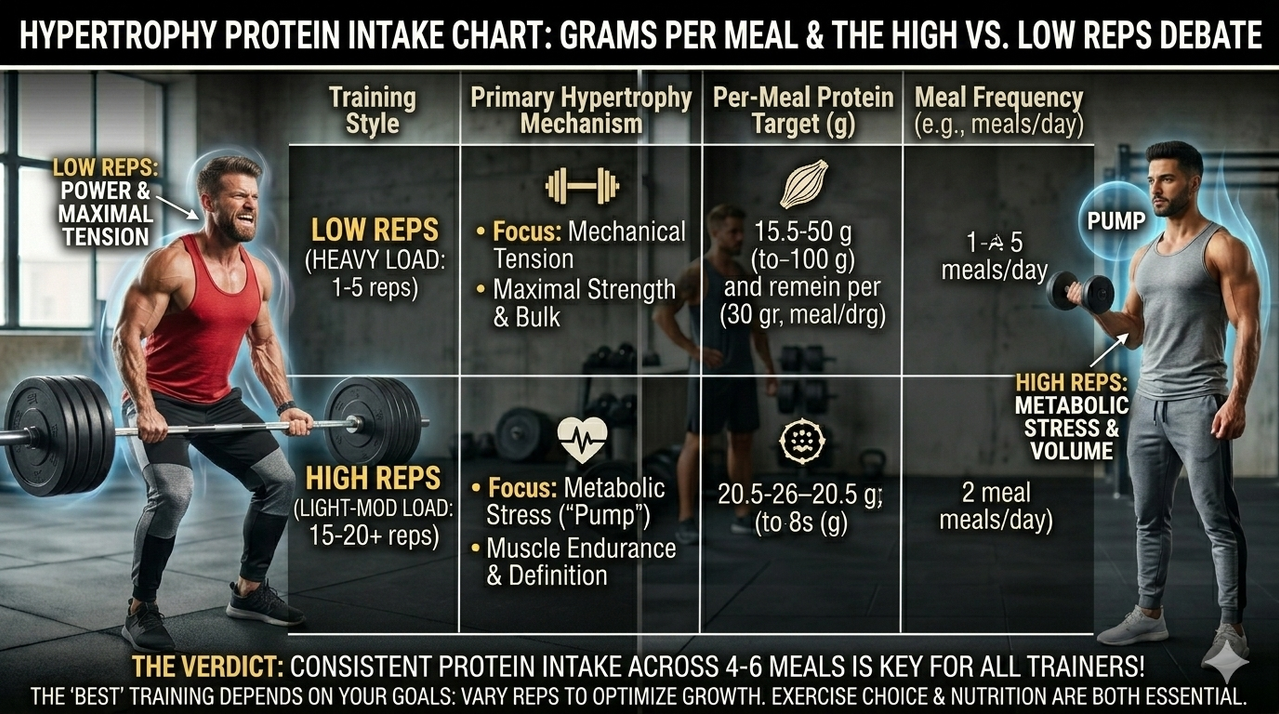
The International Society of Sports Nutrition (ISSN) recommends 1.4–2.0 g/kg of body weight for most exercising individuals, with intakes up to 3.0 g/kg potentially beneficial for body composition . For a 75kg individual, that's 120-150g protein daily.
6.2. Protein Timing and Distribution
To maximize muscle protein synthesis (MPS), consume 20-40g of high-quality protein every 3-4 hours, including a dose containing 700-3000mg of leucine . Pre-sleep casein (30-40g) can enhance overnight MPS .
6.3. Sample Meal Plan for Hypertrophy (~2800 kcal, 170g protein)
- Breakfast: 3 eggs (18g) + 1 cup Greek yogurt (20g) + 1 cup oats (10g) + berries → 48g protein
- Lunch: 200g chicken breast (45g) + 1 cup quinoa (8g) + roasted vegetables → 53g protein
- Snack: 1 scoop whey protein (25g) + apple → 25g protein
- Dinner: 200g salmon (40g) + sweet potato + broccoli → 40g protein
- Evening: 1 cup cottage cheese (24g) → 24g protein
- Total: ~170g protein
6.4. Vegan Hypertrophy Options
- Tofu (firm): 150g = 15g protein
- Tempeh: 150g = 20g protein
- Lentils: 1 cup cooked = 18g protein
- Edamame: 1 cup = 18g protein
- Pea protein powder: 1 scoop = 25g protein
- Quinoa: 1 cup cooked = 8g protein (complete protein)
6.5. Quick Recipes (Under 10 Minutes)
Greek Yogurt Power Bowl
1 cup Greek yogurt + 1 tbsp peanut butter + 1 tbsp chia seeds + berries. (~28g protein)
Microwave Scrambled Eggs
3 eggs + splash of milk, microwave 2 min. (~22g protein)
7. Common Mistakes in Rep Range Selection
- Mistake #1: Always using the same rep range. This leaves gains on the table by not targeting all fiber types .
- Mistake #2: Never training to failure. Proximity to failure is crucial for hypertrophy across all rep ranges .
- Mistake #3: Using ultra-low reps (1-3) exclusively. While great for strength, they don't provide enough volume for maximal hypertrophy .
- Mistake #4: Using ultra-high reps (40-50+) exclusively. Tension per rep becomes too low to stimulate growth, regardless of metabolic stress .
- Mistake #5: Ignoring the mind-muscle connection. Especially with high reps, focusing on the target muscle enhances activation .
8. Rep Ranges for Specific Goals and Populations
8.1. Beginners
Stick with 8-12 reps to master technique and build a foundation. Avoid ultra-high or ultra-low reps, as form can deteriorate under fatigue .
8.2. Injury Recovery or Joint Pain
Higher reps (20-30) with lighter loads are joint-friendly while still stimulating growth . Dr. Schoenfeld notes that many lifters report fewer aches and pains when incorporating higher-rep work .
8.3. Advanced Lifters
Prioritize rep ranges with the highest stimulus-to-fatigue ratio. Use lighter, high-rep work during dieting phases to reduce injury risk .
10. Scientific References
- BOXROX. (2024). Are Low Reps Really MUCH Better for Muscle Growth? BOXROX.com. View Source
- Schoenfeld, B.J., et al. (2016). Muscular adaptations in low- versus high-load resistance training: A meta-analysis. European Journal of Sport Science, 16(1), 1-10. View Source
- Men's Health UK. (2025). Which Rep Range You Should Choose for Your Fitness Goals. Men's Health. View Source
- Jäger, R., et al. (2017). International Society of Sports Nutrition Position Stand: protein and exercise. Journal of the International Society of Sports Nutrition, 14, 20. View Source
- Training & Conditioning. (2024). Study: Higher training volume leads to increased size, not strength. Training & Conditioning. View Source
- Schoenfeld, B. (2015). Does Light Load Training Build Muscle in Experienced Lifters? Lookgreatnaked.com. View Source
- Transparent Labs. (2025). High Reps vs. Low Reps: Which Rep Scheme is Best in 2025? Transparent Labs. View Source
- Barnes, T.M., et al. (2023). Protein quality and the food matrix : defining optimal versus maximal meal-based protein intakes for stimulating muscle protein synthesis. Applied Physiology, Nutrition, and Metabolism, 48(4), 340-344. View Source
- IDEA Health & Fitness. (2016). Skeletal Muscle Hypertrophy. IDEA Fit. View Source
- Schoenfeld, B.J., et al. (2017). Strength and hypertrophy adaptations between low- vs. high-load resistance training: A systematic review and meta-analysis. Journal of Strength and Conditioning Research, 31(12), 3508-3523. View Source
All sources last accessed March 2026. Paraphrased for accessibility.
Join the conversation