Why Your Muscles Look Smaller After a Workout (And How to Fix It Fast)
Why Your Muscles Look Smaller After a Workout (And How to Fix It)

💪 TL;DR
If you've ever left the gym looking pumped, only to feel smaller hours later, you're not alone. The answer to why your muscles look smaller after a workout lies in two key factors: the disappearance of the "muscle pump" and the depletion of muscle glycogen . The pump is temporary fluid buildup from increased blood flow during training . Glycogen, which binds water, gets used up during exercise—and a 2023 study showed that lowering glycogen stores can reduce body mass by 0.7kg (1.5 lbs) . The "fix" isn't about avoiding workouts, but about strategic post-workout nutrition: consuming carbs and protein within the optimal window replenishes glycogen and supports muscle repair . This guide explains the science and provides actionable steps to minimize post-workout shrinkage.
1. The Post-Workout Paradox: Pumped Then Deflated
You crush your workout. Your muscles feel full, tight, and impressive. You catch yourself flexing in the gym mirror. Then, a few hours later, you look in the mirror again and wonder where your muscles went. They look smaller, flatter, and less defined. What happened?
This phenomenon is a universal experience for lifters, yet it's rarely explained. Understanding why your muscles look smaller after a workout isn't just about satisfying curiosity—it's key to optimizing your recovery and long-term gains. The shrinkage is a normal physiological response, driven by two primary mechanisms: the loss of the "muscle pump" and the depletion of glycogen stores . The good news? You can influence how quickly your muscles return to their full, rested size.
2. The Science of the "Pump" (And Why It Fades)
2.1. What Happens During Exercise
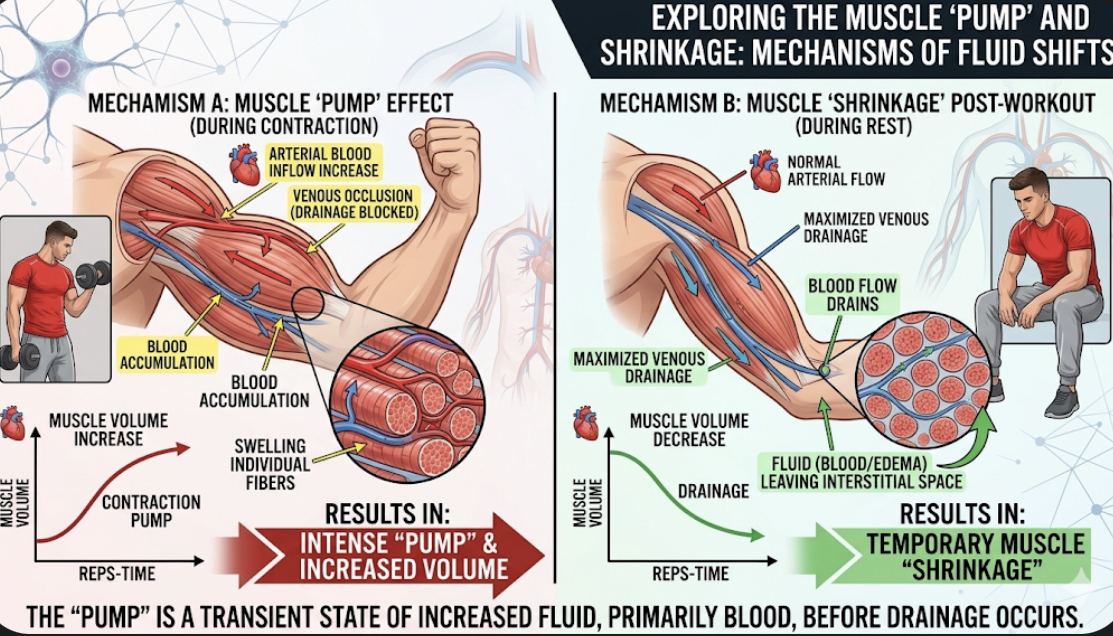
The "muscle pump" is a real, measurable phenomenon. As Professor David Bishop from Victoria University's Institute of Sport and Health explains, intense muscle contractions massively increase blood flow to the working muscles to deliver oxygen and nutrients . However, the veins that carry blood away are narrower than the arteries bringing it in. The contracting muscles also squeeze the veins, creating a "backup" effect .
This results in blood accumulating in the muscles. Additionally, the pressure forces plasma (the liquid part of blood) out of the capillaries and into the spaces between your muscle cells, causing further swelling . This combination of increased blood volume and interstitial fluid is the "pump" you see and feel.
2.2. Why It Goes Away
Your body is exceptionally good at maintaining equilibrium. After your workout, your heart rate drops, blood flow normalizes, and the fluid that accumulated in your muscles is gradually reabsorbed into the bloodstream and lymphatic system. Professor Bishop notes, "That fluid will build up there and it will take a few hours [to go down]" . This drainage is the primary reason for the immediate post-workup decrease in size.
3. The Role of Glycogen: Your Muscles' Fuel Tank
3.1. What Is Glycogen?
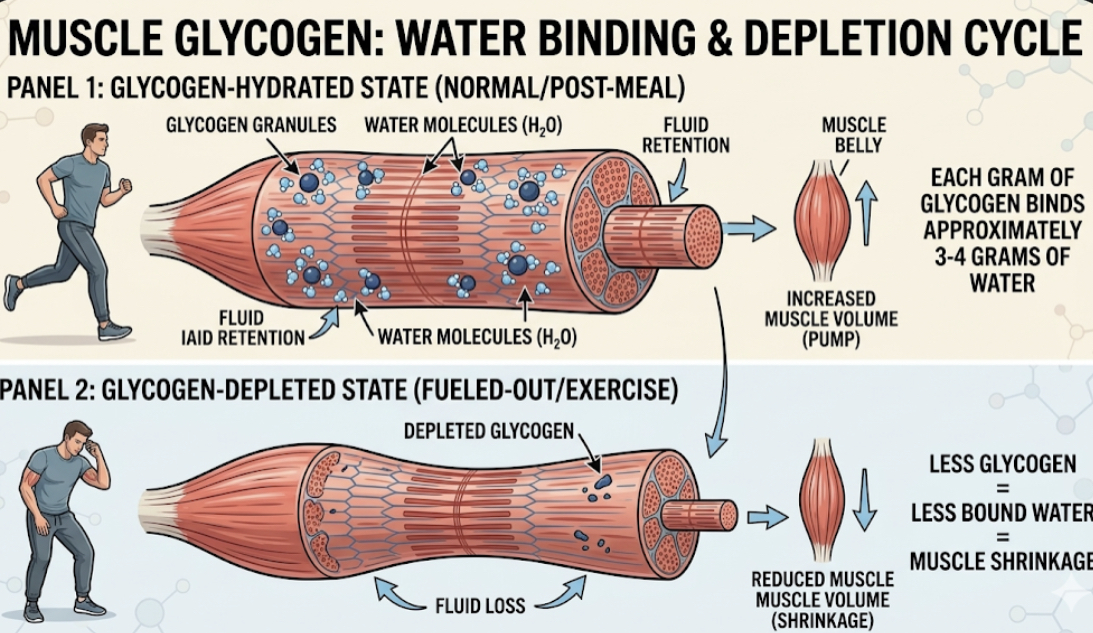
Glycogen is the stored form of carbohydrates in your muscles and liver. It's your body's primary fuel source during high-intensity exercise like weightlifting . Think of it as your muscles' internal gas tank.
3.2. The Glycogen-Water Connection
Critically, glycogen binds with water. For every gram of glycogen stored in your muscle, your body stores about 3-4 grams of water . This is why well-fueled muscles look and feel full and "hydrated."
3.3. The 2023 Study: 0.7kg Lost to Depletion
A rigorous 2023 randomized controlled trial from Denmark, published in the Scandinavian Journal of Medicine & Science in Sports, quantified this effect. Researchers manipulated the glycogen levels of 22 men through diet and exercise . They found that when pre-exercise muscle glycogen was lowered (367 mmol/kg vs. 525 mmol/kg), it was accompanied by a 0.7 kg (1.5 lb) lower body mass . That's over a pound of weight lost simply from glycogen and its associated water being used up. This confirms that a significant part of post-workout shrinkage is due to the depletion of your muscles' energy reserves .
4. How to Fix It: The 3 R's of Recovery
The best way to restore muscle size and promote growth is through strategic post-workout nutrition. Experts from Optimum Nutrition and Health.com emphasize the 3 R's: Rebuild, Refuel, and Rehydrate .
4.1. Rebuild with Protein
Exercise breaks down muscle tissue. Protein provides the amino acids necessary to repair this damage and build new muscle . The International Society of Sports Nutrition recommends consuming high-quality protein post-workout .
- How much: Aim for 0.3g of protein per kg of body weight, which typically translates to 20-40 grams for most people . For example, an 80kg (176lb) person should aim for about 24g of protein post-exercise .
- Best sources: Whey protein (fast-digesting), Greek yogurt, chicken, salmon, or a protein shake .
4.2. Refuel with Carbohydrates
This is the most direct way to replenish the glycogen you've depleted. Eating carbs after exercise restores your muscles' energy reserves, bringing back the water volume that contributes to muscle size . Pairing carbs with protein can restore glycogen more efficiently than carbs alone .
- How much: Consume 0.8–1.2g of carbohydrate per kg of body weight after intense training . For an 80kg person, that's 64–96g of carbs.
- Best sources: Simple carbs like fruits, juices, or white rice digest quickly and are ideal immediately post-workout .
4.3. Rehydrate with Fluids and Electrolytes
Replacing the fluid lost through sweat is critical. A sweat loss of just 2% of your body weight can impair performance .
- How much: Weigh yourself before and after workout. Drink 1.5 liters of fluid for every 1kg (2.2lbs) lost .
5. Sample Post-Workout Meals
Here are some expert-approved meals that combine the right balance of nutrients for recovery .
For Muscle Gain (All options ~40-50g carbs, 25-35g protein)
- Grilled chicken breast with 1.5 cups of rice and roasted vegetables .
- Salmon with 1 cup of brown rice and broccoli .
- Protein smoothie: 1 scoop whey or pea protein, 1 banana, 1 tbsp almond butter, 1 cup milk/soy milk .
- Greek yogurt (1 cup) with berries and ½ cup granola .
For Weight Loss (High-protein, calorie-controlled)
- Egg-white omelet with spinach and one slice of whole-grain toast .
- Low-fat cottage cheese with sliced fruit .
- Tuna salad with an apple .
For Endurance Athletes (Higher Carb Focus)
- Oatmeal topped with banana and peanut butter .
- Quinoa bowl with black beans and roasted veggies .
- Whole-grain toast with nut butter and sliced apple .

6. The Post-Workout Window: When to Eat
The timing of your post-workout meal can make a difference, especially for women. For most people, overall daily nutrient intake matters more than a narrow "anabolic window" . However, to optimize recovery, aim to eat within 1-2 hours after strength training .
6.1. A Sex-Specific Difference
Harvard Health Publishing highlights a crucial distinction: women have a much shorter refueling window than men . Due to hormonal factors like progesterone, which can exacerbate post-exercise muscle breakdown, women should ideally refuel with protein and carbs within 30 to 45 minutes after a workout . Men, on the other hand, have up to three hours to accomplish the same task . Ignoring this can lead to fatigue, soreness, and suboptimal recovery for female athletes .
7. When Shrinkage Signals a Problem
While the temporary post-workout deflation is normal, persistent muscle loss or lack of growth points to other issues .
7.1. Overtraining
If you don't give your muscles enough time to recover (at least 48 hours between strength sessions), the anabolic process of hypertrophy cannot occur, and you may see muscle loss .
7.2. Poor Nutrition
You can't build muscle in a calorie deficit. If you train hard but don't eat enough (especially protein and total calories), your body may break down muscle for energy .
7.3. Chronic Stress
High stress elevates cortisol, a catabolic hormone that breaks down body tissues. Managing stress is crucial for muscle retention .
7.4. Too Much Cardio
Excessive cardio can encourage your body to shed muscle mass for efficiency, counteracting your strength training efforts .
7.5. Aging
After age 40, natural declines in anabolic hormones (testosterone, growth hormone) contribute to sarcopenia, or age-related muscle loss . Strength training becomes even more critical to slow this process .
8. Common Post-Workout Mistakes
- Mistake #1: Not eating after a workout. Especially for those trying to lose weight, skipping post-workout fuel sacrifices muscle strength for a small calorie deficit that can be achieved elsewhere .
- Mistake #2: Eating too much fat. While healthy fats are important, a high-fat meal immediately post-workout can slow down the digestion and absorption of protein and carbs .
- Mistake #3: Only focusing on protein. Carbs are just as critical for replenishing glycogen and creating an insulin response that helps shuttle protein into muscles .
- Mistake #4: Ignoring hydration. Replacing fluids is essential for all bodily functions, including nutrient transport .
- Mistake #5: Inconsistent timing. While not critical for everyone, consistently delaying refueling can impair recovery over time .
9. Related Resources
10. Scientific References
- Dale, P. (2025). Why Are My Muscles Getting Smaller After Lifting Weights? Lose It! View Source
- Thoracic Key. (2016). Venous Physiology and Hemodynamics of Lower Limbs. thoracickey.com. View Source
- Matzkin, E., & Balmes, R. (2018). How to Get Your Muscles Back After Taking a Break From the Gym. Men's Health. View Source
- Schytz, C. T., et al. (2023). Lowered muscle glycogen reduces body mass with no effect on short-term exercise performance in men. Scandinavian Journal of Medicine & Science in Sports, 33(7), 1054-1071. PubMed
- Optimum Nutrition. (2025). Recovery Guide. optimumnutrition.com. View Source
- Bishop, D. (2018). Why your muscles look so pumped up after the gym (and why they shrink later). Nine Coach. View Source
- Women's Health Taiwan. (2025). 一週沒運動肌肉就會縮水,對還錯?womenshealthmag.com. View Source
- Health.com. (2025). 3 Key Nutrients You Need After Every Workout to Build Strength and Recover Faster. health.com. View Source
- Fitness Stack Exchange. (2012). Is it possible for muscles to shrink after a workout? stackexchange.com. View Source
- Salamon, M. (2024). Feeding your fitness. Harvard Health. View Source
Join the conversation