Why Time Under Tension is Key for Natural Lifters
Why Time Under Tension is Key for Natural Lifters

⏱️ TL;DR
Why time under tension is key for natural lifters boils down to one word: efficiency. Without the enhanced recovery and protein synthesis of enhanced athletes, naturals must maximize every set. Research shows that the "sweet spot" for hypertrophy is 30-60 seconds per set . This duration recruits high-threshold motor units and maximizes mechanical tension without excessive metabolic fatigue. A 2025 meta-analysis confirmed that tempo (fast vs. slow) doesn't drastically change outcomes, but controlling the eccentric phase (2-4 seconds) ensures the muscle is under tension long enough to stimulate growth . This guide breaks down the science, provides exact tempos, sample workouts, and nutrition strategies to apply TUT effectively.
1. Introduction: The Natural Lifter's Advantage
If you train without performance enhancers, every variable in your workout matters more. You don't have the luxury of pharmacological safety nets that smooth over programming errors. This is precisely why time under tension is key for natural lifters. Time under tension (TUT)—the total duration a muscle is actively working against resistance during a set—is the lever that controls mechanical tension, muscle damage, and metabolic stress .
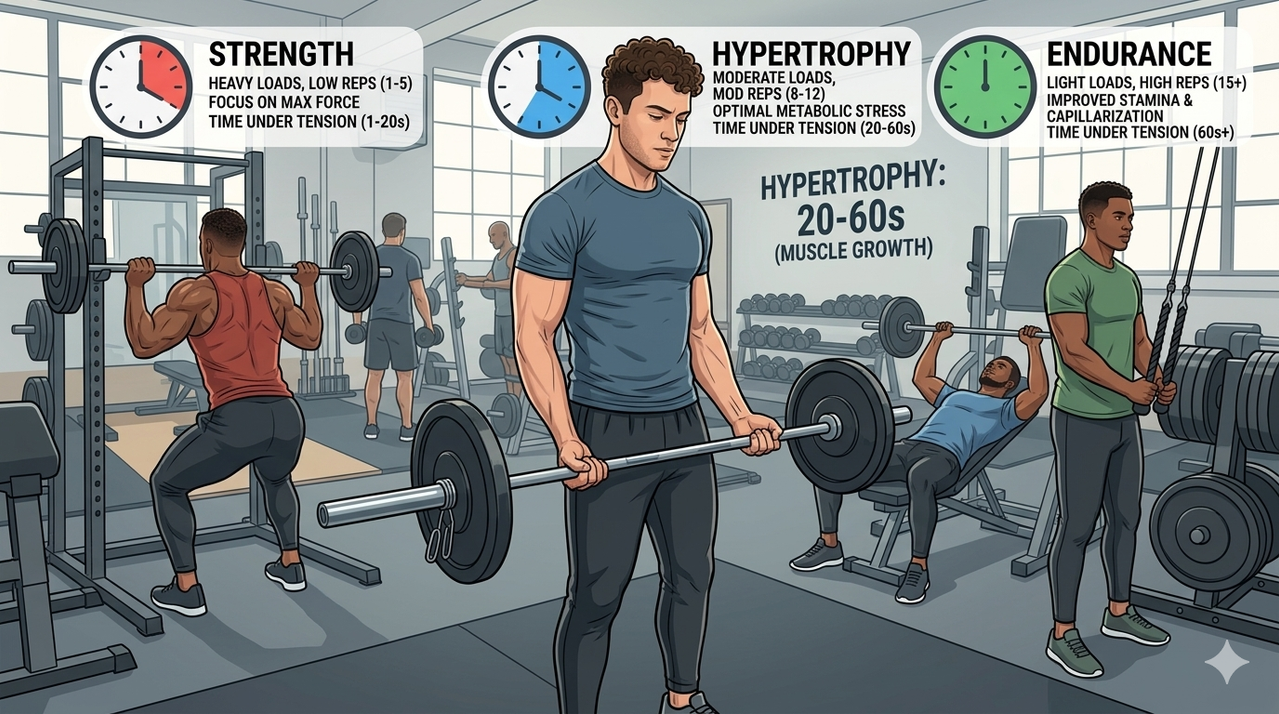
While enhanced lifters can grow from almost any stimulus, naturals need to optimize. A set that lasts 15 seconds (typical for a heavy 5-rep max) primarily trains the nervous system and builds strength. A set that lasts 60 seconds shifts the stimulus toward hypertrophy, recruiting more muscle fibers and creating the metabolic conditions that signal growth . This article explores the science behind TUT and provides actionable protocols to make every rep count.
2. The Science: What TUT Actually Does to Muscle
2.1. Motor Unit Recruitment: The Size Principle
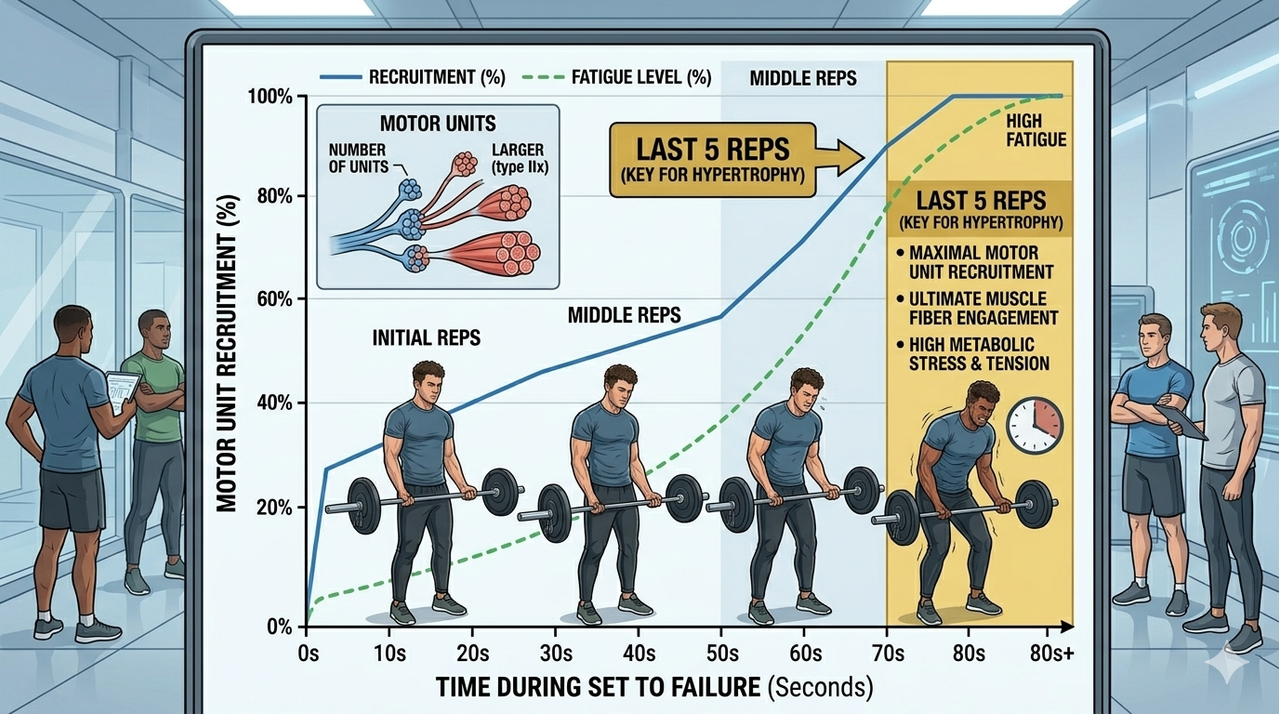
Muscles are composed of motor units—a nerve and the muscle fibers it innervates. Slow-twitch (Type I) fibers are recruited first, followed by fast-twitch (Type IIa and IIx) fibers as force requirements increase . For hypertrophy, we need those high-threshold Type II fibers. Research indicates that the last 5 reps before failure are where these fibers are fully recruited, regardless of the load . This means that to grow, you need to take sets close to failure, and the time spent in that high-threshold zone is critical. A TUT of 30-60 seconds ensures you spend adequate time with those fibers activated.
2.2. Mechanical Tension vs. Metabolic Stress
Hypertrophy is driven by three primary mechanisms: mechanical tension, muscle damage, and metabolic stress . Mechanical tension is the force generated during contraction; it's the primary driver. Metabolic stress—the "pump" from metabolite accumulation (lactate, hydrogen ions)—also contributes, potentially by increasing cellular swelling and anabolic signaling .
TUT directly influences both. A set lasting 15 seconds with a 5RM maximizes tension but minimizes metabolic stress. A set lasting 60 seconds with a 10-12RM balances both, providing sufficient tension while also building metabolite-induced stress. For naturals, this combination is potent because it doesn't rely solely on extreme loads, which can be taxing on joints and the CNS .
2.3. The 2025 Meta-Analysis: Tempo Isn't Everything
A 2025 meta-analysis published in the Journal of Strength and Conditioning Research reviewed 14 studies on rep tempo and hypertrophy. The conclusion? Slower and faster tempos resulted in "almost identical muscle growth" . However, this doesn't negate TUT. It simply means that whether you achieve a 40-second set with 8 slow reps or 12 faster reps, the outcome is similar, provided the set is taken close to failure. The key takeaway for naturals: focus on set duration and proximity to failure, not just counting seconds per rep.
3. Optimal TUT Ranges for Natural Lifters
3.1. The Classic 40-70 Second Rule
Legendary coach Charles Poliquin popularized the idea that for hypertrophy, a set should last 40-70 seconds . Modern research has refined this slightly. A 2025 resource from RockTape breaks down TUT guidelines as follows :
- Power/Relative Strength: 1-12 seconds (Neurological)
- Absolute Strength: 12-25 seconds (Neurological + some Hypertrophy)
- Myofibrillar Hypertrophy: 25-40 seconds (Growth of contractile tissue)
- Sarcoplasmic Hypertrophy: 40-70 seconds (Growth of energy fluid, "the pump")
- Muscular Endurance: >70 seconds (Metabolic adaptations)
For natural lifters, targeting the 30-60 second range per set is ideal. This hits both myofibrillar and sarcoplasmic hypertrophy, leading to dense, full muscle tissue .
3.2. Rep Ranges and Corresponding TUT
Assuming a controlled tempo of about 3 seconds per rep (2 seconds eccentric, 1 second concentric), the following rep ranges equate to these TUTs :
- 5-6 reps: ~15-18 seconds (Strength-focused)
- 8-10 reps: ~24-30 seconds (Lower-end hypertrophy)
- 10-12 reps: ~30-36 seconds (Sweet spot)
- 15-20 reps: ~45-60 seconds (Upper hypertrophy/Endurance)
This is why the classic 8-12 rep range is so effective. It naturally places you in the 30-40 second TUT zone when using a moderate tempo .
| Training Goal | Optimal TUT per Set | Rep Range (approx) | Tempo Example |
|---|---|---|---|
| Pure Strength | 1 - 20 seconds | 1-5 reps | Explosive, 1-0-1-0 |
| Myofibrillar Hypertrophy | 25 - 40 seconds | 6-8 reps | 3-0-1-0 |
| Sarcoplasmic Hypertrophy (Size) | 40 - 70 seconds | 10-15 reps | 3-1-1-1 or 4-0-1-0 |
| Muscular Endurance | >70 seconds | 15-20+ reps | 2-1-1-1 |
4. Elite Application: Phil Heath's 3-Second Rule
Seven-time Mr. Olympia Phil Heath famously used a "3-second rule" to turn his back from a weakness into a strength. His method? On exercises like seated rows, he would "pull all the way for a three count," hold the contraction, and then "slowly working the negative, going all the way up for a good stretch" . This approach, using a 3-0-3-0 tempo, puts each rep at 6 seconds, meaning a set of 10 reps takes a full 60 seconds .
Heath emphasized avoiding "body English" (jerking and swinging) and focusing on the stretch and squeeze . This is a perfect real-world example of applying TUT to maximize muscle fiber recruitment. While enhanced athletes can also benefit, naturals must use this level of control to force growth from every set.

5. Practical TUT Protocols: How to Implement
5.1. The 4X Mass Method
One of the most effective TUT-based protocols for naturals is the 4X method, popularized by Iron Man magazine . Here's how it works:
- Choose a weight you can do for 15 reps (your 15RM).
- Perform 4 sets of 10 reps with that weight.
- Rest only 30-40 seconds between sets.
- Use a tempo of 3 seconds down, 1 second up (4 seconds per rep).
- Each set lasts exactly 40 seconds (10 reps x 4 seconds).
- Go all-out on the fourth set to failure.
This method keeps TUT in the 40-second range for each set, and the short rest periods amplify metabolic stress, creating a powerful hypertrophic stimulus without requiring heavy, joint-crushing loads . It's ideal for older lifters or those prone to injury.
5.2. Tempo Manipulation for Compound vs. Isolation
- Compound Lifts (Squats, Deadlifts, Bench): Use a 3-0-1-0 tempo. Control the eccentric for 3 seconds, then drive up explosively. This maintains tension while allowing heavier loads .
- Isolation Lifts (Curls, Lateral Raises, Leg Extensions): Experiment with longer eccentrics (4 seconds) and add a 1-second squeeze at the peak contraction. A 4-1-1-0 tempo works well .
5.3. Isometric Holds: The 2025 Game Changer
A fascinating 2025 study compared traditional full-range-of-motion leg extensions to isometric holds at the start of the movement. Both legs trained with the same TUT (roughly 30 seconds per set). After six weeks, the isometric-trained leg grew by 2%, while the full-ROM leg grew by 1% . While statistically small, it suggests that isometrics—holding a muscle under tension without movement—can be a powerful addition to a natural lifter's toolbox. Jim Stoppani, who reported on the study, notes it gives us "another useful tool" . Try adding a 10-15 second isometric hold at the hardest point of an exercise (e.g., bottom of a bicep curl) as a finisher.
6. Sample TUT-Focused Full Body Workout
This workout is designed to keep TUT in the 40-60 second range for hypertrophy. Perform 3-4 sets per exercise with 60-90 seconds rest.
- Exercise 1: Goblet Squats (Hypertrophy Focus) — 3 sets of 10-12 reps. Tempo: 3-0-1-0 (TUT: 40-48 seconds). Focus: Slow descent, drive up.
- Exercise 2: Dumbbell Bench Press (Chest Focus) — 3 sets of 10-12 reps. Tempo: 3-0-1-0 (TUT: 40-48 seconds). Focus: Squeeze at top.
- Exercise 3: Seated Cable Rows (Back Focus) — 3 sets of 10-12 reps. Tempo: 3-1-1-1 (TUT: 60-72 seconds). Focus: Hold contraction for 1 second.
- Exercise 4: Dumbbell Shoulder Press (Shoulders) — 3 sets of 10-12 reps. Tempo: 3-0-1-0 (TUT: 40-48 seconds).
- Exercise 5: Romanian Deadlifts (Hamstrings) — 3 sets of 10-12 reps. Tempo: 3-0-1-0 (TUT: 40-48 seconds). Focus: Feel the stretch.
- Finisher: Isometric Bicep Hold — 1 set, hold dumbbells at 90 degrees for 30-45 seconds to failure.
7. Nutrition: Fueling TUT-Based Training
Longer TUT sets (40-60 seconds) deplete muscle glycogen and create significant metabolic stress. Your nutrition must support this.
7.1. Pre-Workout: Carbohydrates are Key
Aim for a meal 2-3 hours pre-workout containing 40-60g complex carbs (oats, sweet potato, brown rice) and 20-30g protein . Example: 1 cup cooked oatmeal with 1 scoop protein powder and a banana.
7.2. Post-Workout: Glycogen Replenishment
After a TUT-focused session, your muscles are primed for glycogen storage. Consume 40-50g fast-digesting carbs (white rice, potatoes, dextrose) with 25-30g fast protein (whey or soy isolate) within 2 hours .
7.3. Sample 3200-Calorie TUT Support Meal Plan
- Breakfast: 3 eggs, 1 cup oats with 1 tbsp honey, 1 cup whole milk. (~600 kcal, 35g protein)
- Lunch: 200g grilled chicken breast, 1.5 cups brown rice, mixed veggies with olive oil. (~700 kcal, 50g protein)
- Pre-Workout Snack: 1 banana + 1 tbsp peanut butter + 1 rice cake. (~250 kcal, 8g protein)
- Post-Workout Shake: 2 scoops whey protein + 40g dextrose (or 1 cup fruit juice). (~350 kcal, 50g protein)
- Dinner: 200g salmon, 1 large sweet potato (with butter), large salad. (~800 kcal, 45g protein)
- Evening Snack: 1 cup Greek yogurt + ½ cup mixed nuts. (~500 kcal, 25g protein)
- Total: ~3,200 kcal, ~213g protein
7.4. Vegan/Vegetarian Options
- Pre-Workout: 1 cup cooked quinoa + 1 cup edamame.
- Post-Workout: 2 scoops pea/rice protein blend + 2 tbsp maple syrup + water.
- High-Carb Meals: Lentil soup with potatoes, tofu stir-fry with jasmine rice.
8. Common TUT Mistakes Natural Lifters Make
- Mistake #1: Extremely Slow Reps (10+ seconds). This forces you to use very light weights, reducing mechanical tension. Studies show "superslow" training is not superior and may be inferior for hypertrophy .
- Mistake #2: Ignoring the Eccentric. Dropping the weight quickly (0-second negative) reduces TUT and eliminates the most damaging (and growth-stimulating) phase of the lift .
- Mistake #3: Counting Tempo but Not Training to Failure. If you use a slow tempo but stop far from failure, you won't recruit high-threshold motor units. TUT must be combined with proximity to failure .
- Mistake #4: Using TUT on Every Set. Strength requires some explosive work. Don't do all your sets with a slow, controlled tempo. Save TUT-focused sets for accessory/hypertrophy work .
10. Scientific References
- Muscle & Fitness. (2025). Phil Heath's 3-Second Rule: Proven Time Under Tension Method to Build a Massive Back. Muscle & Fitness. View Source
- Ianev, S. (2020). Tempo Revisited. Clean Health. View Source
- Men's Health UK. (2025). Slow or Fast Reps? Science Says Tempo Doesn't Change Muscle Growth. Menshealth.com. View Source
- Wilson, T. (2025). Time Under Tension - Hold ON! RockTape Canada. View Source
- Iron Man Magazine. (2011). The BIG Secret: #1 Key to Extreme Muscle Size. Ironmanmagazine.com. View Source
- Cardillo, J. R. Time As A Factor To Building Muscle. Muscle Insider. View Source
- Kumar, V., Bhatia, K. (2025). Effect of Time Under Tension on Strength in Athletes: A Narrative Review. Journal of Clinical and Diagnostic Research, 19(9), 1. View Source
- BOXROX. (2025). How to Master the Art of Time Under Tension for Hypertrophy. BOXROX.com. View Source
- Parker, R. (2017). 6 of the most common questions of building muscle answered. Human Kinetics Blog. View Source
- Stoppani, J. (2026). Isometrics vs. Full ROM Training: New Research Challenges How We Think About Muscle Growth. JimStoppani.com. View Source
Join the conversation