How to Build Explosive Power Without Using Weights
How to Build Explosive Power Without Using Weights

📋 TL;DR
Explosive power is the ability to produce maximum force in minimal time. You can develop it without weights by leveraging the Stretch-Shortening Cycle (SSC) through plyometric training . Recent meta-analyses confirm that bodyweight plyometrics significantly improve countermovement jump (CMJ) and sprint performance across all ages . A 2023 systematic review found that even a single session of bodyweight conditioning activities can produce small but significant post-activation performance enhancement (PAPE) effects, improving subsequent jumps and sprints . This guide teaches you how to build explosive power without using weights, with science-backed progressions, sample workouts, and nutrition strategies (including creatine and omega-3s) to fuel your performance.
1. What Is Explosive Power (And Why You Need It)
Explosive power is the ability to exert maximum force in the shortest possible time. It's the difference between a slow squat and a vertical jump, between a leisurely stride and a sprint . Power is what allows athletes to jump higher, sprint faster, and change direction more quickly, which is essential for learning how to build explosive power without using weights .
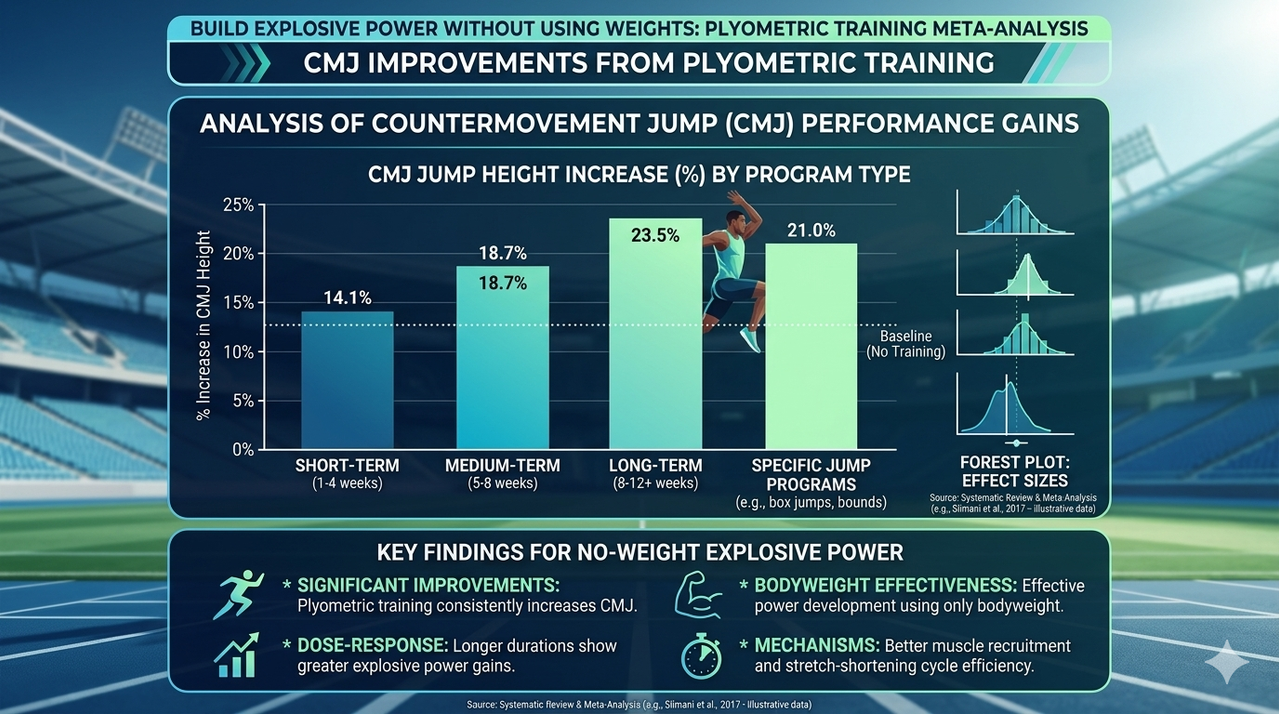
The good news is that you don't need a gym full of equipment to develop it. Research consistently shows that plyometric training—jumping, hopping, and bounding—is a potent strategy for boosting lower limb explosive strength . A 2024 meta-analysis confirmed that plyometric training significantly improves countermovement jump (CMJ) performance, a key marker of explosive power .
This guide will teach you how to build explosive power without using weights, using evidence-based bodyweight exercises, proper progressions, and nutritional support.
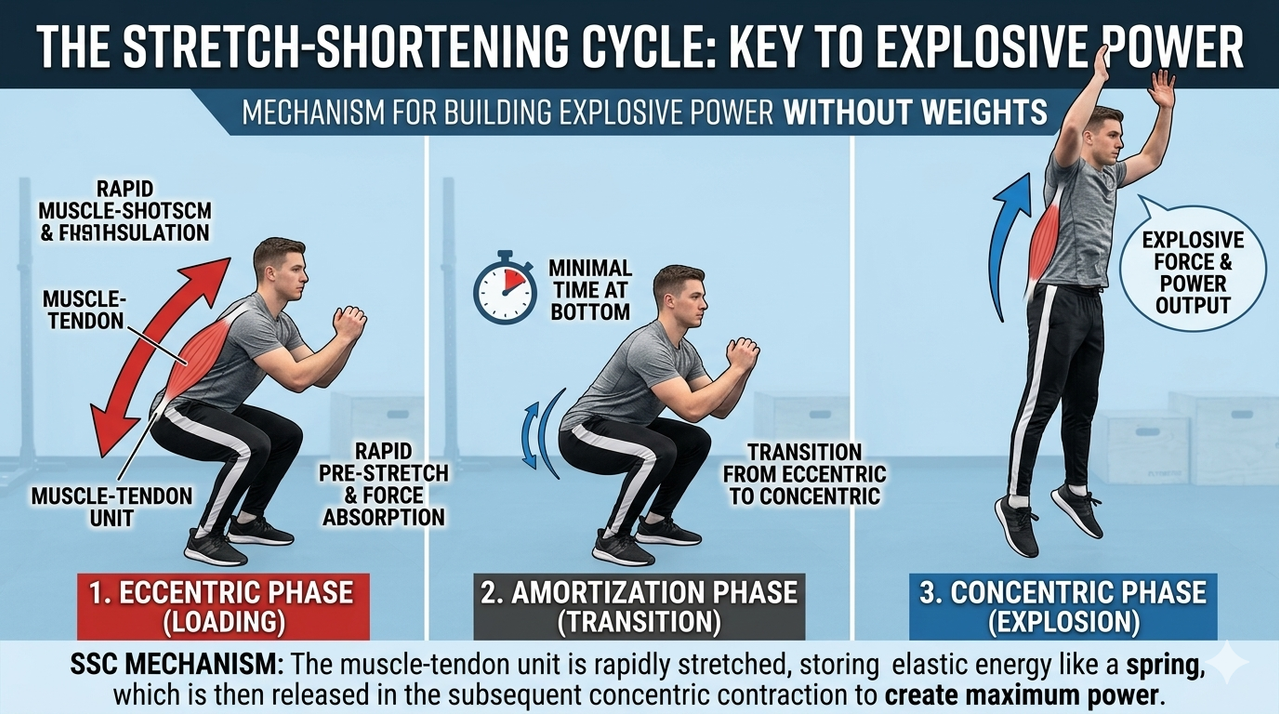
2. The Science: Plyometrics and the Stretch-Shortening Cycle
2.1. What Is the Stretch-Shortening Cycle (SSC)?
The SSC is a natural muscle action characterized by an eccentric (lengthening) action immediately followed by a concentric (shortening) action . This sequence allows the muscle to produce more force and power than a concentric-only contraction, a key concept for how to build explosive power without using weights . Examples include the countermovement in a jump or the flex before a throw .
2.2. What the Research Says: Meta-Analysis Evidence
A 2025 meta-analysis published in the European Journal of Applied Physiology examined plyometric training's impact on lower limb explosive strength across 681 adolescent athletes. The results were clear: plyometric training significantly improved countermovement jump (CMJ) and squat jump (SJ) performance, with age-dependent effects, supporting how to build explosive power without using weights . The greatest CMJ improvements were seen in post-adolescence, with an average gain of 3.89 cm .
For female adolescents, the same analysis found plyometric training effectively improved CMJ by 2.55 cm and SJ by 2.33 cm . This demonstrates that bodyweight power training works across genders and ages .
2.3. Bodyweight PAP: The 2023 Breakthrough
A 2023 systematic review and meta-analysis in the Journal of Strength and Conditioning Research investigated whether a single bodyweight conditioning activity could acutely improve performance through Post-Activation Performance Enhancement (PAPE). The analysis of 19 randomized controlled trials found a small but significant overall effect (0.30) in favor of using bodyweight exercises before vertical jumps or sprints . This means that even within a single workout, you can enhance your explosive performance simply by doing the right bodyweight warm-up, a crucial aspect of how to build explosive power without using weights .
3. Plyometric Progressions: From Beginner to Explosive
3.1. Lower Body Progressions
Level 1: Squat Jumps (Beginner)
FundamentalHow to do it: From a squat position, jump explosively, swinging arms for momentum. Land softly and immediately descend into the next rep, following how to build explosive power without using weights .
Sets/Reps: 2-3 x 6-8
Level 2: Tuck Jumps (Intermediate)
Increased IntensityHow to do it: Jump and bring knees toward chest at peak height. Land softly and repeat .
Sets/Reps: 2-3 x 5-8
Level 3: Box Jumps (Intermediate to Advanced)
Height FocusHow to do it: Jump onto a sturdy box or platform, landing softly. Step down (don't jump down) and reset .
Sets/Reps: 3 x 4-6
Level 4: Depth Jumps (Advanced)
High IntensityHow to do it: Step off a box (12-24 inches), land, and immediately jump as high as possible. Minimize ground contact time .
Warning: This exercise places high stress on joints; ensure proper form and adequate strength base .
Sets/Reps: 3 x 4-6, with full recovery between reps
3.2. Upper Body Progressions
Clapping Push-Ups
Perform a push-up with explosive force to clap hands at the top. Start with regular push-ups and progress to clapping, part of how to build explosive power without using weights.
Medicine Ball Throws (or Imaginary Throws)
Even without a ball, you can simulate explosive overhead throws or chest passes, focusing on maximal speed .
4. Sample Power Workouts (No Weights Required)
Perform these workouts 2-3 times per week, allowing 48 hours recovery between sessions, as part of how to build explosive power without using weights.
4.1. Beginner Power Circuit
- Squat Jumps: 3 x 6 (rest 60s)
- Clapping Push-Ups (or regular plyo push-ups): 3 x 5
- Lateral Bounds: 3 x 6 per side
- Rest 2 minutes between rounds; complete 3 rounds
4.2. Advanced Power Workout
- Depth Jumps (12" box): 4 x 4 (rest 30s between reps)
- Tuck Jumps: 3 x 8
- Bounding (alternating long jumps): 3 x 8 per leg
- Clapping Push-Ups: 4 x 6
- Rest 2-3 minutes between sets
5. Nutrition: Fueling Explosive Performance
5.1. Creatine: The Power Supplement
Creatine monohydrate is the most researched supplement for high-intensity exercise. It increases phosphocreatine (PCr) stores, which helps regenerate ATP during explosive efforts, supporting how to build explosive power without using weights . The Gatorade Sports Science Institute notes that creatine supplementation is particularly effective for repeated short bouts of high-intensity exercise .
5.2. Omega-3s for Power Maintenance
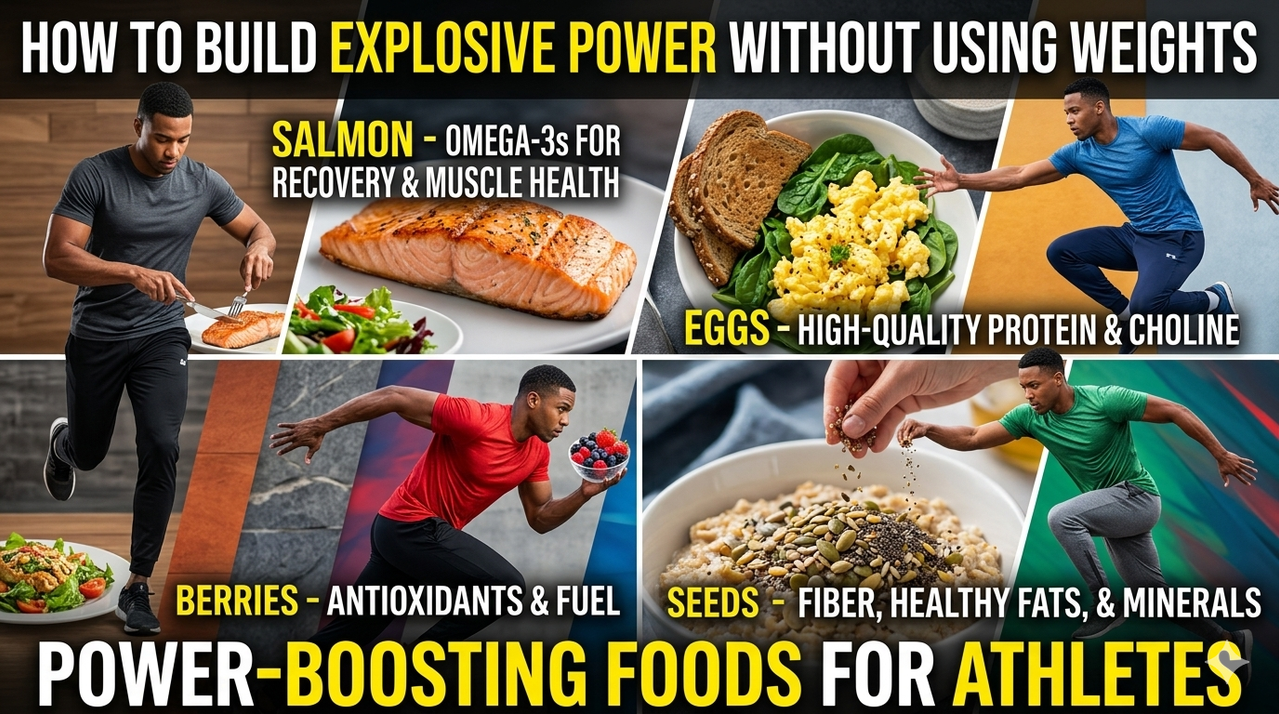
Research from the Gatorade Sports Science Institute shows that omega-3 polyunsaturated fatty acids help maintain explosive power, promote muscle remodeling, and decrease muscle soreness . A study of professional basketball players found that those with higher omega-3 intake had better power outcomes .
5.3. Sample Power-Focused Day (~2600 kcal, 160g protein)
- Breakfast: 3 eggs (18g) + 1 cup oatmeal (10g) + 1 cup milk (8g) + 1 banana → 36g protein
- Lunch: 200g chicken breast (45g) + 1 cup quinoa (8g) + roasted vegetables → 53g protein
- Pre-workout snack (1 hour before): Banana + 1 tbsp peanut butter (4g) → 4g protein
- Post-workout (within 30 min): 1 scoop whey/pea protein (25g) + 1 cup milk (8g) → 33g protein
- Dinner: 200g salmon (40g) + sweet potato + broccoli → 40g protein
- Total: ~166g protein
5.4. Vegan Power Options
- Protein: Tofu, tempeh, lentils, edamame, pea protein
- Creatine: Vegan creatine monohydrate is widely available
- Omega-3s: Flaxseeds, chia seeds, hemp seeds, walnuts, algae oil
- Sample vegan power day: Tofu scramble breakfast, lentil-quinoa bowl lunch, edamame snack, tempeh stir-fry dinner + pea protein shake
6. Safety First: Plyometric Precautions
- Land softly: Always land with knees bent and hips back to absorb impact .
- Quality over quantity: Stop when form deteriorates. Fatigue increases injury risk .
- Progressive overload: Gradually increase intensity (box height, jump distance) over weeks .
- Surface matters: Train on forgiving surfaces (grass, gym mats) rather than concrete .
- Listen to your body: Joint pain is a warning sign—don't push through it.
7. Common Mistakes That Limit Power Development
- Mistake #1: Too much ground contact time. For plyometrics, you want explosive, quick transitions. Minimize time on the ground, a key part of how to build explosive power without using weights .
- Mistake #2: Neglecting the eccentric phase. The loading phase (countermovement) is where elastic energy is stored—use it .
- Mistake #3: Overtraining. Power training is neurologically demanding. 2-3 sessions weekly is plenty .
- Mistake #4: Insufficient recovery between sets. Power requires near-full recovery (2-3 minutes between sets).
- Mistake #5: Ignoring nutrition. Creatine and adequate protein significantly impact power outcomes .
9. Scientific References
- Chen, L., et al. (2024). Maturation-specific enhancements in lower extremity explosive strength following plyometric training in adolescent soccer players: A systematic review and meta-analysis. Heliyon, 10(12), e33063. View Source
- Chen, L., et al. (2025). Timing is everything: the age-related impact of plyometric training on lower limb explosive strength in male adolescents and its general effectiveness in female adolescents. European Journal of Applied Physiology, 125(6), 1665-1685. View Source
- Brink, N.J., Constantinou, D., & Torres, G. (2023). Postactivation Performance Enhancement in Healthy Adults Using a Bodyweight Conditioning Activity: A Systematic Review and Meta-analysis. Journal of Strength and Conditioning Research, 37(4), 930-937. View Source
- Sahlin, K. (2014). Muscle energetics during explosive activities and potential effects of nutrition and training. Sports Medicine, 44(Suppl 2), 167-173. View Source
- Davis, J.K., et al. (2021). Evaluation of Omega-3 Status in Professional Basketball Players. Journal of Strength and Conditioning Research, 35(7), 1794-1799. View Source
- Newton, R.U., et al. (1997). Influence of load and stretch shortening cycle on the kinematics, kinetics and muscle activation that occurs during explosive upper-body movements. European Journal of Applied Physiology, 75, 333-342. View Source
- Esposito, G., et al. (2024). The Effects of the Use of Plyometric Exercises with and without the Ball in the Development of Explosive Strength in Volleyball. Journal of Functional Morphology and Kinesiology, 9(3), 126. View Source
- Bauer, T., Thayer, R.E., & Baras, G. (1990). Comparison of Training Modalities for Power Development in the Lower Extremity. Journal of Strength and Conditioning Research, 4(4), 115-121. View Source
- Hanson, E.D., et al. (2009). Effects of Strength Training on Physical Function: Influence of Power, Strength, and Body Composition. Journal of Strength and Conditioning Research, 23(9), 2627-2637. View Source
- Radnor, J.M., et al. (2018). The Influence of Growth and Maturation on Stretch-Shortening Cycle Function in Youth. Sports Medicine, 48, 57-71. View Source
All sources last accessed March 2026. Paraphrased for accessibility.
Join the conversation