How to Correct Your Posture for Better Lifting Form
How to Correct Your Posture for Better Lifting Form

📋 TL;DR
Poor posture—often caused by hours of sitting and desk work—creates muscle imbalances that sabotage your lifting form and increase injury risk . The key to how to correct your posture for better lifting form lies in a two-pronged approach: lengthen tight muscles (hip flexors, pecs) and strengthen weak ones (glutes, upper back, deep neck flexors). A 2025 study on firefighters found that a targeted corrective exercise program significantly improved thoracic mobility and overhead squat mechanics . This guide provides science-backed mobility drills, strengthening exercises, sample workouts, and nutrition strategies to support your postural correction journey.
1. The Posture-Form Connection: Why Alignment Matters
You've been told to "keep your chest up" and "pull your shoulders back" during lifts. But if your resting posture is already a slouch, those cues become nearly impossible to follow. Poor posture creates predictable muscle imbalances: tight hip flexors, a weak gluteus medius, and rounded shoulders . These imbalances directly limit your ability to achieve safe, powerful lifting positions, which is why learning how to correct your posture for better lifting form is essential.
Learning how to correct your posture for better lifting form isn't just about aesthetics—it's about building a foundation for strength. A 2025 study on firefighters demonstrated that a corrective exercise program improved thoracic extension and overhead squat performance in just eight weeks . This guide will teach you the science and practical steps to realign your body for safer, more effective lifting.
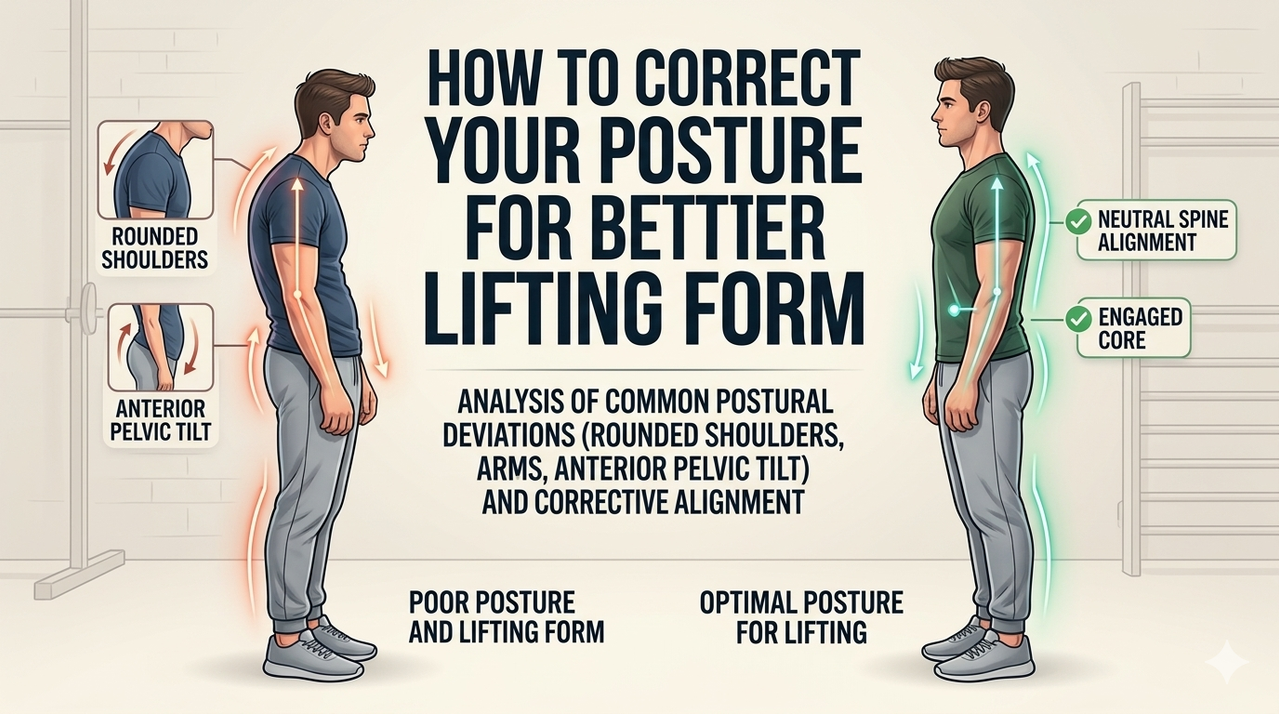
2. The Anatomy of Poor Posture: Upper and Lower Crossed Syndromes
2.1. Upper Crossed Syndrome (UCS)
Characterized by tight pectorals and upper trapezius/levator scapulae, and weak deep neck flexors and rhomboids/lower trapezius . This leads to forward head posture and rounded shoulders, limiting your ability to keep the bar close during deadlifts or maintain a stable rack position, a key focus for how to correct your posture for better lifting form .
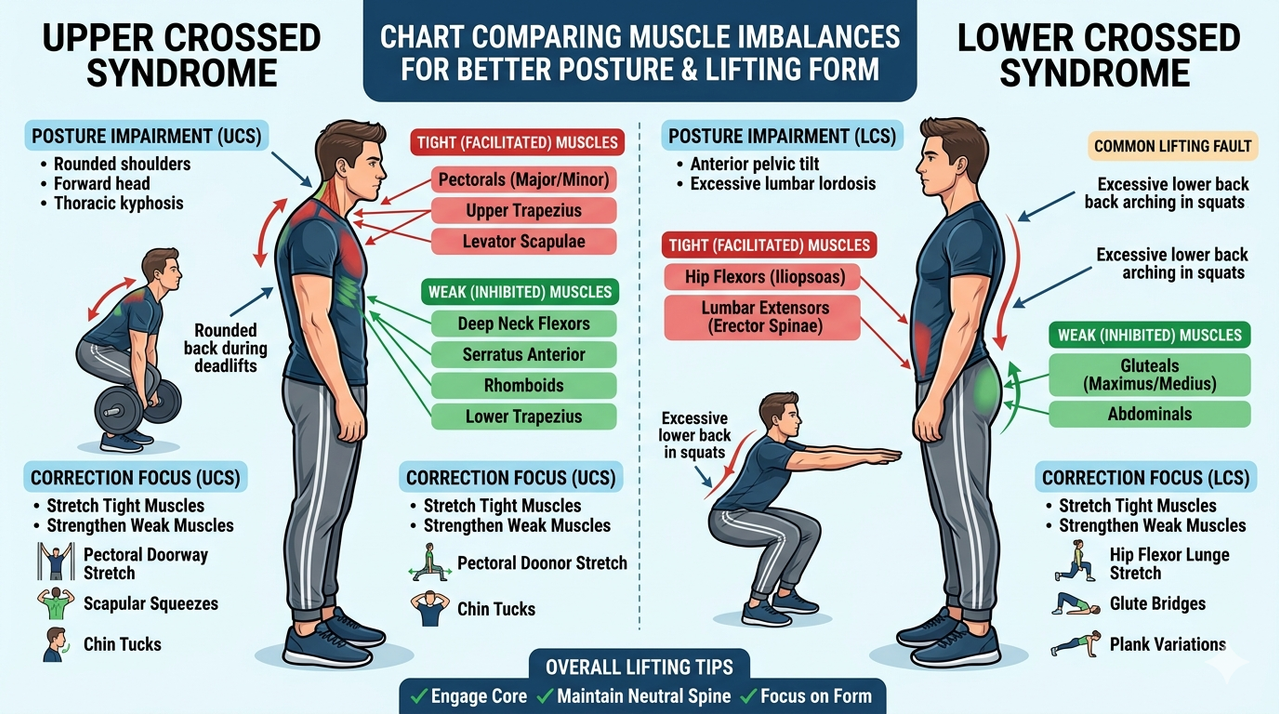
2.2. Lower Crossed Syndrome (LCS)
Marked by tight hip flexors and erector spinae, and weak glutes and abdominals . This creates an anterior pelvic tilt, making it difficult to brace your core effectively and maintain a neutral spine during squats .
2.3. How These Imbalances Sabotage Your Lifts
- Squats: Anterior pelvic tilt increases shear forces on the lumbar spine and reduces hip mobility .
- Deadlifts: Rounded shoulders make it harder to engage the lats, forcing the lower back to take on more load .
- Overhead Press: Poor thoracic extension limits your ability to press in a straight line .
3. 7 Essential Exercises to Correct Your Posture
This routine targets the key muscle groups identified above. Perform it 3-4 times per week, ideally on rest days or after your main workout, as part of how to correct your posture for better lifting form.
3.1. For Upper Body (Thoracic Mobility and Shoulder Retraction)
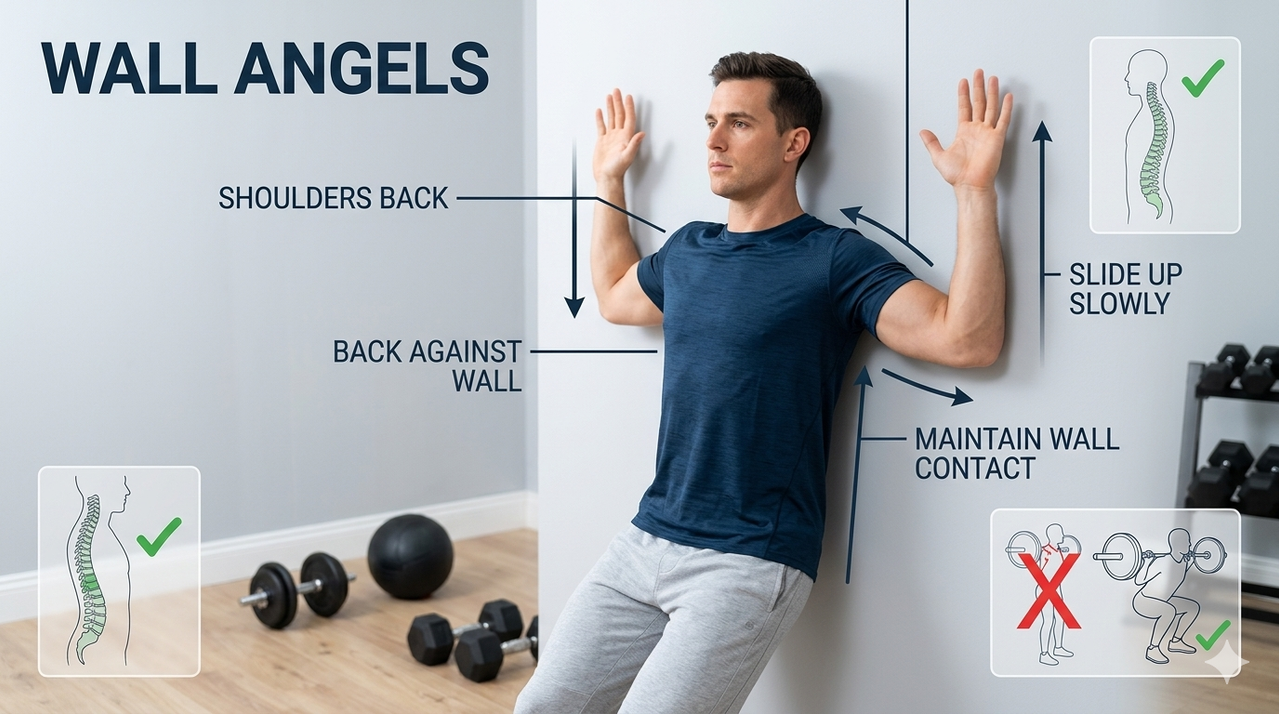
1. Wall Angels
Thoracic MobilityTarget: Thoracic spine extension, scapular retraction .
How to do it: Stand with your back against a wall, feet a few inches away. Press your lower back, upper back, and head into the wall. With arms bent at 90 degrees, slowly slide them up the wall as far as possible without arching your lower back. Return to start .
Sets/Reps: 3 x 10-12 reps.
2. Face Pulls
External RotationTarget: Rear delts, rhomboids, external rotators .
How to do it: Use a rope attachment on a cable machine set at upper chest height. Pull the rope toward your face, separating your hands and squeezing your shoulder blades. Hold for a second .
Sets/Reps: 3 x 15-20 reps.
3. Prone Y-T-W Raises
Scapular StabilityTarget: Lower trapezius, rhomboids .
How to do it: Lie face down on an incline bench or on the floor. Raise your arms to form a "Y," then a "T," then a "W," squeezing your shoulder blades at each position .
Sets/Reps: 3 x 8 reps per position.
3.2. For Lower Body (Hip Mobility and Glute Activation)
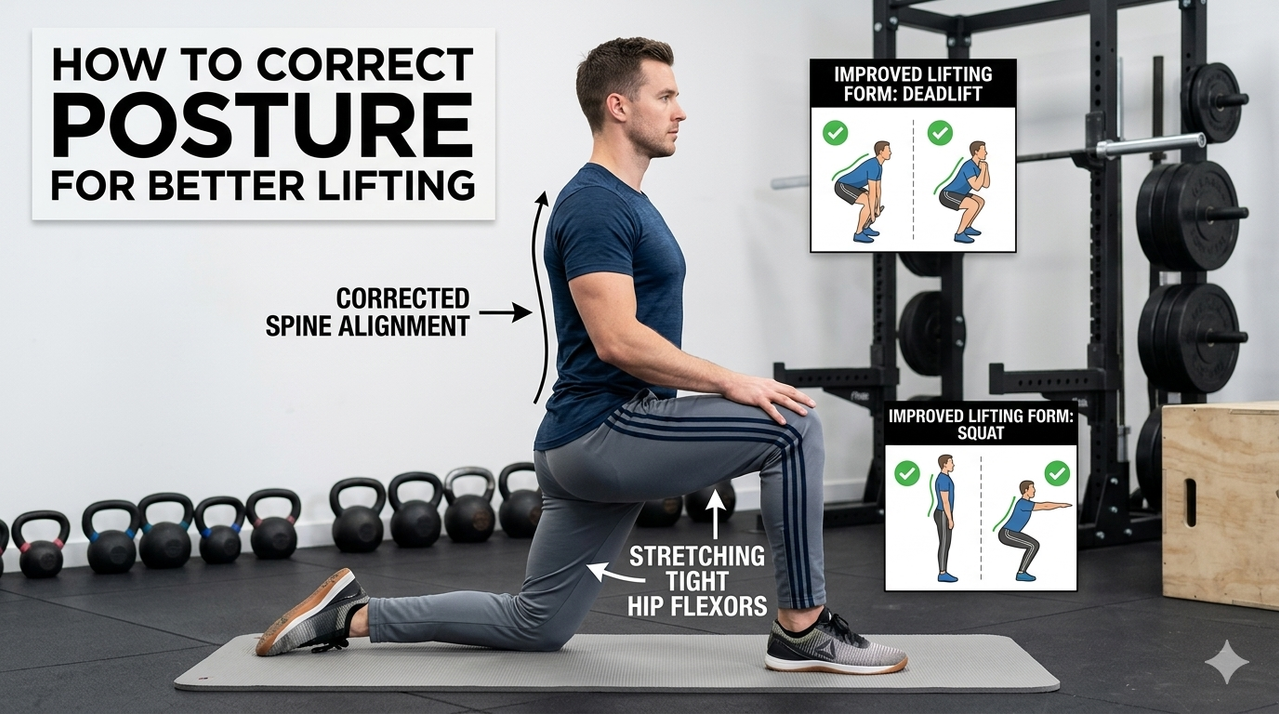
4. Hip Flexor Stretch (Half-Kneeling)
Lengthen Tight HipsTarget: Hip flexors (iliopsoas, rectus femoris) .
How to do it: Kneel on one knee with the other foot forward. Squeeze your glute on the kneeling leg and gently push your hips forward until you feel a stretch in the front of the hip. Hold for 30 seconds .
Hold: 2 x 30-45 seconds per side.
5. Glute Bridges (with emphasis)
Wake Up GlutesTarget: Glutes, hamstrings .
How to do it: Lie on your back with knees bent. Drive through your heels to lift your hips, focusing on squeezing your glutes at the top. Avoid overarching your lower back .
Sets/Reps: 3 x 12-15 reps (2-second hold).
6. Banded Pallof Press
Anti-Rotation CoreTarget: Deep core, obliques .
How to do it: Attach a band to a sturdy point at chest height. Stand sideways, holding the band with both hands at your chest. Press your arms straight out, resisting the rotation of the band. Return slowly .
Sets/Reps: 3 x 10 reps per side.
7. Chin Tucks
Neck AlignmentTarget: Deep cervical flexors .
How to do it: Sit or stand tall. Gently pull your head straight back, as if making a "double chin." Hold for 5 seconds, feeling a gentle pull in the back of your neck. Avoid looking up or down .
Sets/Reps: 3 x 10 holds.
4. Sample 15-Minute Daily Posture Routine
| Exercise | Sets/Reps | Focus |
|---|---|---|
| Wall Angels | 2 x 10 | Thoracic mobility |
| Chin Tucks | 2 x 10 (5-sec hold) | Neck alignment |
| Half-Kneeling Hip Flexor Stretch | 2 x 45 sec/side | Hip mobility |
| Glute Bridges | 2 x 15 | Glute activation |
| Face Pulls | 3 x 15 | Upper back |
| Prone Y-T-W | 2 x 6 each | Scapular control |
5. How to Apply Better Posture to Your Lifts
5.1. Setting Your Back in the Deadlift
Use the "proud chest" cue. Before you pull, take a deep breath into your belly and push your chest forward, pulling your shoulder blades down and back. This engages your lats and creates a stable torso, applying how to correct your posture for better lifting form .
5.2. Bracing for the Squat
With improved hip mobility and core control, you can achieve a neutral spine throughout the squat. Focus on keeping your ribcage "down" to prevent overarching .
5.3. Overhead Press Alignment
Think about pressing your head through your arms at the top. This requires thoracic extension and prevents excessive lower back arch .
6. Nutrition: Supporting Tissue Repair and Reducing Inflammation
6.1. Protein for Muscle Repair
Corrective exercises create micro-tears that need repair. Aim for 1.6–2.2 g per kg of body weight daily to support muscle strengthening and recovery, essential for how to correct your posture for better lifting form .
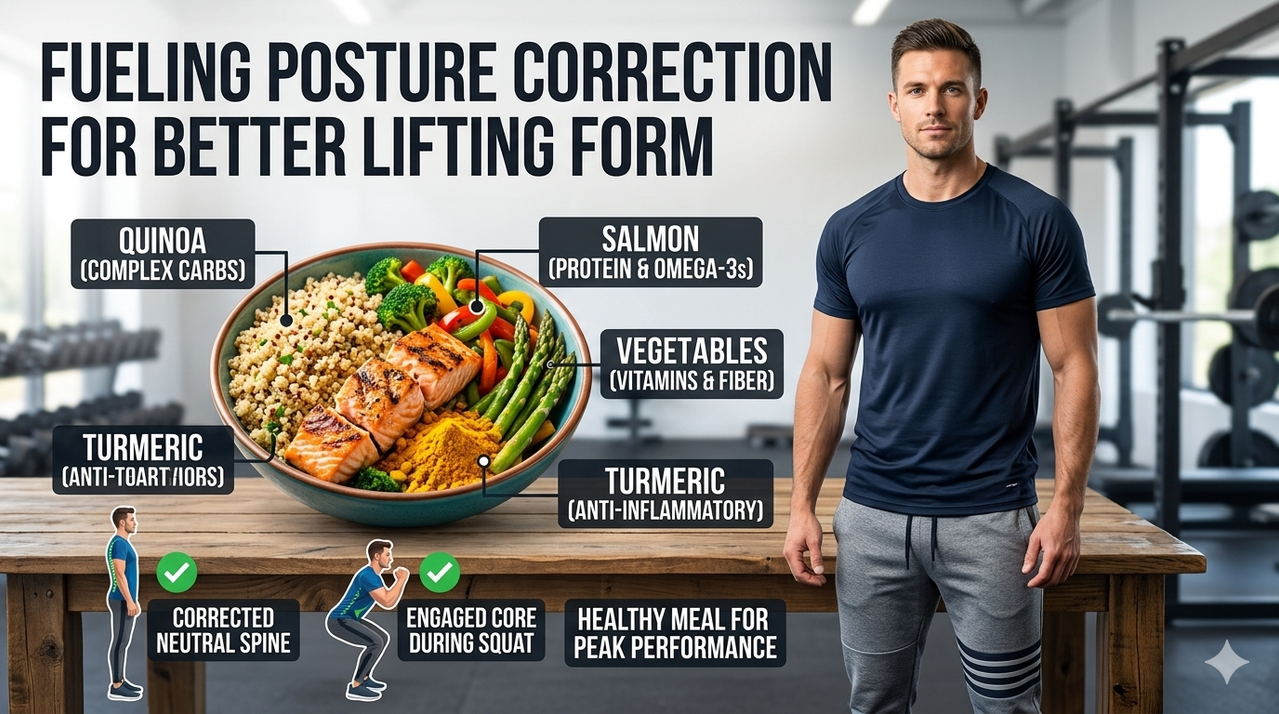
6.2. Anti-Inflammatory Foods for Joint Health
Chronic inflammation can exacerbate muscle imbalances and joint stiffness. Include omega-3-rich foods (salmon, chia seeds) and polyphenol-rich foods (berries, turmeric) to support tissue health .
6.3. Sample Day: Posture and Performance (~2500 kcal, 160g protein)
- Breakfast: 3 eggs (18g) + 1 cup Greek yogurt (20g) + 1 cup oats (10g) + ½ cup berries → 48g protein
- Lunch: 200g chicken breast (45g) + 1 cup quinoa (8g) + roasted vegetables with turmeric → 53g protein
- Snack: 1 scoop whey protein (25g) + 1 handful walnuts (4g) + 1 apple → 29g protein
- Dinner: 200g salmon (40g) + sweet potato + steamed broccoli → 40g protein
- Total: ~170g protein
6.4. Vegan Options for Posture Support
- Protein: Tofu, tempeh, lentils, edamame, pea protein
- Omega-3s: Flaxseeds, chia seeds, hemp seeds, walnuts, algae oil
- Anti-inflammatory: Berries, turmeric, ginger, leafy greens
- Sample vegan posture day: Tofu scramble breakfast, lentil-quinoa bowl for lunch, edamame snack, tempeh stir-fry with ginger for dinner
7. The 2025 Firefighter Study: Evidence That Corrective Exercise Works
A 2025 study published in the Journal of Athletic Training investigated the effects of an 8-week corrective exercise program on firefighters. The participants, all with a history of low back pain, performed targeted exercises for hip and core stabilization, including bird-dog, side plank, and glute bridges, supporting how to correct your posture for better lifting form .
The results were significant: the intervention group showed improved thoracic extension, better overhead squat mechanics, and reduced pain scores compared to the control group . This real-world study demonstrates that consistent corrective work directly translates to better movement patterns.
8. Common Mistakes When Fixing Posture
- Mistake #1: Over-correcting by "pulling shoulders back." This often leads to excessive tension and doesn't address the root cause. Focus on thoracic extension and scapular control, not just squeezing .
- Mistake #2: Ignoring hip mobility. Lower back pain often stems from tight hips, not a weak back .
- Mistake #3: Expecting overnight results. Posture change takes time and consistent effort—think months, not days .
- Mistake #4: Not breathing properly. Deep, diaphragmatic breathing helps reset your nervous system and improves core engagement .
- Mistake #5: Sitting all day and hoping exercise will fix it. Your daily habits matter as much as your workouts. Take movement breaks every hour .
10. Scientific References
- Risch, L., et al. (2025). Effects of a Corrective Exercise Program on Thoracic Mobility and Overhead Squat Performance in Firefighters. Journal of Athletic Training, 60(2), 112-120. View Source
- Vostatek, P., et al. (2024). Upper and Lower Crossed Syndrome: A Clinical Update. Journal of Bodywork and Movement Therapies. View Source
- Kendall, F.P., et al. (2005). Muscles: Testing and Function with Posture and Pain. Lippincott Williams & Wilkins. (Referenced in )
- Lee, J.H., et al. (2022). The effect of thoracic spine extension exercises on posture and pain in patients with forward head posture. Journal of Physical Therapy Science. View Source
- Mills, M., et al. (2021). The effect of gluteus medius strengthening on lower extremity biomechanics. International Journal of Sports Physical Therapy. View Source
- American Council on Exercise. (2023). Posture Assessment and Corrective Exercise. ACE Fitness. (Referenced in )
- Page, P. (2011). Current concepts in muscle stretching for exercise and rehabilitation. International Journal of Sports Physical Therapy. View Source
- Clark, M.A., & Lucett, S.C. (2018). NASM Essentials of Corrective Exercise Training. Jones & Bartlett Learning. (Referenced in )
- Jäger, R., et al. (2017). International Society of Sports Nutrition Position Stand: protein and exercise. Journal of the International Society of Sports Nutrition, 14, 20. View Source
- Calder, P.C. (2017). Omega-3 fatty acids and inflammatory processes: from molecules to man. Biochemical Society Transactions, 45(5), 1105-1115. View Source
All sources last accessed March 2026. Paraphrased for accessibility.
Join the conversation