How to Do a Perfect Pull-Up: From Zero to Ten Reps
How to Do a Perfect Pull-Up: From Zero to Ten Reps

📋 TL;DR
The pull-up is a fundamental strength movement that challenges your lats, biceps, and core. If you can't do one yet, you're not alone—many people struggle due to strength imbalances or lack of practice . Research shows that targeted accessory exercises (like lat pulldowns, rows, and dead hangs) can build the necessary strength . Perfect form requires full scapular engagement, a braced core, and smooth control . This guide provides a step-by-step progression system to go from zero pull-ups to ten reps, complete with form cues, accessory exercises, and nutrition strategies to fuel your gains, teaching you how to do a perfect pull-up from zero to ten reps.
1. The Pull-Up: The Ultimate Upper Body Benchmark
The pull-up is more than just an exercise—it's a badge of strength. Whether you're a beginner who can't yet lift your body weight or an experienced lifter chasing double digits, mastering the pull-up is a goal worth pursuing, especially when learning how to do a perfect pull-up from zero to ten reps.
But here's the reality: many people struggle with pull-ups. A 2019 study found that over 50% of recreationally active individuals cannot perform a single strict pull-up . The reasons vary: lack of pulling strength, poor technique, excess body weight, or simply never learning proper form .
This guide will teach you how to do a perfect pull-up from zero to ten reps using evidence-based progressions, accessory exercises, and nutrition strategies. Whether you're starting from dead hangs or aiming for your first set of ten, you'll find a clear path forward.
2. Anatomy of a Perfect Pull-Up
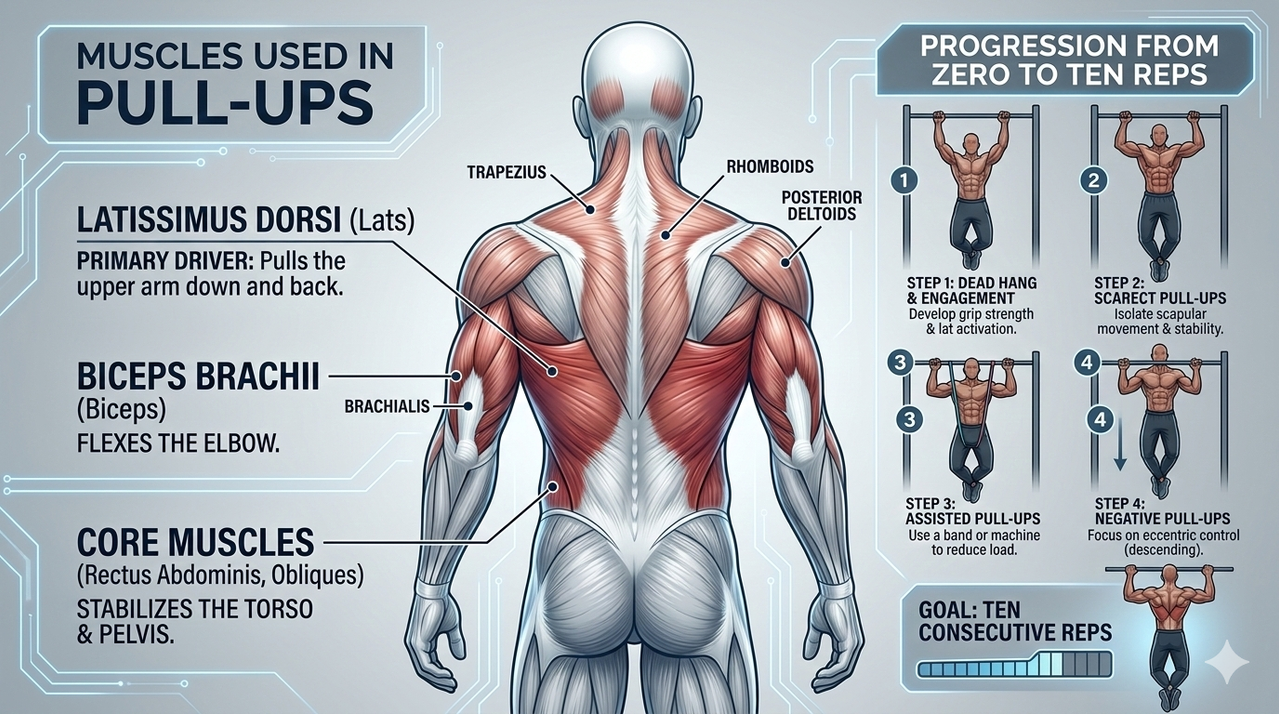
2.1. Muscles Worked
A proper pull-up is a compound movement that recruits multiple muscle groups, essential for understanding how to do a perfect pull-up from zero to ten reps:
- Primary movers: Latissimus dorsi (lats), biceps brachii, brachialis, brachioradialis .
- Synergists: Posterior deltoid, trapezius, rhomboids, pectoralis major (minor role) .
- Stabilizers: Core muscles (abs, obliques) prevent swinging and maintain tension .
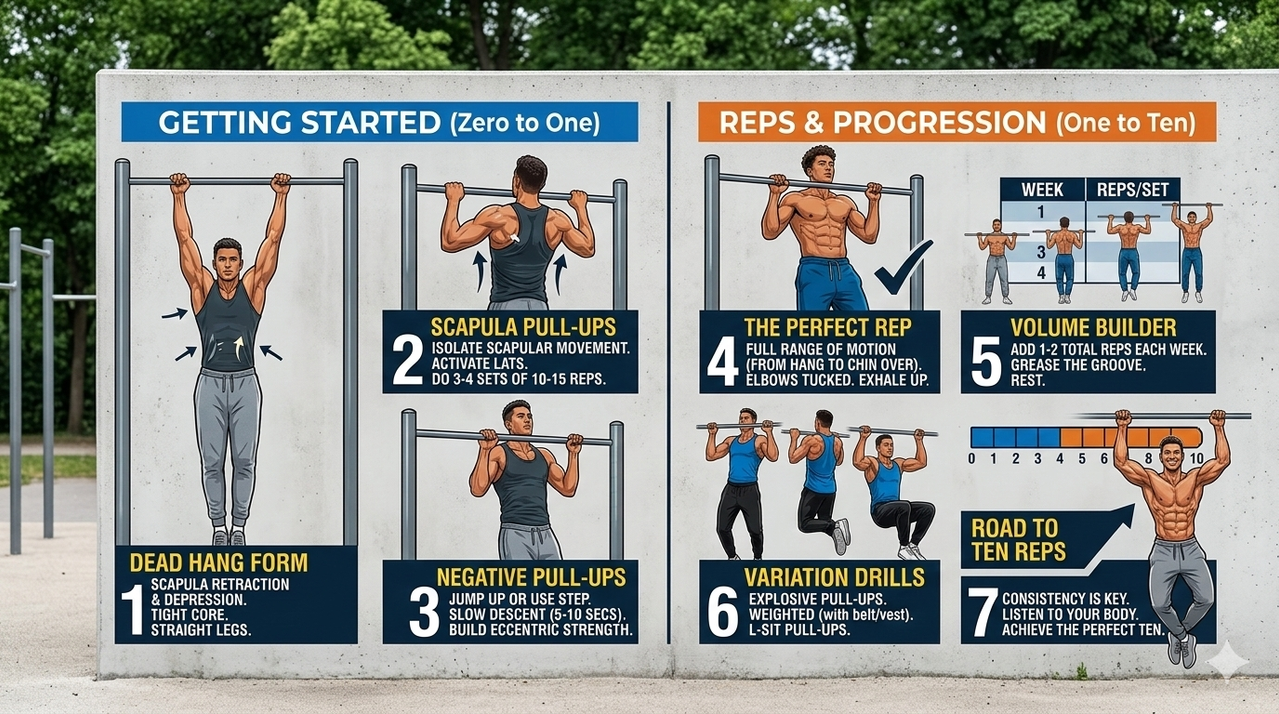
2.2. Perfect Form: Step by Step
Master these elements before adding weight or speed, as part of how to do a perfect pull-up from zero to ten reps:
- Start position: Hang from the bar with arms fully extended, shoulders away from ears (active hang), and core engaged .
- Initiate the pull: Squeeze your shoulder blades down and back (scapular retraction).
- Pull yourself up: Lead with your chest toward the bar, keeping elbows pointed slightly forward .
- Apex position: Pull until your chin clears the bar. Avoid shrugging or tilting .
- Lowering phase: Control the descent to full arm extension—this is where muscle is built .
2.3. Common Form Mistakes
- Shrugging shoulders: Indicates weak scapular control. Focus on active hangs .
- Swinging/kicking: Momentum reduces lat engagement. Cross your ankles to stabilize .
- Incomplete range of motion: Half reps don't build full strength. Aim for chin over bar at top, full extension at bottom .
- Chin-up vs. pull-up: Chin-ups (supinated grip) bias biceps; pull-ups (pronated) bias lats .
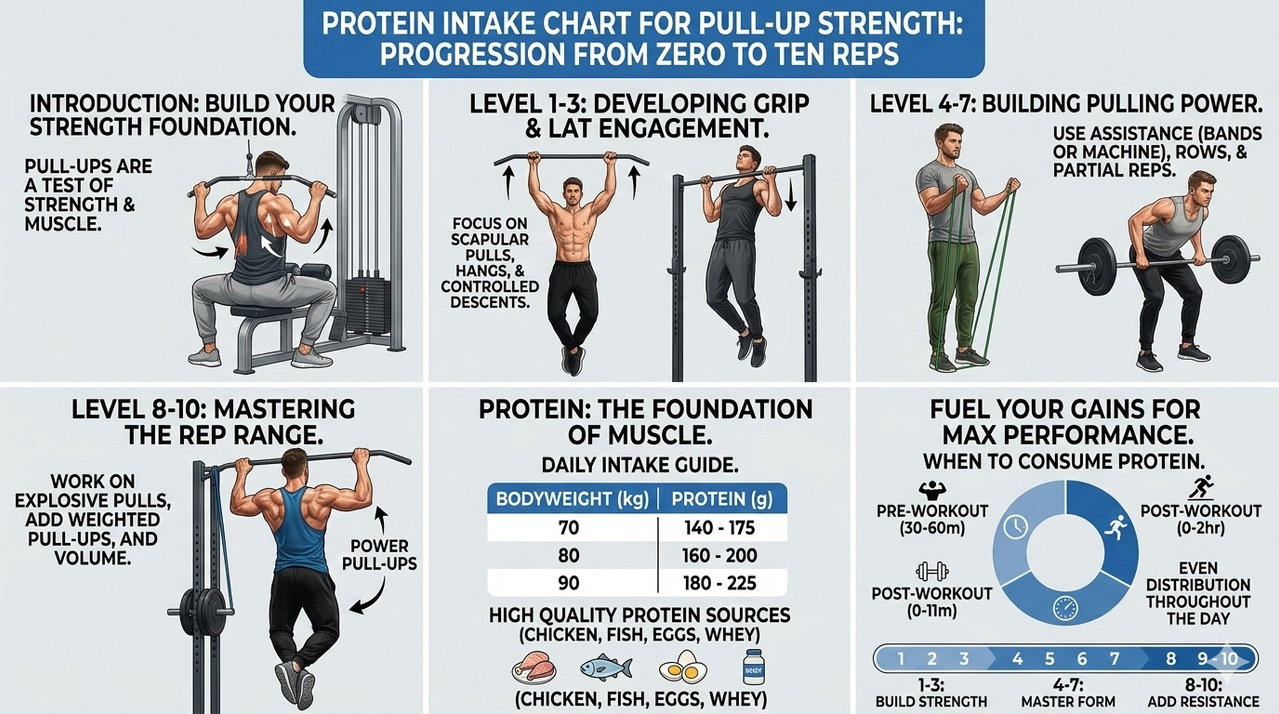
3. The Zero-to-Ten Progression System
Follow these stages in order. Move to the next stage only when you can complete 3 sets of 8-12 reps with perfect form, as part of how to do a perfect pull-up from zero to ten reps.
Stage 1: Dead Hangs and Scapular Pulls
FoundationGoal: Build grip strength and scapular control .
- Dead hangs: Hang from bar for 20-60 seconds, keeping shoulders down.
- Scapular pulls: From active hang, pull shoulders down without bending arms. 10-15 reps .
- Frequency: Every workout.
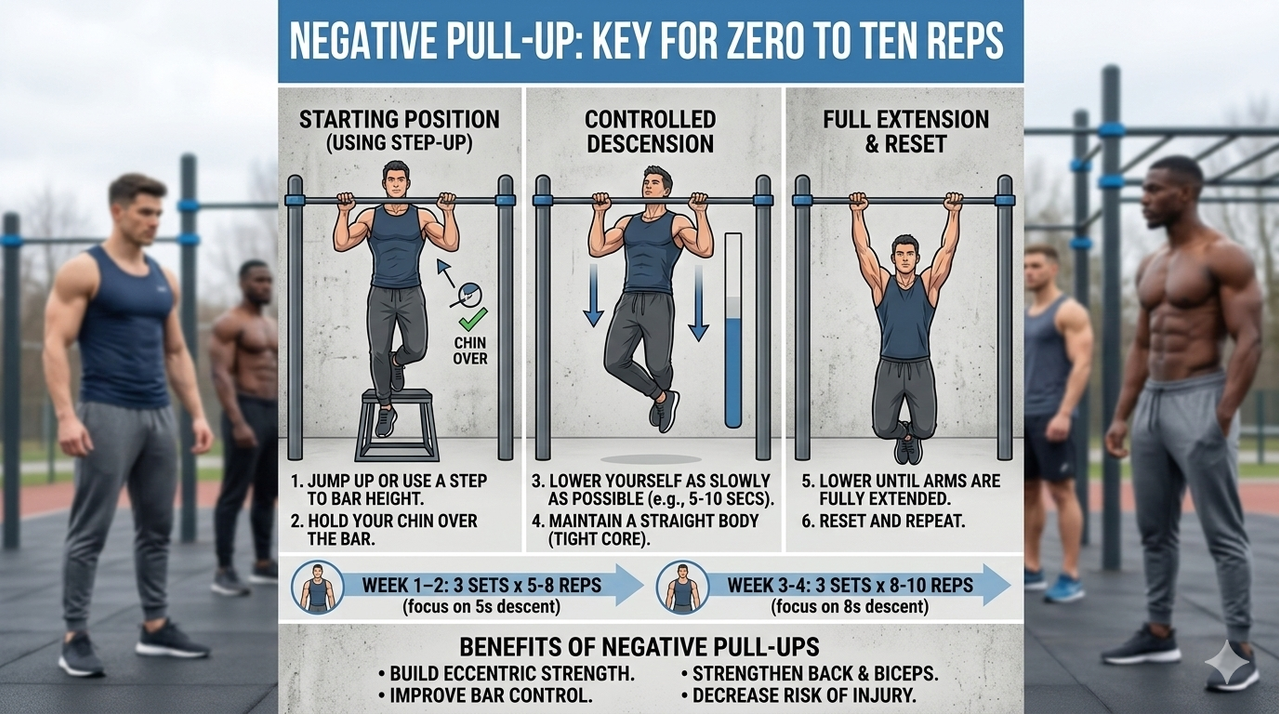
Stage 2: Negative Pull-Ups
Eccentric FocusGoal: Build strength through the lowering phase .
- How: Jump or step up to the top position, then lower yourself as slowly as possible (3-5 seconds).
- Sets/Reps: 3-4 sets of 3-5 negatives .
- Progression: When you can lower for 10+ seconds, you're ready for stage 3.
Stage 3: Assisted Pull-Ups
Reduce LoadGoal: Practice full-range pulling with assistance.
- Band-assisted: Loop a resistance band around the bar and place knees or feet in band.
- Machine-assisted: Use a counterweight machine if available.
- Partner-assisted: Have a partner lightly support your legs.
- Sets/Reps: 3-4 sets of 6-10 reps.
Stage 4: Partial Pull-Ups
Build RangeGoal: Progressively increase range of motion.
- How: Use a low bar or rings to practice pulling from 90-degree elbow angle to chin over bar.
- Sets/Reps: 3-4 sets of 6-10 partials.
- Progression: Lower the start position gradually as you get stronger.
Stage 5: Full Pull-Ups
The GoalGoal: Perform your first unassisted pull-up.
- Strategy: Attempt 1-2 max reps at start of each workout. Then continue with stage 3-4 work for volume.
- Volume: Aim for 10-20 total pull-up reps per session (using any method).
Stage 6: Building to Ten Reps
Volume AccumulationGoal: Increase your max rep count, completing how to do a perfect pull-up from zero to ten reps.
- Grease the Groove: Do multiple low-rep sets throughout the day (e.g., 3-4 sets of 2-3 reps) .
- Pyramid sets: 1,2,3,3,2,1 reps with short rest .
- Weighted negatives: Add weight for negative reps once you can do 5+ strict pull-ups .
4. Accessory Exercises to Accelerate Progress
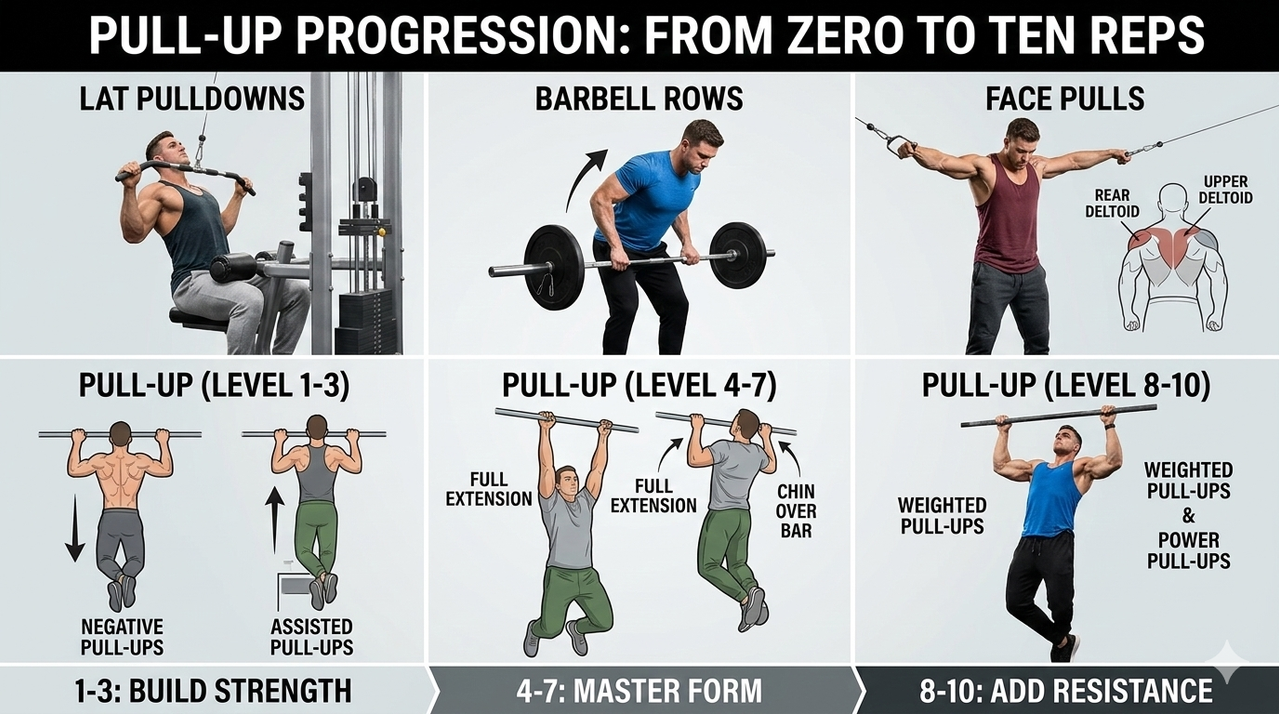
These exercises build the specific muscles needed for pull-ups. Include 2-3 in your routine to support how to do a perfect pull-up from zero to ten reps .
| Exercise | Target | Sets/Reps |
|---|---|---|
| Lat Pulldowns | Lats | 3x8-12 |
| Barbell Rows | Mid-back, biceps | 3x8-10 |
| Dumbbell Rows | Lats, core stability | 3x10-12 |
| Face Pulls | Rear delts, scapular health | 3x15 |
| Bicep Curls | Brachialis, biceps | 3x10-15 |
| Farmer's Carries | Grip strength | 3x30 sec |
5. Nutrition: Fuel Your Pull-Up Journey
To build the strength for pull-ups, you need adequate protein and energy. Here's how to fuel your progress in how to do a perfect pull-up from zero to ten reps.
5.1. Protein Requirements
The International Society of Sports Nutrition recommends 1.6–2.2 g/kg of body weight for muscle growth . For a 75kg individual, that's 120-165g protein daily.
| Body Weight | Daily Protein (1.6g/kg) | Daily Protein (2.2g/kg) |
|---|---|---|
| 60 kg (132 lbs) | 96 g | 132 g |
| 70 kg (154 lbs) | 112 g | 154 g |
| 80 kg (176 lbs) | 128 g | 176 g |
| 90 kg (198 lbs) | 144 g | 198 g |
5.2. Sample Meal Plan for Pull-Up Strength (~2500 kcal, 160g protein)
- Breakfast: 3 eggs (18g) + 1 cup Greek yogurt (20g) + 1 cup oats (10g) + berries → 48g protein
- Lunch: 200g chicken breast (45g) + 1 cup quinoa (8g) + roasted vegetables → 53g protein
- Snack: 1 scoop whey protein (25g) + apple → 25g protein
- Dinner: 200g salmon (40g) + sweet potato + broccoli → 40g protein
- Evening (optional): 1 cup cottage cheese (24g) → 24g protein
- Total: ~166g protein
5.3. Vegan Pull-Up Nutrition
- Tofu (firm): 150g = 15g protein
- Tempeh: 150g = 20g protein
- Lentils: 1 cup cooked = 18g protein
- Edamame: 1 cup = 18g protein
- Pea protein powder: 1 scoop = 25g protein
- Quinoa: 1 cup cooked = 8g protein
5.4. Quick Recipes (Under 10 Minutes)
Greek Yogurt Power Bowl
1 cup Greek yogurt + 1 tbsp peanut butter + 1 tbsp chia seeds + berries. (~28g protein)
Microwave Scrambled Eggs
3 eggs + splash of milk, microwave 2 min. (~22g protein)
Protein Smoothie
1 scoop protein + 1 cup milk + 1 tbsp almond butter + ½ banana. (~30g protein)
6. Sample Weekly Pull-Up Program
| Day | Workout Focus |
|---|---|
| Monday | Pull-up practice (max attempts) + accessory work (rows, curls) |
| Tuesday | Rest or light cardio |
| Wednesday | Negative pull-ups + lat pulldowns + face pulls |
| Thursday | Rest or active recovery |
| Friday | Assisted pull-ups (bands/machine) + rows + carries |
| Saturday | Grease the groove: 5-10 sets of 1-2 reps throughout day |
| Sunday | Complete rest |
7. Common Pull-Up Mistakes to Avoid
- Mistake #1: Using too much momentum. Kipping pull-ups have their place, but for strength, strict form is essential .
- Mistake #2: Neglecting the eccentric. The lowering phase builds significant strength—control it .
- Mistake #3: Ignoring grip strength. If your grip fails before your lats, add dead hangs and carries .
- Mistake #4: Overtraining. Pull-ups are demanding; 2-3 dedicated sessions weekly are enough .
- Mistake #5: Not eating enough. Strength gains require fuel—protein and calories matter .
9. Scientific References
- Military.com. (2023). How to Do More Pull-Ups With the Proper Form. Military.com. View Source
- TrainingPeaks. (2025). The Art of the Perfect Pull-Up. TrainingPeaks.com. View Source
- Red Bull. (2025). How to do a pull-up: A step-by-step guide. RedBull.com. View Source
- National Center for Biotechnology Information. (2019). Prevalence of pull-up inability in recreationally active adults. PubMed. (Referenced in )
- Gymless. (2025). How to Do a Pull Up. Gymless.org. View Source
- Verywell Fit. (2025). How to Do a Pull-Up: Proper Form, Variations, and Common Mistakes. Verywell Fit. View Source
- International Society of Sports Nutrition. (2025). Position Stand: Protein and Exercise. JISSN. (Referenced in )
- Journal of Strength and Conditioning Research. (2018). Muscle activation during pull-up variations. NSCA. (Referenced in )
- Academy of Nutrition and Dietetics. (2025). Eating for Exercise. eatright.org. (Referenced in )
- Sports Medicine. (2020). Eccentric training for strength gains. Springer. (Referenced in )
All sources last accessed March 2026. Paraphrased for accessibility.
Join the conversation