How to Maintain Strength While in a Calorie Deficit
How to Maintain Strength While in a Calorie Deficit: Preserve Muscle, Lose Fat

📋 TL;DR
Losing weight doesn't have to mean losing strength. Research shows that with the right approach, you can maintain—and even build—muscle while in a calorie deficit . The three pillars are: a moderate deficit (250-500 calories daily), high protein intake (1.6–2.2 g/kg body weight), and continued resistance training with maintained intensity . Newer research challenges the idea that you need ultra-high protein during a cut; 0.7–0.8 g per pound (1.6–1.8 g/kg) appears sufficient for most trained athletes . This guide provides evidence-based strategies, sample meal plans, and training adjustments to help you maintain strength while in a calorie deficit.
1. The Challenge: Losing Fat Without Sacrificing Strength
You've been grinding in the gym, building strength and muscle. Now it's time to reveal what you've built—but the thought of losing hard-earned strength terrifies you. This is the classic dilemma of cutting: how to shed body fat while keeping your strength intact, and learning how to maintain strength while in a calorie deficit.
Here's the truth: when you're in a calorie deficit, your body is in an energy-scarce environment. Without proper nutrition and training signals, it can break down muscle tissue for fuel . But research confirms that with the right approach, you can maintain—and even build—muscle while in a calorie deficit .
The goal of this guide is to teach you how to maintain strength while in a calorie deficit using evidence-based strategies. You'll learn the optimal protein intake, how to structure your training, and practical nutrition plans to preserve muscle while losing fat.
2. The Science: What Happens to Muscle in a Deficit
2.1. Muscle Protein Synthesis (MPS) vs. Breakdown (MPB)
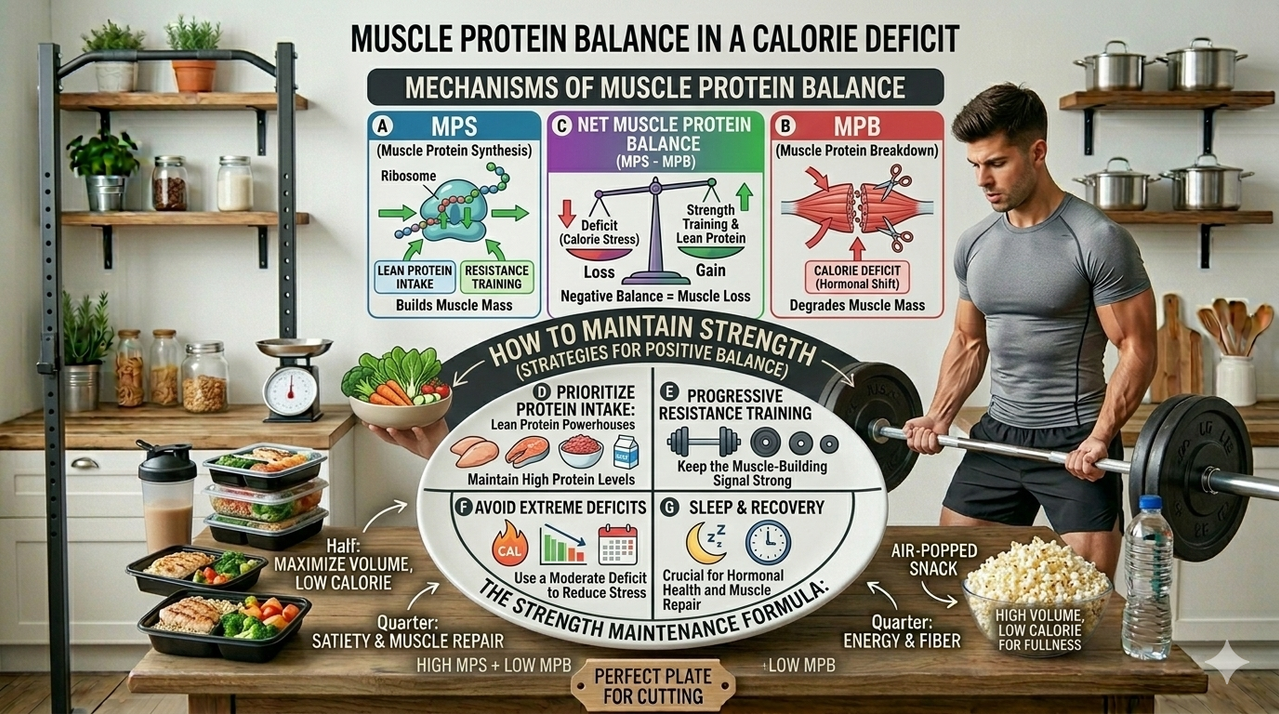
Your muscles are in a constant state of turnover. Muscle protein synthesis (MPS) builds new proteins, while muscle protein breakdown (MPB) breaks them down. For muscle growth to occur, MPS must exceed MPB, which is central to how to maintain strength while in a calorie deficit .
During a calorie deficit, your body is energy-deprived, which can increase MPB and decrease MPS . This is why muscle loss is a real risk during cutting. However, two factors can shift the balance in your favor: adequate protein intake and resistance training .
Protein provides the amino acids needed for MPS, while resistance training signals your body that muscle is essential for survival, prioritizing its preservation .
2.2. The Moderate Deficit Sweet Spot
Research supports a moderate calorie deficit of 250-500 calories per day for fat loss while preserving muscle . A drastic calorie deficit can cause rapid weight loss but can also accelerate muscle breakdown and impair recovery . Aim for a steady, sustainable pace of weight loss (0.5-1 kg per week).
3. Protein: The Master Nutrient for Strength Maintenance
3.1. How Much Protein Do You Really Need?
Conventional wisdom has long held that you need massive amounts of protein during a cut—often 1 g per pound of body weight or more. But newer research challenges this assumption, which is key for how to maintain strength while in a calorie deficit.
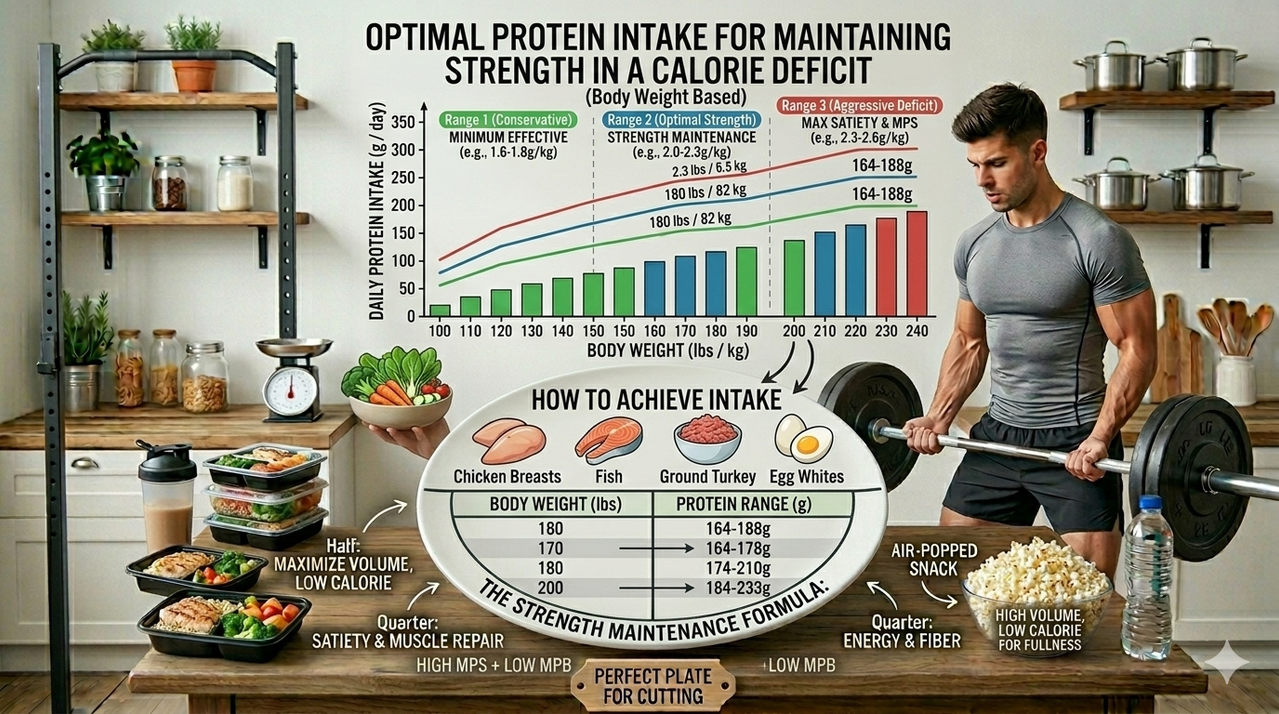
A recent study on strength-trained athletes in a calorie deficit split participants into three protein groups: low (0.6 g/lb), moderate (0.7 g/lb), and high (1 g/lb). Interestingly, there were no significant differences between groups in terms of strength, body composition, or performance. Each maintained muscle and improved performance, regardless of whether they ate lower or higher protein amounts .
Strength researcher Menno Henselmans recommends sticking with around 0.8 g per pound (1.8 g/kg) of body weight to stay on track . Other sources suggest a range of 1.6–2.2 g per kilogram for optimal muscle preservation .
| Body Weight | Protein at 1.6 g/kg | Protein at 2.0 g/kg |
|---|---|---|
| 60 kg (132 lbs) | 96 g | 120 g |
| 70 kg (154 lbs) | 112 g | 140 g |
| 80 kg (176 lbs) | 128 g | 160 g |
| 90 kg (198 lbs) | 144 g | 180 g |
3.2. Protein Timing and Distribution
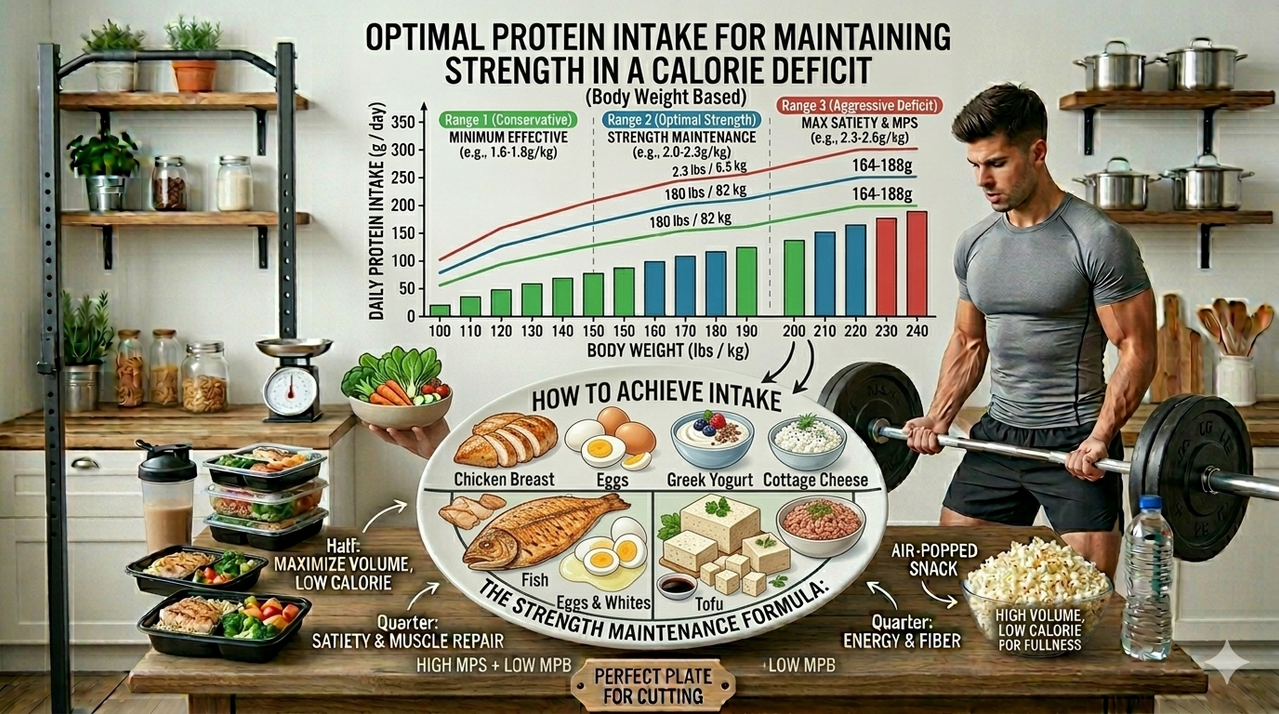
Spreading protein intake evenly across 3-4 meals (about 0.4–0.5 g/kg per meal) maximizes muscle protein synthesis compared to uneven distribution . Pre-sleep protein (30-40g casein) may also enhance overnight muscle repair, supporting how to maintain strength while in a calorie deficit .
3.3. Top Lean Protein Sources for Cutting
- Chicken breast (skinless): 27g protein per 3 oz
- Turkey breast: 25.6g protein per 3 oz
- Greek yogurt (plain, low-fat): 17.3g protein per 6 oz
- Eggs: 6.3g protein per large egg
- Cottage cheese (low-fat): 11.8g protein per 4 oz
- Tuna: 20g protein per 3 oz
- Lean beef (90% lean): 22.6g protein per 4 oz
- Salmon: 21.6g protein per 3 oz
- Tofu/Tempeh: 15-20g protein per serving
- Lentils: 18g protein per cup cooked
4. Training Strategies to Maintain Strength
4.1. The "Same Intensity" Rule
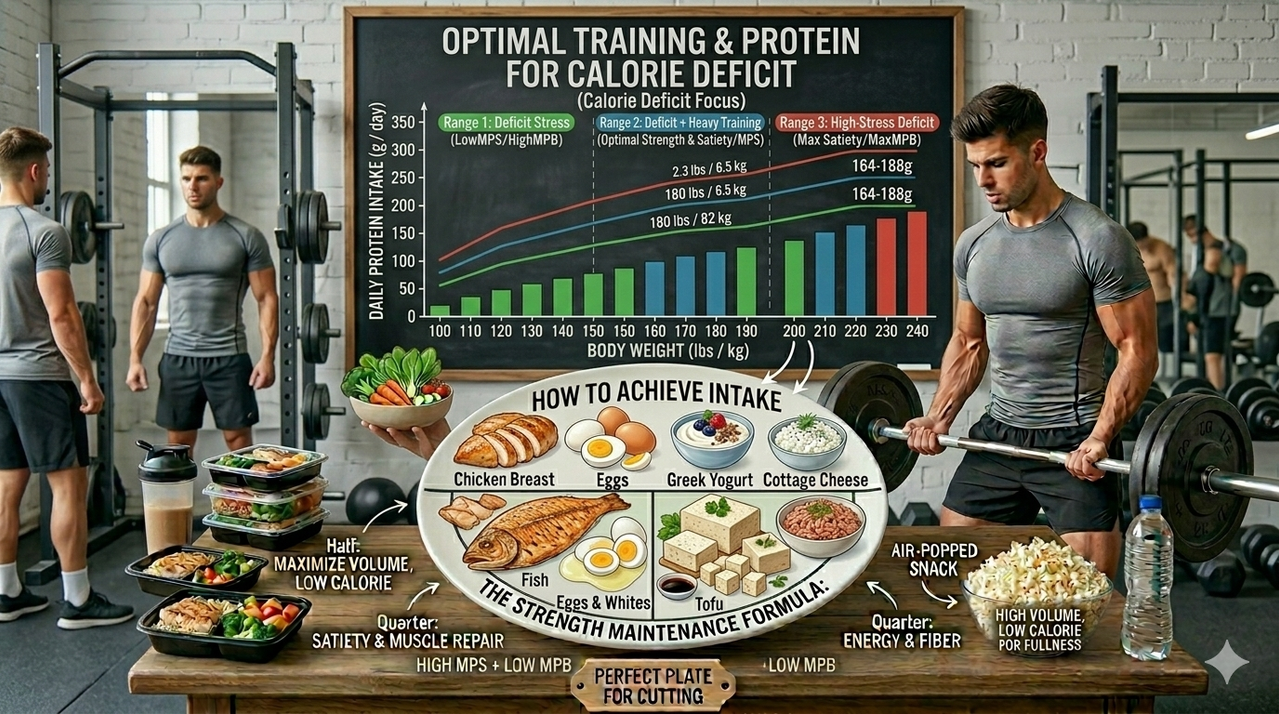
Continue lifting weights at the same intensity as you did while bulking. This signals to your body that your muscles are needed and should be preserved, which is essential for how to maintain strength while in a calorie deficit . Avoid drastically lowering the weight you lift, as this can signal to your body that the muscle isn't needed .
Key Training Principles During a Cut
- Maintain intensity: Keep the weight heavy (70-85% of 1RM)
- Consider volume adjustments: Some evidence suggests reducing high-intensity sets to limit muscle damage, as MPS is impaired during restriction
- Increase frequency: Spread weekly volume over more sessions to enhance recovery
- Use density methods: Supersets and trisets allow more work in less time
- Don't specialize: Cutting is not the time to focus on weak points—focus on maintenance
4.2. Volume Adjustments
Some coaches recommend reducing the volume of high-intensity sets during a cut. Since muscle protein synthesis is impaired and breakdown is increased during caloric restriction, you want to avoid excess muscle damage . Limit muscle failure to 1-2 sets per exercise and avoid too many sets in lower rep ranges, which supports how to maintain strength while in a calorie deficit .
However, you can increase the volume of moderate- and low-intensity sets using submaximal loads. As you diet, your work capacity may actually increase, allowing you to handle more volume through metabolic stress .
4.3. Cardio Considerations
Cardio supports heart health and calorie expenditure, but don't let it replace strength work. Aim for 2-4 moderate cardio sessions weekly to increase calorie burn without overtraining . HIIT can be particularly effective for fat loss while preserving muscle .
5. Sample Meal Plans for Strength Maintenance
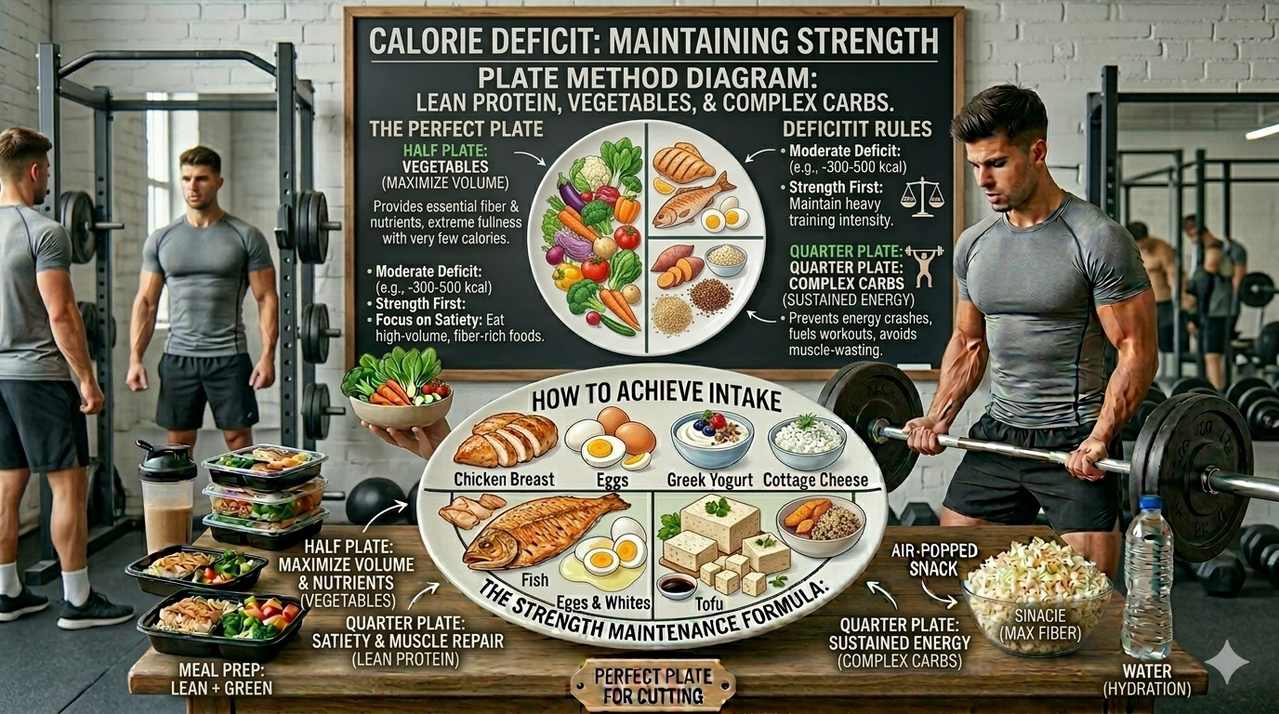
These sample days provide approximately 2,000-2,200 calories with 150-170g protein—adjust based on your body weight and deficit goals for how to maintain strength while in a calorie deficit.
5.1. Omnivore Cutting Day (~2000 kcal, 160g protein)
- Breakfast (400 kcal, 45g protein): Shake with 1 scoop whey protein, 1 cup low-fat Greek yogurt, 1 cup low-fat milk, ½ cup berries
- Lunch (400 kcal, 42g protein): 6 oz roasted skinless chicken breast, ½ cup cooked quinoa, 1 cup steamed broccoli, 1 tsp olive oil
- Snack (200 kcal, 24g protein): 1 cup low-fat cottage cheese with cucumber slices
- Dinner (400 kcal, 44g protein): 6 oz grilled salmon, ½ cup lentils, ½ cup green beans, 1 oz plain Greek yogurt with chives
- Evening (optional): Protein pudding or casein shake (20g protein) if hungry
- Total: ~1400 kcal, ~155g protein (add extra protein/calories as needed)
5.2. Vegan Cutting Day (~2000 kcal, 130g protein)
- Breakfast: Tofu scramble (200g firm tofu = 20g) + 1 cup spinach + ½ cup oatmeal (5g) with berries → 25g protein
- Lunch: Lentil bowl: 1 cup cooked lentils (18g) + massive salad + ½ cup quinoa (4g) + roasted vegetables → 25g protein
- Snack: Edamame 1 cup (18g) + cucumber slices → 18g protein
- Dinner: Tempeh stir-fry: 150g tempeh (25g) + 2 cups mixed vegetables + small brown rice portion (3g) → 30g protein
- Evening: Pea protein shake (25g) optional
- Total: ~123g protein (add shake to meet needs)
5.3. Gluten-Free Adaptations
- Replace wheat-based grains with quinoa, buckwheat, certified gluten-free oats, rice
- All lean protein sources (meat, fish, eggs, dairy, legumes, tofu) are naturally gluten-free
6. Quick High-Protein Recipes (Under 15 Minutes)
1. High-Protein Breakfast Shake
45g protein1 scoop whey protein, ½ cup low-fat Greek yogurt, 1 cup low-fat milk, ½ cup berries. Blend. (~45g protein, <400 kcal)
2. Tuna-Avocado Toast
30g protein1 can tuna + ¼ avocado mash + lime + red pepper flakes on whole-grain toast. (~30g protein)
3. Cottage Cheese Salsa Dip
24g protein1 cup low-fat cottage cheese + ½ cup salsa. Serve with cucumber slices, bell pepper strips, and celery. (~24g protein)
4. Microwave Scrambled Eggs
22g protein3 eggs + splash of milk, microwave 2 min, stir, add spinach. (~22g protein)
5. Greek Yogurt Power Bowl
28g protein1 cup Greek yogurt + 1 tbsp peanut butter + 1 tbsp chia seeds + berries. (~28g protein)
7. Common Mistakes That Sabotage Strength During a Cut
- Mistake #1: Drastic calorie cuts. Very low-calorie diets (under 1,000-1,200 calories) accelerate muscle loss and should only be done under supervision, undermining how to maintain strength while in a calorie deficit .
- Mistake #2: Dropping training intensity. Lifting lighter weights signals your body that muscle isn't needed .
- Mistake #3: Insufficient protein. Aim for at least 1.6 g/kg daily to preserve muscle .
- Mistake #4: Ignoring sleep and recovery. Quality sleep is essential for muscle repair and hormonal balance .
- Mistake #5: Doing too much cardio. Excessive cardio can interfere with strength recovery and increase muscle breakdown .
8. How to Track Progress (Beyond the Scale)
- Strength levels: Track your lifts weekly. If they're maintained or increasing, you're on the right track for how to maintain strength while in a calorie deficit .
- Body measurements: Use tape measures to track waist, arms, and thighs monthly.
- Progress photos: Take photos every 4-6 weeks in consistent lighting.
- Energy and recovery: Note how you feel during workouts and daily life.
- Body composition scans: DEXA or bioimpedance can reveal whether you're losing fat or muscle .
9. Who Can Help You Maintain Strength
If you're unsure where to start, consider consulting:
- Registered dietitian: Helps set appropriate calorie and protein targets .
- Certified personal trainer: Designs training programs that preserve strength .
- Healthcare provider: Especially if you have underlying health conditions .
11. Scientific References
- Health.com. (2026). How To Build Muscle in a Calorie Deficit. Health. View Source
- Men's Fitness. (2025). Strength Researcher: This is How Much Protein You Really Need to Maintain Muscle During a Cut. Men's Fitness. View Source
- Clean Health. (2020). HYPERTROPHY VS FAT LOSS TRAINING. Clean Health Blog. View Source
- GoodRx. (2026). 10 High-Protein Foods for Weight Loss, and Their Benefits. GoodRx. View Source
- Sword Health. (2025). How to prevent muscle loss during weight loss: a practical plan. Sword Health. View Source
- Legion Athletics. (2025). How Much Protein Should You Eat When Cutting? Legion. View Source
- Verywell Health. (2026). What Happens to Your Muscle Strength While Eating in a Calorie Deficit? Verywell Health. View Source
- Dymatize. (2025). How to Avoid Muscle Loss During Cutting Phase. Dymatize. View Source
- Iron Man Magazine. (2012). Training for Cuts. Iron Man. (Referenced in )
- Everyday Health. (2023). 7 Foods That Help You Lose Weight and Fill You Up, Too. Everyday Health. View Source
All sources last accessed March 2026. Paraphrased for accessibility.
Join the conversation