Is Training Every Day Better for Natural Muscle Growth?
Is Training Every Day Better for Natural Muscle Growth?

📋 TL;DR
The short answer to "is training every day better for natural muscle growth?" is: no, not for the same muscle groups. Research consistently shows that when weekly volume (total number of hard sets) is equal, training frequency makes little difference for hypertrophy . However, a landmark 2025 meta-analysis revealed a key nuance: while frequency doesn't significantly impact muscle growth, it does have a positive effect on strength gains . More importantly, muscles need at least 48 hours to recover and grow . Training every day can work if you use a split routine (e.g., upper/lower/upper/lower) that allows 48 hours between sessions for each muscle group. This guide breaks down the science, helps you find your optimal frequency, and provides sample splits and nutrition strategies.
1. The Frequency Question: Does More Equal More?
You see it on social media: influencers claiming you need to train six or seven days a week to maximize gains. The message is seductive—more work equals more results. But when it comes to natural muscle growth, the question "is training every day better for natural muscle growth?" has a surprisingly nuanced answer.
Your muscles don't grow during the workout; they grow during the recovery period that follows . When you lift, you create micro-tears in muscle fibers. This stimulates muscle protein synthesis (MPS)—the process of repairing and building new muscle tissue. Research shows that MPS remains elevated for 24 to 48 hours after training, meaning your body is busy building muscle long after you've left the gym .
This guide will explore the science of training frequency, the critical role of weekly volume, and how to structure your week for optimal results.
2. The Science: What the Latest Research Reveals
2.1. The 2025 Landmark Meta-Analysis
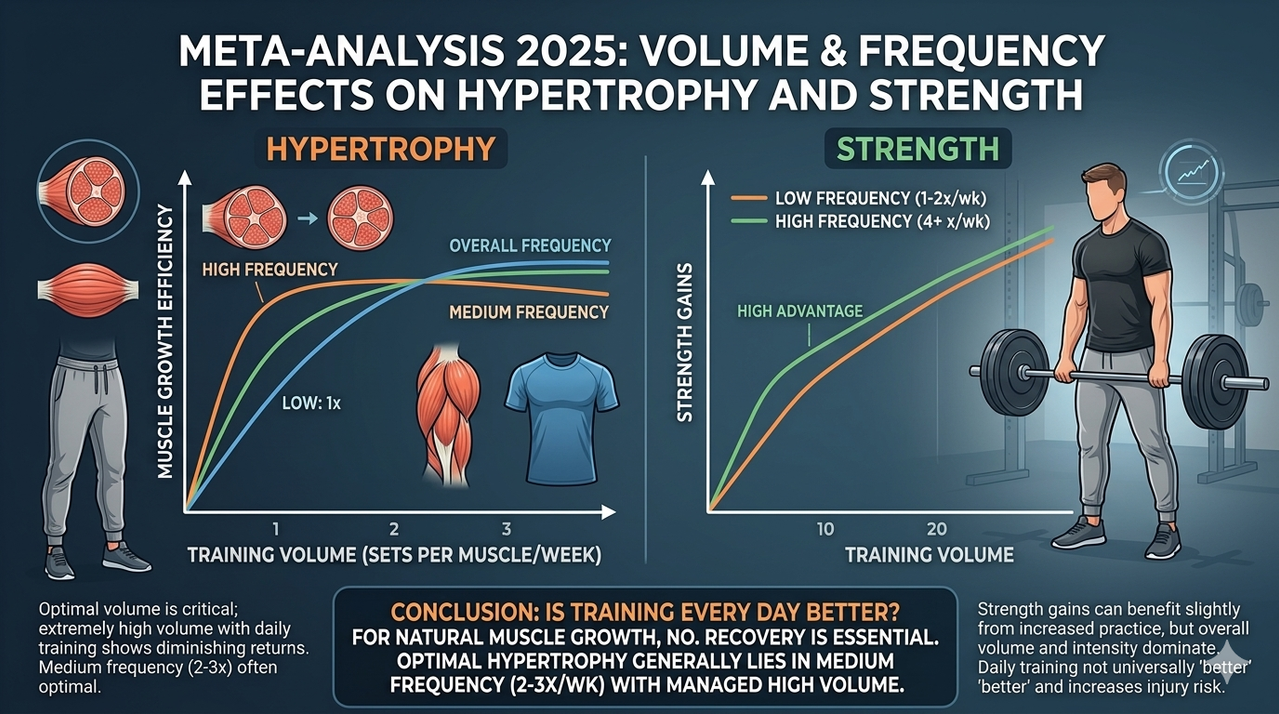
A massive 2025 meta-analysis published in Sports Medicine analyzed 67 studies with over 2,000 participants to answer the frequency question definitively, shedding light on is training every day better for natural muscle growth . The findings were groundbreaking: the posterior probability that volume affects both hypertrophy and strength was 100%—meaning more volume (up to a point) leads to more gains. However, for frequency, the story was different.
The probability that frequency affects hypertrophy was less than 100%, indicating "compatibility with negligible effects" on muscle growth . In plain English: when total weekly volume is the same, how you split it across days doesn't significantly impact how much muscle you build.
2.2. Frequency and Strength: A Different Story
The same 2025 analysis found that for strength gains, the probability that frequency matters was 100%, suggesting that increasing frequency does enhance strength development, albeit with diminishing returns . This means that while you might not build more muscle by training more often, you could become stronger.
2.3. The Volume-Equated Consensus
This aligns with a large body of previous research. A 2019 meta-analysis by Schoenfeld et al. found that "resistance training frequency does not significantly or meaningfully impact muscle hypertrophy when volume is equated" . Other reviews confirm that for muscle size, frequency is primarily a tool to manage weekly volume .
3. The Real Driver of Growth: Weekly Volume
3.1. What Is Weekly Volume?
Weekly volume refers to the total number of "hard sets" you perform for a muscle group over a seven-day period. A "hard set" is one taken close to failure (1-3 reps shy), a key factor in is training every day better for natural muscle growth .
3.2. The Dose-Response Relationship
Research shows a clear dose-response relationship: more weekly sets generally lead to more growth, but with diminishing returns .
- Low volume (≤4 sets/week): Sufficient for beginners to see gains .
- Moderate volume (5-9 sets/week): The sweet spot for most intermediates .
- High volume (10-15+ sets/week): May be beneficial for advanced lifters, but requires careful recovery management .
A 2022 summary of research indicated that multiple sets (2-3) are associated with 40% greater hypertrophy than single sets .
3.3. The 48-Hour Rule
Muscles need at least 48 hours of rest before being worked again intensely . This is because the elevated MPS window lasts up to 48 hours, and training a muscle while it's still repairing can blunt growth, a crucial consideration for is training every day better for natural muscle growth .
| Training Status | Weekly Sets per Muscle | Frequency Recommendation |
|---|---|---|
| Beginner | 4-6 sets | 2-3x/week (full body) |
| Intermediate | 6-10 sets | 2x/week per muscle |
| Advanced | 10-15+ sets | 2-3x/week per muscle (split routine) |
4. Can You Train Every Day? The Split Routine Solution
4.1. The Answer: Yes, If You Use Splits
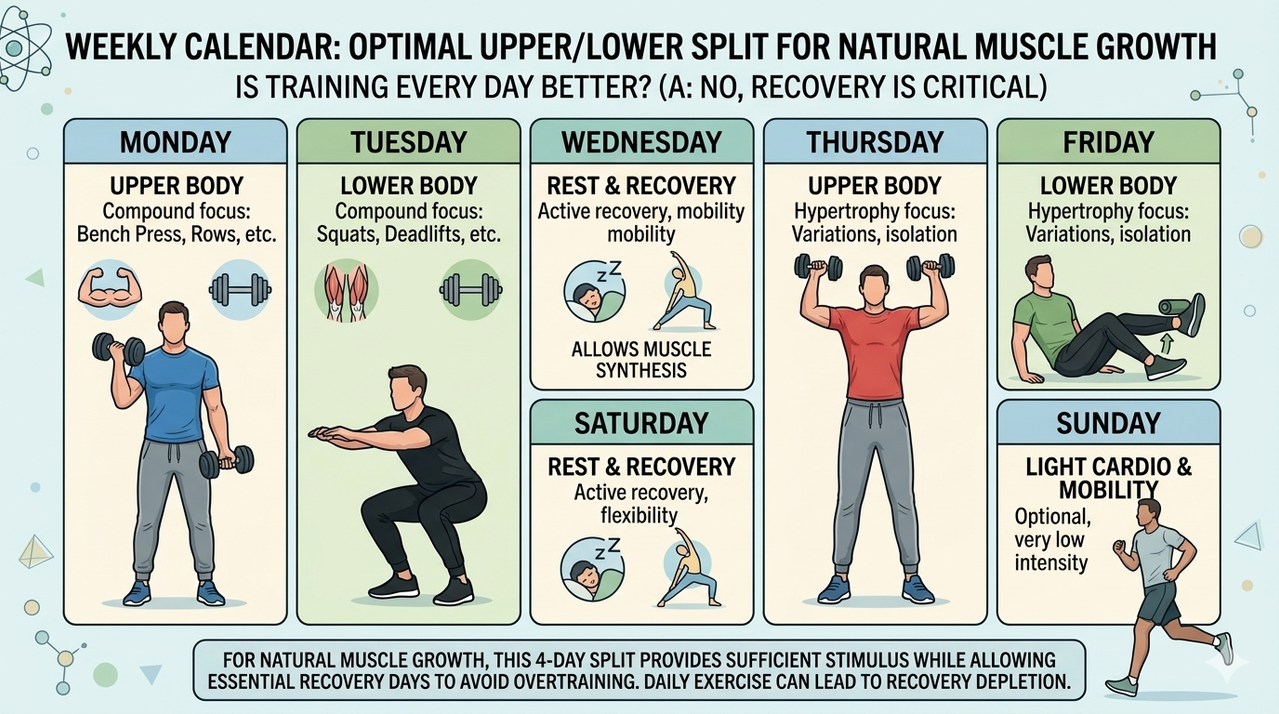
You can train every day—but you cannot train the same muscles every day. By using a split routine, you can hit different muscle groups on different days, ensuring each gets at least 48 hours of recovery, answering is training every day better for natural muscle growth.
4.2. Sample Upper/Lower Split (4 Days/Week)
Monday: Lower Body
Tuesday: Upper Body
Wednesday: Rest
Thursday: Lower Body
Friday: Upper Body
Saturday: Rest or light cardio
Sunday: Rest
4.3. Sample Body-Part Split (5 Days/Week)
Monday: Legs
Tuesday: Chest and Shoulders
Wednesday: Rest
Thursday: Back and Rear Delts
Friday: Calves and Arms
Saturday: Optional light work
Sunday: Rest
5. The Individual Factor: Listen to Your Body
Science provides averages, but individuals vary dramatically. A 2025 study found that only about 32% of individuals displayed an aligned response where the same frequency worked best for both muscle gain and strength, a key insight for is training every day better for natural muscle growth . Some people gained more on high frequency, others on low frequency.
What this means for you: Experiment. Try a 3-day full-body split for 6-8 weeks. Then try a 4-day upper/lower split. Track your progress with measurements, photos, and strength logs. Find what works for your body .
6. Nutrition: Fueling Growth on Any Schedule
6.1. Protein on Training AND Rest Days
Many athletes wonder if they need protein on rest days. The answer is a resounding yes. Muscle protein synthesis remains elevated for 24-48 hours post-workout, and your body needs amino acids to complete the repair process, supporting is training every day better for natural muscle growth .
Spreading protein intake evenly throughout the week—rather than concentrating it on training days—helps maintain a positive protein balance and prevents muscle breakdown .
6.2. How Much Protein?
For active individuals aiming to build muscle, research recommends 1.6–2.2 g per kg of body weight daily (about 0.8-1g per pound) . For a 70kg (154lb) person, that's 112-154g protein per day.

6.3. Sample Meal Plan for Muscle Growth (~2800 kcal, 170g protein)
- Breakfast (7:30 AM): 3 eggs (18g) + 1 cup Greek yogurt (20g) + 1 cup oats (10g) + berries → 48g protein
- Lunch (12:30 PM): 200g chicken breast (45g) + 1 cup quinoa (8g) + roasted vegetables → 53g protein
- Snack (4:00 PM): 1 scoop whey protein (25g) + 1 apple → 25g protein
- Dinner (7:30 PM): 200g salmon (40g) + sweet potato + broccoli → 40g protein
- Evening (10:00 PM): 1 cup cottage cheese (24g) → 24g protein
- Total: ~166g protein
6.4. Vegan Options for Muscle Growth
- Tofu (firm): 150g = 15g protein
- Tempeh: 150g = 20g protein
- Lentils: 1 cup cooked = 18g protein
- Edamame: 1 cup = 18g protein
- Pea protein powder: 1 scoop = 25g protein
- Quinoa: 1 cup cooked = 8g protein (complete protein)
Vegan Muscle-Building Day (~2800 kcal, 150g protein)
- Breakfast: Tofu scramble (200g firm tofu = 20g) + 1 cup oats (10g) + 1 banana → 30g protein
- Lunch: Lentil-quinoa bowl: 1 cup lentils (18g) + 1 cup quinoa (8g) + roasted veggies → 28g protein
- Snack: Edamame 1 cup (18g) + 2 tbsp peanut butter (8g) → 26g protein
- Dinner: Tempeh stir-fry: 200g tempeh (30g) + 1 cup brown rice (5g) + veggies → 35g protein
- Evening: Pea protein shake (25g) + 1 cup soy milk (7g) → 32g protein
- Total: ~151g protein
7. The Recovery Triad: Sleep, Nutrition, and Stress
7.1. Sleep: The Ultimate Anabolic State
During deep sleep, growth hormone is released, and protein synthesis peaks. Research links poor sleep (under 6 hours) to slower muscle repair and reduced strength gains, crucial for is training every day better for natural muscle growth . Aim for 7-9 hours of quality sleep per night.
7.2. Hydration
Even mild dehydration impairs performance and recovery. Drink 2-3 liters of water daily, more if you sweat heavily.
7.3. Active Recovery
On rest days, light activities like walking or mobility work can improve circulation and speed up muscle repair .
8. Common Training Frequency Mistakes
- Mistake #1: Training the same muscles back-to-back. Muscles need at least 48 hours to recover, a key consideration for is training every day better for natural muscle growth .
- Mistake #2: Adding frequency without adjusting volume. If you train more often, reduce volume per session to keep weekly totals appropriate .
- Mistake #3: Ignoring individual response. If you're not progressing on 4 days/week, try 3 days—or vice versa .
- Mistake #4: Sacrificing sleep for training. Recovery is when muscle grows .
- Mistake #5: Dropping protein on rest days. Your muscles still need amino acids for repair .
10. Scientific References
- Onnit. (2025). How Often Should You Lift To Build Muscle? onnit.com. View Source
- NDL Pro-Health. (2025). Protein on rest days? The science behind muscle recovery. ndlprohealth.com. View Source
- Pelland, J.C., et al. (2025). The Resistance Training Dose Response: Meta-Regressions Exploring the Effects of Weekly Volume and Frequency on Muscle Hypertrophy and Strength Gains. Sports Medicine. View Source
- Pelland, J.C., et al. (2025). The Resistance Training Dose Response. PubMed, PMID: 41343037. View Source
- Gonzalez, A.M. (2016). Acute Anabolic Response and Muscular Adaptation After Hypertrophy-Style and Strength-Style Resistance Exercise. Journal of Strength and Conditioning Research, 30(10), 2959-2964. View Source
- Examine.com. (2025). How often should I train to maximize gains in muscle size and strength? examine.com. View Source
- loseit.com. (2025). When Exactly Do Your Muscles Grow After Working Out? loseit.com. View Source
- NIH. (2022). Table 1: Summary of meta-analyses on resistance training variables. PMC, 9302196. View Source
- Dankel, S.J., et al. (2017). Frequency: The Overlooked Resistance Training Variable for Inducing Muscle Hypertrophy? Sports Medicine, 47(5), 799-805. View Source
- Wilson, J.M., et al. (2012). Concurrent Training: A Meta-Analysis Examining Interference of Aerobic and Resistance Exercises. Journal of Strength and Conditioning Research, 26(8), 2293-2307. View Source
All sources last accessed March 2026. Paraphrased for accessibility.
Join the conversation