Signs You Are Actually Gaining Muscle, Not Just Fat
Signs You Are Actually Gaining Muscle, Not Just Fat: A Science-Backed Guide

📋 TL;DR
The scale can't tell muscle from fat—and that's why so many people misread their progress . The #1 sign you are actually gaining muscle, not just fat, is consistent improvement in gym performance (progressive overload) . Other reliable indicators include visible muscle definition with stable waistlines, reduced recovery time, and the fit of your clothes . Muscle growth is slow—most gain only 0.5–2 lbs per month—so patience and tracking multiple metrics are key . This guide breaks down the science and provides actionable nutrition strategies to maximize muscle gain while minimizing fat.
1. The Scale Lies: Why You Need Better Metrics
You're hitting the gym consistently, eating more protein, and watching the scale creep up. But instead of celebrating, you're left wondering: "Am I actually building muscle, or just getting fat?" This is one of the most common frustrations in fitness . The truth is, muscle gain and fat gain can look and feel similar at first—but with the right knowledge, you can learn to tell the difference .
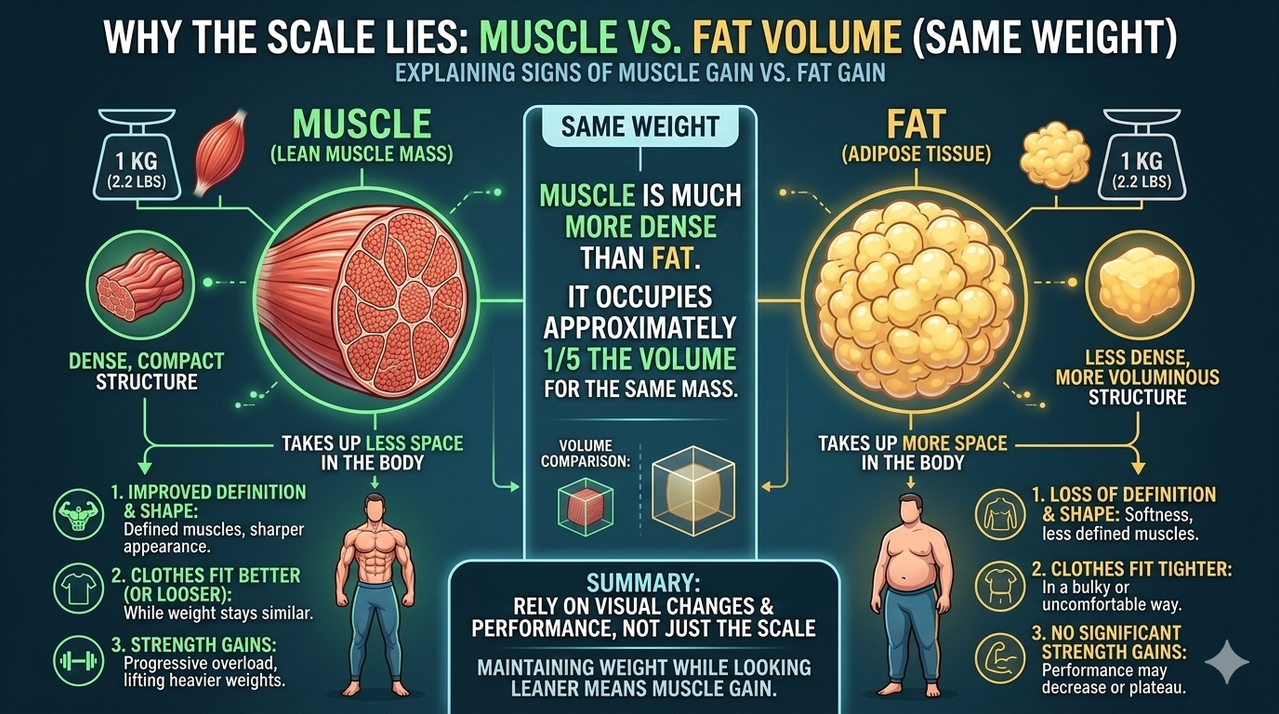
The scale alone is useless here because one pound of muscle weighs the same as one pound of fat—but muscle is much denser . That's why you might actually gain weight while slimming down, especially when starting a new program . "It's definitely not something to be concerned about," says exercise physiologist Joel Seedman, PhD. "It's a good sign that you're doing the right kind of exercises and working out at an intensity that's going to lead to a difference in your body composition" .
This guide will teach you the proven signs you are actually gaining muscle, not just fat, drawing on exercise science and real-world experience.
2. The Science of Muscle Gain vs. Fat Gain
2.1. How Muscle Growth (Hypertrophy) Works
Muscle growth happens when you challenge your muscles through resistance training. Lifting weights creates micro-tears in the muscle fibers, which then repair and grow stronger during recovery . This process, called hypertrophy, requires three key elements :
- Progressive overload: Gradually increasing weight, reps, or intensity
- Caloric surplus (moderate): Extra energy to fuel repair and growth
- Protein synthesis: When muscle protein synthesis exceeds breakdown
Research shows that to optimize hypertrophy, you need resistance training at 70-85% of your one-rep max and sufficient protein intake (1.6-2.2g per kg of body weight daily) .
2.2. How Fat Gain Happens
Fat gain occurs when you consume more calories than your body burns—especially when the surplus is too large or nutrition quality is poor . Excess calories, particularly from processed foods and sugars, are stored as adipose tissue . Hormones like insulin and cortisol also play significant roles; high insulin from poor diet choices can promote fat storage, while chronic stress can lead to abdominal fat gain .
3. 7 Key Signs You Are Actually Gaining Muscle
1. Your Strength Is Consistently Improving
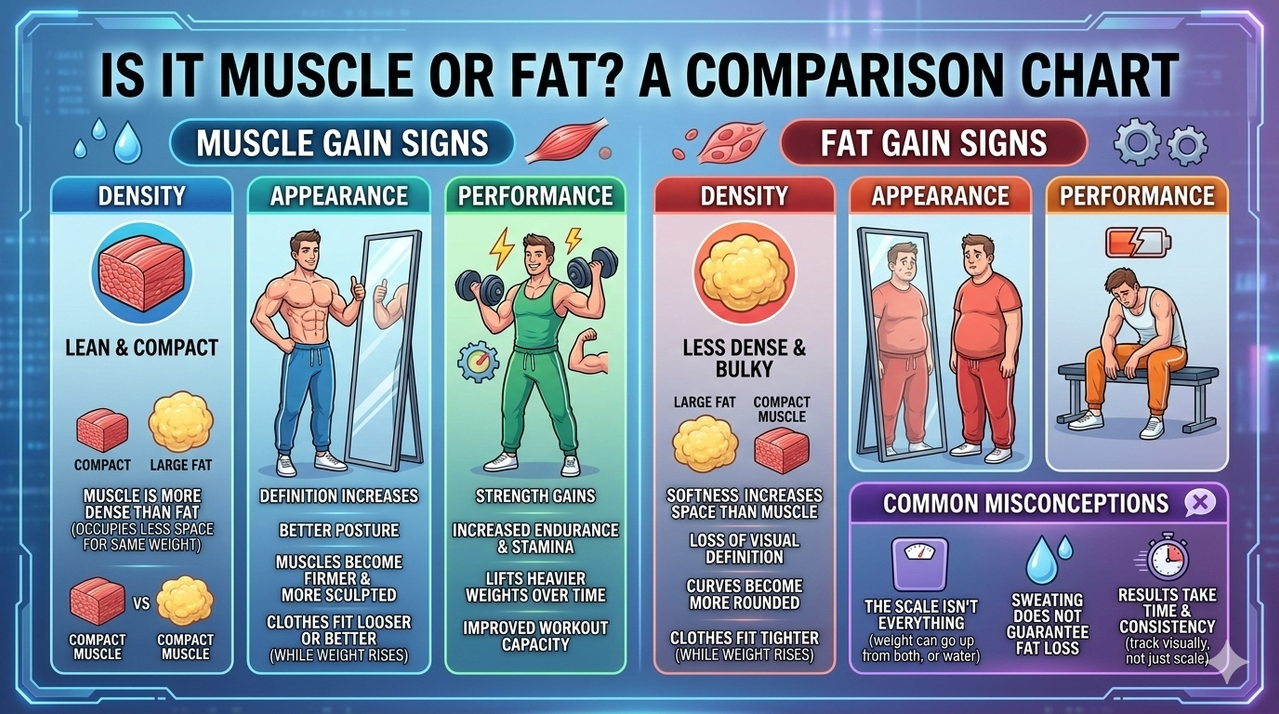
#1 IndicatorThe #1 way to confirm you're building muscle is if your performance in the gym is improving . Are you lifting heavier weights for the same or more reps? Are your rest periods shrinking while your sets stay productive? That's progressive overload in action—the core of muscle gain .
For beginners, strength gains can happen quickly; for advanced lifters, progress slows but still signals adaptation . If your numbers are going up consistently, it's a positive sign of muscle gain .
What to track: Log your lifts weekly. Even small increases in weight or reps matter .
2. Your Body Measurements Are Changing—Especially the Waist
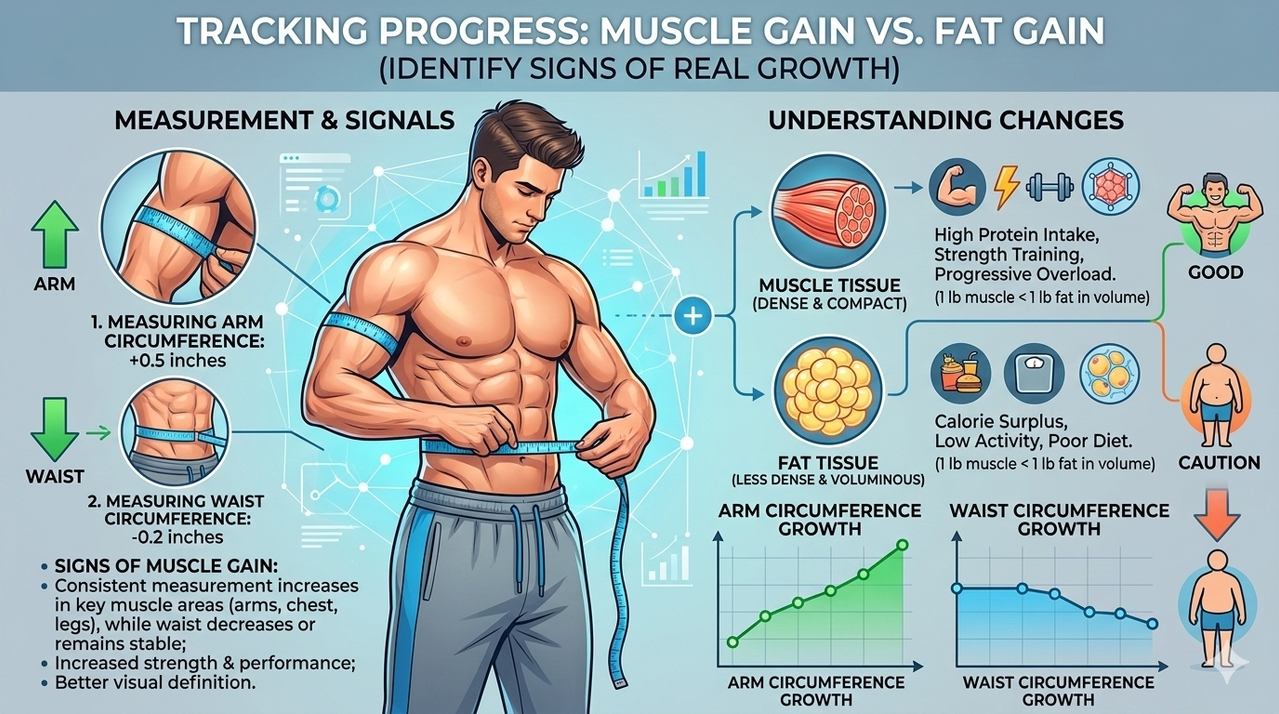
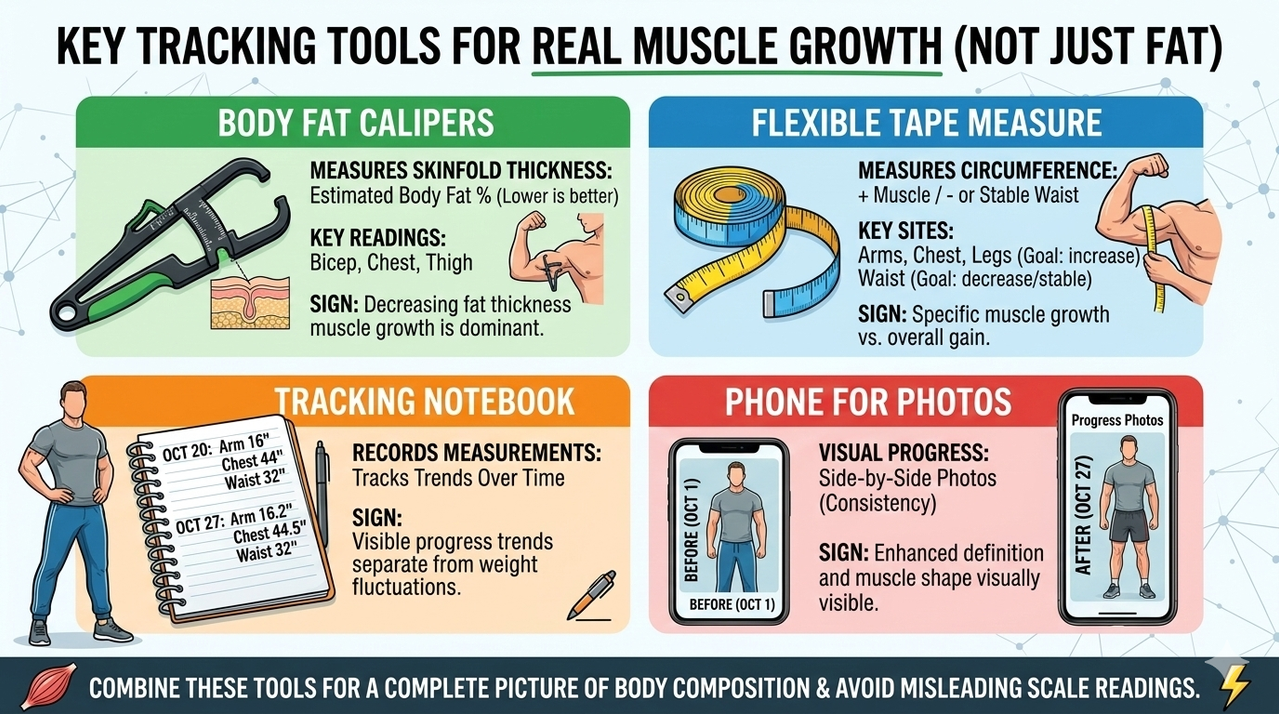
Key MetricWhile the scale might move upward, your body measurements provide more clarity. Muscle gain often leads to increases in size around key muscle groups like chest, arms, thighs, and back, while your waistline might remain stable or shrink slightly . If your arms are getting larger but your waist is staying the same, this is likely muscle gain .
If your waistline is increasing faster than other areas, that could indicate fat storage . Use a tape measure monthly to track areas like biceps, thighs, and waist .
3. You Look Leaner Despite Weighing More
Visual ProofMuscle is denser than fat—so five pounds of muscle spread over the body doesn't give a huge size increase, but if you lose five pounds of fat and gain five pounds of muscle, you're actually losing size . This is why you may notice more definition, vascularity, or visible muscle separation .
Photos taken 6–8 weeks apart, under consistent lighting, are far more telling than daily mirror checks . You might not notice daily changes, but long-term trends become clear with comparisons .
4. Your Clothes Fit Differently
Real-World SignalIf your sleeves are feeling tighter or your shirts are starting to hug your back and shoulders, that's a real-world metric that shouldn't be ignored . Conversely, if your jeans or belts feel tight around the waist but your shirts don't feel tighter around the chest or arms, you might be gaining fat rather than muscle .
5. Your Body Feels Firmer
Tactile SignMuscle tissue is denser and firmer than fat. If your body feels tighter and firmer to the touch, this is a strong indicator of lean muscle gain . Try the pinch test: gently pinch an area like your thighs or arms. If the area feels denser rather than soft, it could indicate muscle growth .
6. You're Less Sore, Recovering Faster
Recovery MarkerIf your muscle soreness (delayed-onset muscle soreness, or DOMS) has decreased and you're recovering faster between workouts, it's a sign your muscles have adapted and become stronger . When muscles become more resilient, they experience less micro-damage from the same stimulus and repair more quickly .
7. Your Appetite Has Increased—But Your Waist Hasn't
Metabolic SignMuscle is metabolically active tissue. As you build more muscle, your resting energy expenditure increases, which can naturally boost your appetite . If you find yourself eating more but not seeing your waistline expand, it's a sign that extra energy is being used to fuel muscle growth rather than stored as fat .
4. Red Flags: Signs You Might Be Gaining Fat
- Your waistline is expanding rapidly: Fat often accumulates first around the abdomen due to insulin and cortisol sensitivity .
- You're not getting stronger: If weight increases but gym performance stagnates or declines, the extra weight is likely fat .
- Clothes feel tight in the wrong places: Tightness around belly, hips, and thighs without corresponding upper body growth suggests fat gain .
- Energy fluctuates: Sluggishness after meals or throughout the day often accompanies fat gain from poor food choices .
- Weight gain is too rapid: Gaining more than 1-2 pounds per week during a bulk usually means the surplus is excessive .
5. Nutrition: Fueling Muscle Gain Without Excess Fat
5.1. Protein: The Non-Negotiable
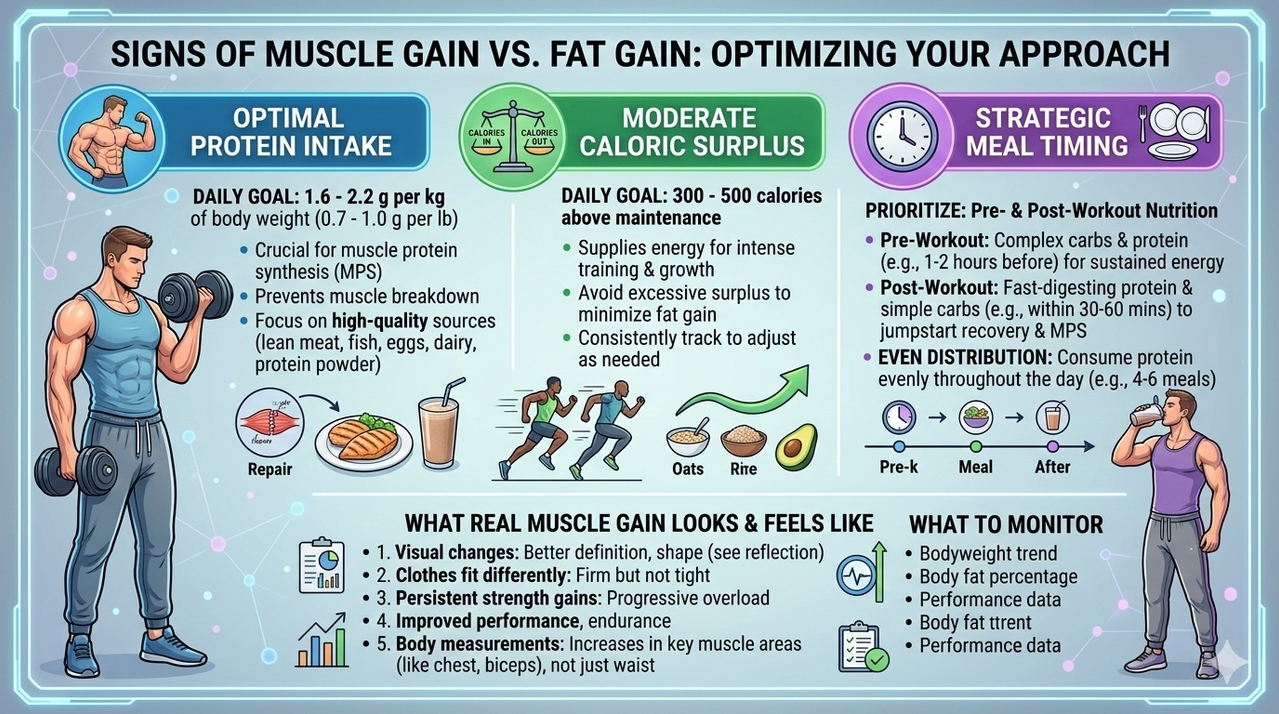
Research shows that to optimize muscle growth, you need 1.6-2.2 grams of protein per kilogram of body weight daily . A 2023 study found that higher protein intake is necessary for athletes attempting to lose fat while maintaining muscle . Spread protein evenly across 3-4 meals to maximize muscle protein synthesis .
| Body Weight | Daily Protein (1.6g/kg) | Daily Protein (2.2g/kg) |
|---|---|---|
| 60 kg (132 lbs) | 96 g | 132 g |
| 70 kg (154 lbs) | 112 g | 154 g |
| 80 kg (176 lbs) | 128 g | 176 g |
| 90 kg (198 lbs) | 144 g | 198 g |
5.2. Caloric Surplus: How Much Is Enough?
To build muscle, you need extra energy—but too much leads to fat gain. Aim for a moderate surplus of 250-500 calories above maintenance . A four-week trial showed that men in a 40% deficit on high protein still gained lean mass, proving protein's power . But for optimal growth without excess fat, stick to the moderate surplus .
5.3. Sample Meal Plan for Muscle Gain (~2800 kcal, 160g protein)
- Breakfast: 3 eggs (18g) + 1 cup oatmeal (10g) + 1 cup milk (8g) + 1 tbsp peanut butter (4g) → 40g protein
- Lunch: 170g chicken breast (40g) + 1 cup quinoa (8g) + 1 cup roasted vegetables → 48g protein
- Snack: 1 cup Greek yogurt (20g) + 1 apple + 10 almonds (3g) → 23g protein
- Dinner: 170g salmon (35g) + 1 medium sweet potato (3g) + 1 cup broccoli → 38g protein
- Evening: 1 cup cottage cheese (24g) + berries → 24g protein
- Total: ~173g protein
5.4. Vegan Muscle-Building Options
- Tofu (firm): 150g = 15g protein
- Tempeh: 150g = 20g protein
- Lentils: 1 cup cooked = 18g protein
- Seitan (if not gluten-free): 100g = 25g protein
- Pea protein powder: 1 scoop = 25g protein
- Quinoa: 1 cup cooked = 8g protein (complete protein)
- Edamame: 1 cup = 18g protein
5.5. Gluten-Free Adaptations
- Replace wheat-based grains with quinoa, buckwheat, certified gluten-free oats, rice.
- All natural protein sources (meat, fish, eggs, dairy, legumes, tofu) are naturally gluten-free.
6. How to Track Progress Accurately
6.1. Body Composition Measurements
- Skinfold calipers: A traditional method that measures fat at multiple sites (3-7 sites is most accurate) . A seven-site test can also give clues about hormones .
- Bioelectrical impedance scales: Convenient but less accurate than calipers or DEXA.
- DEXA scans: The gold standard for body composition, though expensive .
- Lean body mass calculation: Use your body fat percentage to calculate lean mass changes .
6.2. The Lean Mass Calculation Method
Cathe Friedrich explains this simple method :
- Weigh yourself (first thing in the morning, after urinating).
- Get your body fat percentage (via calipers or other method).
- Calculate fat weight: Total weight × body fat % = fat weight.
- Subtract fat weight from total weight = lean body mass (muscle, bone, water).
Example: 130 lbs at 20% body fat = 26 lbs fat. 130 - 26 = 104 lbs lean mass. If months later you're 128 lbs at 18% fat = 23 lbs fat. 128 - 23 = 105 lbs lean mass. You gained 1 lb of lean mass .
6.3. Take Progress Photos
Visual evidence over time can reveal subtle changes in muscle definition that the scale misses . Take photos every 4-6 weeks in consistent lighting and angles .
6.4. Track Strength Gains
Keep a log of your lifts—increases in strength often correlate with muscle growth .
7. Quick High-Protein Recipes (Under 10 Minutes)
1. Greek Yogurt Power Bowl
28g protein1 cup Greek yogurt + 1 tbsp peanut butter + 1 tbsp chia seeds + berries. (~28g protein)
2. Microwave Scrambled Eggs
22g protein3 eggs + splash of milk, microwave 2 min, stir, add cheese. (~22g protein)
3. Tuna Salad Rice Cakes
28g protein1 can tuna + 2 tbsp Greek yogurt + mustard + celery. Serve on rice cakes. (~28g protein)
4. Peanut Butter Banana Smoothie
20g protein1 banana + 2 tbsp peanut butter + 1 cup milk + ice. (~20g protein)
5. Cottage Cheese Bowl
24g protein1 cup cottage cheese + cherry tomatoes + black pepper. (~24g protein)
8. Recovery: The Overlooked Growth Factor
Muscle is built outside the gym, during rest .
8.1. Sleep Quality
If you notice you're sleeping better and waking more refreshed, it's a sign your body is recovering and growing . Deep sleep is when growth hormone is released, supporting muscle repair . Aim for 7-9 hours .
8.2. Active Recovery
Non-exercise activity thermogenesis (NEAT)—like walking—helps burn calories without additional stress . Aim for 8,000-10,000 steps daily .
9. Realistic Expectations: How Fast Does Muscle Grow?
Muscle gain is slow—and that's normal . Most natural trainees can expect :
- Beginners: 1-2 pounds of muscle per month
- Intermediate lifters: 0.5-1 pound per month
- Advanced lifters: 0.2-0.5 pound per month
If your weight gain matches these rates and you're seeing other signs, you're on the right track. Rapid increases usually indicate fat accumulation .
10. Common Mistakes When Tracking Progress
- Mistake #1: Relying only on the scale. The scale can't distinguish between muscle, fat, and water .
- Mistake #2: Equating soreness with growth. Soreness reflects novel stimulus, not actual adaptation . If you're always sore but not improving, you're overemphasizing fatigue .
- Mistake #3: Ignoring early neural adaptations. Early strength gains come from better neuromuscular coordination, not muscle size—but this still leads to growth later .
- Mistake #4: Comparing yourself to social media. Most posts don't show the full reality of slow, steady progress.
- Mistake #5: Expecting linear progress. You won't PR every week; look for long-term trends .
12. Scientific References
- PP Sports. (2025). 肌肉正在生长的 5 个表现. PP Sports. View Source
- Scilit. (2002). Development of Body Modification and Excessive Exercise Scales for adolescents. Assessment. View Source
- RP Strength. (2025). Are You Actually Gaining Muscle? Here's How to Know. RPSTRENGTH.com. View Source
- Prevention. (2018). So Does Muscle Weigh More Than Fat, or What? Prevention.com. View Source
- PP Sports. (2025). 5 个迹象表明你的肌肉正在生长. PP Sports. View Source
- Men's Health UK. (2026). Yes, You Can Build Muscle and Burn Fat at the Same Time. Men's Health. View Source
- Journal of Translational Medicine. (2025). Biomarkers for sarcopenia, muscle mass, muscle strength, and physical performance. Springer. View Source
- BOXROX. (2025). Are You Building Muscle or Getting Fat? This Is How You Know. BOXROX.com. View Source
- Cathe Friedrich. (2017). How Do You Know if You're Gaining Muscle When You Strength Train? Cathe.com. View Source
- Optum Now. (2023). Body Recomposition: Lose Fat and Gain Muscle at the Same Time. Optum.com. View Source
All sources last accessed March 2026. Paraphrased for accessibility.
Join the conversation