Solving the Skinny-Fat Look: Should You Cut or Bulk First?
Solving the Skinny-Fat Look: Should You Cut or Bulk First?

⚖️ TL;DR
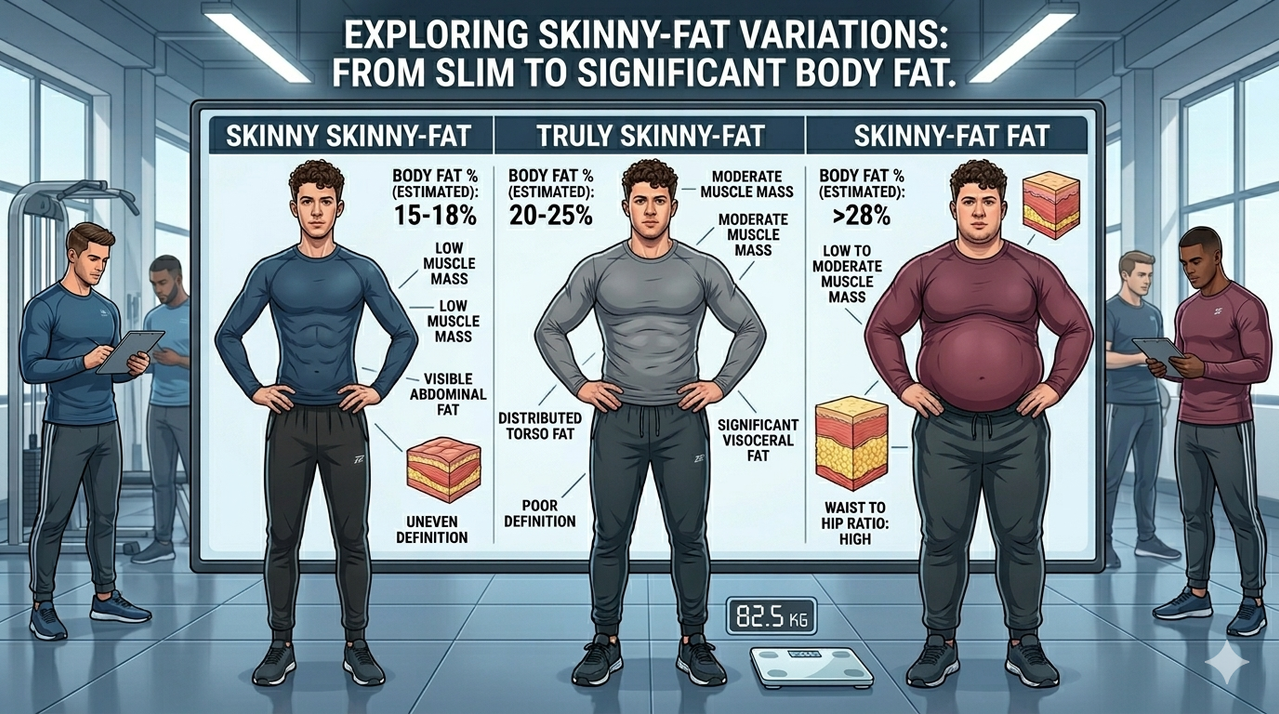
If you're solving the skinny-fat look: should you cut or bulk first?, the answer is not one-size-fits-all. Research and coaching experts categorize skinny-fat individuals into three groups based on body fat percentage .
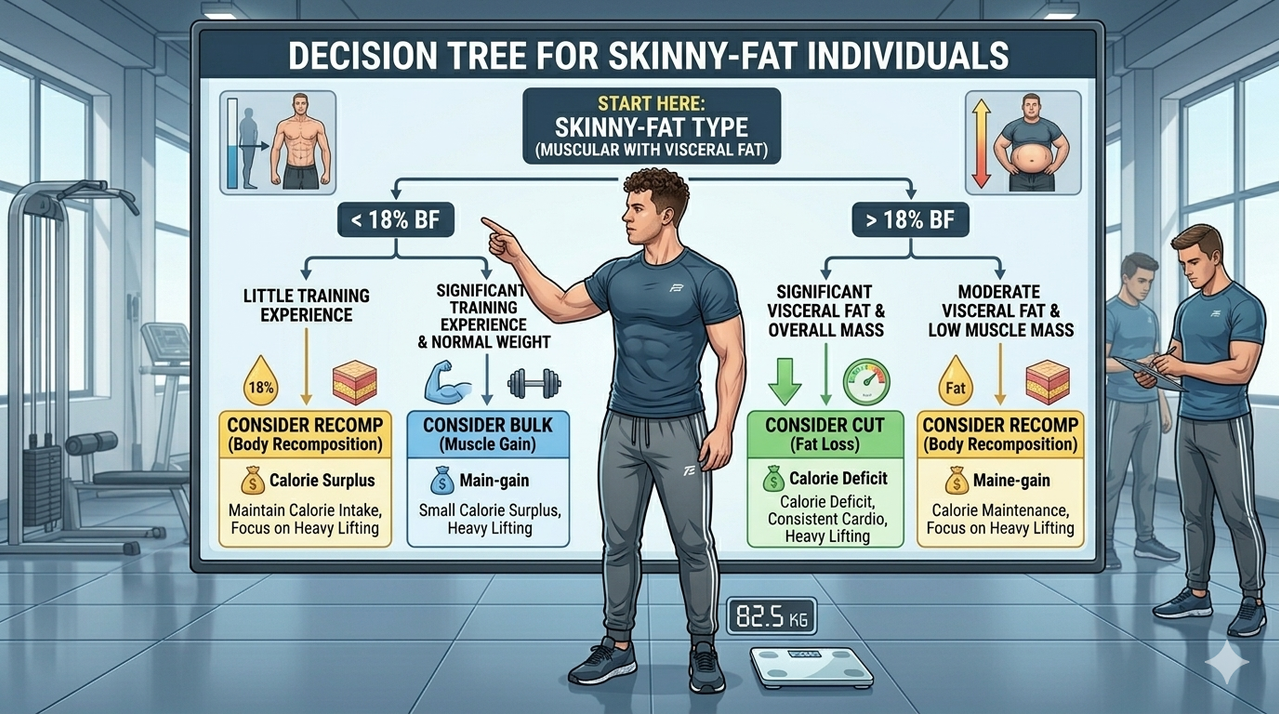
- 👉 Skinny-Fat Fat (Body Fat >20% men / >30% women): Cut first. Get down to ~15% body fat before considering a bulk to avoid stretch marks, fat cell multiplication, and metabolic issues .
- 👉 Truly Skinny-Fat (Body Fat 15-20% men / 25-30% women): Body recomp (maintenance calories). Build muscle and lose fat simultaneously by eating at maintenance with high protein .
- 👉 Skinny Skinny-Fat (Body Fat <15% men / <25% women): Lean bulk first. Run a small surplus (200-300 kcal) to gain muscle without excessive fat .
This guide provides the exact calculations, sample meal plans (including vegan options), and training templates for each path.
1. The Skinny-Fat Paradox: Neither Skinny nor Fat
You look thin in clothes, but without them, there's a softness—especially around the midsection. You have no muscle definition, yet you're not overweight. This is the classic "skinny-fat" physique, medically known as Normal Weight Obesity or TOFI (Thin Outside, Fat Inside) .
The paradox creates a dilemma: if you bulk, you risk getting fatter. If you cut, you might just become a smaller version of the same soft shape. This is why solving the skinny-fat look: should you cut or bulk first? is the most critical question for this body type. The answer isn't willpower—it's physiology. Your decision must be based on your current body fat percentage, not how you feel in the mirror .
2. The Science: Why Skinny-Fat is a Metabolic Red Flag
2.1. Normal Weight Obesity
Having a "normal" BMI but high body fat percentage is associated with significant health risks. Research shows that individuals with normal-weight obesity have higher rates of insulin resistance, metabolic syndrome, and cardiovascular issues compared to those with healthy body composition . This is because visceral fat—the fat stored around your organs—is metabolically active and pro-inflammatory .
2.2. The Muscle-Fat Imbalance
The skinny-fat physique is characterized by low muscle mass and high body fat. This combination slows your resting metabolic rate because muscle is metabolically expensive tissue . Without enough muscle, your body burns fewer calories at rest, making fat loss harder over time . This is why building muscle is essential for long-term weight management .
2.3. The Cortisol Connection
Chronic stress elevates cortisol, a hormone that promotes fat storage—especially around the midsection—while also breaking down muscle tissue . The skinny-fat look is often exacerbated by high-stress lifestyles, poor sleep, and lack of resistance training .
3. Step 1: Find Your Body Fat Percentage
3.1. The Navy Method Formula
To decide your path, you need an estimate of your body fat. The U.S. Navy method is a practical, free approach using a tape measure . Here's the simplified formula for men:
- Measure your neck circumference at its narrowest point.
- Measure your abdomen at the level of your navel.
- Measure your height.
- Use this formula:
86.010 × log(abdomen - neck) - 70.041 × log(height) + 36.76.
For women, you also need hip measurement at the widest point. Alternatively, use an online calculator or consider DEXA scans for accuracy .
3.2. Interpreting Your Numbers
For men: Optimal health range is 10-15% body fat. Athletic range is 6-13% .
For women: Optimal health range is 19-23% body fat. Athletic range is 14-20% .
Now, let's categorize your skinny-fat status :
- Skinny Skinny-Fat: Men <15% / Women <25% — Low muscle, not much excess fat.
- Truly Skinny-Fat: Men 15-20% / Women 25-30% — Moderate fat, low muscle.
- Skinny-Fat Fat: Men >20% / Women >30% — Significant fat, very little muscle.
| Category | Men Body Fat | Women Body Fat | Recommended First Step |
|---|---|---|---|
| Skinny Skinny-Fat | <15% | <25% | Lean Bulk |
| Truly Skinny-Fat | 15-20% | 25-30% | Body Recomposition |
| Skinny-Fat Fat | >20% | >30% | Cut First |
4. Path 1: Cut First (For Skinny-Fat Fat)
4.1. Why Cut First?
If you have significant body fat (>20% men / >30% women), bulking would only add more fat, potentially leading to stretch marks, fat cell multiplication, and making it harder to get lean later . The priority is to reduce body fat to a healthier baseline (around 15% men / 25% women) before focusing on muscle gain .
4.2. The Cut Protocol
- Calories: Moderate deficit of 300-500 below TDEE. Aim to lose 0.5-1 lb per week .
- Protein: High intake: 1.8-2.2 g per kg of body weight to preserve muscle .
- Training: 3-4 strength sessions per week (full body) + 2-3 LISS cardio sessions for added deficit .
- Duration: 8-12 weeks, or until you reach ~15% body fat .
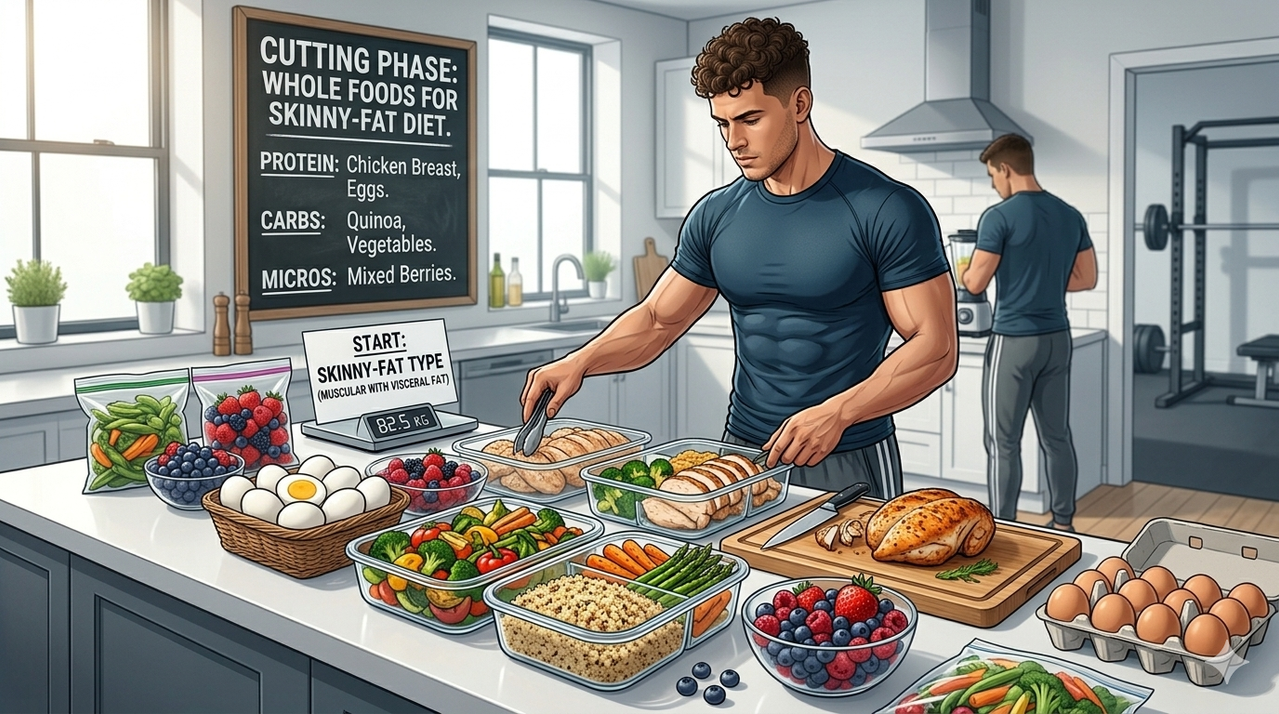
4.3. Sample 2200-Calorie Cut Day (for 80 kg male)
- Meal 1: 3 eggs + 1 cup spinach + 1 slice whole-grain toast. (350 kcal, 25g protein)
- Meal 2: 1 scoop whey protein + 1 cup mixed berries. (200 kcal, 25g protein)
- Meal 3: 150g grilled chicken breast + 2 cups mixed veggies + 1 tbsp olive oil. (400 kcal, 35g protein)
- Meal 4 (Pre-Workout): 1 apple + 1 tbsp almond butter. (200 kcal, 5g protein)
- Meal 5 (Post-Workout): 150g lean fish + 1 cup broccoli + ½ cup brown rice. (350 kcal, 30g protein)
- Meal 6: 1 cup Greek yogurt (non-fat). (150 kcal, 20g protein)
- Total: ~2,200 kcal, ~140g protein
5. Path 2: Body Recomposition (For Truly Skinny-Fat)
5.1. The Power of Maintenance
If you're in the middle range (15-20% men / 25-30% women), you're in the "sweet spot" for body recomposition—gaining muscle and losing fat simultaneously . This is sometimes called "maingaining" or "culking" . Because you have both fat to lose and muscle to gain, your body can reallocate energy stores .
5.2. The Recomposition Protocol
- Calories: Eat at maintenance (TDEE) on average. Some coaches cycle calories: slightly above on training days, slightly below on rest days .
- Protein: Very high: 2.0-2.4 g per kg body weight to support both muscle synthesis and satiety .
- Training: Heavy compound lifts 3-4x/week with progressive overload. Focus on performance .
- Cardio: Minimal. 2-3 LISS sessions (30 min) or increase NEAT (steps) to 8,000-10,000 daily .
5.3. Sample 2600-Calorie Recomp Day (Maintenance)
- Meal 1: 3 eggs + 1 cup oatmeal + 1 tbsp peanut butter. (500 kcal, 30g protein)
- Meal 2: 1 cup Greek yogurt + ½ cup berries + 1 oz walnuts. (300 kcal, 20g protein)
- Meal 3: 200g chicken thighs + 1 cup quinoa + roasted veggies. (600 kcal, 45g protein)
- Meal 4 (Pre-Workout): 1 banana + 1 scoop protein. (250 kcal, 25g protein)
- Meal 5 (Post-Workout): 200g salmon + 1 large sweet potato + 1 tbsp butter. (700 kcal, 40g protein)
- Meal 6 (Optional): 1 cup cottage cheese. (200 kcal, 25g protein)
- Total: ~2,550 kcal, ~185g protein
6. Path 3: Lean Bulk First (For Skinny Skinny-Fat)
6.1. Why Bulk?
If you're already relatively lean (<15% men / <25% women) but lack muscle, a traditional "cut" would leave you looking emaciated . Your priority is building muscle tissue. However, a lean bulk (small surplus) is superior to a dirty bulk to minimize fat gain .
6.2. The Lean Bulk Protocol
- Calories: Small surplus of 200-300 above TDEE. Aim to gain no more than 0.5-1% of body weight per month .
- Protein: 1.6-2.2 g per kg body weight .
- Training: Progressive overload on compound lifts. Focus on getting stronger in the 6-10 rep range.
- Duration: Run this for at least 6 months, then do a short cut (8-12 weeks) to reveal the new muscle .
6.3. Sample 3000-Calorie Lean Bulk Day (for 70 kg male)
- Breakfast: 3 eggs + 1.5 cups oats + 1 cup whole milk. (650 kcal, 40g protein)
- Snack: 1 cup Greek yogurt + 1 oz almonds + 1 tbsp honey. (400 kcal, 20g protein)
- Lunch: 200g lean beef + 1.5 cups rice + 1 tbsp olive oil. (700 kcal, 45g protein)
- Pre-Workout: 1 banana + 2 rice cakes + 1 tbsp peanut butter. (300 kcal, 8g protein)
- Post-Workout Shake: 2 scoops whey + 1 cup milk + ½ cup oats. (500 kcal, 50g protein)
- Dinner: 200g chicken thighs + 1 cup quinoa + roasted veggies. (600 kcal, 45g protein)
- Evening: 1 cup cottage cheese. (200 kcal, 25g protein)
- Total: ~3,350 kcal, ~230g protein
7. The Training Engine: 3-Day Full Body Template
7.1. Why Full Body?
For skinny-fat individuals, a 3-day full body routine is ideal. It maximizes frequency for each muscle group (stimulating growth 3x/week) while allowing adequate recovery . It also elevates metabolism more than a split .
7.2. The Core Lifts
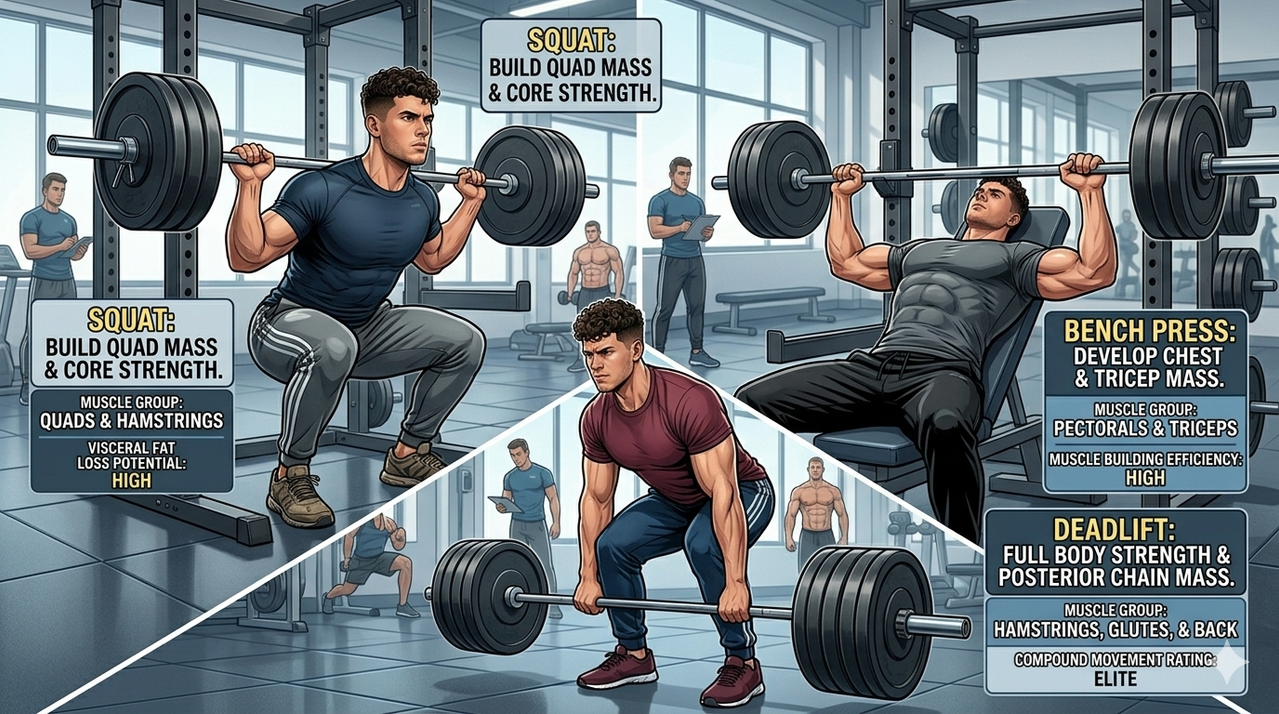
Focus on compound movements that recruit the most muscle mass :
- Squats (or leg press)
- Deadlifts (or Romanian deadlifts)
- Bench Press (or dumbbell press)
- Overhead Press
- Bent-Over Rows
- Pull-ups/Lat Pulldowns
7.3. Sample 3-Day Full Body Workout
- Day 1 (Monday): Squat 3x8-10, Bench Press 3x8-10, Bent Row 3x8-10, Plank 3x45s.
- Day 2 (Wednesday): Deadlift 3x5, Overhead Press 3x8-10, Pull-ups 3xMax, Hanging Leg Raise 3x10.
- Day 3 (Friday): Front Squat 3x8-10, Incline Press 3x8-10, Lat Pulldown 3x10-12, Farmer's Walk 3x30s.
Apply progressive overload: aim to add weight or reps each week .
8. Nutrition: The Macronutrient Breakdown
8.1. Protein: The Foundation
Regardless of your path, protein is paramount. Aim for 1.8-2.2 g per kg of body weight daily . This ensures muscle preservation during a cut and muscle synthesis during a bulk.
8.2. Carbohydrates: Fuel for Performance
Carbs should be timed around workouts. On training days, consume more carbs pre- and post-workout. On rest days, reduce carbs slightly and replace with extra veggies . Focus on whole-food sources: oats, rice, potatoes, quinoa, fruits.
8.3. Fats: Hormonal Health
Don't drop fats too low. Aim for 20-30% of total calories from healthy fats (avocado, nuts, olive oil, fatty fish). This supports testosterone production and overall health .
Sample Macronutrient Targets (for 75 kg person)
- Cut: 2,200 kcal: Protein 165g (30%), Carbs 220g (40%), Fat 73g (30%).
- Recomp: 2,600 kcal: Protein 180g (28%), Carbs 300g (46%), Fat 75g (26%).
- Lean Bulk: 3,000 kcal: Protein 180g (24%), Carbs 380g (51%), Fat 83g (25%).
8.4. Vegan/Vegetarian Options
- Protein Sources: Tofu, tempeh, seitan, lentils, chickpeas, edamame, pea protein, vegan yogurt.
- High-Calorie Shake for Bulking: 1 cup soy milk, 1 banana, 2 tbsp peanut butter, 1 scoop pea protein, ¼ cup oats.
- Cutting-Friendly Meal: Tofu scramble with spinach, mushrooms, and black beans.
9. Common Mistakes That Keep You Skinny-Fat
- Mistake #1: Only Doing Cardio. Cardio without resistance training burns muscle and leaves you "smaller but still soft" .
- Mistake #2: Yo-Yo Dieting. Severe calorie restriction leads to muscle loss, slowing metabolism and reinforcing the skinny-fat cycle .
- Mistake #3: Not Eating Enough Protein. Even if calories are correct, insufficient protein means lost muscle .
- Mistake #4: Chronic Cardio. Too much steady-state cardio can interfere with strength recovery and muscle growth .
- Mistake #5: Inconsistent Training. Random workouts without progressive overload yield random results .
11. Scientific References
- Gaspari Nutrition. (2019). Should I Build Muscle Or Lose Weight First? gasparinutrition.com. View Source
- Apollo 24|7. (2026). How To Reduce Skinny Fat? apollo247.com. View Source
- BOXROX. (2023). Bulk vs Cut: Which Should You Do if You're Skinny Fat? boxrox.com. View Source
- Apollo 24|7. (2025). How to Reduce Skinny Fat: A Simple Guide to a Healthier You. apollo247.com. View Source
- Apollo Pharmacy. (2025). Fix Skinny Fat for Indian Men: Build Muscle & Lose Belly Fat. apollopharmacy.in. View Source
- Men's Health. (2018). How to Cut Fat and Gain Muscle at the Same Time. menshealth.com. View Source
- THIP Media. (2025). How to get rid of skinny fat: Addressing the skinny fat body type. thip.media. View Source
- GQ. (2025). How to Properly Bulk, Cut, and Eliminate Fatigue in the Gym. gq.com. View Source
- Power Plate. (2025). How to Quickly Get Rid of Skinny Fat. powerplate.com. View Source
- Onnit. (2025). No Nonsense Shredded Diet Plan. onnit.com. View Source
Join the conversation