The Best Bodyweight Exercises for a Stronger Lower Back
The Best Bodyweight Exercises for a Stronger Lower Back

📋 TL;DR
A stronger lower back is essential for posture, injury prevention, and athletic performance. The key muscles—erector spinae, quadratus lumborum, and multifidus—are designed for endurance and stability, not just brute force . Research shows that training these muscles with bodyweight exercises that emphasize control and time under tension can be highly effective . This guide covers the best bodyweight exercises for a stronger lower back, including the Superman, Bird Dog, Glute Bridge, and Cat-Camel, with progressions, sample workouts, and nutrition strategies to support recovery.
1. Why Lower Back Strength Matters
Your lower back is the central pillar of your body. It supports your spine during every bend, lift, twist, and step you take. When these muscles are weak, posture suffers, and injury risk skyrockets . The muscles of the lower back—particularly the erector spinae, quadratus lumborum, and multifidus—are designed for endurance and stability, which is why the best bodyweight exercises for a stronger lower back are so important .
Research from the Canadian Centre for Occupational Health and Safety suggests that muscle endurance may be even more protective against low back injury than sheer strength . This makes bodyweight exercises, which emphasize time under tension and muscular control, an ideal choice for building a resilient lower back.
This guide will teach you the best bodyweight exercises for a stronger lower back, explain the anatomy behind them, and provide sample workouts to integrate into your routine.
2. The Anatomy of a Strong Lower Back
2.1. Key Muscles Explained
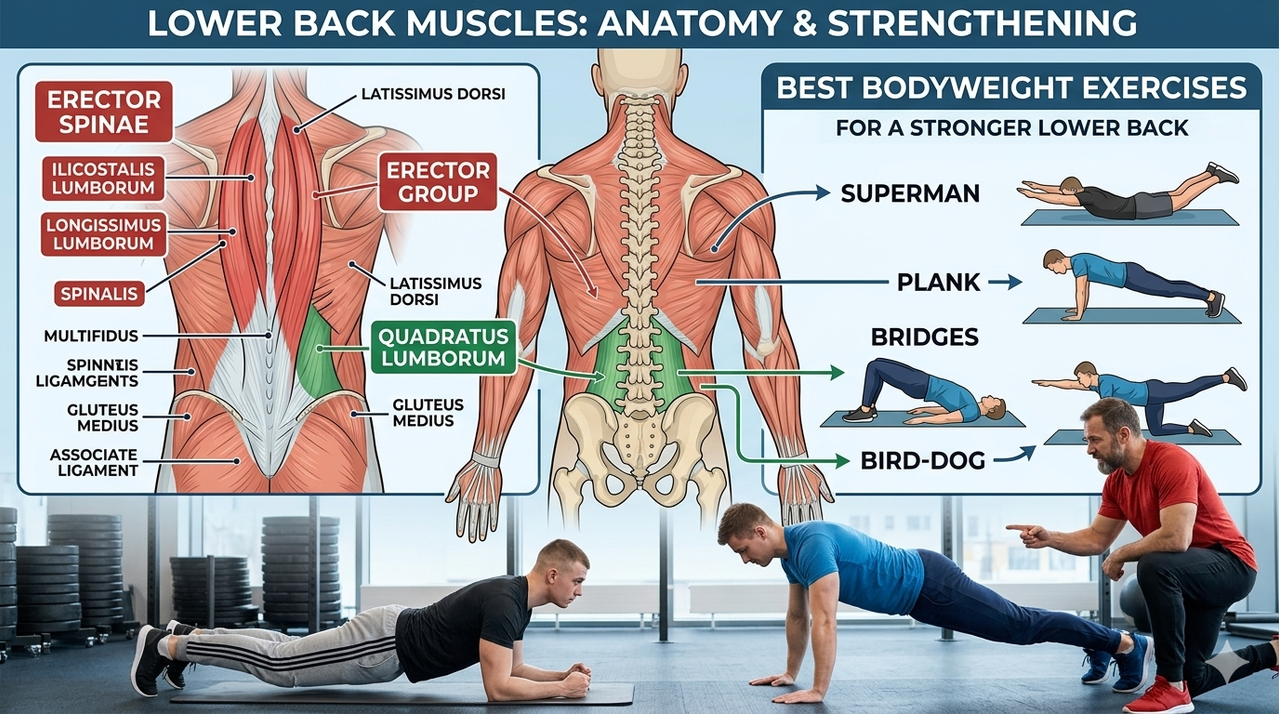
Understanding the muscles you're training helps you target them effectively, which is key for the best bodyweight exercises for a stronger lower back :
- Erector Spinae: A large group of muscles running from your lower spine to your neck. The lumbar-specific portions (iliocostalis lumborum and longissimus thoracis) are prime movers for extending the spine (bending backward) .
- Multifidus: Deep muscles that provide segmental stability to the spine. They are crucial for controlling movement between individual vertebrae .
- Quadratus Lumborum (QL): A deep muscle connecting the hip to the lumbar vertebrae. It stabilizes the spine and helps with lateral bending .
- Glutes and Hamstrings: These posterior chain muscles work synergistically with the lower back. A strong lower back requires strong glutes .
2.2. Extensors, Flexors, and Obliques
The lower back muscles are categorized into three groups based on function :
- Extensors (Back): Help bend the spine backward and maintain upright posture .
- Flexors (Front): Including the psoas major, help bend the trunk forward .
- Obliques (Sides): Work with abdominal muscles to rotate and side-bend the trunk .
All three groups must work in balance for a healthy, pain-free back.
3. The 7 Best Bodyweight Exercises for a Stronger Lower Back
1. Superman (Prone Extension)
Fundamental StrengthTarget: Erector spinae, glutes, hamstrings, making it one of the best bodyweight exercises for a stronger lower back .
How to do it: Lie face down with arms extended overhead. Lift your arms, chest, and legs off the floor simultaneously, keeping your neck neutral. Hold for 2-3 seconds at the top, then lower with control .
Key cue: Think about lengthening your body, not just lifting as high as possible. Imagine reaching through your fingertips and toes.
Progression: Hold for longer durations (15-30 seconds) or perform alternating arm/leg lifts.
2. Bird Dog
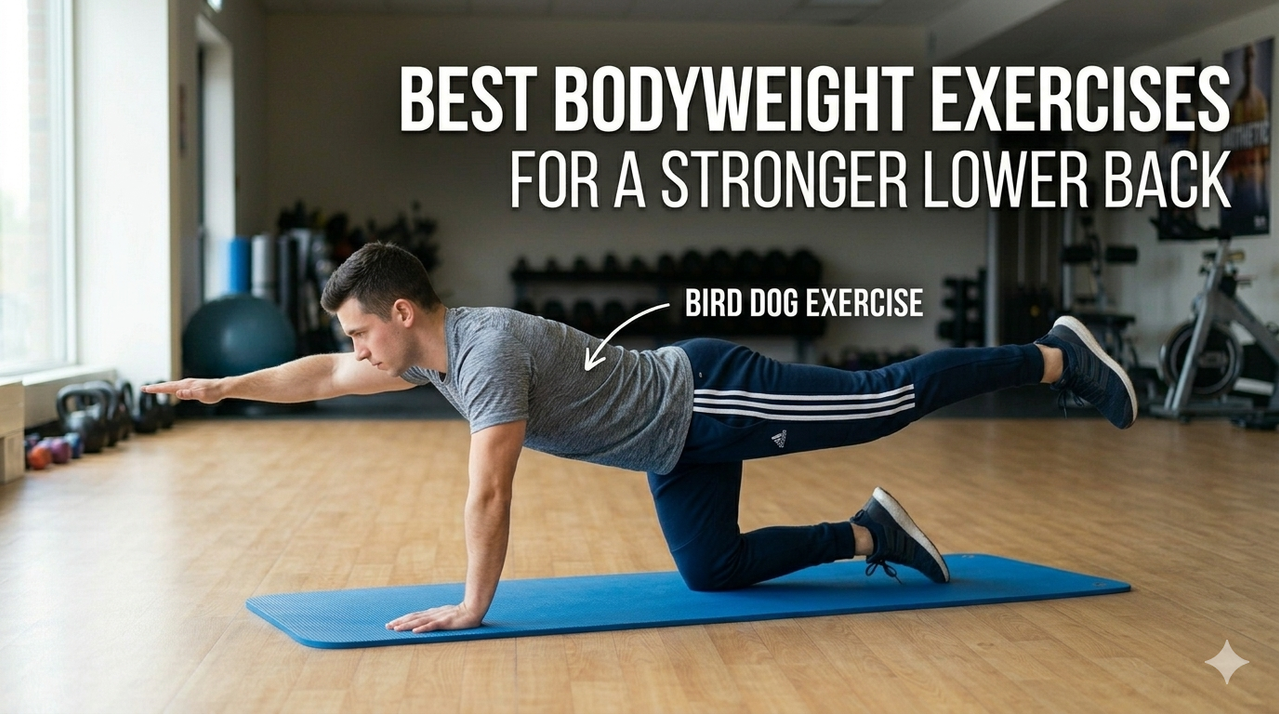
Stability & ControlTarget: Multifidus, core stabilizers, glutes, essential for the best bodyweight exercises for a stronger lower back .
How to do it: Start on all fours with a flat back. Extend one arm forward and the opposite leg back, keeping hips and shoulders square. Hold for 2-3 seconds, then return to start. Alternate sides .
Key cue: Imagine balancing a glass of water on your lower back—don't let it spill.
Progression: Increase hold time, or draw slow circles with your extended limbs .
3. Glute Bridge
Posterior Chain IntegrationTarget: Glutes, hamstrings, lower back .
How to do it: Lie on your back with knees bent and feet flat. Lift your hips toward the ceiling, squeezing your glutes at the top. Hold for 2 seconds, then lower .
Key cue: Drive through your heels and avoid overarching your lower back.
Progression: Single-leg bridges, or elevate your feet on a surface.
4. Cat-Camel Stretch
Mobility & ActivationTarget: Spinal mobility, paraspinal muscles, core .
How to do it: On all fours, slowly round your back toward the ceiling (cat), then let your belly sink and lift your head (camel). Move with your breath .
Key cue: Initiate the movement from your pelvis and let it flow through your spine.
Benefit: This dynamic movement warms up the spine and improves flexibility before strength work.

5. Reverse Snow Angels
Upper Back & PostureTarget: Upper back extensors, rhomboids, rear delts .
How to do it: Lie face down with arms at your sides. Lift your chest slightly and sweep your arms outward and overhead in a controlled motion, squeezing your shoulder blades. Reverse the motion to return .
Key cue: Keep your arms straight and focus on the feeling of your upper back working.
6. Arm Haulers
Full Back IntegrationTarget: Erector spinae, posterior deltoids, rhomboids, lats .
How to do it: Lie face down, lift your chest and legs slightly. Place hands behind your back, palms up. Slowly sweep arms out wide and overhead, keeping them straight and elevated. Reverse the motion .
Key cue: Maintain full-body tension throughout; think of reaching your hands toward your feet as they sweep back .
Benefits: Promotes spinal stability, shoulder resilience, and counteracts desk posture .
7. Tabletop Reverse Plank
Full Posterior ChainTarget: Lower back, glutes, hamstrings, shoulders .
How to do it: Sit with hands behind you, fingers pointing forward. Press through hands and heels to lift your hips until your body forms a straight line from shoulders to knees .
Key cue: Keep your core engaged to prevent sagging hips.
Hold: 15-30 seconds.
4. Sample Lower Back Workouts
Perform these workouts 2-3 times per week on non-consecutive days. Focus on quality over quantity, using the best bodyweight exercises for a stronger lower back.
4.1. Beginner Routine
- Cat-Camel: 10 slow reps
- Glute Bridge: 3 x 12-15 reps
- Bird Dog: 3 x 8 reps per side (2-second hold)
- Superman (legs only or arms only): 3 x 10 reps per side
- Rest 45-60 seconds between sets
4.2. Intermediate Routine
- Cat-Camel: 10 reps
- Superman: 3 x 10-12 reps (3-second hold)
- Single-Leg Glute Bridge: 3 x 10 reps per side
- Bird Dog (with 3-second hold): 3 x 6 reps per side
- Reverse Snow Angels: 3 x 12 reps
- Rest 30-45 seconds between sets
4.3. Advanced Routine
- Cat-Camel: 10 reps
- Arm Haulers: 3 x 8-10 reps (slow tempo)
- Tabletop Reverse Plank: 3 x 30-second holds
- Superman with 5-second hold: 3 x 8 reps
- Bird Dog with limb circles: 3 x 5 circles per side
- Rest 30 seconds between sets
5. Nutrition: Fueling Back Strength and Recovery
5.1. Protein for Muscle Repair
To build and repair muscle tissue, adequate protein is essential. Aim for 1.6–2.2 g per kg of body weight if you're active . For a 70kg individual, that's 112–154g protein daily, supporting the best bodyweight exercises for a stronger lower back.
5.2. Sample Meal Plan for Back Strength (~2500 kcal, 150g protein)
- Breakfast: 3 eggs (18g) + 1 cup Greek yogurt (20g) + 1 cup oats (10g) + berries → 48g protein
- Lunch: 200g chicken breast (45g) + 1 cup quinoa (8g) + roasted vegetables → 53g protein
- Snack: 1 scoop whey protein (25g) + 1 apple → 25g protein
- Dinner: 200g salmon (40g) + sweet potato + broccoli → 40g protein
- Total: ~166g protein
5.3. Vegan Options for Back Strength
- Breakfast: Tofu scramble (200g firm tofu = 20g) + 1 cup oats (10g) + berries → 30g protein
- Lunch: Lentil-quinoa bowl: 1 cup lentils (18g) + 1 cup quinoa (8g) + roasted veggies → 26g protein
- Snack: Edamame 1 cup (18g) + 2 tbsp pumpkin seeds (4g) → 22g protein
- Dinner: Tempeh stir-fry: 150g tempeh (25g) + 1 cup brown rice (5g) + veggies → 30g protein
6. Common Mistakes to Avoid
- Mistake #1: Using momentum. Bodyweight exercises require control. Flailing or jerking reduces muscle activation and increases injury risk. Slow down .
- Mistake #2: Overarching the neck. Keep your neck in line with your spine during prone exercises. Look at the floor, not forward .
- Mistake #3: Holding your breath. Exhale on the effort; inhale on the return. Breath-holding spikes blood pressure and reduces control .
- Mistake #4: Ignoring core engagement. Your core stabilizes your spine during every exercise. Keep it braced .
- Mistake #5: Training through sharp pain. Muscle fatigue is normal; sharp pain is not. Stop if you feel anything beyond a mild burn .
7. Safety First: Listen to Your Body
Because the lower back is involved in so many movements, it's crucial to approach training with good form and moderation . Always warm up before training (5-10 minutes of light cardio and Cat-Camel). If you have a history of back pain or injury, consult a healthcare provider or physical therapist before starting a new exercise program .
9. Scientific References
- Wolf, D. (2025). No-Equipment Back Exercises. Generation Iron. View Source
- SilverSneakers. (2025). Weights 101: Strength Training for a Stronger Back. SilverSneakers.com. View Source
- Henderson, A. (2025). 'Arm haulers' is the underrated bodyweight move that strengthens your entire back. Women's Health UK. View Source
- Spine-health. (2020). Soft Tissues of the Lumbar Spine. Spine-health.com. View Source
- Canadian Centre for Occupational Health and Safety. (2025). Exercises for a Healthy Back. ccohs.ca. View Source
- Irwin, S. (2025). Back Strength Basics! Australian Institute of Fitness. View Source
- eMedicineHealth. (2021). How Can I Make My Lower Back Stronger? eMedicineHealth.com. View Source
- Onnit. (2025). The Best At-Home Back Exercises and Workouts. Onnit.com. View Source
- Spine-health. (2025). Lumbar Muscle Anatomy Animation. Spine-health.com. View Source
- International Lumbago Clinic. (2025). The Relationship between Low Back Pain and Exercise. ilclinic.or.jp. View Source
All sources last accessed March 2026. Paraphrased for accessibility.
Join the conversation