The Difference Between Water Weight and Actual Fat Loss
The Difference Between Water Weight and Actual Fat Loss

📋 TL;DR
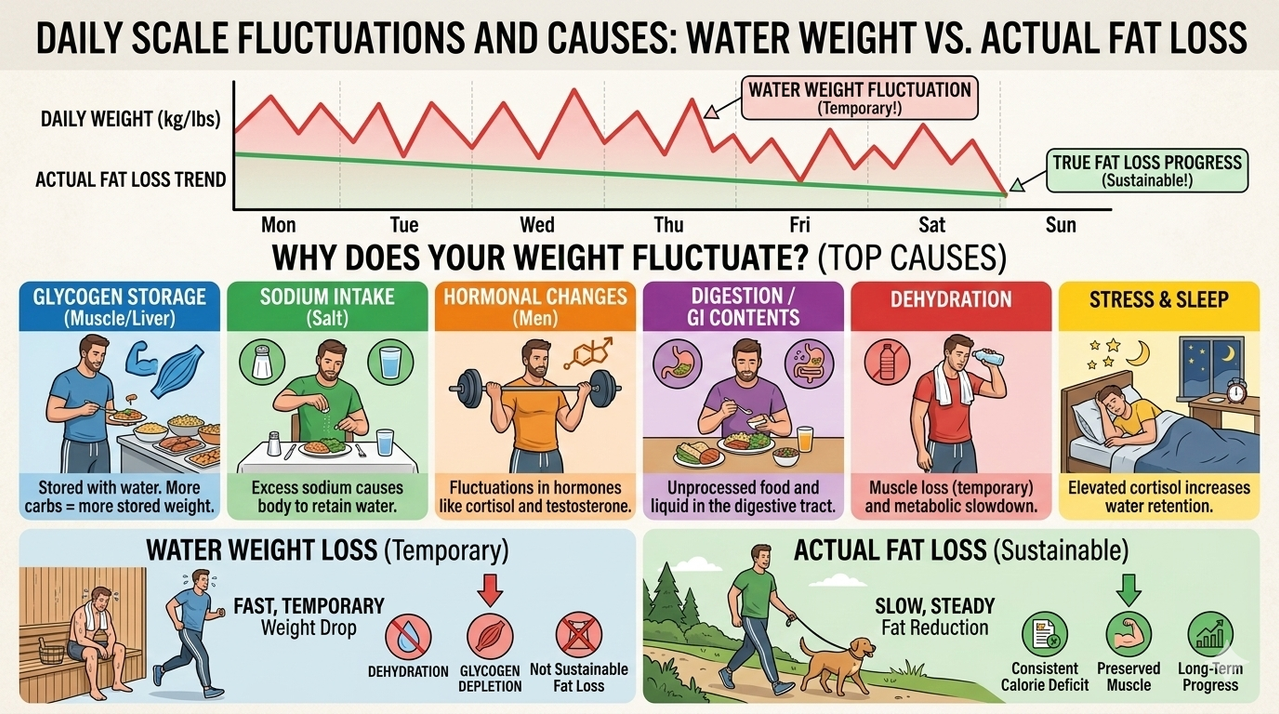
The scale can fluctuate 2-5 pounds in a single day—and that's almost never fat. The difference between water weight and actual fat loss comes down to speed, location, and composition. Water weight shifts rapidly due to sodium, carbs (glycogen holds 3g water per 1g glycogen), hormones, and hydration status . Actual fat loss is slow, steady, and distributed across the body . This guide breaks down the science, teaches you how to tell them apart, and provides actionable strategies to track real progress without scale frustration.
1. The Scale Lied: Why Daily Weight Fluctuations Drive Us Crazy
You've been there: a week of perfect eating, crushing workouts, and the scale shows you're up 2 pounds. Before you throw your scale out the window, understand this: it's almost impossible for sudden weight gain to be fat . True fat loss is slow, just as true weight gain takes time, which is key to understanding the difference between water weight and actual fat loss .
The number on the scale represents everything in your body at that moment: water, glycogen, undigested food, bone, muscle, and fat . Understanding the difference between water weight and actual fat loss is the key to maintaining sanity and motivation on your fitness journey.
This guide will teach you the science behind water fluctuations, how to distinguish them from real fat loss, and practical strategies to track your true progress.
2. The Science: What Is Water Weight?
2.1. Your Body Is Mostly Water
About 60% of your body weight is water—it's essential for regulating temperature, carrying nutrients, removing waste, and lubricating joints . Water exists in your blood vessels, tissues, and cells, so it absolutely affects the numbers you see on a scale, contributing to the difference between water weight and actual fat loss .
2.2. The Glycogen-Water Connection
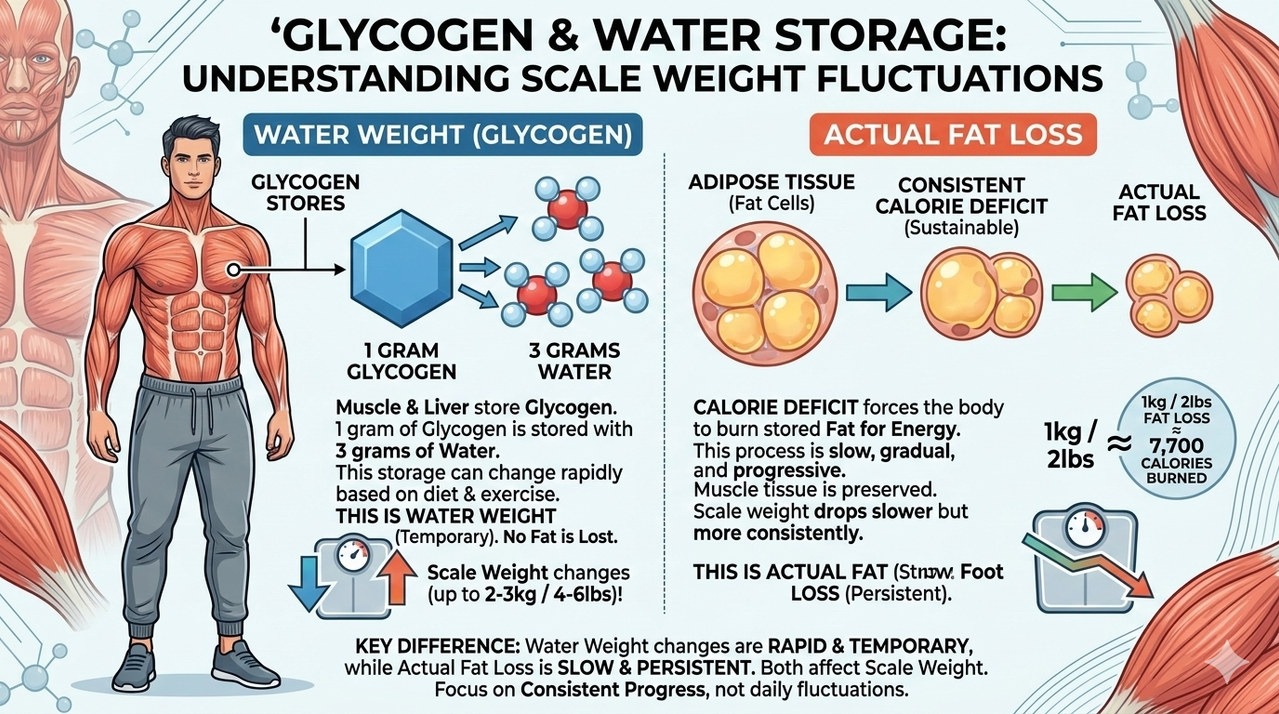
Your body stores carbohydrates as glycogen in your liver and muscles. Here's the key fact: for every gram of glycogen stored, your body also stores about 3 grams of water . This means your glycogen stores are literally "bulky and heavy" with water, a crucial concept for the difference between water weight and actual fat loss .
When you start a diet or reduce calories, your body dips into these glycogen stores for energy and releases the accompanying water . This accounts for much of the rapid weight loss in the first week—it's water weight, not fat .
2.3. What Is Body Fat?
Body fat (adipose tissue) is your body's stored energy reserve. Unlike water weight, it's not meant to fluctuate rapidly. There are two types: visceral fat (around internal organs) and subcutaneous fat (under the skin) . Both serve important functions like energy storage, insulation, and organ protection .
3. Key Differences: How to Tell Them Apart
3.1. Speed of Change
The #1 clue is timing. Water weight changes rapidly—within hours or days. Fat loss is slow and steady, taking weeks to become visible, a primary difference between water weight and actual fat loss . If your weight shoots up or down overnight, it's water.
3.2. Location and Sensation
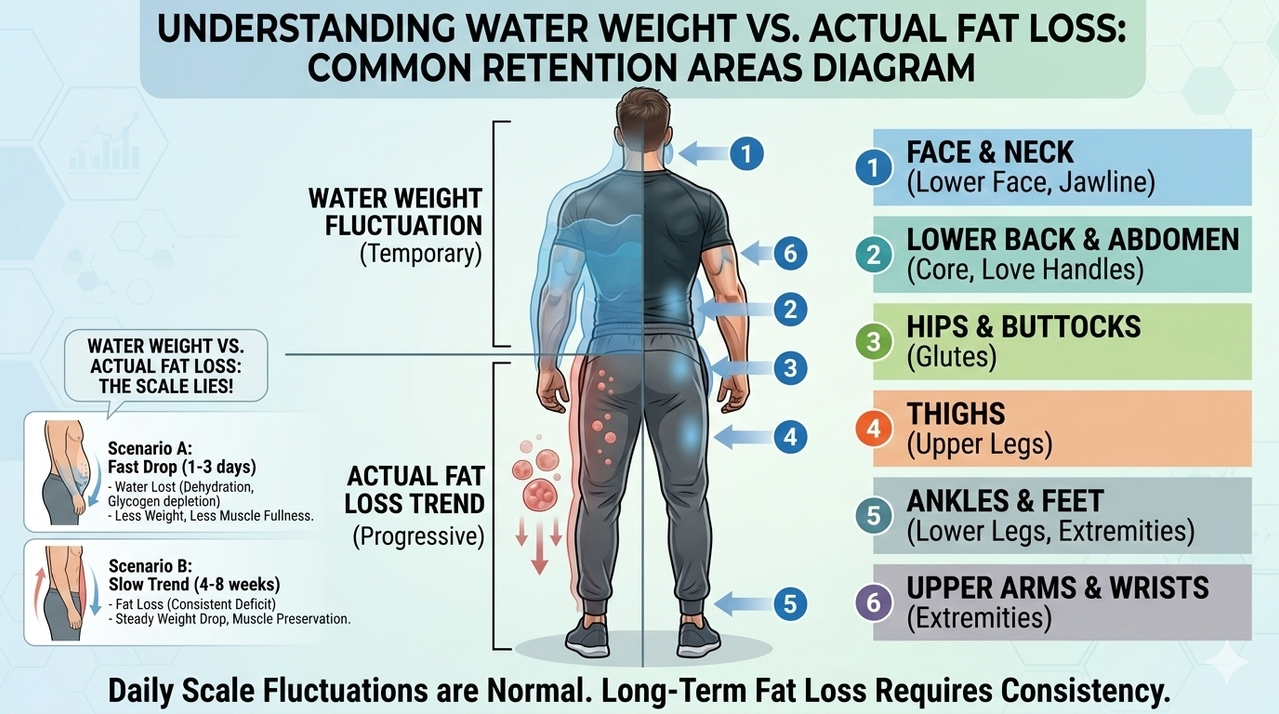
Water weight often causes puffiness and bloating, especially in the abdomen, hands, feet, and face . You might notice rings feeling tighter or socks leaving marks. Fat gain is distributed more evenly across the stomach, hips, thighs, and arms, and doesn't cause the same "puffy" feeling, helping you understand the difference between water weight and actual fat loss .
3.3. Common Causes of Water Weight
- Sodium intake: Sodium acts like a magnet for water, forcing your body to retain fluid to maintain chemical balance . One salty meal can cause a temporary 2-3 pound jump.
- Carbohydrate intake: Carbs are stored as glycogen with water. A higher-carb meal replenishes glycogen and its accompanying water .
- Hormonal changes: Especially in women during menstrual cycles, hormonal shifts can cause temporary water retention .
- Dehydration: Paradoxically, not drinking enough water can cause your body to hold onto fluid .
- Medications: Some blood pressure drugs, steroids, and anti-inflammatories can cause water retention .
| Characteristic | Water Weight | Fat Loss |
|---|---|---|
| Timeframe | Hours to days | Weeks to months |
| Sensation | Puffy, bloated | Gradual, distributed |
| Location | Hands, feet, face, abdomen | Stomach, hips, thighs, arms |
| Triggers | Sodium, carbs, hormones, dehydration | Calorie surplus over time |
4. What Research Says: Water Loss vs. Fat Loss
4.1. The Ramadan Fasting Study
A 2023 study on intermittent fasting during Ramadan tracked body composition changes in healthy adults. Participants lost an average of 1,030g (about 2.3 pounds) over 20+ days. Here's the critical finding: 828g (80%) of that loss was fat mass, while changes in total body water were minimal, illustrating the difference between water weight and actual fat loss . However, intracellular water decreased slightly, indicating that rapid weight loss can affect cellular hydration .
4.2. Fasting vs. Calorie Restriction
A 2010 study compared total fasting, very low-calorie diets, and low-calorie diets. After about 5% weight loss, the fasting group lost significantly more water (3.2kg of water) compared to the low-calorie diet group (0.3kg of water) . This proves that the method of weight loss dramatically affects how much water you lose versus fat, a key aspect of the difference between water weight and actual fat loss .
4.3. Body Composition Assessment
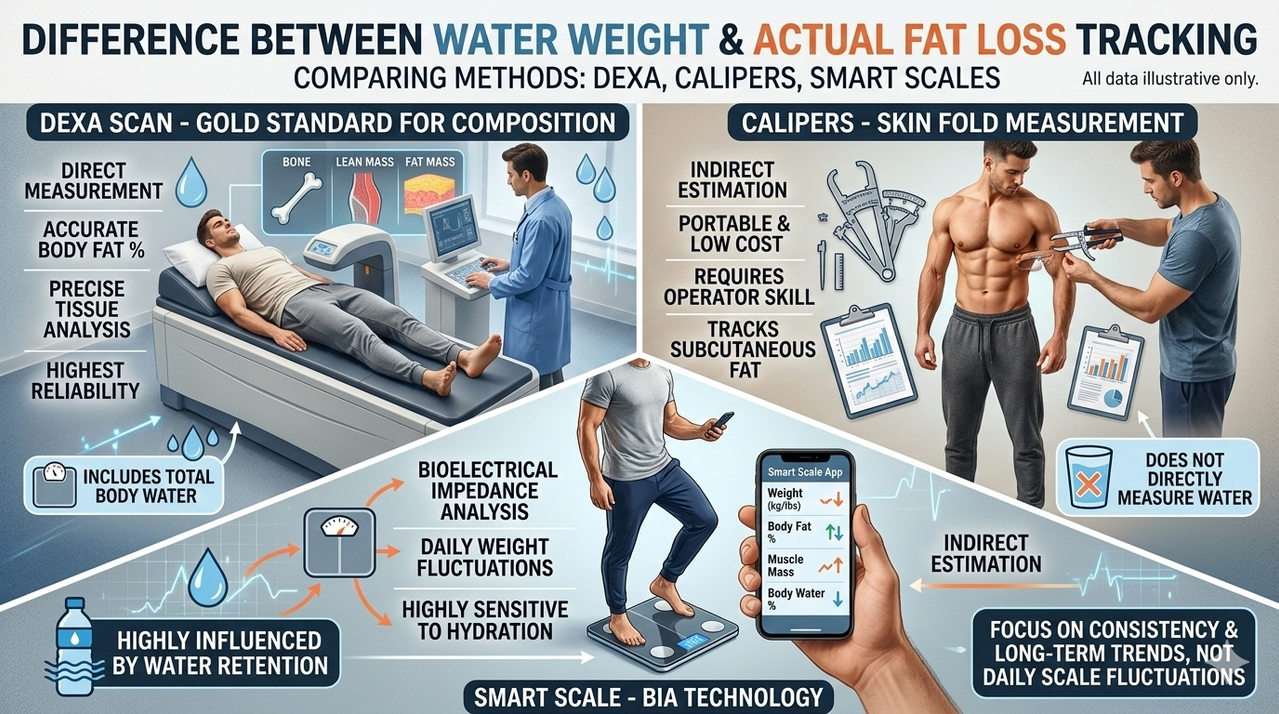
Research emphasizes that tracking body composition—not just weight—is essential for true progress monitoring. Tools like DEXA scans, bioelectrical impedance, and even waist circumference provide far more insight than the scale alone .
5. How to Track Real Fat Loss (Not Water)
5.1. The Waist Circumference Method
Dr. Garth Davis at Houston Methodist recommends monitoring weight via waistline circumference instead of numbers on a scale . If the scale goes up but your waist stays the same, it's likely fluid, not fat, helping you understand the difference between water weight and actual fat loss . For women, a waist circumference over 35 inches signals excess abdominal fat; for men, it's 40 inches .
5.2. Body Composition Tools
The scale simply shows body weight but doesn't specify if you're losing water, fat, or muscle . Here are better options :
- DEXA scans: The gold standard for accuracy, though expensive and not for frequent use .
- Bioelectrical Impedance Analysis (BIA): Found in smart scales; estimates body fat percentage . While not as accurate as DEXA, it's good for tracking trends .
- Skinfold calipers: Measure subcutaneous fat thickness; accuracy depends on technician skill .
- Progress photos: Visual evidence over time reveals changes the scale misses.
- How clothes fit: If your pants feel looser, you're losing fat—even if the scale hasn't moved.
6. Nutrition: Managing Water Weight and Fueling Fat Loss
6.1. How to Reduce Water Weight Naturally
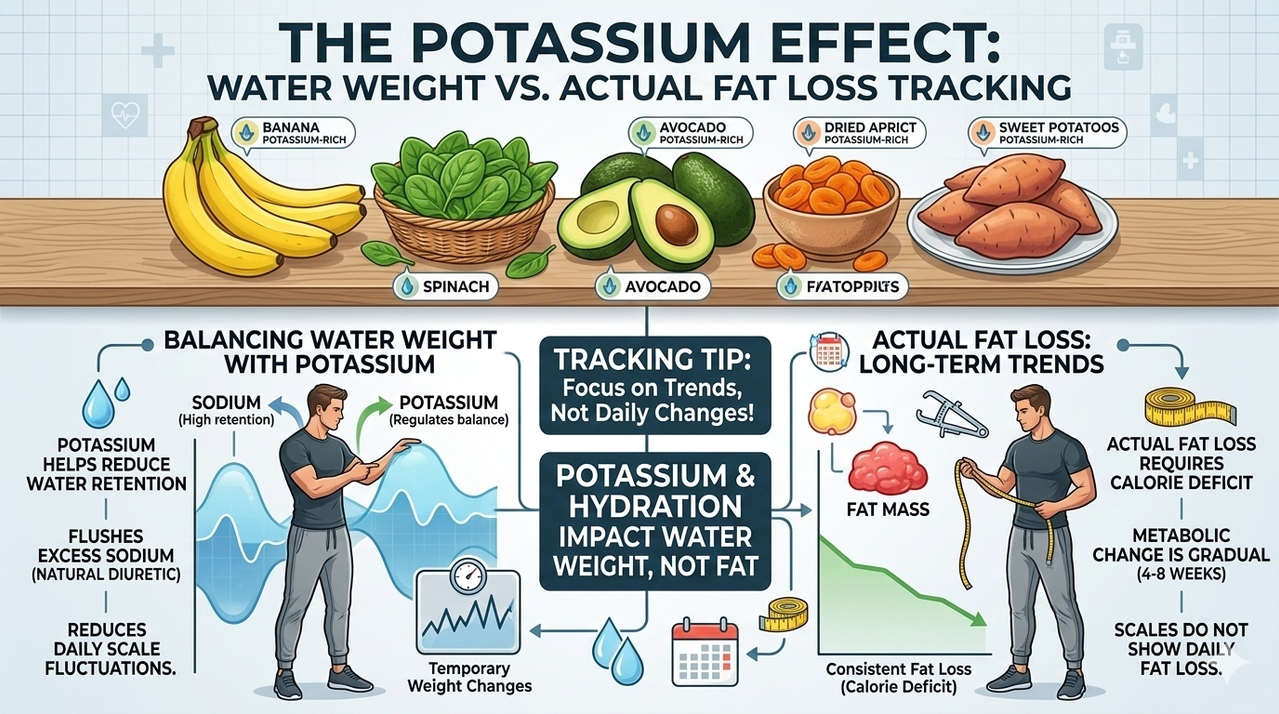
- Reduce sodium intake: Limit processed foods, salty snacks, and fast foods. Aim for less than 2,300mg daily .
- Stay hydrated: Drinking enough water actually helps balance fluid retention .
- Eat potassium-rich foods: Bananas, avocados, spinach, sweet potatoes help counter sodium effects .
- Be active: Movement promotes circulation, helping move excess water out .
- Limit alcohol and caffeine: Both can contribute to dehydration and water retention .
6.2. Protein for Fat Loss and Muscle Preservation
To lose fat (not muscle), adequate protein is crucial. During weight loss, aim for 1.2–1.5g per kg of body weight, and up to 2.0g/kg if you exercise intensely .
6.3. Sample Day: Fat Loss Focus (~1800 kcal, 140g protein)
- Breakfast: 3 eggs (18g) + 1 cup spinach + ½ avocado + 1 slice whole-grain toast (3g) → 21g protein
- Lunch: Large salad with 150g chicken breast (35g), mixed greens, cucumber, bell peppers, and vinaigrette → 35g protein
- Snack: 1 cup Greek yogurt (20g) + ½ cup berries → 20g protein
- Dinner: 150g salmon (30g) + 1 cup roasted broccoli + ½ cup quinoa (4g) → 34g protein
- Evening (optional): 1 scoop casein protein (25g) → 25g protein
- Total: ~135g protein
6.4. Vegan Options for Fat Loss
- Breakfast: Tofu scramble (200g firm tofu = 20g) + 1 cup spinach + 1 slice toast → 23g protein
- Lunch: Lentil bowl: 1 cup cooked lentils (18g) + ½ cup quinoa (4g) + roasted veggies + tahini dressing → 25g protein
- Snack: 1 cup edamame (18g) → 18g protein
- Dinner: Tempeh stir-fry: 150g tempeh (25g) + mixed vegetables + ½ cup brown rice (3g) → 28g protein
7. Quick Recipes (Under 10 Minutes)
1. Hydrating Smoothie
Anti-Water Retention1 cup coconut water + ½ cup frozen pineapple + 1 handful spinach + 1 tbsp chia seeds. Blend. (Rich in potassium, low sodium)
2. Avocado Toast with Eggs
Fat Loss Fuel1 slice whole-grain toast + ½ mashed avocado + 2 poached eggs + red pepper flakes. (~22g protein)
3. Microwave Scrambled Eggs with Spinach
Fat Loss Fuel3 eggs + splash of milk + handful spinach. Microwave 2 min, stir, add cheese. (~22g protein)
4. Cucumber-Lime Infused Water
Anti-Water RetentionSlice cucumber and lime into a pitcher of water. Add mint leaves. Let sit 10 min. (Natural diuretic)
8. When Water Retention Signals a Problem
While most water weight is harmless, persistent or severe edema can indicate underlying health issues . Contact your doctor if you experience:
- Persistent swelling that doesn't improve with lifestyle changes
- Shortness of breath or difficulty breathing
- Swelling in only one leg (possible deep vein thrombosis)
- History of heart, kidney, or liver disease with new swelling
9. Common Mistakes When Distinguishing Water vs. Fat
- Mistake #1: Trusting daily scale readings. Day-to-day fluctuations are almost always water. Look at weekly trends, a key part of understanding the difference between water weight and actual fat loss .
- Mistake #2: Crash dieting for quick results. The rapid drop is mostly water and glycogen—not sustainable fat loss .
- Mistake #3: Using diuretics without supervision. "Taking diuretics without physician supervision can be very dangerous if it leads to severe dehydration" .
- Mistake #4: Ignoring waist measurements. The scale can't tell you if you're losing fat or muscle .
- Mistake #5: Giving up after a "bad" weigh-in. That 2-pound jump is likely salty food, not fat. Get back on track .
11. Scientific References
- Collins, A. (2023). You Lose More Than Fat on a Diet, And The Consequences Are Serious. ScienceAlert / The Conversation. View Source
- CSIRO Total Wellbeing Diet. (2020). Are your bath scales telling the truth. Total Wellbeing Diet Blog. View Source
- Healthline. (2024). Water Weight vs. Fat: How to Tell Them Apart. Healthline.com. View Source
- NIH National Library of Medicine. (2025). Table 2: Comparison of body composition assessment technologies. PMC, 12067000. View Source
- Najafi, M.T., et al. (2023). Alteration in body water compartments following intermittent fasting in Ramadan. Frontiers in Nutrition, 10, 1232979. View Source
- Women's Health. (2021). Weight Loss Versus Fat Loss—What's The Difference, Anyway? WomensHealthMag.com. View Source
- Houston Methodist Hospital. (2025). What Is Water Weight? And Should You Be Trying to Lose It? HoustonMethodist.org. View Source
- Visbody. (2024). Water Weight vs Fat: Decoding Body Weight. Visbody.com. View Source
- DePrenger, M., et al. (2025). Practical tools for evaluating body fat distribution. Nutrition in Clinical Practice. View Source
- Siervo, M., et al. (2010). Changes in body water compartments after total fasting, very low calorie diet and low calorie diet in obese men. International Journal of Obesity, 34(5), 908-918. View Source
All sources last accessed March 2026. Paraphrased for accessibility.
Join the conversation