The Mind-Muscle Connection: How to Feel Every Rep
The Mind-Muscle Connection: How to Feel Every Rep

📋 TL;DR
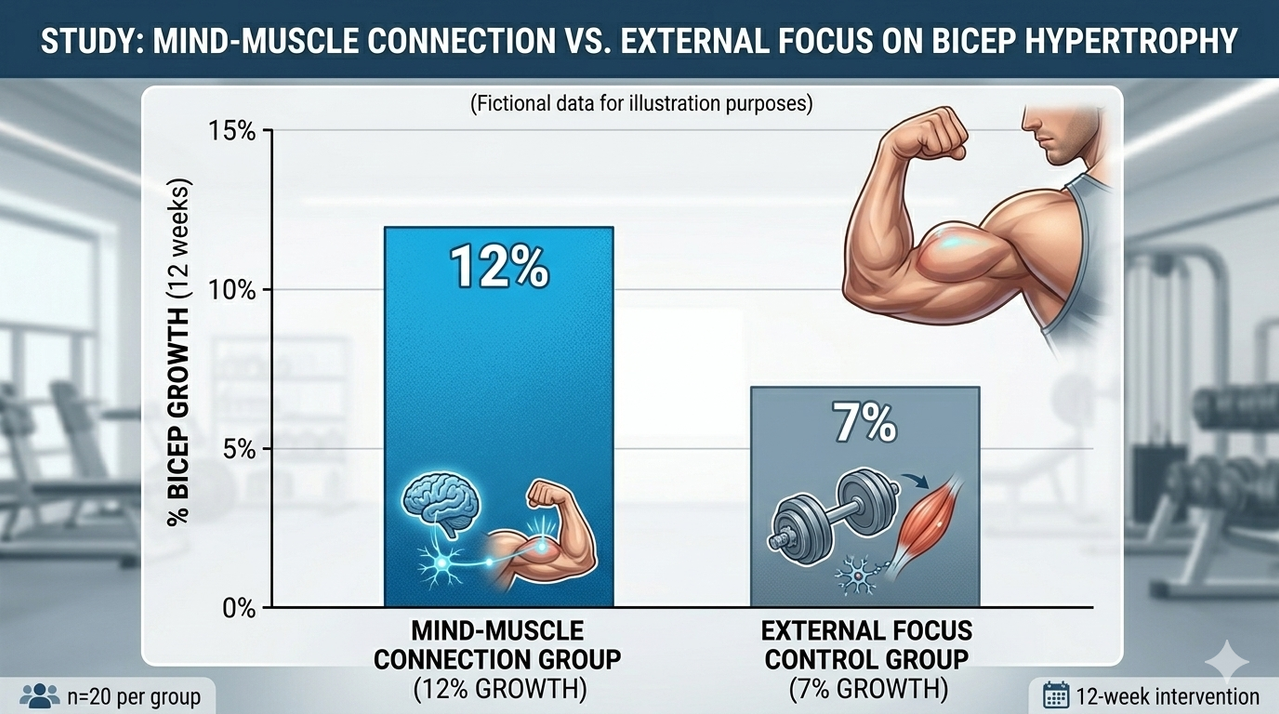
The mind-muscle connection (MMC) is the intentional, internal focus on contracting a specific muscle during an exercise . It's not "bro science"—it's backed by research. A landmark study by Schoenfeld et al. (2018) found that participants who focused on squeezing their biceps experienced nearly twice the muscle growth (12% increase) compared to those focused on just lifting the weight (7% increase) . EMG studies confirm that internal focus increases electrical activity in targeted muscles . This guide reveals how to master the mind-muscle connection, with science-backed strategies, sample workouts, and nutrition tips to fuel your focus, teaching you the mind-muscle connection and how to feel every rep.
1. What Is the Mind-Muscle Connection?
Have you ever watched a bodybuilder perform a curl and noticed they seem almost hypnotized by the movement? They're not just lifting—they're feeling. That's the mind-muscle connection (MMC) in action. Brad Schoenfeld, PhD, a leading expert in muscle growth, defines it as "thinking about a muscle as you perform a repetition so that the target muscle is maximally activated" —the essence of the mind-muscle connection and how to feel every rep.
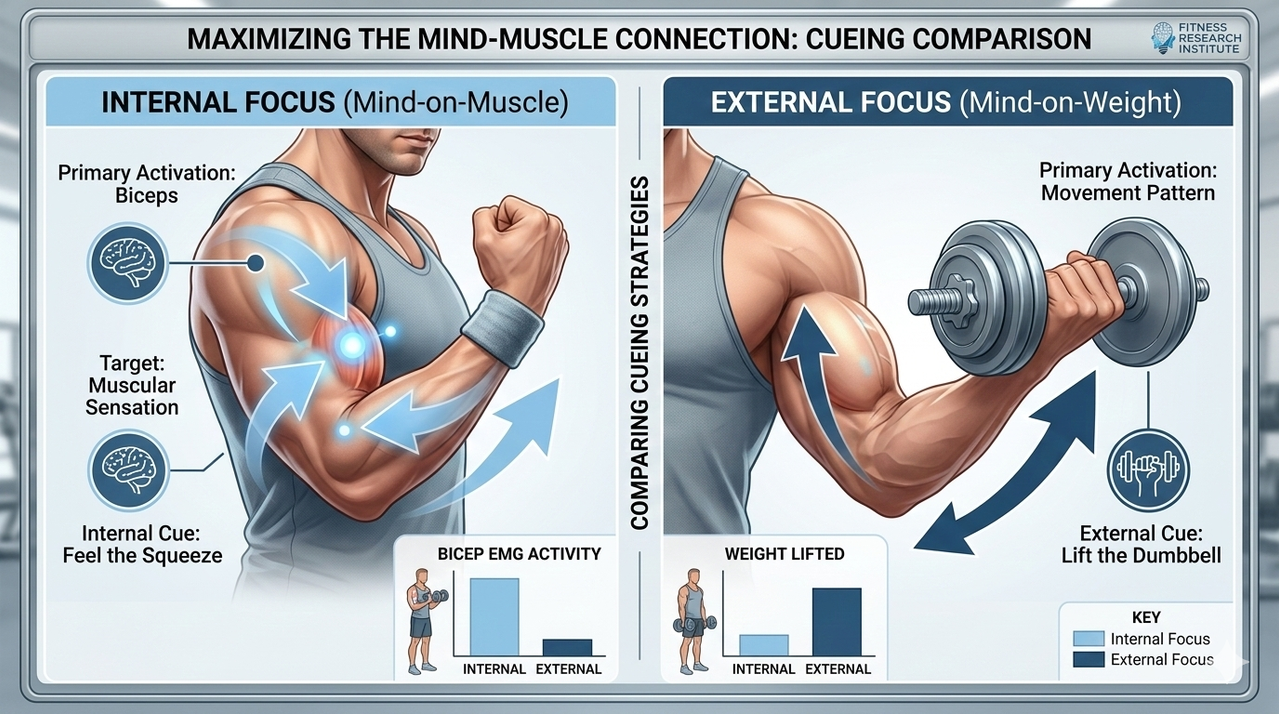
MMC involves what scientists call "internal focus"—directing your attention to the contraction of the muscle itself, rather than "external focus" on the weight or outcome . For hypertrophy (muscle growth), internal focus appears to be a game-changer. A 2018 study showed that lifters who focused on their biceps during curls grew significantly more muscle than those focused on simply moving the weight .
This guide will teach you the mind-muscle connection and how to feel every rep using evidence-based techniques that amplify muscle activation and accelerate gains.
2. The Science: What Happens When You Focus
2.1. EMG Evidence: Muscles Respond to Attention
Electromyography (EMG) measures electrical activity in muscles. Studies consistently show that directing attention to a specific muscle increases its EMG amplitude, which is key to the mind-muscle connection and how to feel every rep . A 2025 study on hamstring muscles found that attentional focus produced muscle-specific differences in activation, with the semimembranosus being particularly responsive to internal focus cues .
2.2. The Schoenfeld Bicep Study: 12% vs. 7% Growth
The most compelling evidence comes from a 2018 study published in the European Journal of Sports Science. Two groups trained with the same program, but one group was instructed to "squeeze the muscle" during curls (internal focus), while the other was told to "get the weight up" (external focus). After eight weeks, the internal focus group experienced 12% increase in bicep size—almost double the 7% growth of the external focus group . This demonstrates that how you think about a rep matters as much as the weight on the bar, proving the mind-muscle connection and how to feel every rep.
2.3. Muscle-Specific Responses
Not all muscles respond identically to attentional focus. Research shows that some muscles—like the semimembranosus (a hamstring muscle)—are more "connected" to conscious control than others . This may explain why some lifters struggle to "feel" certain muscles. The good news: MMC can be trained like any skill, enhancing the mind-muscle connection and how to feel every rep .
3. 7 Science-Backed Strategies to Master the Mind-Muscle Connection
1. Use Internal Cues (Squeeze, Contract, Feel)
#1 Most ImportantReplace "lift the weight" with "squeeze the muscle." Research shows that internal cues like "contract your chest" during bench press increase EMG activity in the target muscle, a cornerstone of the mind-muscle connection and how to feel every rep . Before each rep, mentally command the muscle to engage. Visualization helps: picture the muscle fibers shortening .
Example cues: "Squeeze your glutes" (hip thrusts), "spread the floor" (squats, for glutes), "crush the bar" (chest flyes).
2. Slow Down the Eccentric (Lowering) Phase
Time Under TensionSlowing down the eccentric phase (3-4 seconds) increases time under tension, which is strongly linked to hypertrophy . It also forces you to stay mentally present, enhancing proprioceptive feedback and the mind-muscle connection and how to feel every rep . A systematic review confirmed that eccentric-focused training produces greater strength and muscle gains .
Try: 3-0-1-0 tempo (3 seconds down, 1 second up).
3. Pre-Exhaust with Isolation Exercises
Wake Up the MuscleStart with an isolation exercise to "wake up" the target muscle before compound lifts. A study by Augustsson et al. (2003) found that pre-fatiguing the glutes with hip abduction increased gluteal activation during squats, supporting the mind-muscle connection and how to feel every rep .
Example: Do leg extensions before squats to activate quads; pec flyes before bench press to activate chest; hamstring curls before deadlifts to activate hamstrings.
4. Train with Lighter Weights (12-20 Rep Range)
Control Over MomentumHeavy weights shift focus to moving the load rather than feeling the muscle . Using 50-65% of your 1RM in the 12-20 rep range allows you to concentrate on contraction without fighting for survival, enhancing the mind-muscle connection and how to feel every rep . Calatayud et al. (2015) showed that submaximal loads with intentional contraction produced higher EMG activity in the pecs during bench press than heavier loads .
5. Use Isometric Holds and Flexing Between Sets
Neural PrimingIsometric contractions (holding a peak contraction) improve neuromuscular efficiency. Counts et al. (2016) demonstrated that isometric training can induce hypertrophy when contraction intensity is sufficient . Flexing between sets enhances proprioceptive feedback—your brain learns what the muscle feels like when fully contracted, reinforcing the mind-muscle connection and how to feel every rep .
Try: After each set, take 15-20 seconds to flex and hold the target muscle.
6. Train Unilaterally (One Limb at a Time)
Eliminate ImbalancesUnilateral exercises (single-arm rows, Bulgarian split squats) allow greater focus on each muscle individually. Research by Behm et al. (2002) suggests single-limb training increases neuromuscular coordination and enhances MMC, contributing to the mind-muscle connection and how to feel every rep . It also helps correct strength imbalances that may mask proper activation.
7. Use Mirror Feedback and Partner Tapping
Visual & Tactile CuesMirrors can help by providing visual confirmation of muscle contraction, though research suggests they are most effective when combined with internal focus . For hard-to-feel muscles (like lats), having a partner tap the target muscle during exercise can "wake up" the neural connection—a technique borrowed from physical therapy called "facilitation tapping," which supports the mind-muscle connection and how to feel every rep .
4. Sample Mind-Muscle Connection Workout
This full-body workout emphasizes MMC with lighter loads, slow tempos, and strategic pre-exhaustion, perfect for developing the mind-muscle connection and how to feel every rep.
| Exercise | Sets & Reps | Tempo | Focus Cue |
|---|---|---|---|
| Pec Flye (Machine or Cable) | 3 x 12-15 | 3-0-1-0 | "Squeeze chest at peak" |
| Dumbbell Bench Press | 3 x 10-12 | 3-0-1-0 | "Press with chest" |
| Lat Pulldown (close grip) | 3 x 12-15 | 3-0-1-0 | "Pull with lats, squeeze" |
| Seated Cable Row | 3 x 10-12 | 3-0-1-0 | "Retract shoulder blades" |
| Leg Extension | 3 x 15-20 | 3-0-1-0 | "Squeeze quads at top" |
| Goblet Squat | 3 x 10-12 | 3-0-1-0 | "Drive through heels" |
| Hamstring Curl | 3 x 15-20 | 3-0-1-0 | "Curl with hamstrings" |
| Dumbbell Curl | 3 x 12-15 | 3-0-1-0 | "Squeeze biceps" |
Focus on contraction, not weight. Rest 60-90 seconds between sets.
5. Nutrition: Fueling the Mind-Muscle Connection
Your brain runs on glucose, and intense mental focus during workouts requires energy. Here's how to fuel your focus for the mind-muscle connection and how to feel every rep.
5.1. Pre-Workout Fuel for Mental Clarity
Consume 30-60 minutes before training: easily digestible carbs to fuel the brain and light protein for amino acid availability .
Pre-Workout MMC Smoothie
~25g protein, 40g carbs1 banana + 1 scoop whey/pea protein + 1 cup milk (dairy/oat) + ½ cup berries. Blend and sip slowly while focusing on your upcoming workout.
5.2. Sample Day for Mental Focus (~2500 kcal, 160g protein)
- Breakfast: 3 eggs (18g) + 1 cup oatmeal (10g) + 1 cup berries + 1 tbsp honey → 30g protein
- Lunch: 200g chicken breast (45g) + 1 cup quinoa (8g) + roasted vegetables → 53g protein
- Pre-workout snack: MMC Smoothie (above) → 25g protein
- Dinner: 200g salmon (40g) + sweet potato + broccoli → 40g protein
- Evening: 1 cup cottage cheese (24g) optional → 24g protein
- Total: ~172g protein
5.3. Vegan Focus Options
- Pre-workout: Banana + 1 tbsp peanut butter + 1 cup soy milk → 15g protein
- Post-workout: Tofu scramble (200g = 20g) + 1 cup quinoa (8g) + veggies
- Snack: Edamame 1 cup (18g) + pumpkin seeds (4g) → 22g protein

6. Common Mind-Muscle Connection Mistakes
- Mistake #1: Lifting too heavy for MMC work. When loads exceed ~60% 1RM, focus naturally shifts to moving the weight . Save heavy lifting for strength-focused days and use moderate loads for MMC practice.
- Mistake #2: Relying only on the mirror. While useful, visual feedback can distract from internal sensation. Look away occasionally to feel the contraction .
- Mistake #3: Ignoring the eccentric. The lowering phase is where you have the most time to feel the muscle. Slow it down .
- Mistake #4: Using external cues for hypertrophy. External cues ("push the floor") are great for power, but for muscle growth, internal cues ("squeeze glutes") are superior .
- Mistake #5: Expecting instant results. MMC is a skill. It takes practice to "wake up" dormant neural pathways .
7. Quick Reference: MMC Tips at a Glance
| Technique | How to Apply | Benefit |
|---|---|---|
| Internal Cueing | "Squeeze the muscle," not "lift the weight" | Increases EMG activity in target muscle |
| Slow Eccentric | 3-4 second lowering phase | Time under tension, more growth |
| Pre-Exhaustion | Isolation before compound | Improves target muscle activation |
| Isometric Holds | Flex between sets, hold peak contraction | Strengthens neuromuscular pathways |
| Unilateral Training | One limb at a time | Enhances individual muscle focus |
| Lighter Loads | 12-20 reps, 50-65% 1RM | Allows focus on contraction |
9. Scientific References
- De Gruyter. (2025). Muscular activity of hamstrings under attentional focus instructions: an electromyography based study. De Gruyter Brill. View Source
- BarBend. (2025). The Simple Movement Phil Heath Uses to Boost Mind-Muscle Connection. BarBend. View Source
- Women's Health. (2025). This Simple, Underrated Skill Is The Key To Faster Strength Gains. Women's Health. View Source
- Universidade de Lisboa. (2023). Mind-muscle connection during resistance exercise: can mirror self-imaging enhance verbally instructed internal focus? Repositório da Universidade de Lisboa. View Source
- Peloton. (2025). How to Tap Into the 'Mind-Muscle Connection'—and Unlock More Strength. Peloton Blog. View Source
- OUCI. (2025). Altered Muscle–Brain Connectivity During Left and Right Biceps Brachii Isometric Contraction Following Sleep Deprivation. Sensors, 25(7), 2162. View Source
- ASU Sun Devil Fitness. (2024). The Mind-Muscle Connection. Arizona State University. View Source
- Scholar CNKI. (2025). Altered Muscle–Brain Connectivity During Left and Right Biceps Brachii Isometric Contraction Following Sleep Deprivation. CNKI. View Source
- BOXROX. (2025). 6 Mind-Muscle Connection Tips for Better Gains. BOXROX. View Source
- BOXROX. (2025). 7 Ways to Improve Your Mind-Muscle Connection for Faster Gains. BOXROX. View Source
All sources last accessed March 2026. Paraphrased for accessibility.
Join the conversation