The Truth About Late-Night Eating and Metabolism
The Truth About Late-Night Eating and Metabolism

📋 TL;DR
The truth about late-night eating and metabolism is nuanced: technically, your body doesn't process food differently at night based on time alone, and total daily calorie intake remains the primary driver of weight change . However, emerging research in chrononutrition reveals that meal timing significantly influences metabolism through circadian rhythms . Late eating is associated with consuming more calories overall , choosing higher-calorie foods , and may reduce the thermic effect of food . For muscle growth, pre-sleep protein (30-40g casein) is actually beneficial, boosting overnight muscle protein synthesis . The verdict? It's not strictly about the clock—it's about total intake, food choices, and your individual goals.
1. The Midnight Snack Dilemma: Myth vs. Reality
You've probably heard it a thousand times: "Don't eat after 8 PM, or it will turn straight into fat." This piece of nutritional dogma has been passed down for generations. But like many "rules" in nutrition, the truth about late-night eating and metabolism is far more interesting and complex.
The reality is that your body doesn't suddenly switch into "fat-storage mode" at a specific hour. A 2006 study on rhesus monkeys—a useful model for human obesity—found that those who ate most of their food at night were at no greater risk for gaining weight than those who ate earlier in the day . The National Institute of Diabetes and Digestive and Kidney Diseases (NIDDK) confirms that it's the total amount of calories you take in, not the time of day, that primarily affects weight .
However, that's not the whole story. Modern science has uncovered that when you eat does matter—just not for the reasons you might think.
2. The Science: How Your Body Clock Affects Metabolism
2.1. What Are Circadian Rhythms?
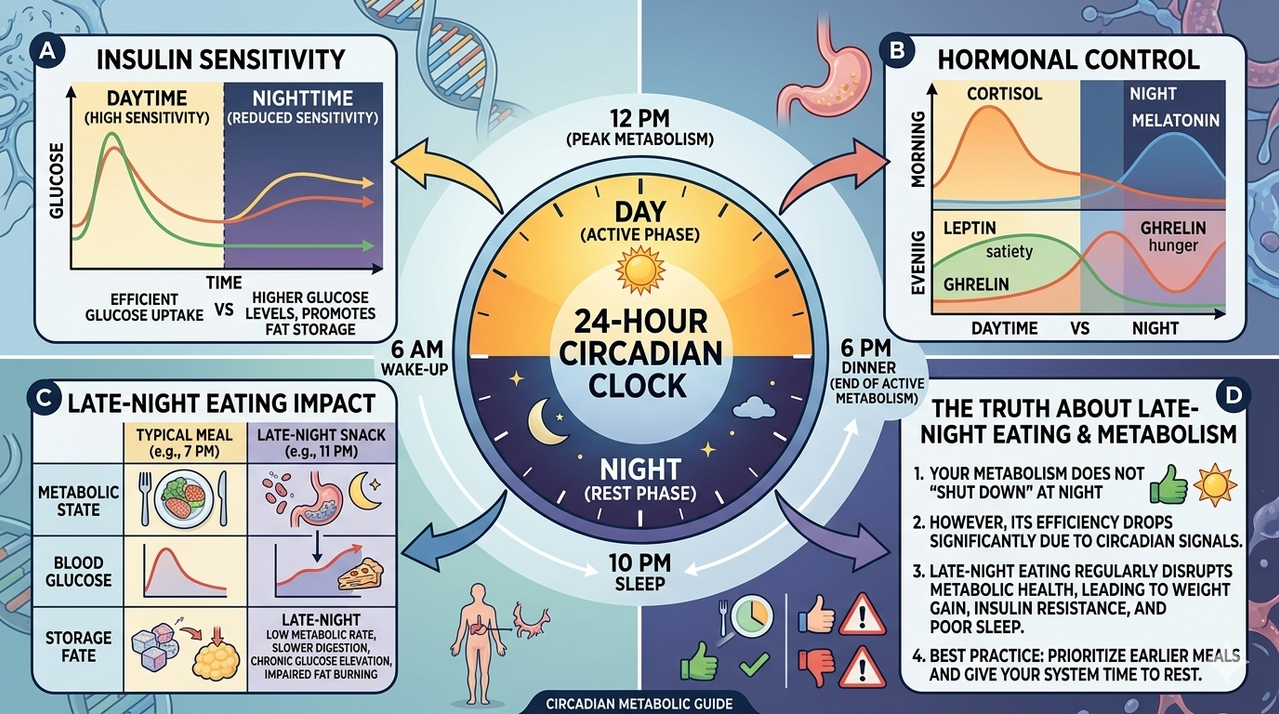
Your body operates on a roughly 24-hour internal clock called the circadian rhythm. This "master clock" is located in the suprachiasmatic nucleus (SCN) of the hypothalamus and is synchronized primarily by light exposure . It then coordinates peripheral clocks in organs like the liver, pancreas, and adipose tissue, regulating when enzymes, hormones, and metabolic processes should be activated, which is key to the truth about late-night eating and metabolism .
2.2. The Thermic Effect of Food (TEF) and Time of Day
Research suggests that the thermic effect of food—the energy your body burns to digest, absorb, and transport nutrients—may be lower for some people in the evening . This means that the same meal eaten late at night might result in slightly fewer calories burned during digestion compared to eating it earlier in the day. However, this effect is small and varies between individuals, adding nuance to the truth about late-night eating and metabolism .
2.3. Insulin Sensitivity and Glucose Tolerance
Your body's ability to handle carbohydrates follows a daily rhythm. Insulin sensitivity and glucose tolerance are typically higher in the morning and early afternoon, and decline as the day progresses . A 2025 review in Springer confirms that consuming meals later in the day, particularly at night, can lead to impaired glucose metabolism and increased fat storage due to this circadian misalignment .
3. The 2025 Harvard Study: Late Eating Changes Behavior
A landmark 2025 randomized controlled trial from Harvard Medical School investigated the causal effects of late eating on hunger, appetite, and dietary behaviors, shedding light on the truth about late-night eating and metabolism . Sixteen participants with overweight/obesity completed two 9-day protocols: one with early meals and one with late meals (shifted by about 4 hours).
3.1. Key Findings
While late eating didn't significantly change subjective hunger during a controlled constant routine, it dramatically altered food choices when participants could eat freely :
- Increased dietary glycemic index: Participants chose foods with higher glycemic index at breakfast after the late-eating protocol .
- Increased dietary inflammatory index: During the week following discharge, late eaters consumed more pro-inflammatory foods .
- Decreased total energy intake: Interestingly, late eating reduced subsequent total calorie intake by about 169 calories per day in the outpatient phase, but with a trade-off in food quality .
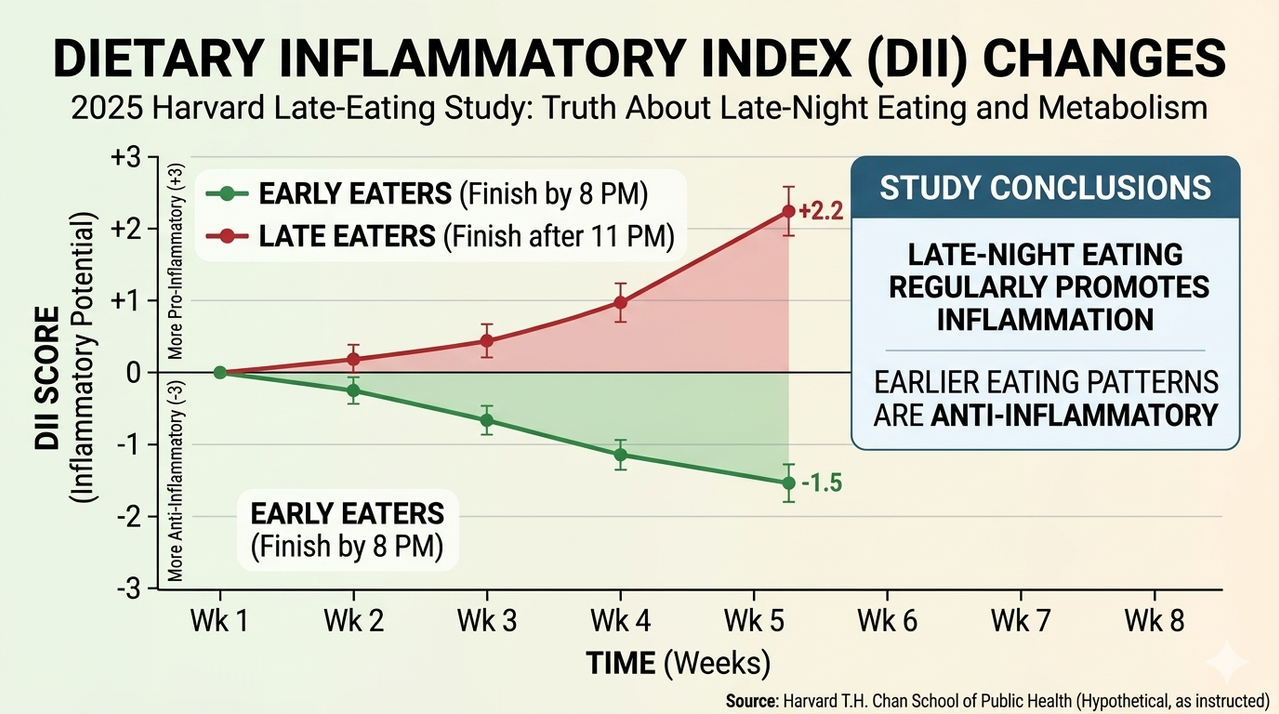
This study suggests that late eating creates a tendency to choose less healthy, more inflammatory foods—a behavioral effect that may be just as important as any metabolic change .
4. The Real Culprit: Behavioral Patterns
The strongest evidence against late-night eating has less to do with metabolism and more to do with behavior. Research consistently shows that people who eat late at night tend to consume more total calories, a key aspect of the truth about late-night eating and metabolism .
4.1. Why Late Eaters Consume More
- Mindless snacking: Eating while distracted by TV or devices prevents your brain from registering satiety .
- Emotional eating: Late-night hunger is often driven by boredom, stress, or fatigue rather than true metabolic need .
- Unhealthy food choices: Late-night snacks tend to be high-calorie options like chips, cookies, pizza, and ice cream .
- Larger portions: If you're very hungry because lunch was hours ago, you naturally opt for bigger portions .
4.2. The Data on Calorie Intake
A 2020 study in the NIH database compared eating patterns and found that late meals were associated with significantly higher total calorie intake: 3,762 kcal in the late-meal group vs. 3,309 kcal in the normal-meal group . Late eaters also consumed more fat, saturated fat, sugar, and sodium .
| Condition | Total Calories (kcal) | Fat (g) | Carbohydrates (g) |
|---|---|---|---|
| Normal meals | 3,309 ± 611 | 150.4 ± 42.2 | 375.7 ± 71.1 |
| Late meals | 3,762 ± 812 | 169.8 ± 57.8 | 421.6 ± 112.4 |
Data from NIH study on late meal timing
5. Late-Night Eating for Muscle Gain: A Different Story
For those focused on building muscle, the truth about late-night eating and metabolism takes a positive turn. Research on pre-sleep protein ingestion has revolutionized our understanding of overnight recovery.
5.1. Pre-Sleep Protein Boosts Muscle Repair
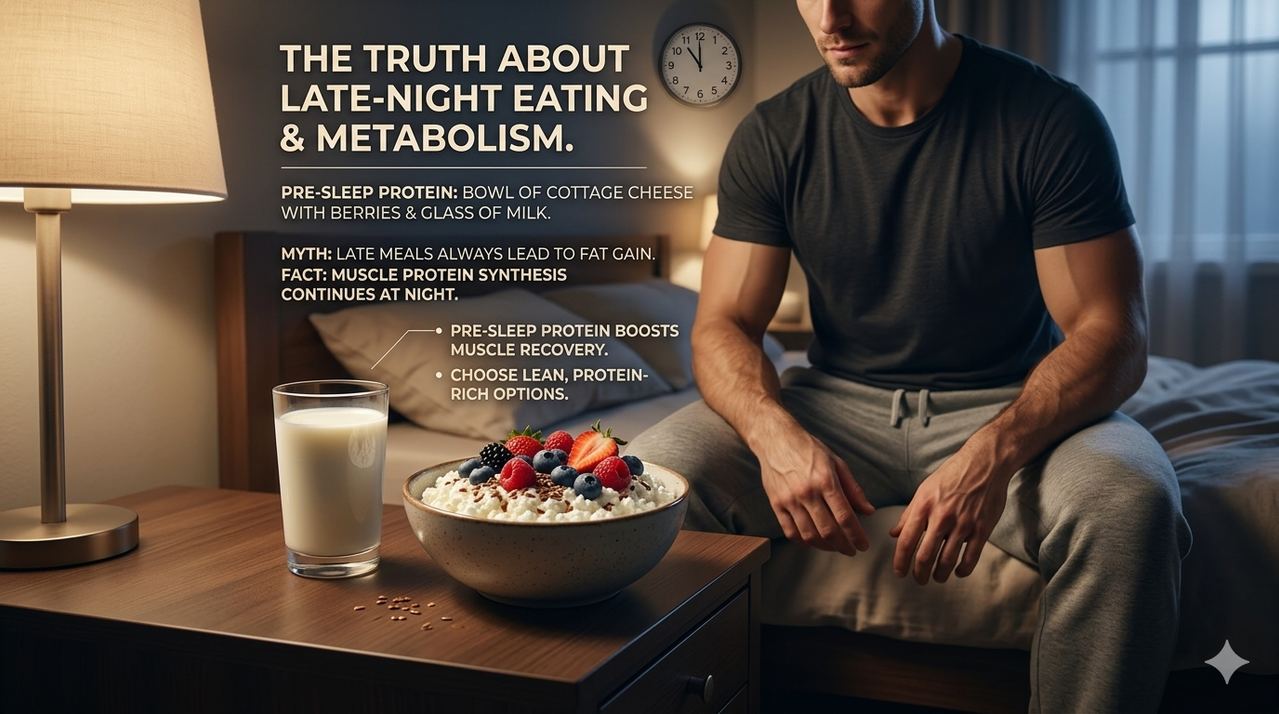
Studies from leading laboratories have demonstrated that protein ingested prior to sleep is effectively digested and absorbed, increasing overnight muscle protein synthesis rates by ~22% . This is crucial because overnight muscle protein synthesis tends to be low due to limited amino acid availability during sleep .
5.2. The Optimal Pre-Sleep Protein Dose
Research indicates that about 40 grams of casein protein is required to display a robust increase in muscle protein synthesis rates throughout overnight sleep . A 12-week training study showed that participants who consumed 27.5g of protein before sleep gained significantly more muscle mass and strength than those taking a placebo .
5.3. Sample Pre-Sleep Meals for Muscle Gain
- Option 1 (Omnivore): 1 cup (225g) low-fat cottage cheese (24g protein) + handful of berries.
- Option 2: 1 scoop casein protein powder mixed with 8-10 oz of milk or water (25-30g protein).
- Option 3 (Vegan): 1 cup (200g) plain soy yogurt (15-20g protein) + 1 tbsp hemp seeds (3g protein).
6. Smart Late-Night Eating: Practical Guidelines
6.1. The 4:4:2 Golden Ratio
Nutritionists recommend the "4:4:2" principle for late-night snacks: 40% vegetables, 40% carbohydrates, and 20% protein. This combination provides satiety while minimizing digestive stress .

6.2. The 200-Calorie Rule
If you need a bedtime snack, keep it under 200 calories. Use this calorie budget on healthier carbohydrates and protein, such as whole-grain toast and unsweetened yogurt .
6.3. What to Eat
- Apple slices or whole-grain crackers with peanut butter
- Greek yogurt with fresh fruit
- Carrot slices with toasted almonds
- Cottage cheese with bell pepper strips
- Banana with 1 tbsp peanut butter
6.4. What to Avoid
- Spicy foods: Can cause heartburn and disrupt sleep .
- High-fat foods: Slow digestion and may trigger acid reflux .
- Caffeine and alcohol: Disrupt sleep architecture and hormone release .
- Chocolate: Contains caffeine and may cause heartburn .
7. Sample Late-Night Snack Plans (Under 200 Calories)
| Snack | Calories | Protein | Best For |
|---|---|---|---|
| Greek yogurt (½ cup) + berries | ~120 | 12g | Balanced satiety |
| Apple + 1 tbsp peanut butter | ~150 | 5g | Sweet craving |
| Cottage cheese (½ cup) + cucumber | ~90 | 14g | High protein, low cal |
| Banana | ~105 | 1g | Quick energy |
| 2 rice cakes + 1 tsp almond butter | ~120 | 4g | Light crunch |
Vegan Late-Night Options
- Banana with 1 tbsp peanut butter (~150 kcal, 5g protein)
- Soy yogurt (¾ cup) + berries (~120 kcal, 8g protein)
- Whole-grain toast (1 slice) + ½ mashed avocado (~150 kcal, 4g protein)
- Edamame (½ cup, shelled) (~100 kcal, 9g protein)
8. The Digestion-Sleep Connection
Going to bed on a full stomach can trigger digestive issues. Lying down diminishes the role gravity plays in digestion, allowing stomach contents to stick around longer and potentially come back up more easily . This can cause heartburn or acid reflux, disrupting sleep quality and impacting appetite and food choices the following day .
If you have a tendency toward acid reflux, aim to finish your last meal at least 2-3 hours before bedtime and avoid lying down immediately after eating .
9. Common Mistakes About Late-Night Eating
- Mistake #1: Believing the "no food after X hour" rule is universal. The evidence doesn't support a strict cut-off time for everyone. What matters is your total daily intake and food choices .
- Mistake #2: Eating large, heavy meals before bed. This can disrupt sleep and cause digestive distress, even if it doesn't directly cause more fat storage .
- Mistake #3: Using late-night eating as a primary muscle-building strategy without adjusting total intake. Pre-sleep protein works best when it's part of a well-distributed daily protein intake .
- Mistake #4: Ignoring hunger signals. Going to bed ravenous can disrupt sleep and increase stress hormones . A small, healthy snack is better than trying to sleep while starving .
- Mistake #5: Assuming all calories after 8 PM are "wasted." Your body doesn't have an off switch. Calories eaten at night are processed, stored, and used just like any other time .
11. Scientific References
- WeightWatchers. (2024). Eating Before Bed: Is It Really That Bad? weightwatchers.com. View Source
- NIH. (2025). Chrononutrition and Energy Balance: How Meal Timing and Circadian Rhythms Shape Weight Regulation. PMC, 12252119. View Source
- Springer. (2025). Circadian nutrition and obesity: timing as a nutritional strategy. Journal of Health, Population and Nutrition, 44, 367. View Source
- Women's Health Taiwan. (2025). 減肥宵夜吃什麼?謹記「4:4:2 」營養學原則. womenshealthmag.com. View Source
- Arab, A., Vujovic, N., & Scheer, F. (2025). Effects of Late Meal Timing on Hunger, Appetite, and Dietary Behaviors of Adults with Overweight/Obesity. Sleep, 48(Supplement_1), A91. View Source
- Upstate Patient Care. (2017). True or False: Eating at Night Will Make You Gain Weight. epnet.com. View Source
- NIH. (2019). The Impact of Pre-sleep Protein Ingestion on the Skeletal Muscle Adaptive Response to Exercise in Humans: An Update. Frontiers in Nutrition, 6, 17. View Source
- NIH. (2016). Pre-Sleep Protein Ingestion to Improve the Skeletal Muscle Adaptive Response to Exercise Training. Nutrients, 8(12), 763. View Source
- Rajakumar, A.T., et al. (2025). Tuned by time: the role of circadian rhythms in metabolic energy sensing and chronotherapy. Annals of Medicine, 57(1), 2596548. View Source
- NIH. (2020). Table 3: Nutrient intake by meal timing condition. PMC, 6538463. View Source
All sources last accessed March 2026. Paraphrased for accessibility.
Join the conversation