The Ultimate Custom Workout Plan Guide: Build a Science-Based Routine for Hypertrophy & Fat Loss
Ultimate Custom Workout Plan Guide: Science-Based Results
· 12 min read
Why Generic Workout Plans Fail You
You've downloaded the PDF. You've followed the influencer's "guaranteed mass builder." Six weeks later, your joints ache, your progress stalled, and you're no closer to your goals than when you started.
Here's the uncomfortable truth: most generic workout plans are designed for the average of nobody. They assume a recovery capacity, schedule, training age, and biomechanics that likely don't match yours.
A 35-year-old desk worker with two kids and a history of shoulder impingement has radically different programming needs than a 22-year-old college student with unlimited sleep and a competitive powerlifting background. Yet both might find themselves running the same cookie-cutter "5x5 for mass" template.
The solution isn't working harder. It's working smarter—with a custom workout plan engineered around your unique physiology, schedule, and goals. This guide will teach you exactly how to build one, using the same evidence-based principles that elite coaches use with their athletes.

💡 Want to skip the guesswork and get a workout plan engineered specifically for your body, schedule, and goals with personalized support?
👉 Click here to request your custom workout plan nowThe Foundation: Calculating Your Optimal Training Volume
Training volume is the single most important variable for hypertrophy. Get it wrong, and you'll either spin your wheels with junk volume or crush your recovery capacity.
The Science of Sets Per Muscle Group
Recent meta-analyses have clarified the dose-response relationship between volume and muscle growth. A minimum of 4 sets per muscle per week is needed to stimulate growth, while 5–10 sets optimizes gains for most lifters (Schoenfeld et al., 2017). However, the ceiling is far higher than previously believed.
Research from exercise scientist Mike Israetel and colleagues indicates that trained lifters can productively handle 25–40 working sets per muscle group per week during specialization phases—provided recovery is adequate (Israetel, 2025). The key phrase is per muscle group, not per session.
This is where fractional set counting becomes critical. When you perform a set of bench press, you're doing 1.0 set for chest but only 0.5 sets for front delts and triceps (RP Strength, 2026). Ignoring these fractional contributions leads to accidental overtraining of secondary movers and chronic underdevelopment of lagging muscle groups.
Volume by Training Age
Your training age determines your starting point:
| Training Age | Weekly Sets Per Muscle | Frequency |
|---|---|---|
| Beginner (0–1 year) | 10–12 sets | 2–3x/week |
| Intermediate (1–3 years) | 12–20 sets | 2–3x/week |
| Advanced (3+ years) | 20–30+ sets | 3–4x/week |
Intermediate and advanced lifters can push toward the higher end, but should cycle volume strategically—ramping up during accumulation phases and reducing during intensification (Robinson et al., 2024).
Avoiding Junk Volume
More is not always better. Junk volume refers to sets performed beyond the point of productive stimulus—when fatigue accumulates faster than adaptation. Signs you're accumulating junk volume:
- Performance declines within a single session
- Rest periods balloon from 2–3 minutes to 5+ minutes
- The same weight feels heavier week over week
- Persistent joint ache without muscle soreness
A practical ceiling: most lifters cannot productively exceed 30 total hard sets per workout across all muscle groups before set quality degrades due to the pacing effect (Israetel, 2025).
Choosing Your Workout Split: Matching Structure to Lifestyle
Your split determines how volume is distributed across the week. The "best" split is the one you can execute consistently while respecting per-session volume limits.
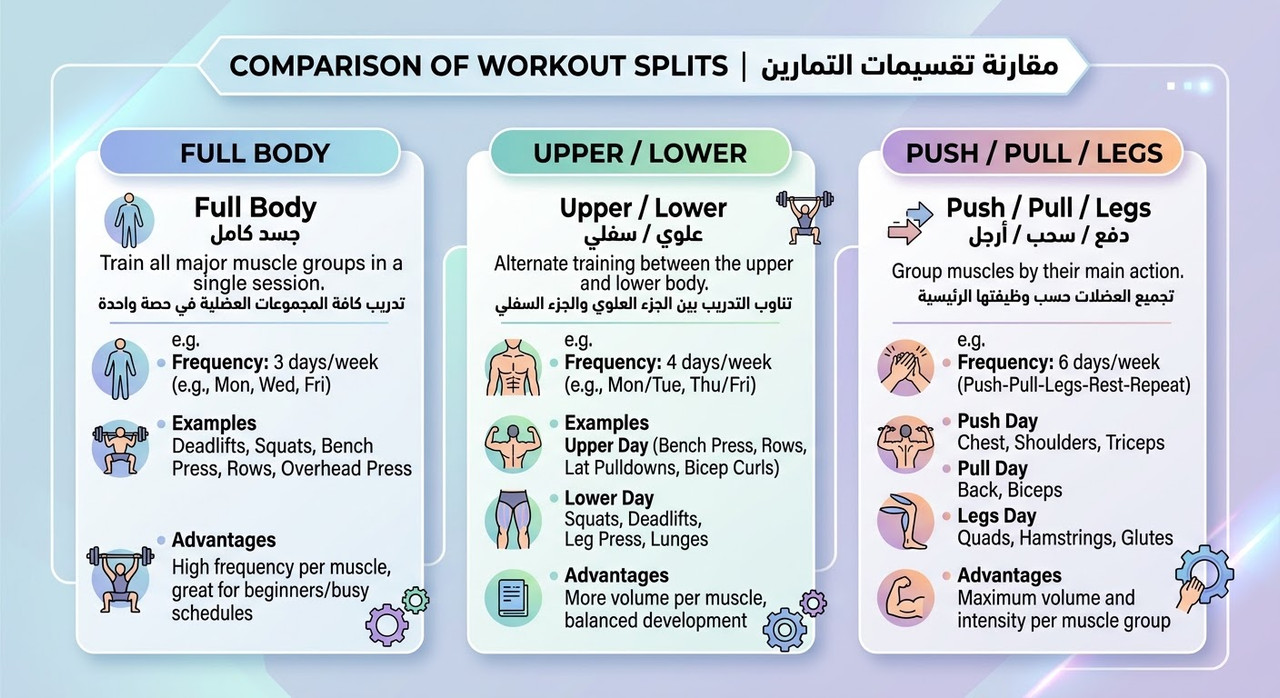
Full Body (3 Days Per Week)
Best for: Beginners, busy professionals, and anyone training fewer than 4 days weekly.
A well-designed full-body routine hits each muscle group 3x weekly, allowing frequent practice of compound lifts without excessive per-session volume. With 5–6 exercises per session, you can accumulate 15–18 weekly sets per major muscle group while keeping each workout under 60 minutes.
Upper/Lower Split (4 Days Per Week)
Best for: Intermediate lifters seeking a balance of frequency and volume.
The upper/lower split is perhaps the most evidence-aligned structure for intermediate hypertrophy training. Research shows that when weekly volume is equated, training a muscle group 2x per week produces equal or superior hypertrophy compared to 1x weekly (Schoenfeld et al., 2019). At moderate volumes (10–20 sets per muscle weekly), an upper/lower split caps at roughly 10 fractional sets per muscle per session—well within productive limits (Nuckols, 2025).
Push/Pull/Legs (5–6 Days Per Week)
Best for: Advanced lifters with high volume demands and excellent recovery capacity.
At 20+ weekly sets per muscle group, higher frequency becomes necessary to avoid exceeding per-session thresholds. However, traditional PPL run only 2x weekly for each muscle, potentially pushing session volume to 15+ fractional sets for some muscle groups (RP Strength, 2026). This split works best when you can train 5–6 days weekly and manage recovery meticulously.
💡 Still unsure which split fits your lifestyle? Let a certified coach build it for you.
👉 Request your personalized training programExercise Selection: Compound Foundations with Strategic Isolation
Your exercise selection should accomplish three goals: stimulate maximum muscle tissue, manage fatigue intelligently, and address individual weaknesses.
The Compound Lift Framework
Compound movements—squats, deadlifts, bench presses, rows, overhead presses—form the backbone of any effective personalized training program. They allow heavy loading, drive systemic adaptation, and efficiently stimulate multiple muscle groups.
A practical approach: anchor each training session with 1–2 primary compound lifts, then supplement with secondary compounds and isolation work. This balances stimulus magnitude with fatigue management.
Addressing Aesthetic Weaknesses
This is where generic plans fail and custom workout plans excel. Your individual leverage, injury history, and muscle insertion points create unique weak points that require targeted work.
- Lagging delts: Add lateral raises at multiple angles, plus rear delt flyes
- Underdeveloped arms: Direct triceps and biceps work with varying joint angles
- Weak posterior chain: Romanian deadlifts, back extensions, hamstring curls
- Upper chest deficiency: Incline pressing variations before flat pressing
Allocate 4–8 weekly sets to weak-point isolation work on top of your compound volume. This targeted approach is what separates a muscle hypertrophy guide from a random exercise list.
Mastering Progressive Overload: Beyond Adding Weight
Progressive overload is the foundational principle of all adaptation (Damas et al., 2019). But most lifters interpret it too narrowly—they think only about adding plates to the bar.
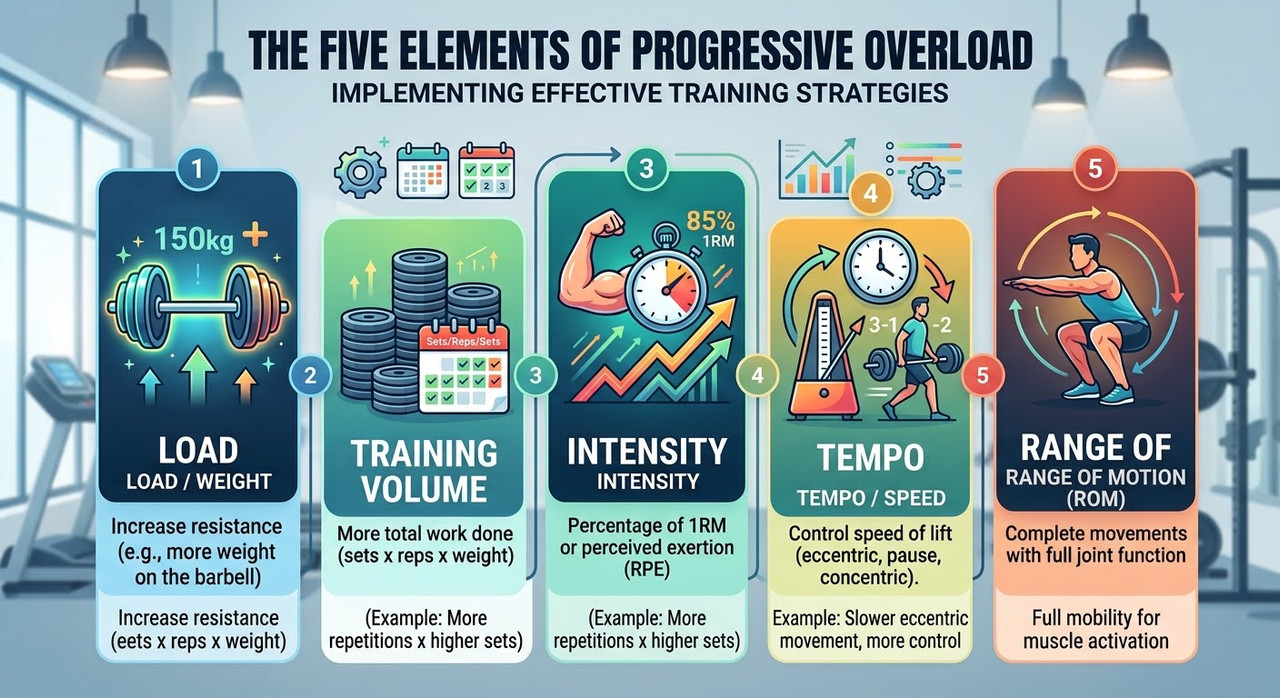
True progressive overload encompasses multiple variables:
Load Progression
The classic approach: when you hit the top of your rep range (e.g., 12 reps), increase weight by the smallest available increment and rebuild reps.
Volume Progression
Adding sets over weeks. This is how you climb from 10 to 20+ weekly sets per muscle group during a training block.
Density Progression
Reducing rest periods while maintaining load and reps. This increases metabolic stress and cardiovascular demand.
Tempo and Time Under Tension
Slowing the eccentric phase (3–4 seconds down) increases mechanical tension and muscle damage—potent hypertrophy drivers.
Range of Motion
Progressively increasing ROM—deeper squats, fuller stretches on flyes—increases stimulus without adding load.
💡 Coach's note: Track every progressive overload variable. Most lifters plateau not because they stop adding weight, but because they stop tracking the other four variables.
The Recovery Equation: Sleep, Protein, and Adaptation
Your workout is the stimulus. Recovery is where adaptation actually happens. Ignore this, and no amount of programming precision will save you.
Sleep: The Anabolic Multiplier
Sleep deprivation impairs myofibrillar protein synthesis, reduces insulin sensitivity, and shifts the anabolic-catabolic balance toward breakdown (Skurvydas et al., 2020). In a calorie deficit, sleeping 5.5 hours versus 8 hours shifts fat loss from 50% to just 25%—meaning more of your weight loss comes from muscle (Knowles et al., 2018).
Target: 7–9 hours of quality sleep. Optimize sleep hygiene: cool room, dark environment, consistent schedule, no screens 30 minutes before bed.
Protein: The Building Material
Current evidence places optimal protein intake for hypertrophy at 1.6–2.2 g/kg bodyweight daily (Morton et al., 2018). The benefit plateaus around 1.6 g/kg for most individuals, with some responding up to 2.2 g/kg.
Distribution matters. Spreading protein across 3–4 meals at roughly 0.4 g/kg per meal supports muscle repair more effectively than one large bolus (Cronometer, 2026). For a 70 kg lifter, that's approximately 28 g protein per meal.
Hydration
Even mild dehydration (2% body weight loss) impairs strength performance and recovery. Aim for 35–45 ml per kg bodyweight daily, adjusted for training volume and climate.
Frequently Asked Questions
How long should a custom workout plan last before I change it?
Run a structured program for 8–12 weeks before major changes. This allows progressive overload to accumulate and gives you enough data to assess what's working. Minor exercise substitutions can happen sooner if an exercise causes pain or isn't producing results.
Can I build muscle and lose fat simultaneously with a custom plan?
Yes—especially if you're new to training, returning from a layoff, or carrying higher body fat. Prioritize protein, maintain a modest calorie deficit, and keep training volume high. The leaner you become, the harder simultaneous recomposition gets (Robinson et al., 2024).
How many days per week should I train?
Most people see excellent results with 3–4 training days weekly. The deciding factor is your ability to accumulate sufficient volume per muscle group without exceeding per-session limits. If you're doing 20+ sets per muscle weekly, you'll likely need 4+ days to distribute that volume productively (Gentil et al., 2018).
What if I miss a workout?
Don't try to "make it up" by cramming two sessions together. Simply resume your plan at the next scheduled session. Your weekly volume will dip slightly, but consistency over months matters far more than perfection in any single week.
References
- Schoenfeld, B. J., Ogborn, D., & Krieger, J. W. (2017). Dose-response relationship between weekly resistance training volume and increases in muscle mass. Journal of Sports Sciences, 35(11), 1073–1082.
- Israetel, M. (2025). Optimal Amount of Working Sets for Growing Bigger Muscles. Men's Fitness.
- RP Strength. (2026). Training Frequency Decoded: The 11-Set Rule Every Lifter Should Know.
- Schoenfeld, B. J., Grgic, J., & Krieger, J. (2019). Resistance Training Volume Enhances Muscle Hypertrophy but Not Strength in Trained Men. Journal of Sports Sciences.
- Nuckols, G. (2025). How Often Should I Train to Maximize Gains in Muscle Size and Strength? Examine.com.
- Damas, F., Angleri, V., & Phillips, S. M. (2019). Individual Muscle Hypertrophy Responses to Resistance Training. European Journal of Sport Science.
- Gentil, P., Fisher, J., & Steele, J. (2018). Effects of Resistance Training Frequency on Muscular Adaptations in Well-Trained Men. Journal of Strength and Conditioning Research.
- Morton, R. W., Murphy, K. T., & McKellar, S. R. (2018). A Systematic Review of Protein Supplementation and Resistance Training. British Journal of Sports Medicine.
- Robinson, Z., Pelland, L., & Remmert, J. (2024). Meta-Analysis on Training Volume and Frequency for Hypertrophy. Sports Medicine.
- Skurvydas, A., Zlibinaite, L., & Solianik, R. (2020). Sleep Deprivation and Muscle Recovery. Biology of Sport.
- Knowles, O. E., Drinkwater, E. J., & Pyne, D. B. (2018). Inadequate Sleep and Muscle Strength. Journal of Science and Medicine in Sport.
- Cronometer. (2026). Protein, Energy, and Glycogen: The Three Baselines Under Every Training Plan.
Continue Your Education
Final Thoughts: Your Body Deserves a Custom Plan
Generic programs produce generic results. The lifters who transform their physiques—who actually break plateaus and build the body they want—are the ones who treat their training as a personal science project, not a template off the internet.
You now have the framework: volume, splits, exercise selection, progressive overload, and recovery. Apply these principles with consistency, and you'll outpace 95% of gym-goers.
🚀 Stop wasting time on generic templates. Take control of your progress today with a 100% personalized training program designed for maximum results:
📲 Fill out the application form to claim your custom workout routine
Join the conversation