How Much Weight Should You Add Each Week? Progressive Overload Guide
How Much Weight Should You Add Each Week to Your Lifts?

🏋️ TL;DR
Knowing how much weight you should add each week to your lifts is the difference between consistent gains and injury. The answer depends entirely on your training experience. A 2022 expert breakdown suggests beginners can add 2.5-3% per week, intermediates 1-1.5%, and advanced lifters just 0.5-1% . A Cleveland Clinic sports medicine physician recommends the "2-5 rep rule": if you can do 5+ more reps on your last set, it's time to add 5 pounds . For most, this means small, sustainable jumps of 2.5-5 lbs on upper body lifts and 5-10 lbs on lower body lifts . When linear progress stalls, techniques like volume step-loading (adding sets while keeping weight constant) or autoregulation using RPE can drive continued gains . This guide breaks down the numbers, the science, and the strategies to keep your lifts climbing.
1. The Progression Puzzle: How Fast Is Too Fast?
You walk into the gym, load the bar, and hit your sets. Next week, you add 5 pounds. The week after, another 5. This is the dream of linear progression—endless weekly gains. But for most lifters, reality eventually intervenes. The bar slows down, form crumbles, and that 5-pound jump feels like 50.
The question of how much weight should you add each week to your lifts doesn't have a single answer. It depends on your experience level, the lift itself, your recovery, and the programming strategy you're using . Research and coaching experience have given us clear guidelines for sustainable progression. Adding weight too fast leads to injury and burnout; adding too slowly leaves gains on the table . This guide provides the evidence-based numbers and strategies to keep you progressing safely.
2. The Science: Why Progression Slows Over Time
2.1. Neurological vs. Structural Adaptations
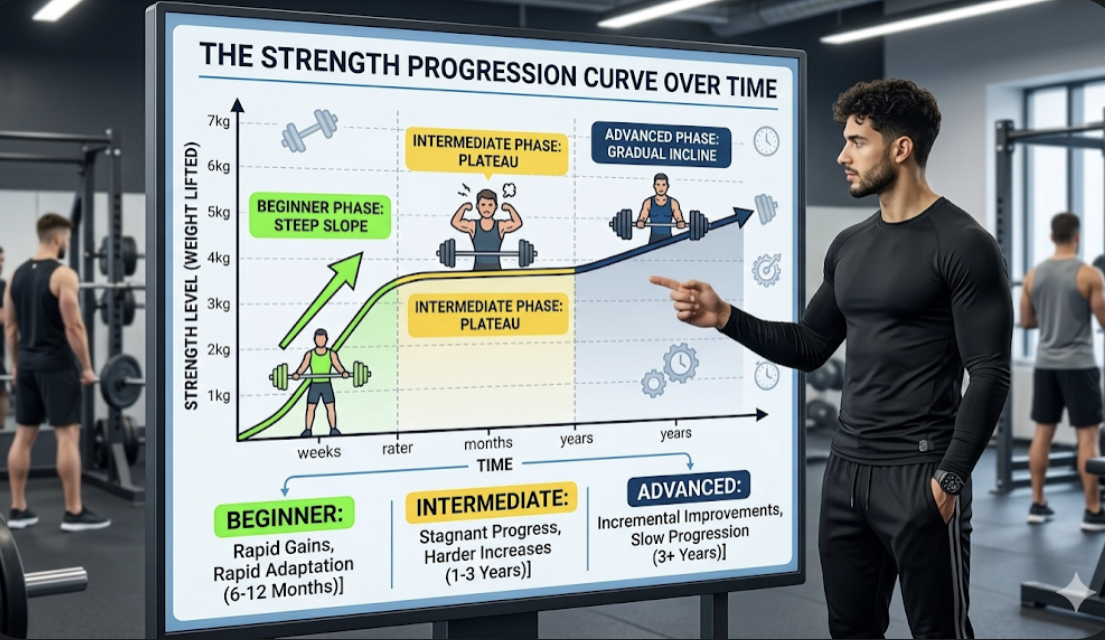
Early gains in strength are largely neurological. Your nervous system learns to recruit motor units more efficiently, improving coordination and force production without significant muscle growth . This is why beginners can add weight rapidly. As you advance, further strength gains require structural changes—actual muscle hypertrophy—which is a slower process .
2.2. The SRA Cycle
Every training session creates Stress, followed by Recovery, and then Adaptation (the SRA cycle). As weights get heavier, the stress increases and recovery takes longer. Beginners may recover in 24-48 hours, allowing session-to-session progress. Intermediates need 48-72 hours, and advanced lifters may require a week or more to fully recover from a maximal stress .
2.3. Percentage-Based Progression Rates
Fitness expert Christian Thibaudeau provides these estimated weekly strength gains based on experience level :
- Newbies: 2.5 to 3% per week
- Beginners: 1.5 to 2% per week
- Intermediate: 1.0 to 1.5% per week
- Advanced: 0.5 to 1.0% per week
- Elite: 0.25 to 0.5% per week
For a 200lb squatter, a 1% gain is just 2 pounds per week. This illustrates why advanced lifters need patience and smaller incremental jumps .
| Experience Level | Weekly Gain (%) | Example (200lb Squat) |
|---|---|---|
| Newbie | 2.5 - 3% | +5 - 6 lbs/week |
| Beginner | 1.5 - 2% | +3 - 4 lbs/week |
| Intermediate | 1.0 - 1.5% | +2 - 3 lbs/week |
| Advanced | 0.5 - 1.0% | +1 - 2 lbs/week |
| Elite | 0.25 - 0.5% | +0.5 - 1 lbs/week |
3. When to Add Weight: The 2-5 Rep Rule
3.1. The Cleveland Clinic Protocol
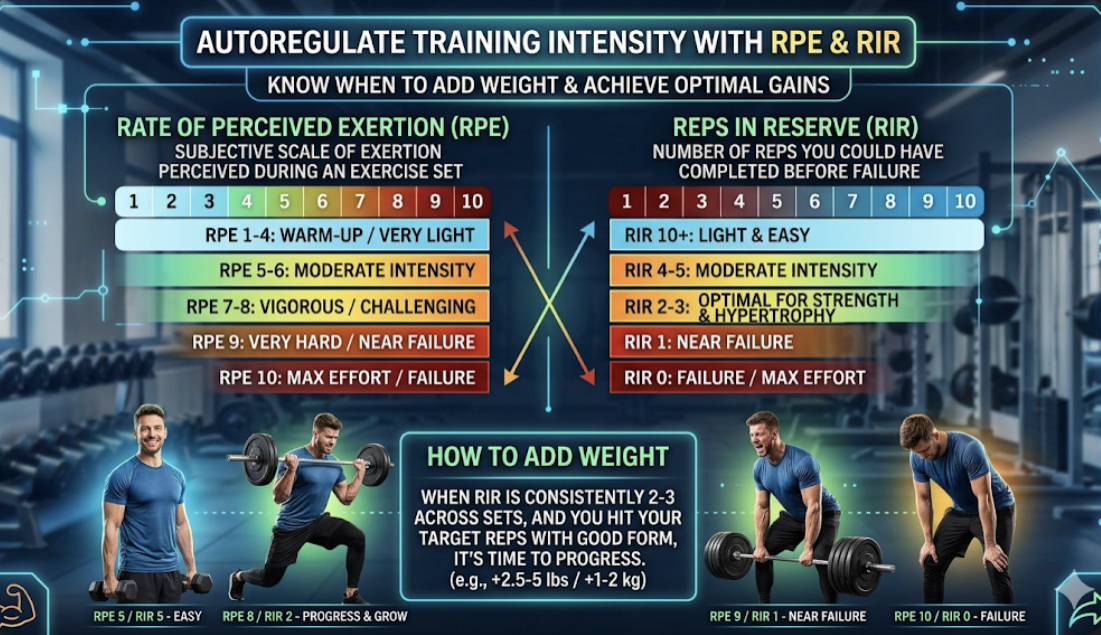
Dr. Dominic King, a sports medicine physician at Cleveland Clinic, offers a simple, practical guideline for when to increase weight: "Dr. King recommends adding 5 pounds of weight to a lift if you feel like you could do at least five more repetitions on your last set." . This "five more reps" feeling indicates you've adapted to the current load and can handle more.
In a progressive overload workout plan, this might look like:
- Week 1: Perform bicep curls with 5 pounds.
- Week 3: Perform bicep curls with 10 pounds.
- Week 5: Perform bicep curls with 15 pounds .
3.2. Using Reps in Reserve (RIR)
Another method is the RIR scale, which represents the number of reps you could have completed before failure . To see progress, challenge yourself to at least a 2 RIR—meaning at the end of your set, you could have pushed for two more reps . When your perceived exertion drops and things feel easier, you know you can increase intensity .
4. Practical Weight Increments: Upper vs. Lower Body
4.1. General Guidelines
While percentages are useful, they need to be translated into actual plates on the bar. Here are practical, experience-based recommendations :
- Upper Body Lifts (Bench Press, Overhead Press, Rows): 2.5 to 5 pounds per week. The smaller muscles involved recover more slowly .
- Lower Body Lifts (Squat, Deadlift): 5 to 10 pounds per week. Larger muscle groups can handle slightly larger jumps .
4.2. The Problem with Standard Plates
The smallest plate in most gyms is 2.5 lbs (1.25 kg), which adds 5 lbs to the bar total. For an advanced lifter needing a 2 lb gain, a 5 lb jump is over double the optimal stimulus. This is why investing in microplates (0.5 lb or 1 lb) or using fractional plates can be a game-changer for intermediate and advanced lifters .
5. Beyond Linear Progression: What to Do When Gains Stall
5.1. Volume Step-Loading
When you can't add weight every week, you can still progress by adding volume. Christian Thibaudeau's "volume step-loading" method involves keeping the weight constant while gradually increasing sets and decreasing rest over several weeks .
A sample 7-week progression for a main lift:
- Week 1: 4 x 5, 180 sec rest
- Week 2: 5 x 5, 165 sec rest
- Week 3: 6 x 5, 150 sec rest
- Week 4: 7 x 5, 135 sec rest
- Week 5: 8 x 5, 120 sec rest
- Week 6: 9 x 5, 105 sec rest
- Week 7: 10 x 5, 90 sec rest
After this block, you can reset and attempt a new 5-10 lb weight increase, which will feel more manageable due to improved work capacity and technical efficiency .
5.2. Wave (Undulating) Progression
Once linear gains stall, "start planning some fluctuation into training." Decrease volume, increase intensity, change your training, and repeat . This periodized approach allows for longer-term progress by cycling different training phases.
6. Nutrition: Fueling Weekly Gains
You can't add weight to the bar if you're not adding fuel to your body. Protein and total calories are critical for recovery and growth.
6.1. Protein Requirements
For individuals engaging in regular strength training, a daily intake of 1.6 to 2.2 grams of protein per kilogram of body weight is widely recommended . A 70 kg person should consume between 112 and 154 g of protein per day .
6.2. Protein Distribution
Spreading protein evenly across 3-5 meals helps maximize muscle protein synthesis. Aim for 0.4 to 0.55 g/kg per meal . For a 70 kg person, that's 28–38 g per meal .
6.3. Sample 3000-Calorie Strength-Building Day
- Breakfast (7 AM): 3 eggs, 1 cup oatmeal with berries, 1 cup whole milk. (550 kcal, 35g protein)
- Morning Snack: 1 cup Greek yogurt with 1 tbsp honey and 1 oz almonds. (350 kcal, 20g protein)
- Lunch (1 PM): 200g grilled chicken breast, 1.5 cups brown rice, roasted vegetables with 1 tbsp olive oil. (700 kcal, 45g protein)
- Pre-Workout Snack: 1 banana with 1 tbsp peanut butter. (200 kcal, 5g protein)
- Post-Workout Shake: 2 scoops whey protein, 1 cup milk, ½ cup oats. (450 kcal, 50g protein)
- Dinner (8 PM): 200g salmon, 1 large sweet potato, large salad. (600 kcal, 40g protein)
- Evening Snack: 1 cup cottage cheese. (200 kcal, 25g protein)
- Total: ~3,050 kcal, ~220g protein
6.4. Vegan/Vegetarian Options
- Protein sources: Tofu, tempeh, seitan, lentils, chickpeas, pea protein powder.
- High-calorie shake: 1 cup soy milk, 1 banana, 2 tbsp peanut butter, 1 scoop pea protein, ¼ cup oats.
- Sample meal: Tofu stir-fry with quinoa and mixed vegetables.
7. Common Progression Mistakes
- Mistake #1: Adding weight every session regardless of performance. This mindset leads to technique breakdown, missed reps, and CNS fatigue .
- Mistake #2: Progressing on multiple lifts simultaneously. Try to progress on one major lift at a time while maintaining others .
- Mistake #3: Ignoring form for the sake of weight. Reinforcing consistent bad form can backfire .
- Mistake #4: Not accounting for external factors. Sleep, nutrition, and stress affect strength performance. Be realistic on bad days .
- Mistake #5: Confusing "max effort" with "good effort." Not every set needs to be a max. Leave 2-3 reps in the tank for most training .
8. Related Resources
9. Scientific References
- Thibaudeau, C. (2022). Get Bigger and Stronger: The Step Loading Method. T-Nation. View Source
- Cleveland Clinic. (2025). Your Simple Guide to Progressive Overload Training. health.clevelandclinic.org. View Source
- Magnante, M. (2025). When Should You Increase Weight on the Barbell? BarBend. View Source
- NDL Pro-Health. (2025). How much protein to eat to gain muscle mass? ndlprohealth.com. View Source
- Men's Health UK. (2025). Progressive Overload Is the Key to Building Muscle and Strength. menshealth.com. View Source
- Hughes DC, Ellefsen S, Baar K. (2018). Adaptations to Endurance and Strength Training. Cold Spring Harb Perspect Med. PMC
- Greig L, et al. (2020). Autoregulation in Resistance Training: Addressing the Inconsistencies. Sports Med. PubMed
- Mangine GT, et al. (2015). The effect of training volume and intensity on improvements in muscular strength and size. Physiol Rep. PubMed
- Affinity Health. (2025). How Much Protein Do You Need To Build Muscle? affinityhealth.co.za. View Source
- Starting Strength Forums. (2018). Discussion on SRA cycle and progression. startingstrength.com. View Source
Join the conversation