How Long Does It Take to Build Noticeable Muscle? (Real Timeline Explained)
How Long Does It Take to Build Noticeable Muscle? (Real Timeline Explained)
⚡ TL;DR
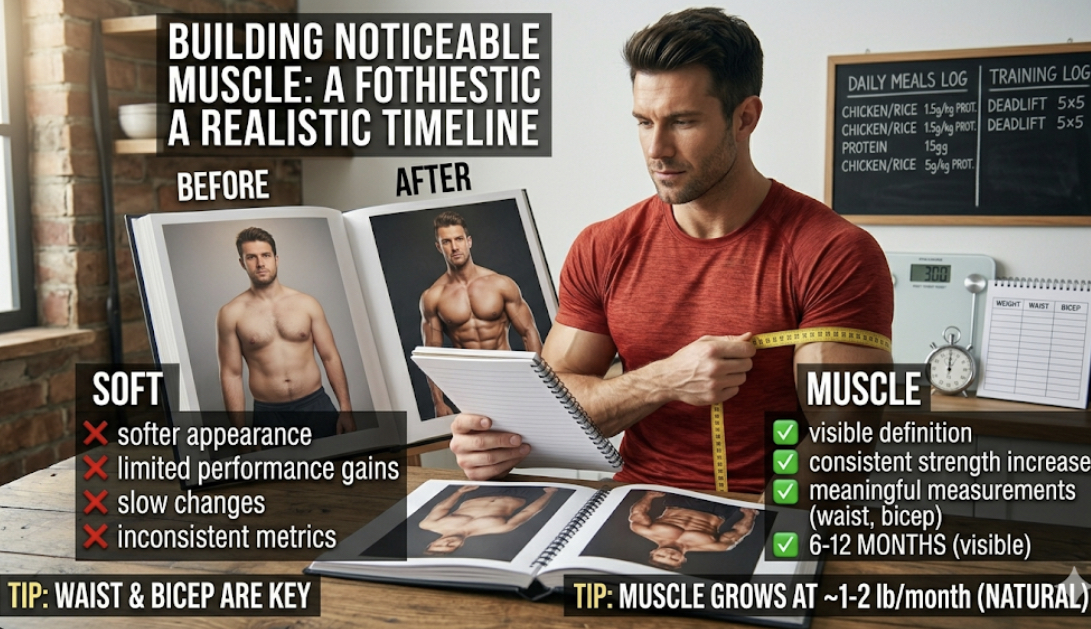
The time it takes to build noticeable muscle depends on your experience level: beginners see visible changes in 4–8 weeks, intermediates in 8–12 weeks, and advanced lifters in 12–16+ weeks. Maximum natural muscle growth rates are: beginners 0.5–1% body weight per month, intermediates 0.25–0.5%, advanced 0.1–0.25% . Consistent training, adequate protein (1.6–2.2 g/kg), proper recovery, and realistic expectations are key. This guide provides a detailed muscle growth timeline and actionable tips to maximize your results.
1. The Impatience Trap: Why Realistic Expectations Matter
You've been training consistently for two weeks. You look in the mirror and see... the same reflection. Frustration sets in. Social media promises "transformations" in 30 days, but the reality of natural muscle growth is slower—and that's okay. Understanding the muscle growth timeline is essential for staying motivated and avoiding burnout.
How long does it take to see muscle growth?
For beginners, you can typically start to see noticeable muscle growth in 4–8 weeks of consistent training with proper nutrition. Early changes include improved muscle definition, strength gains, and better posture. More significant visual changes usually appear after 8–12 weeks. For intermediates, visible changes take 8–12 weeks; for advanced lifters, 12–16+ weeks . The rate of muscle growth declines as you become more experienced.
2. The Science: How Fast Can You Actually Build Muscle?
2.1. Research-Based Maximums
Studies on natural resistance training show that the maximum rate of muscle gain varies by experience level:
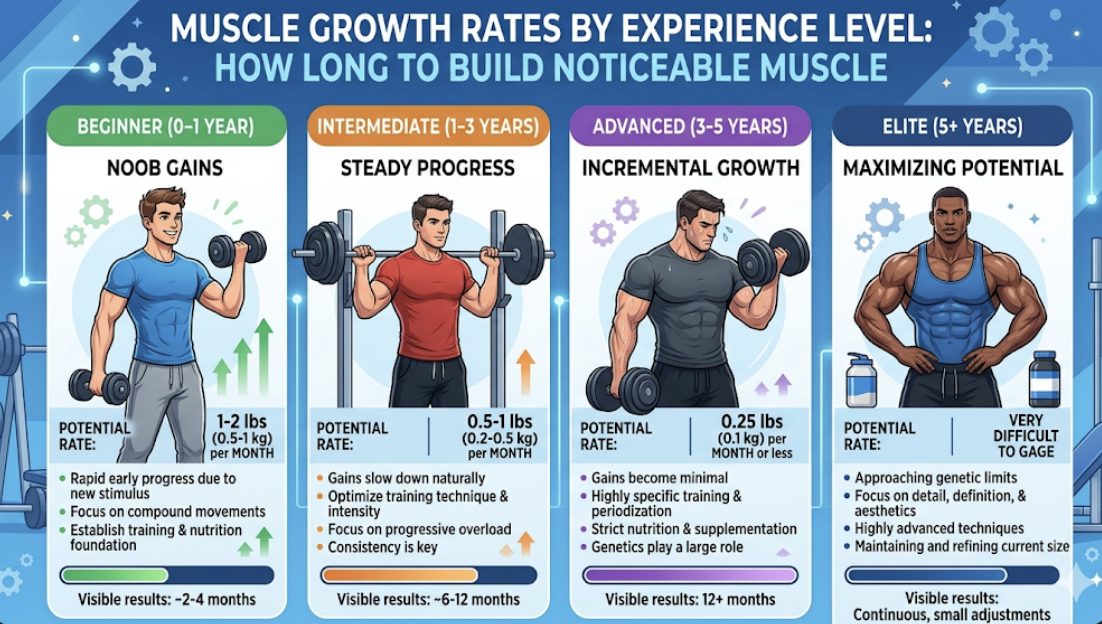
- Beginners (first year): 0.5–1.0% body weight per month (1–2% per month in lean mass gain). For an 80 kg person, that's 0.4–0.8 kg per month.
- Intermediate (1–3 years): 0.25–0.5% body weight per month.
- Advanced (3+ years): 0.1–0.25% body weight per month.
2.2. Why Muscle Growth Slows Down
As you become more trained, your body becomes more efficient at recruiting motor units, and the stimulus required for further growth increases. This is why beginners enjoy "newbie gains"—rapid progress in the first months .
2.3. Strength Gains Come First
In the first 4–8 weeks, most improvements come from neural adaptations—your nervous system learns to activate muscles more efficiently. Strength gains often precede visible muscle growth .
3. Detailed Timeline by Experience Level
3.1. Beginner (0–1 year): 4–12 Weeks for Noticeable Change
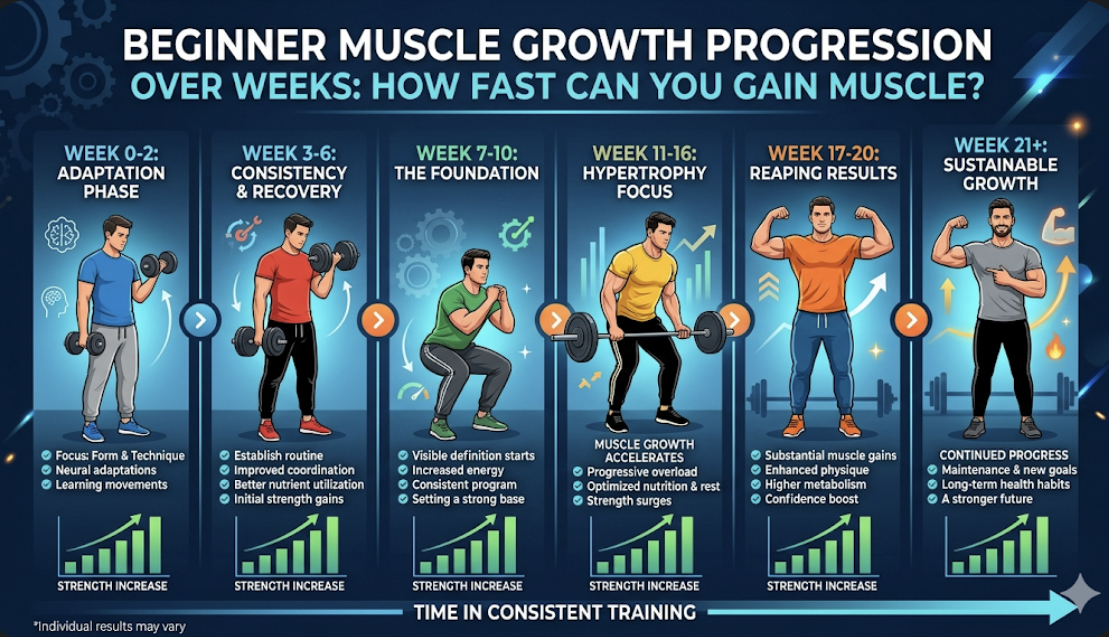
- Weeks 1–4: Neural adaptations. Strength increases, but minimal visible change. Improved energy and workout performance.
- Weeks 4–8: First visible changes. Slight muscle definition, better posture, clothes may fit differently. Strength continues to increase.
- Weeks 8–12: More noticeable muscle growth. Friends and family may comment. Increased confidence in the gym.
- Months 6–12: Significant transformation possible with consistent training and nutrition. Average gain: 10–20 lbs lean mass in first year .
3.2. Intermediate (1–3 years): 8–16 Weeks for Noticeable Change
- Weeks 1–8: Gradual strength increases. Minor visual changes.
- Weeks 8–12: Visible changes become apparent, especially with a focused training block.
- Months 3–6: Noticeable improvements in problem areas with targeted training. Average annual gain: 5–10 lbs lean mass .
3.3. Advanced (3+ years): 12–24 Weeks for Noticeable Change
- Progression slows significantly. Visible changes require longer training blocks (3–6 months).
- Focus on progressive overload and periodization. Small increments in muscle mass (1–3 lbs per year) .
- Visual changes often subtle but meaningful. Improved muscle separation, density, and definition.
| Experience Level | First Noticeable Visual Change | Monthly Muscle Gain (% BW) | Year 1 Lean Mass Gain |
|---|---|---|---|
| Beginner (0–1 year) | 4–8 weeks | 0.5–1.0% | 10–20 lbs (4.5–9 kg) |
| Intermediate (1–3 years) | 8–12 weeks | 0.25–0.5% | 5–10 lbs (2.3–4.5 kg) |
| Advanced (3+ years) | 12–16+ weeks | 0.1–0.25% | 1–3 lbs (0.5–1.4 kg) |
4. 7 Factors That Speed Up (or Slow Down) Muscle Growth
4.1. Training Consistency
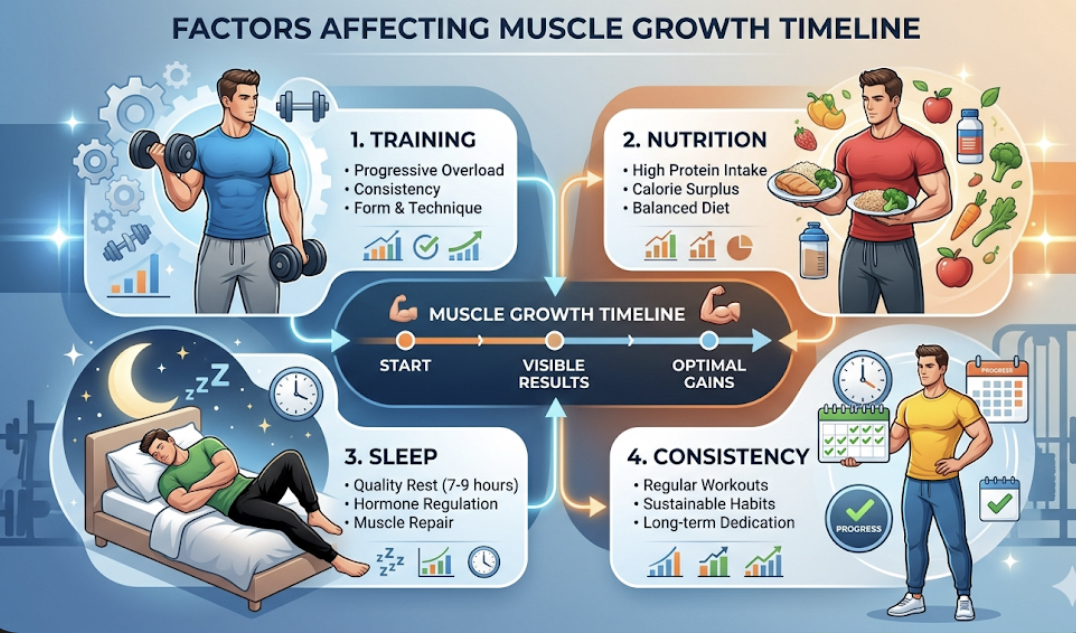
Missed workouts = missed growth. Consistency over months is the #1 predictor of success. Aim for 3–5 sessions per week without long breaks .
4.2. Progressive Overload
Without adding weight, reps, or sets, your muscles have no reason to grow. Track your lifts and aim to progress weekly .
4.3. Nutrition: Calories and Protein
Adequate calories (moderate surplus) and protein (1.6–2.2 g/kg) are essential. Under-eating is the most common reason for stalled growth .
4.4. Sleep and Recovery
Muscle repair happens during sleep. <7 hours impairs growth. Aim for 7–9 hours nightly .
4.5. Training Volume
10–20 sets per muscle group per week is optimal. Too little = no stimulus; too much = overtraining .
4.6. Genetics
Some individuals respond better to training (high responders vs low responders). This can account for 2–3x differences in growth rates .
4.7. Age and Hormones
Testosterone and growth hormone decline with age, but older lifters can still build significant muscle with proper training .
5. Sample Nutrition to Maximize Muscle Growth
5.1. Omnivore Plan – 2,800 kcal, 160g Protein (for 75 kg beginner)
- Breakfast (7:30): 4 eggs, 1 cup oatmeal with 1 tbsp peanut butter, 1 banana (650 kcal, 40g protein)
- Lunch (12:30): 200g grilled chicken breast, 1.5 cups brown rice, 1 cup broccoli, 1 tbsp olive oil (650 kcal, 50g protein)
- Snack (4:00): 200g Greek yogurt, 1 cup berries, 1 oz almonds (350 kcal, 25g protein)
- Dinner (7:30): 200g salmon or lean beef, 1.5 cups sweet potato, 2 cups mixed greens (650 kcal, 45g protein)
- Evening (10:00): 200g cottage cheese, 1 tbsp honey (250 kcal, 20g protein)
5.2. Vegan/Vegetarian Plan – 2,800 kcal, 150g Protein
- Breakfast: Tofu scramble (200g firm tofu), 1.5 cups oatmeal with 2 tbsp peanut butter, banana (700 kcal, 40g protein)
- Lunch: 200g tempeh, 1.5 cups quinoa, 1 cup roasted chickpeas, mixed greens (700 kcal, 45g protein)
- Snack: 200g silken tofu with berries, 2 tbsp hemp seeds (300 kcal, 20g protein)
- Dinner: 1.5 cups cooked lentils, 1.5 cups sweet potato, 150g edamame, 1 tbsp olive oil (650 kcal, 35g protein)
- Evening: 1 cup unsweetened soy milk + 1 tbsp chia seeds (150 kcal, 10g protein)
Gluten-Free Options
- Use certified gluten-free oats, quinoa, rice, or buckwheat.
- Ensure tempeh and tofu are gluten-free certified (most are).
6. Quick Recipes to Support Muscle Growth
- Post-Workout Smoothie (400 kcal, 30g protein): 1 cup Greek yogurt, 1 banana, 1 tbsp peanut butter, 1 cup oat milk.
- Protein Oatmeal (450 kcal, 25g protein): 1 cup oats, 1 scoop whey/pea protein, 1 tbsp peanut butter, 1 tbsp honey.
- Chicken Rice Bowl (550 kcal, 45g protein): 150g chicken breast, 1 cup brown rice, 1 cup broccoli, soy sauce.
- Lentil Soup (400 kcal, 20g protein): 1 cup lentils, vegetable broth, carrots, celery, onion.
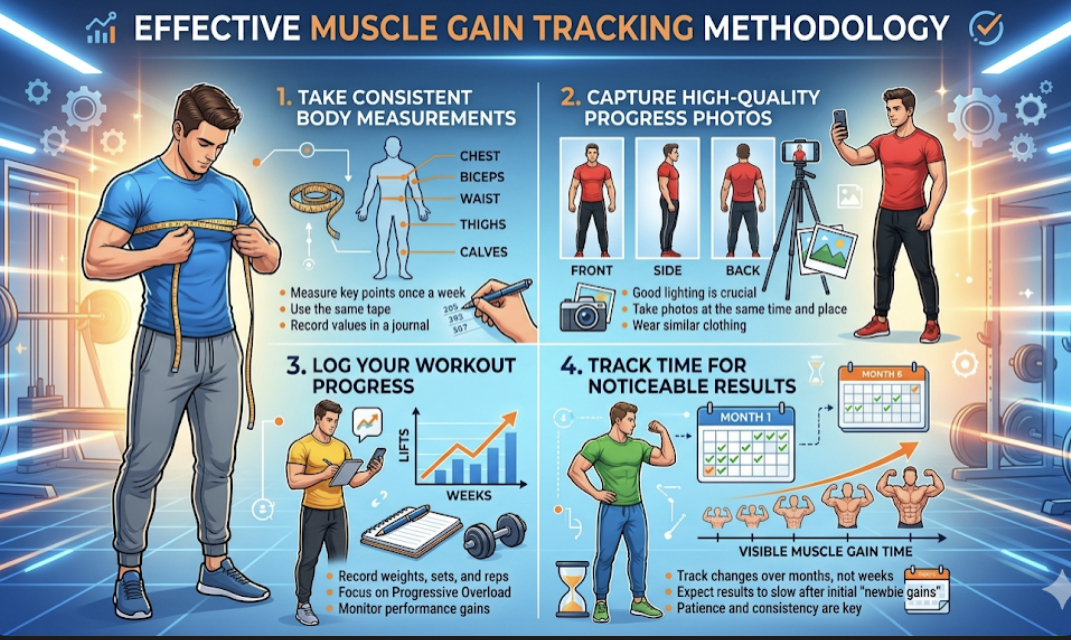
7. How to Track Progress Realistically
- Take progress photos: Same lighting, same poses, every 4 weeks. Visual changes are often subtle but real.
- Track strength gains: If your lifts are going up, you're building muscle—even if the mirror doesn't show it yet.
- Measure key areas: Arms, chest, thighs—growth here indicates muscle gain.
- Monitor waist: Stable or shrinking waist with weight gain = muscle, not fat.
- Don't obsess over daily scale weight: Look at 4-week averages.
8. Common Mistakes That Slow Muscle Growth
- Mistake #1: Inconsistent training. Missing weeks resets progress.
- Mistake #2: Not eating enough. Muscle requires energy. In a deficit, growth is limited.
- Mistake #3: Too little protein. Below 1.6 g/kg, muscle protein synthesis is suboptimal.
- Mistake #4: No progressive overload. Lifting the same weight = no growth stimulus.
- Mistake #5: Poor sleep. Growth happens during rest, not training.
- Mistake #6: Comparing yourself to others (especially social media). Genetics, lighting, and often unrealistic standards.
9. Frequently Asked Questions
How long does it take to see muscle growth?
Beginners: 4–8 weeks for first noticeable changes. Intermediates: 8–12 weeks. Advanced: 12–16+ weeks.
How much muscle can I gain in a month?
Beginners: 0.5–1% of body weight per month (0.4–0.8 kg for 80 kg person). Intermediates: 0.25–0.5%. Advanced: 0.1–0.25%.
Why am I gaining strength but not muscle?
Early strength gains come from neural adaptations. Give it 4–8 weeks—muscle growth typically follows strength increases.
How much protein do I need to build muscle?
1.6–2.2 grams per kilogram of body weight daily. For a 75 kg person, that's 120–165 grams of protein per day.
Can I build muscle in a calorie deficit?
Yes, if you're a beginner, have higher body fat, or are returning after a break. For advanced lifters, a surplus is usually needed.
How long do newbie gains last?
Typically 6–12 months of consistent training. During this period, you'll see the fastest rate of muscle growth.
Do genetics affect how fast I build muscle?
Yes, genetics can account for 2–3x differences in growth rates. Focus on what you can control: training, nutrition, and recovery.
10. Related Resources
- How Much Weight Should You Add Each Week? Progressive Overload Guide
- Mind-Muscle Connection: How to Train Your Brain for Better Muscle Gains
- Why Your Muscles Look Smaller After a Workout (And How to Fix It Fast)
- Ectomorph Diet Guide: How to Eat 3000 Calories of Whole Foods for Muscle Gain
- How to Break Through a Squat Plateau Naturally and Increase Strength
11. Scientific References
- Morton, R. W., et al. (2018). A systematic review, meta-analysis and meta-regression of the effect of protein supplementation on resistance training-induced gains in muscle mass and strength in healthy adults. British Journal of Sports Medicine, 52(6), 376–384. PubMed
- Slater, G. J., et al. (2019). Is an Energy Surplus Required to Maximize Skeletal Muscle Hypertrophy Associated With Resistance Training? Frontiers in Nutrition, 6, 131. PubMed
- Helms, E. R., et al. (2014). Evidence-based recommendations for natural bodybuilding contest preparation. Journal of the International Society of Sports Nutrition, 11(1), 20. PubMed
- Schoenfeld, B. J., et al. (2017). Effects of Resistance Training Frequency on Measures of Muscle Hypertrophy: A Systematic Review and Meta-Analysis. Sports Medicine, 46(11), 1689–1697. PubMed
- Phillips, S. M. (2014). A brief review of higher dietary protein diets in weight loss: a focus on athletes. Sports Medicine, 44(Suppl 2), S149–S153. PubMed
- Aagaard, P., et al. (2002). Neural adaptation to resistance training: changes in evoked V-wave and H-reflex responses. Journal of Applied Physiology, 92(6), 2309–2318. PubMed
- ACSM. (2021). Nutrition and Athletic Performance. Medicine & Science in Sports & Exercise, 53(3), 600–618. PubMed
Join the conversation