Mind-Muscle Connection: How to Train Your Brain for Better Muscle Gains
The Mind-Muscle Connection: Training Your Brain for Better Gains

🧠 TL;DR
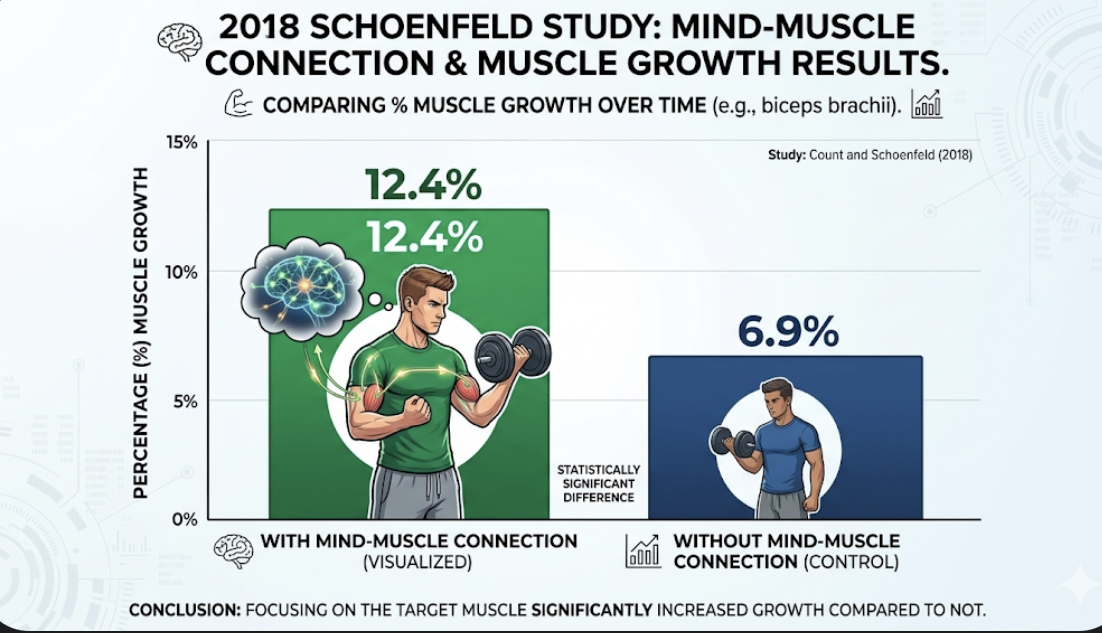
The mind-muscle connection (MMC) is the ability to deliberately focus on a specific muscle during an exercise to enhance its activation . Research confirms it works: a 2018 study found that subjects who used MMC during bicep curls gained 12.4% in muscle size over eight weeks, compared to 6.9% for those who didn't . The mechanism involves enhanced neural drive, increased acetylcholine release at the neuromuscular junction, and better motor unit recruitment . However, it works best with lighter loads (<60% 1RM), isolation exercises, and for hypertrophy goals. For heavy compound lifts and power training, an external focus is superior . This guide covers the science, the 2018 Schoenfeld study, and six actionable techniques to train your brain for better gains.
1. The Brain Gym: Why Focus Matters
What if I told you that you could use your mind to lift more weight and get better results? If you've ever watched a seasoned bodybuilder train, you might notice a deliberate, almost meditative focus on every rep. They're not just moving weight—they're feeling it, visualizing it, and consciously commanding their muscles to work .
This is the mind-muscle connection (MMC), and it's not just motivational talk. Research shows that the stronger the signal from your brain to your muscles, the greater the activation, and ultimately, the better your gains . Understanding the mind-muscle connection: training your brain for better gains can be the missing link between a good workout and a great one. This guide explores the neuroscience, the key studies, and the practical steps to develop this powerful skill.
2. The Science: How Your Brain Talks to Your Muscles
2.1. The Neuromuscular Junction
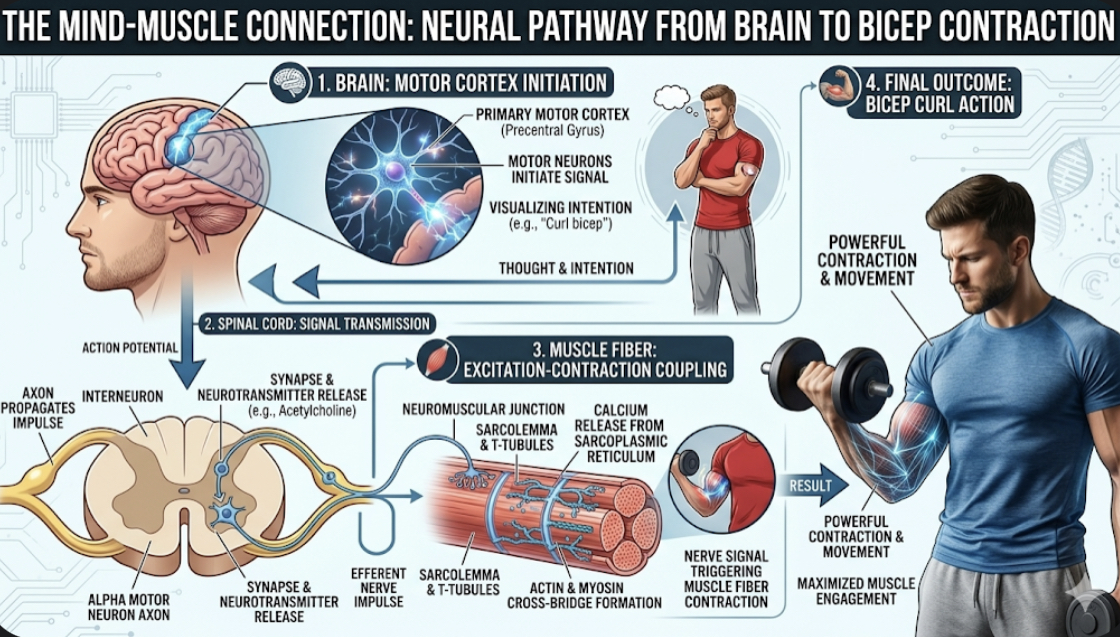
Every voluntary movement begins in your brain's motor cortex. From there, signals travel down your spinal cord and through motor neurons to your muscles. The point where a nerve meets a muscle fiber is called the neuromuscular junction. Here, a neurotransmitter called acetylcholine is released, telling the muscle to contract . The mind-muscle connection is about consciously influencing this process to ensure the signal is as strong and precise as possible .
2.2. Motor Unit Recruitment
A motor unit consists of a motor neuron and all the muscle fibers it innervates. When you focus internally on a specific muscle, you can increase the number of motor units recruited and the rate at which they fire . This is especially effective at lighter loads, where the nervous system has the "bandwidth" to prioritize specific muscles over simply moving the weight .
2.3. The 2018 Schoenfeld Study: Proof of Concept
The most compelling evidence for MMC comes from a 2018 study led by renowned researcher Brad Schoenfeld, published in the European Journal of Sports Science . Researchers divided men into two groups doing the same eight-week training program. One group was instructed to focus on "squeezing the muscle" during bicep curls (internal focus), while the other was told to simply "get the weight up" (external focus). The results were striking: the internal focus group gained 12.4% in muscle thickness, nearly double the 6.9% gain of the external focus group . This demonstrates that simply directing your attention can significantly amplify hypertrophic outcomes.
3. Internal vs. External Focus: When to Use Each
3.1. Internal Focus
Internal focus means concentrating on the muscle you're trying to work—thinking about your bicep contracting during a curl, or your pec squeezing at the top of a press . This is the essence of the mind-muscle connection. Research shows it's particularly effective for:
- Hypertrophy training with light to moderate loads (<60% 1RM)
- Isolation exercises like curls, lateral raises, and flyes
- Targeting stubborn muscles that are hard to "feel" (like rear delts or lower traps)
- Rehabilitation when retraining specific muscle activation patterns
3.2. External Focus
External focus is about the result of the movement—like pushing the floor away during a squat, or moving the bar from point A to B . This strategy consistently improves force production, power, and movement efficiency . It's superior for:
- Strength and power training with near-maximal loads
- Compound movements like deadlifts, squats, and Olympic lifts
- Explosive and athletic performance
- Beginners still learning proper movement patterns
4. 6 Proven Techniques to Train Your Mind-Muscle Connection
4.1. Use Internal Cues
Instead of thinking "lift the weight," think "squeeze the muscle." Practice cues like "stretch the lats at the bottom and squeeze at the top" for pulldowns, or "feel the glutes contract" for hip thrusts . Over time, these cues become second nature.
4.2. Slow Down the Eccentric Phase
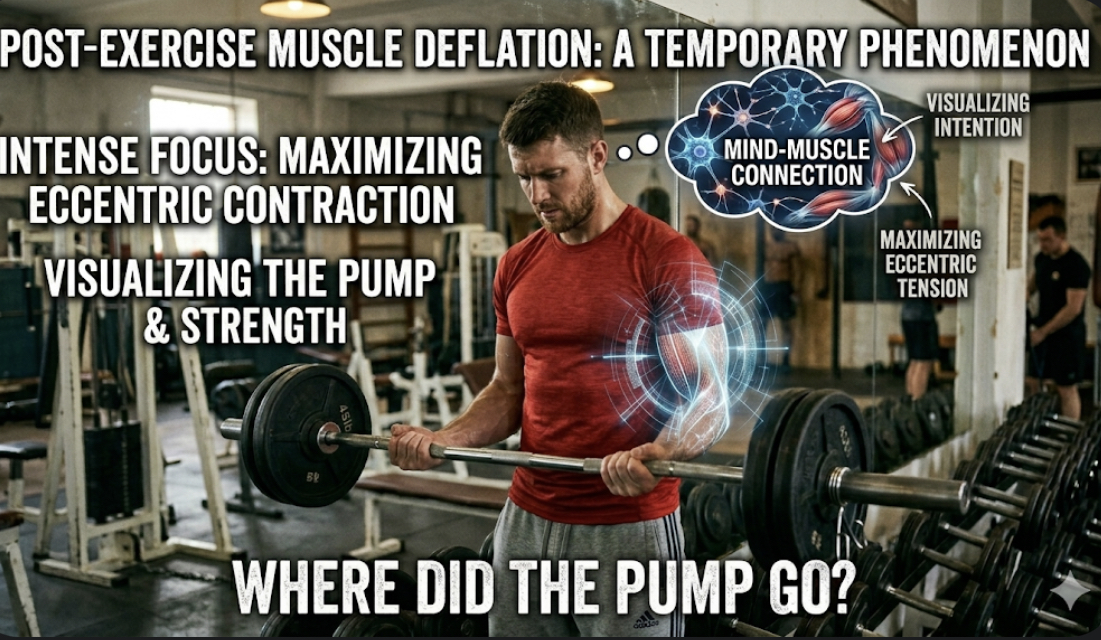
Slowing down the lowering phase (eccentric) gives your CNS more time to engage the muscle mindfully and eliminates momentum . Use a 3-4 second tempo on the eccentric portion of lifts like bench press, curls, and squats. This increases mechanical tension and reinforces proprioceptive feedback .
4.3. Pre-Activate with Isolation Work
Starting with isolation exercises can "wake up" the target muscle before compound lifts—a principle known as pre-exhaustion . For example, do leg extensions before squats to elevate quad awareness, or cable flyes before bench pressing to activate the pecs. Keep the intensity moderate; the goal is neural activation, not fatigue .
4.4. Use Lighter Weights with Higher Control
For developing MMC, lighter loads (50-65% of 1RM) allow better focus. A 2015 study by Calatayud et al. showed that using submaximal loads with intentional contraction led to higher EMG activity in the pecs compared to heavier loads . Prioritize contraction quality over weight, and work in the 12-20 rep range.
4.5. Pose and Flex Between Sets
Isometric contractions like flexing between sets improve neuromuscular efficiency . After each set, take 15-20 seconds to flex the target muscle—hit a biceps pose, squeeze your quads, or retract your lats. This enhances proprioceptive feedback and primes the muscle for the next set .
4.6. Use Touch and Visualization
Lightly touching or tapping the working muscle can enhance awareness—a technique called "facilitation tapping" used in neurological rehab . Visualizing the muscle contracting and the fibers gliding over one another also helps . As one expert notes, "Picture the muscle getting pumped with blood as you work, and imagine the muscle fibers engaging with each rep" .
4.7. Bonus: Move Away from the Mirror
While mirrors are useful for checking form, relying on them too heavily can mean you're missing out on what you actually feel . Try looking away for a few sets and focusing on internal sensation rather than visual feedback.
5. Sample Mind-Muscle Connection Workout
This workout is designed to build MMC using the principles above. Focus on controlled tempos, internal cues, and lighter loads.
Upper Body Focus
- 1. Cable Flyes (Pre-activation): 3 sets x 15 reps. Cue: "Squeeze the chest at the peak."
- 2. Dumbbell Bench Press: 3 sets x 12-15 reps (60% 1RM). Tempo: 3-0-1-0. Cue: "Feel the pectorals working."
- 3. Lat Pulldown: 3 sets x 12-15 reps. Tempo: 3-0-1-0. Cue: "Stretch at the top, squeeze at the bottom."
- 4. Seated Cable Row: 3 sets x 12-15 reps. Cue: "Drive elbows back and squeeze shoulder blades."
- 5. Dumbbell Bicep Curl: 3 sets x 12-15 reps. Tempo: 3-0-1-0. Cue: "Squeeze the bicep hard at the top."
- 6. Tricep Pushdown: 3 sets x 15 reps. Cue: "Lock out and squeeze triceps."
- Between sets: 15-second isometric flex of the target muscle.
6. Nutrition: Fueling Your Nervous System
A sharp mind-muscle connection requires a healthy nervous system. Certain nutrients play a key role in neurotransmitter synthesis and neural function.
6.1. Choline for Acetylcholine
Acetylcholine is the primary neurotransmitter at the neuromuscular junction . Its precursor is choline, found in egg yolks, beef liver, soybeans, and cruciferous vegetables. Eggs, for example, contain about 1388mg of choline per egg.
6.2. Tyrosine for Neurotransmitters
Tyrosine is an amino acid precursor to dopamine and norepinephrine, which influence focus and drive. Good sources include eggs, salmon, tofu, and pumpkin seeds .
6.3. Omega-3s for Brain Health
Omega-3 fatty acids (DHA and EPA) are structural components of brain cell membranes and support neural communication. Sources include fatty fish (salmon, sardines), walnuts, and flaxseeds.
6.4. Sample 2500-Calorie Neural Health Day
- Breakfast (7 AM): 3-egg omelet with spinach + 1 cup oatmeal with berries + 1 cup whole milk. (600 kcal, 30g protein, rich in choline)
- Lunch (12 PM): 150g grilled salmon + 1 cup quinoa + roasted broccoli + 1 tbsp olive oil. (600 kcal, 35g protein, rich in omega-3s)
- Afternoon Snack (4 PM): Handful of almonds + 1 apple. (200 kcal, 5g protein)
- Pre-Workout (if training): 1 banana with 1 tbsp peanut butter. (200 kcal, 5g protein)
- Dinner (7 PM): 150g lean beef stir-fry with mixed vegetables and 1 cup brown rice. (650 kcal, 40g protein)
- Evening Snack: 1 cup Greek yogurt with 1 tbsp pumpkin seeds. (250 kcal, 20g protein, rich in tyrosine)
- Total: ~2,500 kcal, ~135g protein
6.5. Vegan/Vegetarian Options
- Choline sources: Tofu, broccoli, quinoa, peanuts.
- Tyrosine sources: Pumpkin seeds, soy products, lima beans.
- Omega-3 sources: Walnuts, flaxseeds, chia seeds, hemp seeds.
7. Common Mind-Muscle Connection Mistakes
- Mistake #1: Using MMC with max loads. At >80% 1RM, your focus must shift to external cues to produce force .
- Mistake #2: Expecting overnight results. MMC is a skill that requires consistent practice over weeks and months .
- Mistake #3: Neglecting compound lifts. For strength, external focus is better. Use MMC strategically, not for every rep .
- Mistake #4: Moving too fast. Speed robs you of the time needed to feel the contraction. Slow down .
- Mistake #5: Ignoring the eccentric. The lowering phase is where you can really focus on feeling the muscle stretch and engage .
9. Related Resources
9. Scientific References
- Naked Nutrition. (2025). The Mind-Muscle Connection: Does It Really Work? nakednutrition.com. View Source
- Seynaeve, M., Mantini, D., & de Beukelaar, T. T. (2025). Electrophysiological Approaches to Understanding Brain-Muscle Interactions During Gait: A Systematic Review. Bioengineering, 12(5), 471. PubMed
- Ritchey, C. (2025). This Simple, Underrated Skill Is The Key To Faster Strength Gains. Women's Health. View Source
- Marathon Handbook. (2023). The Mind Muscle Connection: Does It Actually Exist, And What Does It Do? marathonhandbook.com. View Source
- BOXROX. (2025). 6 Mind-Muscle Connection Tips for Better Gains. boxrox.com. View Source
- Triathlete. (2023). Want to Get Stronger? Improve Your Mind-Muscle Connection. triathlete.com. View Source
- Peloton. (2025). How to Tap Into the 'Mind-Muscle Connection'—and Unlock More Strength. onepeloton.com. View Source
- Schoenfeld, B. J., et al. (2018). Effects of resistance training with different muscle action and velocity on muscular adaptations in trained men. Journal of Sports Science and Medicine, 17(4), pp.645–653. View Source
Join the conversation