Beginner Mistakes That Kill Muscle Growth (Avoid These 7 Errors)
Beginner Mistakes That Kill Muscle Growth (Avoid These 7 Errors)

⚡ TL;DR
Most beginners make the same beginner muscle mistakes that sabotage their progress. The top 7 errors: 1) No progressive overload (lifting the same weight forever), 2) Poor nutrition (not enough protein or calories), 3) Insufficient recovery (not sleeping enough), 4) Too much volume (overtraining), 5) Inconsistent training, 6) Ego lifting (bad form), and 7) No tracking progress. Fixing these muscle building errors will unlock newbie gains and set you up for long-term success. This guide shows you exactly how to avoid each mistake and build muscle efficiently.
1. The Newbie's Dilemma: Why Most Beginners Never Grow
You walk into the gym excited, ready to transform your body. You train hard, you sweat, you feel the burn. Yet months later, you look the same. Sound familiar? This is the reality for countless beginners who unknowingly commit mistakes that stop muscle growth. The good news? These are all fixable. This guide reveals the 7 most common muscle building errors and how to correct them.
What mistakes stop muscle growth for beginners?
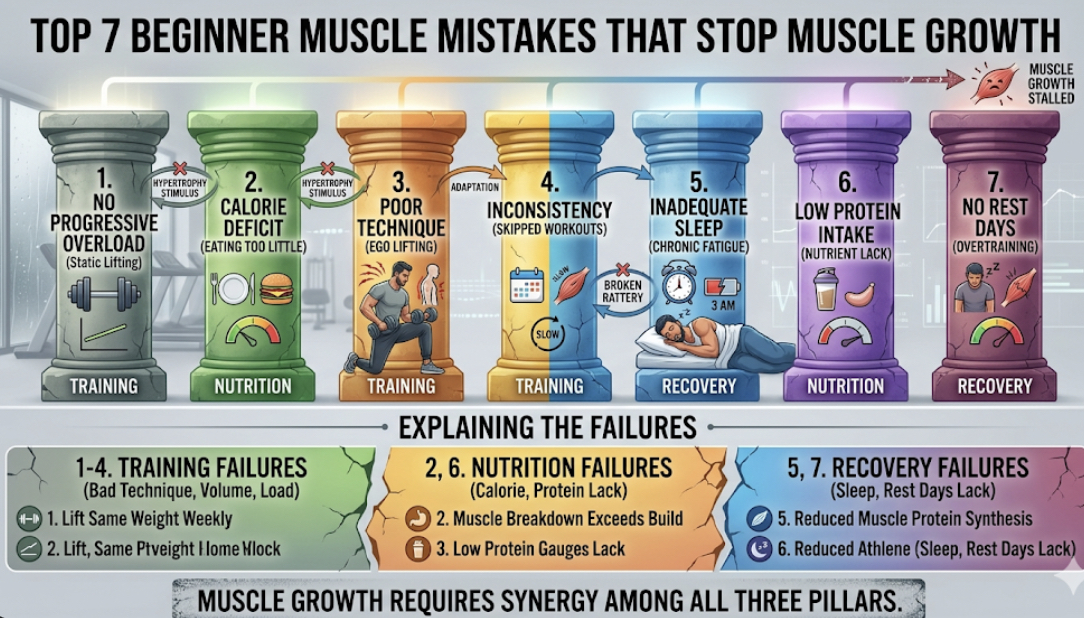
The primary mistakes that stop muscle growth for beginners are: lack of progressive overload (using the same weights week after week), poor diet (insufficient protein and calories), and not enough rest (skimping on sleep and training too frequently without recovery). These three errors alone account for most beginner plateaus. Fixing them—by consistently adding weight/reps, eating 1.6–2.2 g protein per kg body weight, and sleeping 7–9 hours nightly—will reignite growth .
2. Mistake #1: No Progressive Overload – The #1 Growth Killer
2.1. What Is Progressive Overload?
Your muscles grow only when forced to adapt to increasing demands. If you lift the same weight for the same reps week after week, your body has no reason to build new muscle tissue. Progressive overload is the gradual increase of stress placed on the body during exercise—it's the fundamental principle of muscle growth .
2.2. How to Apply It
- Add weight: Increase by 2.5–5 kg when you hit the top of your rep range.
- Add reps: Aim to add 1–2 reps per set before increasing weight.
- Add sets: Add an extra set to your exercises.
- Reduce rest time: Shorten rest between sets (advanced).
3. Mistake #2: Poor Nutrition – Starving Your Gains
3.1. Not Enough Calories
Muscle requires energy to build. If you're in a calorie deficit or eating at maintenance, you won't gain significant muscle (except for beginners or those returning from a break). Research shows that a moderate surplus of 250–500 kcal above maintenance optimizes muscle growth .
3.2. Not Enough Protein
Protein provides the amino acids necessary for muscle protein synthesis. Studies consistently show that intakes below 1.6 g per kg of body weight limit muscle growth . For a 70 kg person, that's at least 112 g of protein daily.

4. Mistake #3: Insufficient Recovery – Training Too Much, Sleeping Too Little
4.1. The Sleep-Mass Connection
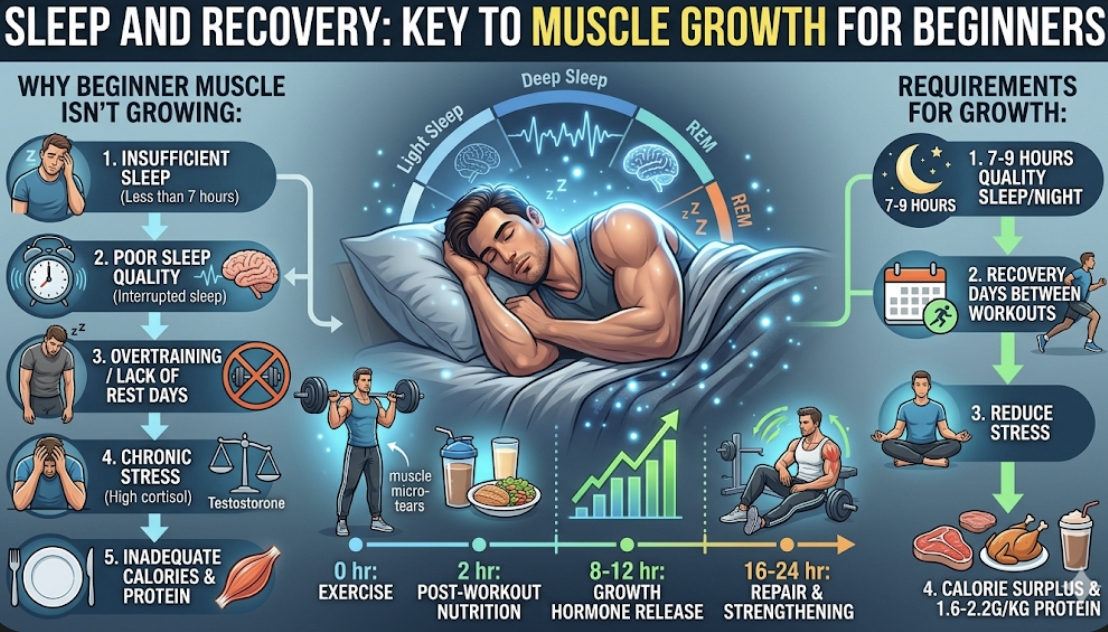
Muscle repair and growth happen during sleep, not while you're lifting. Poor sleep (<7 hours) impairs protein synthesis, increases cortisol, and reduces testosterone . A 2020 study found that sleep restriction significantly reduced muscle mass gains .
4.2. Overtraining vs. Under-recovering
Many beginners train 6–7 days a week without adequate rest. Muscles need 48–72 hours to recover between sessions. Without recovery, you'll experience diminishing returns and increased injury risk .
5. Mistake #4: Too Much Volume – More Is Not Always Better
5.1. The J-Curve of Volume
While some volume is necessary for growth, there's a point of diminishing returns. Research suggests that for hypertrophy, 10–20 sets per muscle group per week is optimal . Many beginners do 25+ sets per muscle group, leading to overtraining, poor recovery, and slower progress.
5.2. Signs You're Doing Too Much
- Persistent soreness lasting >72 hours
- Decreasing strength despite consistent training
- Chronic fatigue, irritability, poor sleep
- Lack of motivation
6. Mistake #5: Inconsistent Training – The Sporadic Lifter
Muscle growth requires consistent stimulus over time. Skipping workouts, taking weeks off, or training only when motivated disrupts the progressive overload cycle. Even 1–2 missed weeks can set you back significantly .
7. Mistake #6: Ego Lifting – Sacrificing Form for Weight
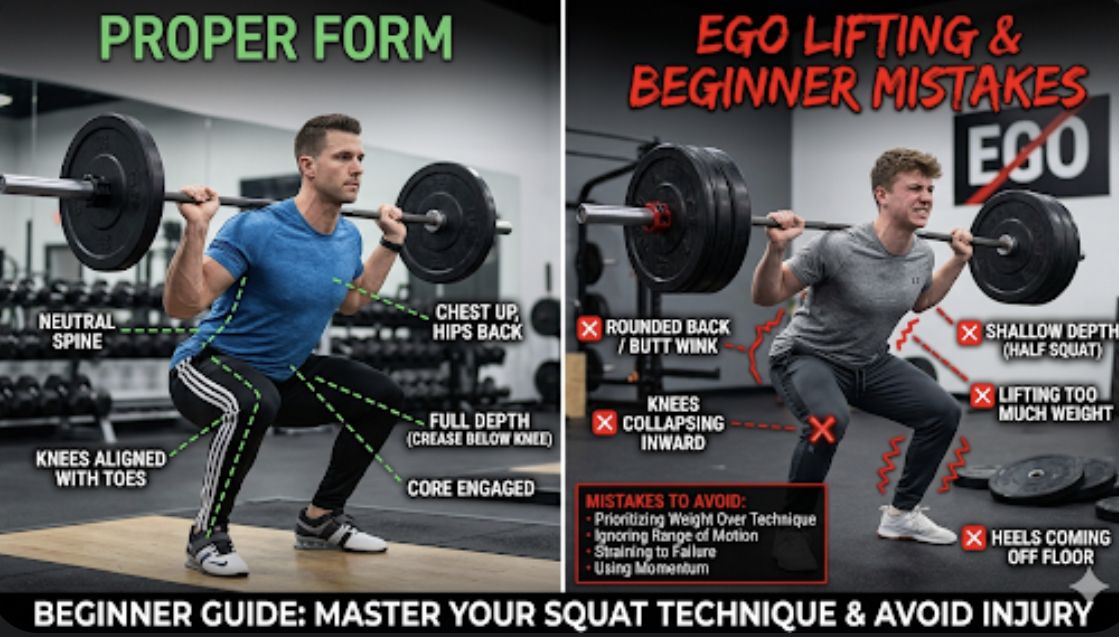
We've all seen it: someone loading up the bar with more weight than they can handle, then using momentum, jerky movements, and half reps to "lift" it. Ego lifting not only increases injury risk but also reduces time under tension and muscle activation . Controlled, full-range-of-motion movements with appropriate weight build more muscle.
8. Mistake #7: Not Tracking Progress – Flying Blind
If you don't track your workouts, you have no idea if you're progressing. You might be lifting the same weights for months without realizing it. Tracking allows you to see trends, identify plateaus, and adjust programming accordingly.
9. Sample Beginner Muscle-Building Meal Plan (2,500 kcal, 140g Protein)
Omnivore Plan (for 70–75 kg beginner)
- Breakfast (7:30): 3 eggs, 1 cup oatmeal with 1 tbsp peanut butter, 1 banana (550 kcal, 30g protein)
- Lunch (12:30): 150g grilled chicken breast, 1.5 cups brown rice, 1 cup broccoli (550 kcal, 40g protein)
- Pre-workout (4:30): 1 scoop whey, 1 apple (200 kcal, 25g protein)
- Post-workout/Dinner (7:30): 150g lean beef or salmon, 1 medium sweet potato, 2 cups mixed greens (550 kcal, 35g protein)
- Evening Snack (10:00): 200g Greek yogurt, 1 cup berries (250 kcal, 20g protein)
Vegan/Vegetarian Plan (2,500 kcal, 130g Protein)
- Breakfast: Tofu scramble (200g firm tofu), 1 cup oatmeal with 1 tbsp peanut butter, banana (600 kcal, 35g protein)
- Lunch: 200g tempeh, 1.5 cups quinoa, 1 cup roasted chickpeas, mixed greens (650 kcal, 40g protein)
- Pre-workout: 1 scoop pea protein, 1 apple (200 kcal, 25g protein)
- Post-workout/Dinner: 1.5 cups cooked lentils, 1 medium sweet potato, 150g edamame, 1 tbsp olive oil (600 kcal, 30g protein)
- Evening: 200g silken tofu with berries (250 kcal, 10g protein)
Gluten-Free Options
- Use certified gluten-free oats, quinoa, rice, or buckwheat.
- Ensure protein powders and tempeh/tofu are gluten-free certified.
10. Quick Beginner-Friendly Recipes
- Post-Workout Smoothie (400 kcal, 30g protein): 1 scoop whey or pea protein, 1 cup oat milk, 1 banana, 1 tbsp peanut butter.
- Protein Oatmeal (450 kcal, 25g protein): 1 cup oats, 1 scoop protein, 1 tbsp peanut butter, 1 tbsp honey, cinnamon.
- Chicken Rice Bowl (550 kcal, 45g protein): 150g chicken breast, 1 cup brown rice, 1 cup broccoli, soy sauce.
11. Quick Fix Checklist: Are You Making These Mistakes?
- ☐ Progressive overload? (Adding weight/reps weekly)
- ☐ Eating enough calories? (Weight slowly increasing)
- ☐ Protein ≥1.6 g/kg body weight?
- ☐ Sleep ≥7 hours nightly?
- ☐ Training volume 10–20 sets per muscle group/week?
- ☐ Consistent training (3–5 sessions/week)?
- ☐ Using proper form (not ego lifting)?
- ☐ Tracking workouts?
12. Frequently Asked Questions
What mistakes stop muscle growth for beginners?
The top mistakes are: lack of progressive overload, poor nutrition (insufficient protein/calories), and not enough recovery (sleep and rest days).
How much weight should a beginner gain per week while bulking?
Aim for 0.25–0.5% of body weight per week. For an 80 kg beginner, that's 0.2–0.4 kg per week. This ensures mostly muscle gain.
How many days a week should a beginner train?
3–4 days per week is ideal for most beginners. This allows adequate recovery while providing sufficient stimulus. Full-body workouts 3x/week are an excellent starting point.
How much protein does a beginner need to build muscle?
1.6–2.2 grams per kilogram of body weight daily. For a 70 kg beginner, that's 112–154 grams of protein per day.
Can I build muscle without supplements?
Absolutely. Whole foods provide all the nutrients needed for muscle growth. Supplements are optional and can help convenience, but are not required.
How long before a beginner sees muscle growth?
Most beginners see visible changes in 4–8 weeks with consistent training and nutrition. Strength gains often appear within the first 2–4 weeks (neural adaptations).
Is it okay to train the same muscle group every day?
No—muscles need 48–72 hours to recover. Training the same muscle group daily prevents growth and increases injury risk. Train each muscle group 2–3 times per week with adequate rest.
13. Related Resources
- How Much Weight Should You Add Each Week? Progressive Overload Guide
- Mind-Muscle Connection: How to Train Your Brain for Better Muscle Gains
- Why Your Muscles Look Smaller After a Workout (And How to Fix It Fast)
- Ectomorph Diet Guide: How to Eat 3000 Calories of Whole Foods for Muscle Gain
- How to Break Through a Squat Plateau Naturally and Increase Strength
14. Scientific References
- Morton, R. W., et al. (2018). A systematic review, meta-analysis and meta-regression of the effect of protein supplementation on resistance training-induced gains in muscle mass and strength in healthy adults. British Journal of Sports Medicine, 52(6), 376–384. PubMed
- Slater, G. J., et al. (2019). Is an Energy Surplus Required to Maximize Skeletal Muscle Hypertrophy Associated With Resistance Training? Frontiers in Nutrition, 6, 131. PubMed
- Schoenfeld, B. J., et al. (2017). Effects of Resistance Training Frequency on Measures of Muscle Hypertrophy: A Systematic Review and Meta-Analysis. Sports Medicine, 46(11), 1689–1697. PubMed
- Helms, E. R., et al. (2014). Evidence-based recommendations for natural bodybuilding contest preparation. Journal of the International Society of Sports Nutrition, 11(1), 20. PubMed
- Areta, J. L., et al. (2013). Timing and distribution of protein ingestion during prolonged recovery from resistance exercise alters myofibrillar protein synthesis. Journal of Physiology, 591(9), 2319–2331. PubMed
- Nedeltcheva, A. V., et al. (2010). Insufficient sleep undermines dietary efforts to reduce adiposity. Annals of Internal Medicine, 153(7), 435–441. PubMed
- ACSM. (2021). Nutrition and Athletic Performance. Medicine & Science in Sports & Exercise, 53(3), 600–618. PubMed
Join the conversation