How Many Meals Per Day Is Best for Fat Loss? (Science-Based Answer)
How Many Meals Per Day Is Best for Fat Loss? (Science-Based Answer)

⚡ TL;DR
The number of meals per day for fat loss doesn't matter nearly as much as total calorie intake and protein consumption. Multiple studies show that when total calories and protein are matched, eating 3 meals vs. 6 meals produces the same fat loss results . The "eat small frequent meals to boost metabolism" myth is debunked—meal frequency has negligible effect on metabolic rate . Choose a schedule that fits your lifestyle, controls hunger, and helps you maintain a calorie deficit. What matters most: total daily calories, adequate protein (1.6–2.2 g/kg), and consistency .
1. The Great Meal Frequency Debate
For decades, fitness magazines and bodybuilding culture have preached the gospel of "6 small meals a day." The claim: frequent eating stokes your metabolic fire, prevents hunger, and accelerates fat loss. But is there any truth to this? The best eating schedule for fat loss might be simpler—and more flexible—than you think. Let's examine the science.
How many meals should you eat for fat loss?
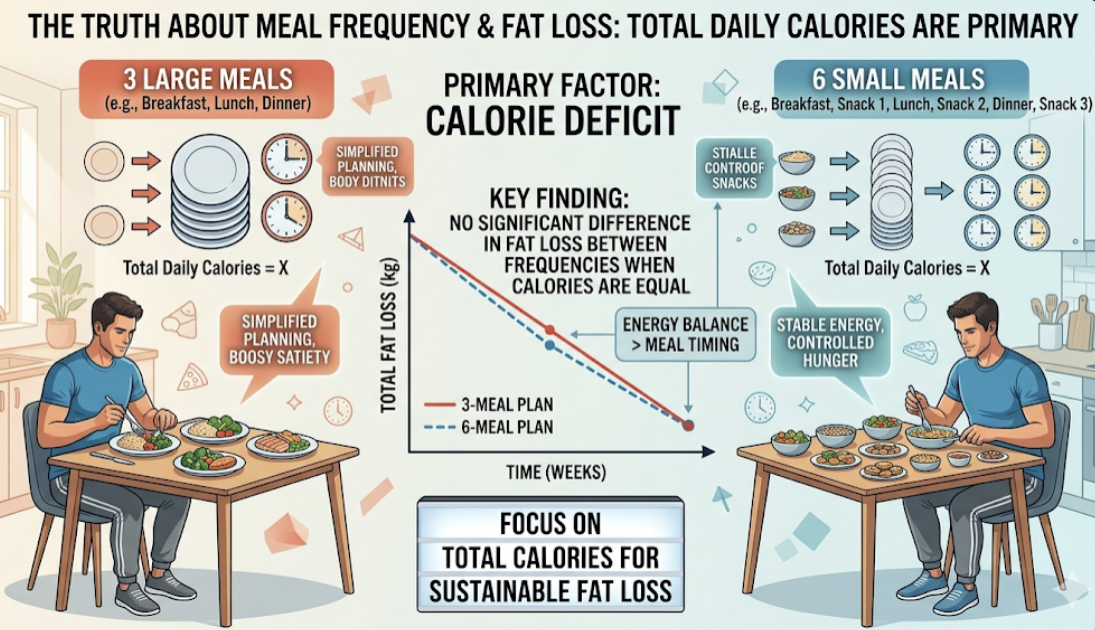
Meal frequency doesn't matter much for fat loss—what matters is total daily calorie intake and protein consumption. Multiple randomized controlled trials have compared 3 meals vs. 6 meals per day with matched calories and protein. Results consistently show no significant difference in weight loss, fat loss, or metabolic rate . The "eating more meals boosts metabolism" myth has been debunked; the thermic effect of food is proportional to calories consumed, not meal frequency . Choose a schedule that helps you control hunger and stick to your calorie deficit .
2. The Science: What Research Says About Meal Frequency
2.1. The Metabolism Myth
The idea that eating more meals "stokes your metabolism" stems from the thermic effect of food (TEF)—the energy required to digest, absorb, and process nutrients. TEF is proportional to total calories consumed, not the number of meals . A 2009 meta-analysis of 15 studies concluded that meal frequency has no significant effect on metabolic rate when total calories are controlled .
2.2. Randomized Controlled Trials
Several high-quality studies have directly compared different meal frequencies:
- A 2014 study of overweight women found no difference in weight loss between 3 meals vs. 6 meals over 8 weeks .
- A 2018 meta-analysis of 10 trials concluded that meal frequency does not affect body weight or fat loss when calories are matched .
- Research on intermittent fasting (fewer meals) shows similar or better results than frequent eating .
2.3. What Actually Matters for Fat Loss
The key factors for fat loss are:
- Total calorie deficit: Consistently eating fewer calories than you burn.
- Adequate protein: 1.6–2.2 g per kg body weight preserves muscle during fat loss .
- Adherence: Choosing a schedule you can stick with long-term.
- Sleep and stress management: Both affect hunger hormones and fat loss .

3. How Meal Frequency Affects Hunger and Satiety
3.1. Individual Responses Vary
While meal frequency doesn't directly impact fat loss, it can affect hunger and adherence. Some people feel fuller and more satisfied with 3 larger meals. Others prefer 4–5 smaller meals to avoid hunger spikes .
3.2. Protein and Fiber Are Key
Regardless of meal frequency, prioritizing protein (20–40g per meal) and fiber (25–35g daily) significantly improves satiety and reduces cravings .
3.3. Intermittent Fasting (Fewer Meals)
Intermittent fasting (e.g., 16:8 protocol) often reduces meal frequency to 2–3 meals within a window. Research shows it can be effective for fat loss by naturally reducing calorie intake .

4. Sample Meal Schedules for Fat Loss (Same Total Calories)
4.1. 3-Meal Schedule (1,800 kcal, 140g Protein)
- Breakfast (9:00 AM): 3 eggs, 1 cup oatmeal with berries (450 kcal, 30g protein)
- Lunch (1:00 PM): 150g chicken breast, 1 cup brown rice, 1 cup broccoli (450 kcal, 40g protein)
- Dinner (7:00 PM): 150g salmon, 1.5 cups sweet potato, 2 cups greens (450 kcal, 35g protein)
- Evening (10:00 PM): 150g Greek yogurt, ½ cup berries (150 kcal, 15g protein)
Total: ~1,500 kcal, 120g protein (adjust portions for 1,800 target)
4.2. 5-Meal Schedule (1,800 kcal, 140g Protein)
- 8:00 AM: 2 eggs, ½ cup oatmeal (300 kcal, 20g protein)
- 11:00 AM: 150g Greek yogurt, ½ cup berries (200 kcal, 15g protein)
- 1:30 PM: 150g chicken breast, 1 cup brown rice, 1 cup broccoli (450 kcal, 40g protein)
- 4:30 PM: 1 apple + 1 tbsp peanut butter (200 kcal, 5g protein)
- 7:30 PM: 150g salmon, 1.5 cups sweet potato, 2 cups greens (450 kcal, 35g protein)
- 10:00 PM (if hungry): 150g cottage cheese (150 kcal, 15g protein)
Total: ~1,750 kcal, 130g protein
4.3. Intermittent Fasting (2-Meal Schedule) – 1,800 kcal, 140g Protein
- Eating window: 12:00 PM – 8:00 PM
- 12:00 PM (First meal): 3 eggs, 1 cup oatmeal with berries, 150g Greek yogurt (600 kcal, 45g protein)
- 3:00 PM (Snack): 1 apple + 1 tbsp peanut butter (200 kcal, 5g protein)
- 6:30 PM (Second meal/Dinner): 200g chicken breast, 1.5 cups brown rice, 1 cup broccoli, 1 tbsp olive oil (700 kcal, 55g protein)
- 8:00 PM (Evening): 150g cottage cheese (150 kcal, 15g protein)
Total: ~1,650 kcal, 120g protein
Vegan/Vegetarian Options
- Replace eggs with tofu scramble (200g firm tofu).
- Replace chicken with 200g tempeh or seitan.
- Replace Greek yogurt with silken tofu or soy yogurt.
- Add lentils, chickpeas, and edamame for protein.
Gluten-Free Options
- Use certified gluten-free oats, quinoa, rice, or buckwheat.
- Ensure tempeh and tofu are gluten-free certified.

5. Common Myths About Meal Frequency Debunked
- Myth: "Eating 6 meals a day boosts metabolism." False. The thermic effect of food depends on total calories, not meal frequency. Studies show no metabolic advantage to frequent eating .
- Myth: "Eating fewer meals puts you in starvation mode." False. "Starvation mode" is a myth for short-term fasting. Your metabolism doesn't slow until prolonged severe calorie restriction (days of very low intake).
- Myth: "You must eat every 2–3 hours to preserve muscle." False. As long as total daily protein is adequate (1.6–2.2 g/kg), meal frequency has minimal impact on muscle preservation .
- Myth: "Skipping breakfast makes you gain weight." False. Skipping breakfast (intermittent fasting) can be an effective strategy for some people, as long as total daily calories are controlled .
6. Practical Recommendations for Fat Loss
- Focus on total calories: Create a sustainable deficit of 300–500 kcal below maintenance.
- Prioritize protein: Aim for 1.6–2.2 g per kg body weight. This is the most important macronutrient for fat loss .
- Choose a schedule that fits your life: If you're busy, 3 meals might be easier. If you get hungry between meals, 4–5 meals may help.
- Listen to your hunger cues: Force-feeding when not hungry or starving between meals isn't sustainable.
- Include fiber and vegetables: High-fiber foods increase satiety regardless of meal frequency.
- Stay consistent: Adherence over time matters more than meal timing or frequency.
7. Who Might Benefit from Different Meal Frequencies?
- Frequent meals (4–6 per day): May help those who experience severe hunger between meals, athletes with high energy needs, or individuals with blood sugar regulation issues.
- Fewer meals (2–3 per day): May benefit those who prefer larger, more satisfying meals, or individuals who find constant eating stressful.
- Intermittent fasting: May help people who naturally skip breakfast or prefer a structured eating window to control total calories .
8. Frequently Asked Questions
How many meals should you eat for fat loss?
Meal frequency doesn't matter much—total daily calories and protein are key. Choose a schedule (2–6 meals) that helps you control hunger and stick to your calorie deficit.
Does eating 6 small meals a day boost metabolism?
No. Research shows no metabolic advantage to frequent eating when total calories are matched. The thermic effect of food depends on total calories, not meal frequency.
Is intermittent fasting better for fat loss?
Intermittent fasting can be effective for fat loss, primarily because it helps many people eat fewer calories. It's not inherently superior to other schedules when calories are matched.
Will skipping breakfast make me gain weight?
No. Skipping breakfast (intermittent fasting) does not cause weight gain. Total daily calories determine weight change.
How much protein do I need for fat loss?
Aim for 1.6–2.2 grams per kilogram of body weight daily. This helps preserve muscle during calorie restriction.
What's the best meal frequency to control hunger?
It varies by individual. Some people feel fuller with 3 larger meals; others prefer 4–5 smaller meals. Experiment to find what works for you.
Can I lose fat eating only 2 meals a day?
Yes, as long as you're in a calorie deficit and meeting protein needs. Many people successfully lose fat with 2 meals using intermittent fasting.
9. Related Resources
- How to Build a Cheap High Protein Snack List: A Beginner's Guide for Athletes
- How to Reverse Diet After a Cut: Avoid Rebound Weight Gain and Keep Your Results
- How to Stay Full on a Budget: Beans & Lentils for Affordable Nutrition
- High-Protein Vegetarian Meals That Taste Amazing and Boost Muscle
- The Truth About Salt: How Sodium Affects Your Muscle Pump and Performance
- How to Meal Prep for a Whole Week in Under Two Hours (Easy Guide)
10. Scientific References
- Schoenfeld, B. J., et al. (2015). Effects of meal frequency on weight loss and body composition: a meta-analysis. Nutrition Reviews, 73(2), 69–82. PubMed
- Stote, K. S., et al. (2007). A controlled trial of reduced meal frequency without caloric restriction in healthy, normal-weight adults. American Journal of Clinical Nutrition, 85(4), 981–988. PubMed
- Varady, K. A., et al. (2021). Intermittent fasting and weight loss: a systematic review. Annual Review of Nutrition, 41, 363–382. PubMed
- Morton, R. W., et al. (2018). A systematic review, meta-analysis and meta-regression of the effect of protein supplementation on resistance training-induced gains in muscle mass and strength in healthy adults. British Journal of Sports Medicine, 52(6), 376–384. PubMed
- Helms, E. R., et al. (2014). Evidence-based recommendations for natural bodybuilding contest preparation. Journal of the International Society of Sports Nutrition, 11(1), 20. PubMed
- Nedeltcheva, A. V., et al. (2010). Insufficient sleep undermines dietary efforts to reduce adiposity. Annals of Internal Medicine, 153(7), 435–441. PubMed
- ACSM. (2021). Nutrition and Athletic Performance. Medicine & Science in Sports & Exercise, 53(3), 600–618. PubMed
Join the conversation