How to Balance Carbs, Protein, and Fats for Beginners (Macro Guide)
How to Balance Carbs, Protein, and Fats for Beginners (Macro Guide)
⚡ TL;DR
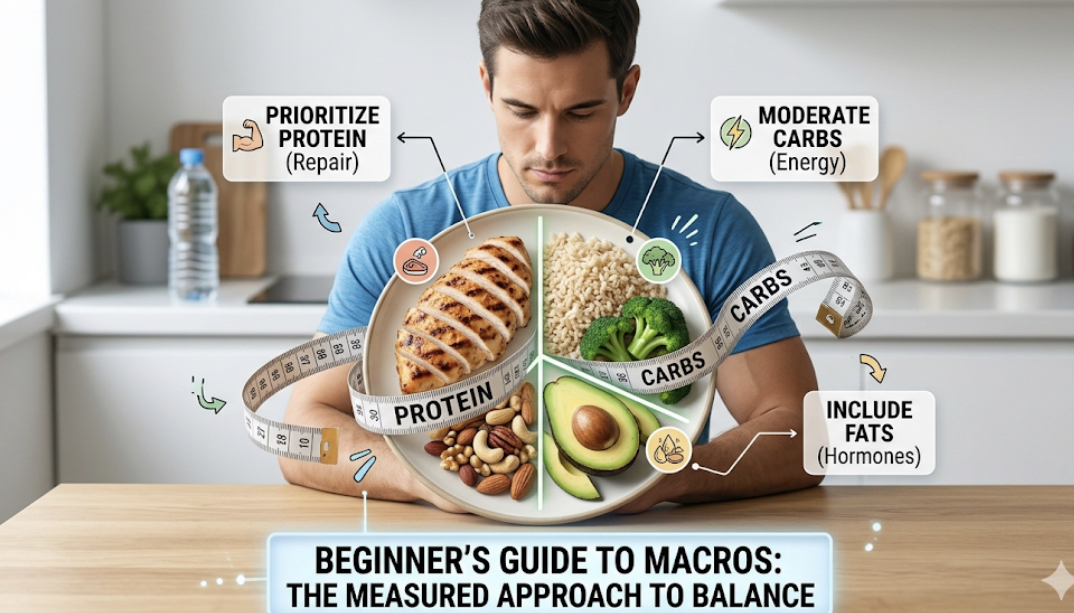
To balance macros for beginners, start with these general ratios: Protein: 1.6–2.2 g per kg body weight (20–30% of calories), Fats: 20–35% of calories (0.8–1.2 g/kg), and Carbs: remaining calories (40–60%). For fat loss, increase protein and slightly reduce carbs. For muscle gain, increase total calories while maintaining protein . This macronutrients guide provides step-by-step calculations, sample meal plans for omnivores and vegans, and simple tracking methods to help you master diet balance for fitness goals.
1. Why Macronutrients Matter More Than Calories Alone
You've heard "calories in, calories out" for weight management. But 1,500 calories of soda and candy affects your body very differently than 1,500 calories of chicken, rice, and vegetables. The quality and composition of your calories—the balance macros beginners need to understand—determines whether you build muscle, lose fat, or just feel terrible .
What is the best macro balance for beginners?
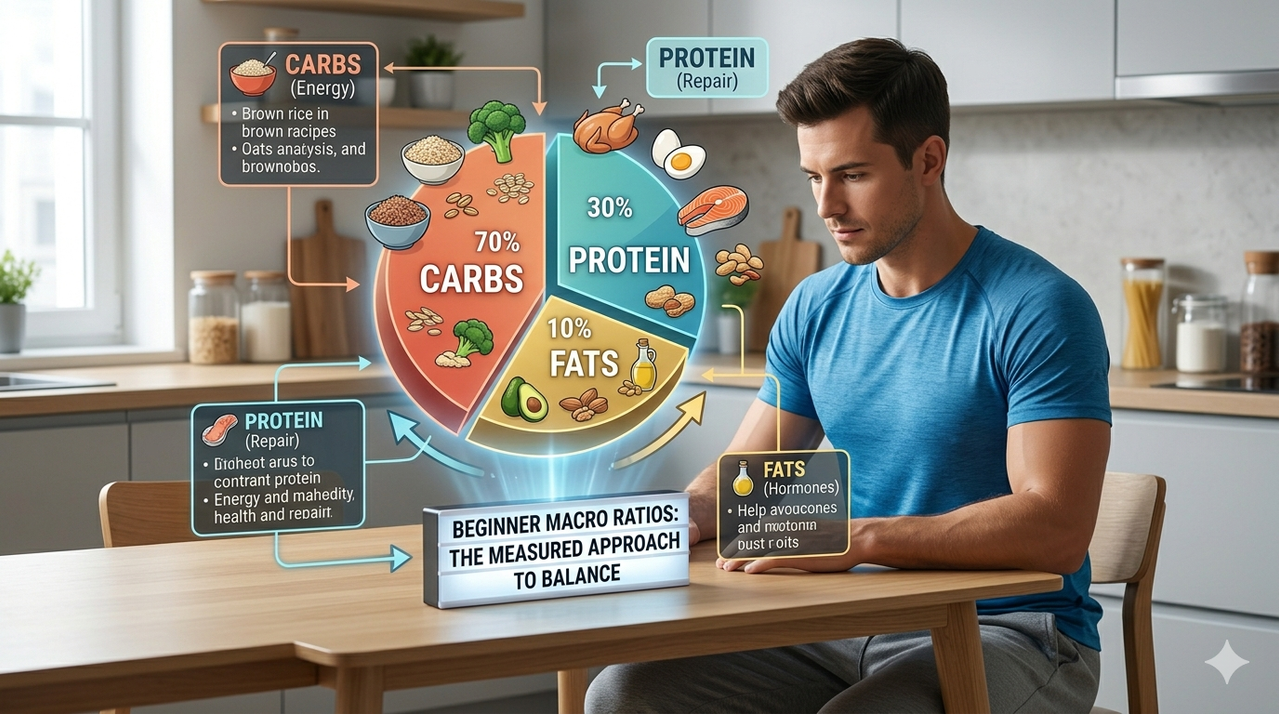
The best macro balance for beginners is a balanced approach that prioritizes adequate protein, moderate healthy fats, and fills the rest with carbohydrates. A solid starting point: Protein: 1.6–2.2 g per kg body weight (20–30% of calories), Fats: 20–35% of calories (0.8–1.2 g/kg), Carbs: remaining calories (40–60%). This provides enough protein for muscle repair, essential fats for hormones, and carbs for energy. Adjust based on goals: more protein for fat loss, more carbs for athletic performance .
2. Understanding Each Macronutrient: What They Do
2.1. Protein – The Building Block
Calories per gram: 4
Role: Muscle repair, hormone production, enzyme function, immune health. Protein provides amino acids necessary for muscle protein synthesis (MPS). Aim for 1.6–2.2 g per kg body weight for active individuals .
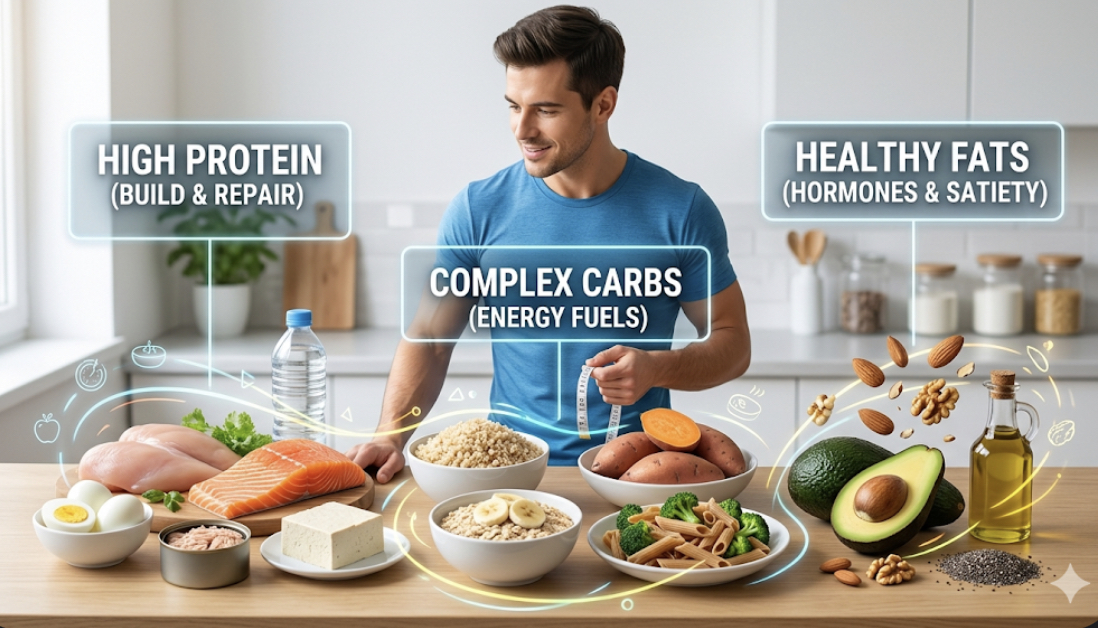
- Sources: Chicken, fish, eggs, beef, Greek yogurt, cottage cheese, tofu, tempeh, lentils, beans, protein powder.
- Timing: Spread across 3–5 meals (20–40 g per meal) to maximize MPS .
2.2. Carbohydrates – The Primary Fuel
Calories per gram: 4
Role: Energy for training, brain function, glycogen replenishment. Carbs are especially important for high-intensity exercise .
- Sources: Oats, rice, quinoa, potatoes, sweet potatoes, fruits, vegetables, whole grains, legumes.
- Timing: Pre-workout for energy; post-workout to replenish glycogen .
2.3. Fats – Hormonal Support
Calories per gram: 9
Role: Hormone production (testosterone, estrogen), cell membrane structure, nutrient absorption, satiety .
- Sources: Olive oil, avocados, nuts, seeds, fatty fish, eggs, coconut oil.
- Recommended intake: 20–35% of total calories (0.8–1.2 g/kg body weight) .
3. Step-by-Step: How to Calculate Your Macros
3.1. Step 1: Determine Your Calorie Needs
Use the Mifflin-St Jeor equation to estimate maintenance calories, then adjust based on goals:
- Men: (10 × weight in kg) + (6.25 × height in cm) – (5 × age) + 5
- Women: (10 × weight in kg) + (6.25 × height in cm) – (5 × age) – 161
- Multiply by activity factor: sedentary (1.2), light (1.375), moderate (1.55), active (1.725), very active (1.9).
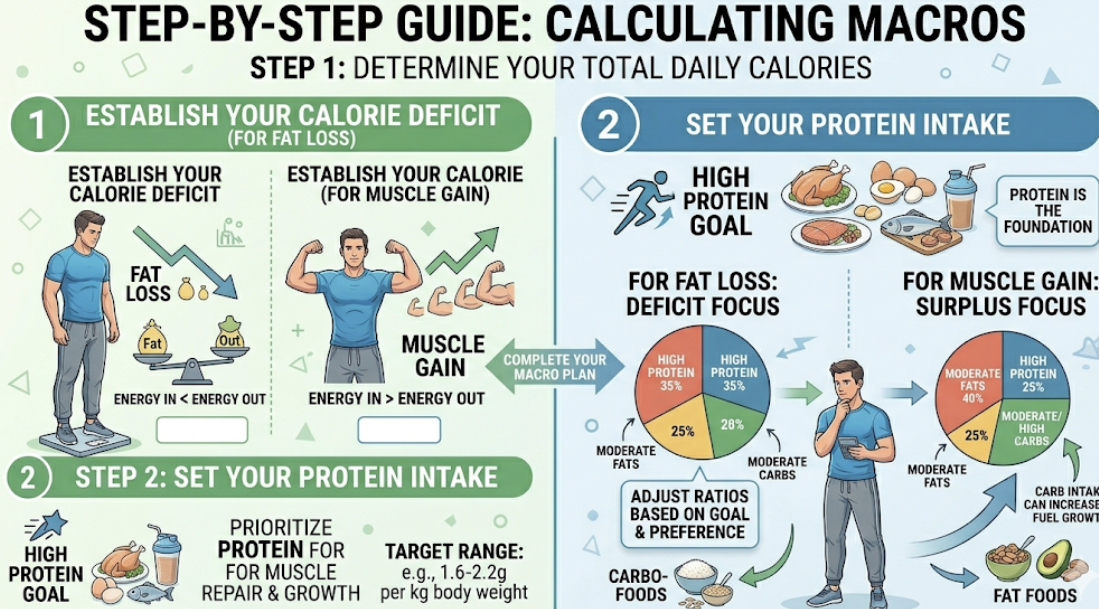
For fat loss: subtract 300–500 kcal. For muscle gain: add 250–500 kcal.
3.2. Step 2: Set Protein First
1.6–2.2 g per kg body weight. For an 80 kg person: 128–176 g protein daily. Multiply by 4 to get calories from protein.
3.3. Step 3: Set Fats
20–35% of total calories. For a 2,500 kcal diet, that's 500–875 kcal (56–97 g fat).
3.4. Step 4: Fill Remaining Calories with Carbs
Carbs = total calories – (protein calories + fat calories). Divide by 4 for grams of carbs.
3.5. Example Calculation (80 kg, active, 2,800 kcal goal)
- Protein: 160 g (640 kcal) – 1.6–2.2 range
- Fats: 75 g (675 kcal) – 24% of calories
- Carbs: 2,800 – (640 + 675) = 1,485 kcal / 4 = 371 g carbs
- Macro split: 23% protein, 24% fat, 53% carbs
4. Macro Splits for Different Goals
5. Sample Meal Plans by Macro Target
5.1. 2,500 kcal, 150g Protein, 75g Fat, 300g Carbs (Balanced)
- Breakfast (7:30): 4 eggs, 1 cup oatmeal with berries, 1 tbsp peanut butter (550 kcal, 35g protein, 45g carbs, 25g fat)
- Lunch (12:30): 200g chicken breast, 1.5 cups brown rice, 1 cup broccoli, 1 tbsp olive oil (650 kcal, 50g protein, 65g carbs, 20g fat)
- Snack (4:00): 200g Greek yogurt, 1 apple, 1 oz almonds (350 kcal, 25g protein, 30g carbs, 15g fat)
- Dinner (7:30): 200g salmon, 1.5 cups sweet potato, 2 cups mixed greens (600 kcal, 45g protein, 50g carbs, 20g fat)
- Evening (10:00): 150g cottage cheese, ½ cup berries (200 kcal, 20g protein, 10g carbs, 5g fat)
5.2. Vegan/Vegetarian Macro Plan (2,500 kcal, 140g Protein, 75g Fat, 320g Carbs)
- Breakfast: Tofu scramble (200g firm tofu), 1.5 cups oatmeal with 2 tbsp peanut butter, banana (700 kcal, 40g protein, 85g carbs, 25g fat)
- Lunch: 200g tempeh, 1.5 cups quinoa, 1 cup roasted chickpeas, mixed greens (700 kcal, 45g protein, 80g carbs, 25g fat)
- Snack: 1 cup edamame, 1 apple (250 kcal, 15g protein, 30g carbs, 5g fat)
- Dinner: 1.5 cups cooked lentils, 1.5 cups sweet potato, 1 cup spinach, 1 tbsp olive oil (650 kcal, 30g protein, 90g carbs, 15g fat)
- Evening: 1 cup unsweetened soy milk + 2 tbsp hemp seeds (200 kcal, 10g protein, 10g carbs, 12g fat)
Gluten-Free Options
- Use certified gluten-free oats, quinoa, rice, or buckwheat.
- Ensure tempeh and tofu are gluten-free certified (most are).

6. How to Track Macros Without Obsessing
- Use an app: MyFitnessPal, Cronometer, or MacroFactor make tracking easy.
- Focus on protein first: Hit your protein target, then let carbs and fats fall where they may within ranges.
- Use the "plate method": Fill half your plate with vegetables, a quarter with lean protein, and a quarter with complex carbs. Add a thumb-sized portion of healthy fats.
- Track for 2–3 weeks to calibrate: Once you learn portion sizes, you can transition to intuitive eating while monitoring weight and performance.
- Don't stress small variations: Being within 5–10% of your targets is fine. Consistency over time matters more than perfection.
7. Common Macro Mistakes Beginners Make
- Mistake #1: Too little protein. Below 1.6 g/kg limits muscle growth and recovery.
- Mistake #2: Fear of carbs. Carbs are not the enemy—they fuel training and recovery. Choose whole food sources.
- Mistake #3: Avoiding healthy fats. Fats are essential for hormone production. Don't drop below 0.8 g/kg.
- Mistake #4: Relying on processed "macro-friendly" foods. Whole foods provide better nutrition and satiety.
- Mistake #5: Not adjusting for goals. The same macro split doesn't work for both fat loss and muscle gain.
- Mistake #6: Being too rigid. Missing your macros by a few grams is fine. Consistency over weeks matters more.
8. Frequently Asked Questions
What is the best macro balance for beginners?
A balanced approach: protein 1.6–2.2 g/kg body weight, fats 20–35% of calories, carbs filling the remaining calories (40–60%).
Do I need to track macros forever?
No. Track for 2–4 weeks to learn portion sizes and food composition. After that, you can eat intuitively while monitoring weight and performance trends.
What happens if I don't hit my macros exactly?
Nothing significant. Aim to be within 5–10% of your targets. Consistency over days and weeks matters more than perfection at each meal.
Should I use the same macros on rest days?
You can reduce carbs slightly on rest days if desired, but keep protein and fats consistent. Many people keep macros the same for simplicity.
Can I build muscle on a lower carb diet?
Yes, but carbs support high-intensity performance. If you train intensely, sufficient carbs will improve recovery and performance.
How much fat is too low?
Aim for at least 0.8 g per kg body weight. Below this, you risk hormonal disruptions (especially in women).
Do macros matter for weight loss?
Yes. Adequate protein preserves muscle during fat loss. Fats support hormones. Carbs fuel training. All three matter for sustainable results.
9. Related Resources
- How to Build a Cheap High Protein Snack List: A Beginner's Guide for Athletes
- How to Reverse Diet After a Cut: Avoid Rebound Weight Gain and Keep Your Results
- How to Stay Full on a Budget: Beans & Lentils for Affordable Nutrition
- High-Protein Vegetarian Meals That Taste Amazing and Boost Muscle
- The Truth About Salt: How Sodium Affects Your Muscle Pump and Performance
- How to Meal Prep for a Whole Week in Under Two Hours (Easy Guide)
10. Scientific References
- Morton, R. W., et al. (2018). A systematic review, meta-analysis and meta-regression of the effect of protein supplementation on resistance training-induced gains in muscle mass and strength in healthy adults. British Journal of Sports Medicine, 52(6), 376–384. PubMed
- Helms, E. R., et al. (2014). Evidence-based recommendations for natural bodybuilding contest preparation. Journal of the International Society of Sports Nutrition, 11(1), 20. PubMed
- Schoenfeld, B. J., & Aragon, A. A. (2018). How much protein can the body use in a single meal for muscle-building? Journal of the International Society of Sports Nutrition, 15, 10. PubMed
- Iraki, J., et al. (2019). Nutrition Recommendations for Bodybuilders: An Evidence-Based Approach. Journal of the International Society of Sports Nutrition, 16(1), 17. PubMed
- Kerksick, C. M., et al. (2017). International society of sports nutrition position stand: nutrient timing. Journal of the International Society of Sports Nutrition, 14, 33. PubMed
- ACSM. (2021). Nutrition and Athletic Performance. Medicine & Science in Sports & Exercise, 53(3), 600–618. PubMed
Join the conversation