How to Read Nutrition Labels for Fitness Goals (Beginner-Friendly Guide)
How to Read Nutrition Labels for Fitness Goals (Beginner-Friendly Guide)
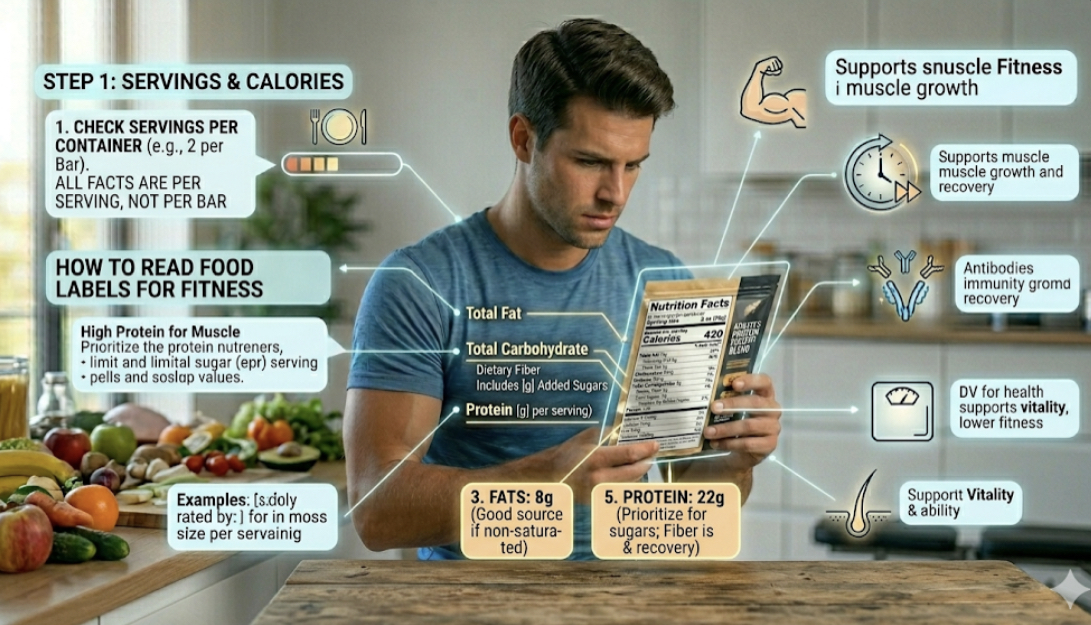
⚡ TL;DR
To read nutrition labels for fitness goals, focus on: 1) Serving size—this determines all other numbers. 2) Calories—for weight management. 3) Protein—aim for 1.6–2.2 g/kg daily. 4) Carbohydrates and fiber—fuel for training. 5) Fats—prioritize unsaturated. 6) Added sugars—limit to <10% of calories. Ignore front-of-package marketing claims like "low-fat" or "high-protein"—they can be misleading . This guide breaks down every section of the nutrition label with practical tips to help you hit your fitness targets.
1. Why Nutrition Labels Matter for Fitness Success
You track your workouts, you meal prep, but are you actually hitting your nutritional targets? The difference between guessing and knowing is the ability to read nutrition labels for fitness goals. Whether you're trying to build muscle, lose fat, or simply eat healthier, understanding food labels gives you control over your results .
How do you read nutrition labels for fitness?
To read nutrition labels for fitness, follow this step-by-step process: 1) Check serving size—all numbers on the label are based on this. 2) Look at calories—match to your daily target. 3) Review protein—prioritize higher protein for muscle goals. 4) Examine carbs and fiber—choose higher fiber options. 5) Assess fats—limit saturated and trans fats. 6) Watch added sugars—keep them low. Always compare to the serving size you actually eat, not the package's suggested serving .
2. Section 1: Serving Size – The Foundation of Everything
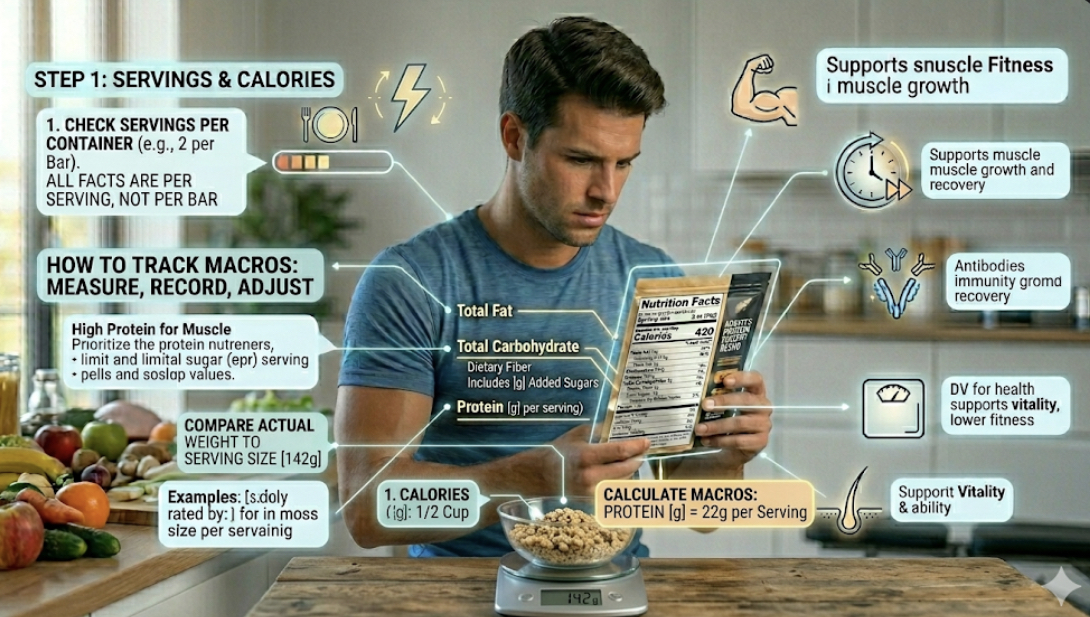
The serving size is the most critical—and most overlooked—part of the label. All other numbers (calories, macros) are based on this serving. If you eat double the serving, double everything .
- Check servings per container: Many packages contain 2–3 servings. A "small" bag of chips often has 2.5 servings—meaning you're consuming 2.5x the listed calories.
- Compare to your actual intake: If you eat the whole package, multiply all numbers by the servings per container.
- Use a food scale: For accuracy, weigh your food. A "serving" may say 30g—weigh to confirm.
3. Section 2: Calories – The Energy Number
Calories are the total energy from protein, carbs, and fat combined. For weight management, total calories matter most .
- Weight loss: Aim for a deficit of 300–500 kcal below maintenance.
- Weight gain (muscle): Aim for a surplus of 250–500 kcal above maintenance.
- Maintenance: Eat to keep weight stable.
- Calories per macro: 1g protein = 4 kcal, 1g carbs = 4 kcal, 1g fat = 9 kcal.
4. Section 3: Protein – Your Most Important Macro
Protein supports muscle repair, growth, and satiety. For active individuals, aim for 1.6–2.2 g per kg body weight .
- What to look for: Higher protein per serving, especially in meals and snacks.
- What to avoid: Protein sources with high added sugars or unhealthy fats.
- Plant-based check: Ensure adequate protein per serving; consider combining complementary proteins.
5. Section 4: Carbohydrates – Fuel for Training
Carbs are your body's primary energy source, especially for high-intensity exercise .
- Total carbohydrates: Includes fiber, sugar, and starches.
- Dietary fiber: Aim for 25–35g daily. Higher fiber = better satiety and digestion .
- Total sugars vs. added sugars: Added sugars should be limited (<10% of total calories). Natural sugars (in fruit, dairy) are less concerning.
- What to look for: Whole grain sources with at least 3g fiber per serving.
6. Section 5: Fats – Choose Quality
Fats are essential for hormone production and nutrient absorption. The type matters more than total amount .
- Total fat: 20–35% of daily calories is recommended.
- Saturated fat: Limit to <10% of calories. Found in fatty meats, butter, processed foods.
- Trans fat: Avoid completely. Even 0g can mean <0.5g—check ingredients for "hydrogenated oils."
- Unsaturated fats: Prioritize (olive oil, nuts, avocado, fatty fish).
7. Section 6: % Daily Value (DV) – Nutrient Density
The % DV tells you how much a nutrient contributes to a 2,000-calorie diet. For fitness, aim for:
- Higher % DV (20%+): Good for fiber, vitamins, minerals (iron, calcium, vitamin D).
- Lower % DV (5% or less): Good for saturated fat, sodium, added sugars.
This helps you quickly identify nutrient-dense foods .
8. Section 7: Ingredient List – Don't Trust the Front
Marketing claims like "natural," "high-protein," or "low-fat" can be misleading. The ingredient list tells the real story .
- Ingredients are listed by weight: The first ingredient is what's most abundant.
- Avoid products with: Added sugars as one of the first ingredients, long lists of artificial additives, hydrogenated oils (trans fats).
- Look for: Short ingredient lists, whole food ingredients you recognize.
9. Common Marketing Traps to Avoid
- "Low-fat": Often high in added sugar to compensate. Check sugar content.
- "High-protein": Compare to regular version—sometimes only slightly higher.
- "Whole grain": Doesn't mean 100% whole grain. Check ingredient list for "whole wheat flour" as first ingredient.
- "Natural": No regulatory definition—doesn't mean healthy.
- "Keto-friendly": Often highly processed; check protein and fiber.
- "Gluten-free": Not automatically healthier—check calories and macros.
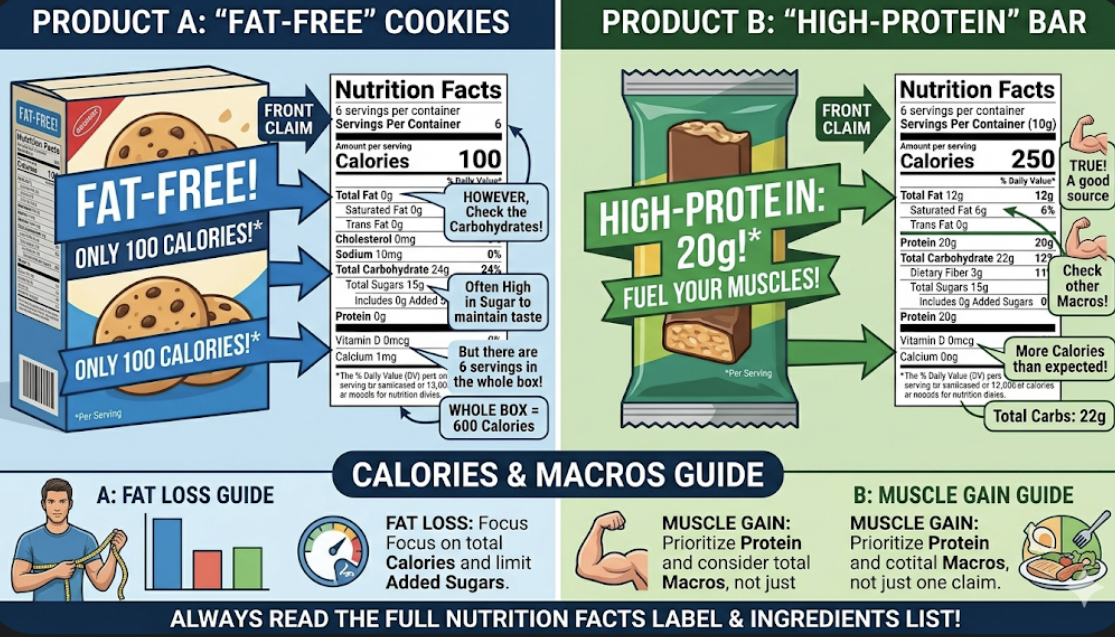
10. Side-by-Side Comparison: Choosing Better Options
Conclusion: Plain Greek yogurt has 2.5x more protein and 22g less sugar. Always compare.
11. How to Apply Label Reading to Your Fitness Goals
- Muscle gain: Prioritize foods with high protein per calorie (e.g., Greek yogurt, chicken, tofu). Check serving size to ensure you're eating enough.
- Fat loss: Focus on calorie density and protein. Choose high-protein, high-fiber foods that keep you full.
- Performance: Look for carbohydrates for energy—choose whole grain, higher fiber options.
- General health: Limit added sugars (<10% of calories), saturated fat, and sodium. Prioritize fiber and vitamins.
12. Sample Day: Reading Labels for 2,000 kcal, 140g Protein
- Breakfast: 3 eggs (label: 210 kcal, 18g protein) + 1 cup oatmeal (150 kcal, 5g protein) + 1 banana (105 kcal, 1g protein)
- Lunch: 150g chicken breast (label: 250 kcal, 45g protein) + 1 cup brown rice (215 kcal, 5g protein) + 1 cup broccoli (55 kcal, 4g protein)
- Snack: 200g Greek yogurt (label: 150 kcal, 20g protein) + ½ cup berries (40 kcal, 1g protein)
- Dinner: 150g salmon (label: 300 kcal, 35g protein) + 1.5 cups sweet potato (260 kcal, 4g protein) + 2 cups mixed greens (20 kcal, 2g protein)
Total: ~1,755 kcal, 139g protein
13. Quick Label Reading Checklist
- ☐ Serving size matches what you eat?
- ☐ Calories align with your daily target?
- ☐ Protein adequate (≥1.6 g/kg target)?
- ☐ Fiber ≥3g per serving for carb sources?
- ☐ Added sugars ≤5g per serving (ideally)?
- ☐ Saturated fat <10% of total fat?
- ☐ Ingredient list short with whole foods?
14. Frequently Asked Questions
How do you read nutrition labels for fitness?
Check serving size first, then calories, protein, carbs, fiber, fats, and added sugars. Use these numbers to track against your daily macros and calorie targets.
What's the most important part of a nutrition label?
Serving size—all other numbers are based on it. Misreading serving size is the most common mistake.
How can I tell if a food is high in added sugar?
Look at "Added Sugars" on the label. Aim for <5g per serving. Also check ingredient list for sugar, corn syrup, dextrose, etc.
Is 0g trans fat really zero?
Not necessarily. If a product has <0.5g trans fat per serving, it can round down to 0g. Check ingredients for "hydrogenated oils."
Should I worry about total fat or just saturated fat?
Focus on saturated and trans fats. Unsaturated fats are beneficial. Total fat matters for calorie management but not for health.
How do I track macros from labels?
Multiply grams of protein, carbs, and fat by the serving size you eat. Use a tracking app to log daily totals.
What about foods without labels (fruits, vegetables, meat)?
Use USDA FoodData Central or a tracking app to look up whole foods. They're generally healthier than packaged options.
15. Related Resources
- How to Build a Cheap High Protein Snack List: A Beginner's Guide for Athletes
- How to Reverse Diet After a Cut: Avoid Rebound Weight Gain and Keep Your Results
- How to Stay Full on a Budget: Beans & Lentils for Affordable Nutrition
- High-Protein Vegetarian Meals That Taste Amazing and Boost Muscle
- The Truth About Salt: How Sodium Affects Your Muscle Pump and Performance
- How to Meal Prep for a Whole Week in Under Two Hours (Easy Guide)
16. Scientific References
- USDA. (2024). Food Labeling: Nutrition Facts Panel. Food and Drug Administration. FDA
- Morton, R. W., et al. (2018). A systematic review, meta-analysis and meta-regression of the effect of protein supplementation on resistance training-induced gains in muscle mass and strength in healthy adults. British Journal of Sports Medicine, 52(6), 376–384. PubMed
- Slavin, J. L., & Lloyd, B. (2012). Health benefits of fruits and vegetables. Advances in Nutrition, 3(4), 506–516. PubMed
- Mozaffarian, D. (2016). Dietary and policy priorities for cardiovascular disease, diabetes, and obesity. Circulation, 133(2), 187–225. PubMed
- ACSM. (2021). Nutrition and Athletic Performance. Medicine & Science in Sports & Exercise, 53(3), 600–618. PubMed
Join the conversation