Best 3-Day Full Body Workout Plan for Beginners (Simple & Effective)
Best 3-Day Full Body Workout Plan for Beginners (Simple & Effective)
⚡ TL;DR
A 3-day full body workout plan for beginners is the most effective and sustainable way to start your fitness journey. Train Monday, Wednesday, Friday with compound movements: squat, bench press, row, overhead press, deadlift variation, and pull-ups. Each session takes 45–60 minutes. Focus on progressive overload (adding weight or reps weekly) and proper form. Research shows that training each muscle group 2–3 times per week is optimal for hypertrophy . This guide provides a complete 12-week program, form tips, nutrition advice, and sample meal plans.
1. Why a 3-Day Full Body Workout Is Perfect for Beginners
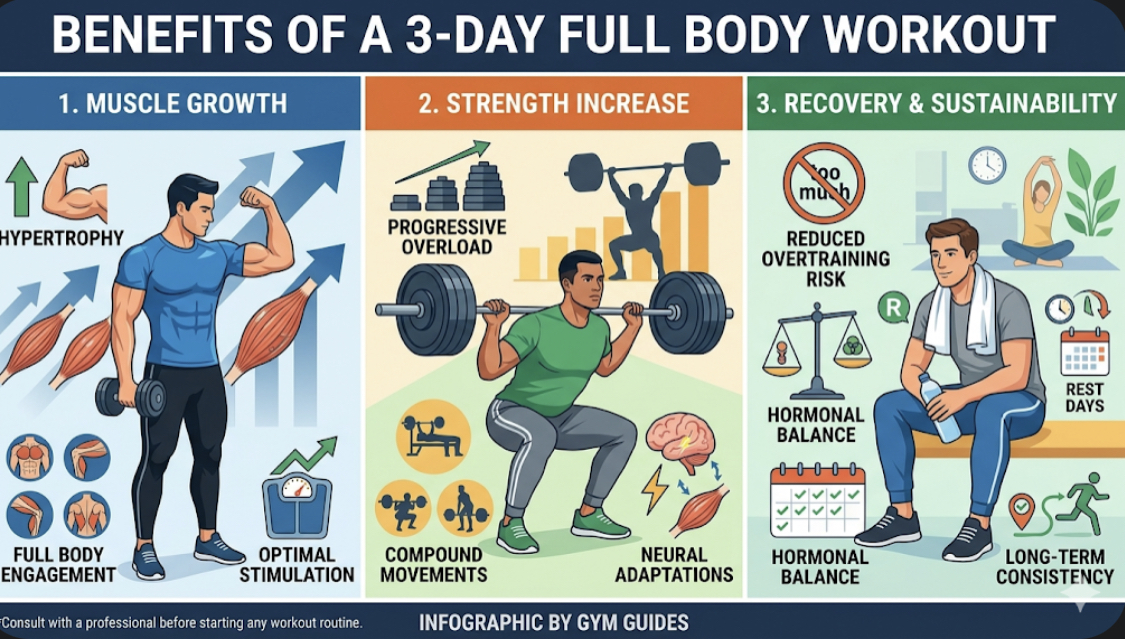
As a beginner, you don't need complex split routines or 6 days a week in the gym. In fact, research shows that training each muscle group 2–3 times per week is more effective for muscle growth than training once a week . A full body workout 3 days a week provides the perfect balance of stimulus and recovery, allowing you to build muscle, gain strength, and establish a sustainable habit.
Is a 3-day full body workout enough for beginners?
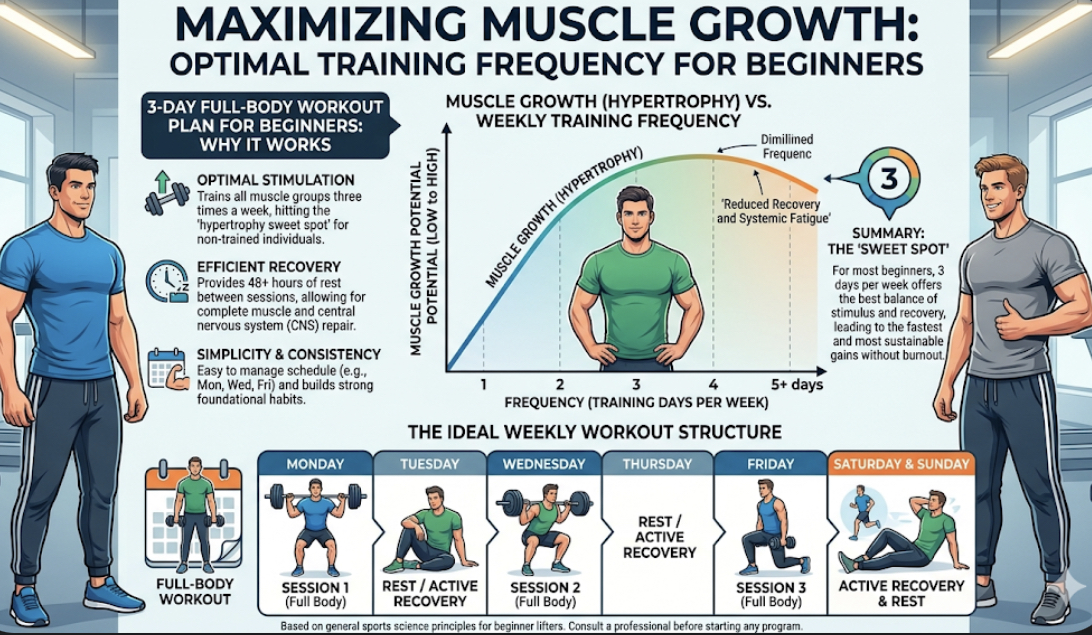
Yes, a 3-day full body workout is more than enough for beginners. Training 3 times per week allows you to hit each muscle group 3 times weekly, which research shows is optimal for hypertrophy . It provides sufficient stimulus while allowing 48–72 hours of recovery between sessions—essential for muscle repair and growth. Most beginners see significant strength gains and visible muscle growth within 8–12 weeks on a consistent 3-day routine .
2. The Science: Why 3 Days Per Week Works
2.1. Optimal Training Frequency
A 2020 meta-analysis found that training each muscle group twice per week produces superior hypertrophy compared to once per week . A 3-day full body routine hits each muscle group 3 times weekly—well within the optimal range.
2.2. Recovery and Adaptation
Muscle growth occurs during rest, not training. With 48–72 hours between sessions, your body has adequate time to repair and grow. Beginners often experience "newbie gains"—rapid strength and muscle gains in the first 3–6 months .
2.3. Compound Movements Are Key
Compound lifts (squat, bench, row, deadlift) recruit the most muscle fibers and provide the greatest anabolic stimulus. They're ideal for full-body routines .
3. The 12-Week Beginner Full Body Workout Plan
3.1. Workout A (Monday & Friday)
- Squat (or Goblet Squat) – 3 sets × 8–10 reps
- Bench Press (or Dumbbell Press) – 3 sets × 8–10 reps
- Bent-Over Row (or Dumbbell Row) – 3 sets × 8–10 reps
- Overhead Press (Dumbbell or Barbell) – 3 sets × 8–10 reps
- Plank – 3 sets × 30–60 seconds
3.2. Workout B (Wednesday)
- Deadlift (or Romanian Deadlift) – 3 sets × 6–8 reps
- Pull-Ups (or Lat Pulldown) – 3 sets × 6–10 reps (use assisted or bands if needed)
- Dumbbell Row (or Machine Row) – 3 sets × 8–10 reps
- Leg Press – 3 sets × 10–12 reps
- Face Pulls – 3 sets × 12–15 reps (for shoulder health)
- Hanging Knee Raise (or Leg Raise) – 3 sets × 10–15 reps
3.3. Progression Schedule
- Weeks 1–4: Focus on form. Use light weight to master technique. Add 2.5–5 lbs each week if form is good.
- Weeks 5–8: Increase weight when you can complete 10 reps on the first set. Aim to add 2.5–5 lbs weekly.
- Weeks 9–12: Continue progressive overload. If you plateau, deload (reduce weight by 20% for one week) and rebuild.
4. Form Guide for Key Exercises
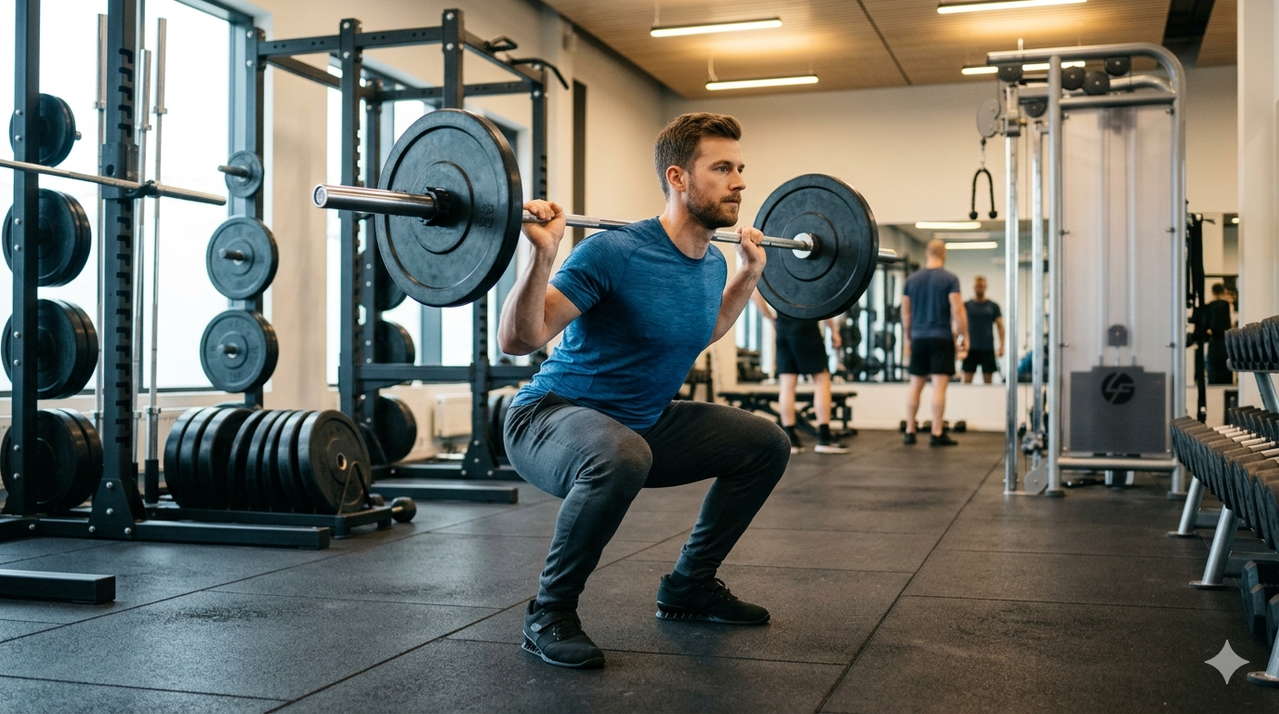
4.1. Squat
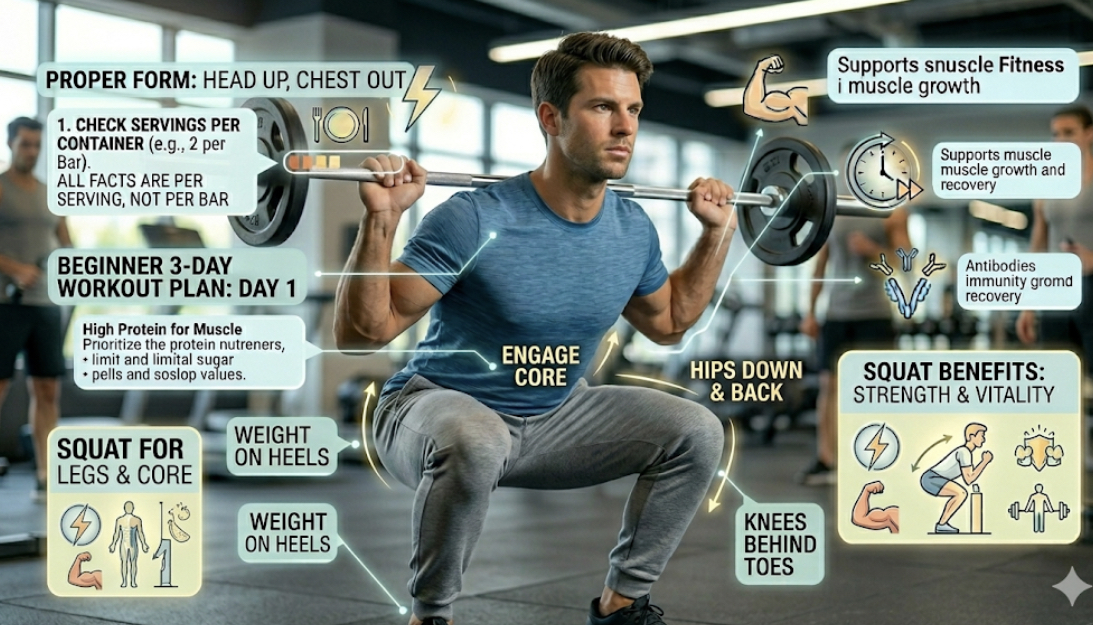
Stand with feet shoulder-width, chest up, back straight. Lower hips back and down as if sitting in a chair. Keep knees tracking over toes. Aim for thighs parallel to ground or deeper.
4.2. Deadlift
Hinge at hips, keeping back flat. Grip bar just outside knees. Drive through heels, extending hips forward. Keep bar close to body throughout.
4.3. Bench Press
Keep shoulders pinned back, feet flat. Lower bar to mid-chest, elbows at 45°. Press explosively.
4.4. Bent-Over Row
Hinge at hips, back flat. Pull bar to lower chest, squeeze shoulder blades. Avoid using momentum.
5. Nutrition for Beginners (Muscle Growth & Recovery)
5.1. Calorie and Protein Targets
- Calories: Eat at maintenance or a small surplus (200–300 kcal above maintenance) for muscle growth.
- Protein: 1.6–2.2 g per kg body weight (e.g., 70 kg person: 112–154 g protein).
- Carbs: 4–6 g per kg body weight for energy and recovery.
- Fats: 0.8–1.2 g per kg body weight for hormonal health.
5.2. Sample Meal Plan (2,200 kcal, 140g Protein)
- Breakfast: 3 eggs, 1 cup oatmeal with berries (450 kcal, 25g protein)
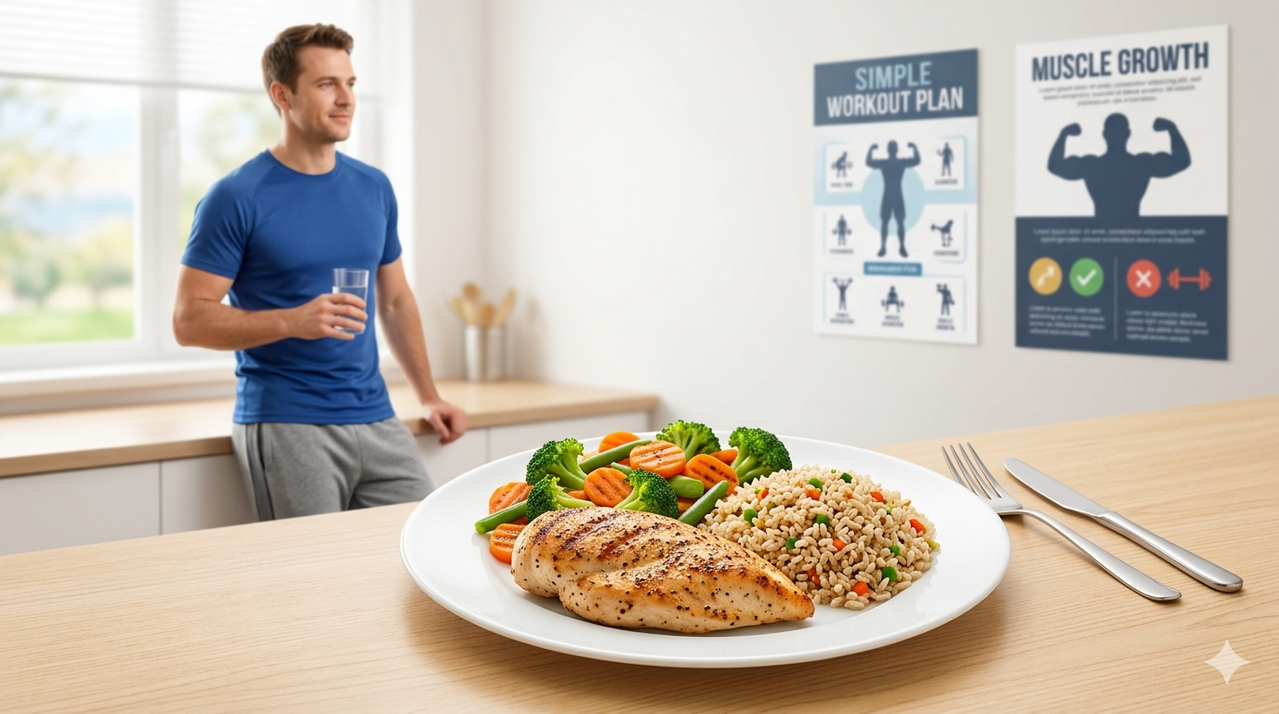
- Lunch: 150g chicken breast, 1.5 cups brown rice, 1 cup broccoli (550 kcal, 45g protein)
- Pre-workout snack: 1 banana + 1 tbsp peanut butter (200 kcal, 5g protein)
- Post-workout/dinner: 150g salmon, 1.5 cups sweet potato, 2 cups greens (500 kcal, 35g protein)
- Evening snack: 200g Greek yogurt, ½ cup berries (200 kcal, 20g protein)
Vegan/Vegetarian Alternatives
- Replace eggs with tofu scramble (200g firm tofu).
- Replace chicken with 200g tempeh or seitan.
- Replace salmon with 1.5 cups cooked lentils.
- Replace Greek yogurt with silken tofu or soy yogurt.
Gluten-Free Options
- Use certified gluten-free oats, quinoa, rice, or buckwheat.
- Ensure tempeh and tofu are gluten-free certified.
6. Sample Weekly Schedule
- Monday (Day 1): Workout A + 10 min light cardio warm-up, 5 min cool-down stretch
- Tuesday: Rest or active recovery (walk, light stretching)
- Wednesday (Day 2): Workout B
- Thursday: Rest or active recovery
- Friday (Day 3): Workout A
- Saturday: Rest or light activity
- Sunday: Full rest
7. Common Beginner Mistakes to Avoid
- Mistake #1: Lifting too heavy with poor form. Form > weight. Injuries will derail progress.
- Mistake #2: Not progressing (adding weight/reps). Progressive overload is essential for growth .
- Mistake #3: Skipping workouts. Consistency beats intensity. Missed sessions add up.
- Mistake #4: Overtraining. 3 days is enough. Adding extra sessions without recovery can backfire.
- Mistake #5: Not eating enough. Muscle requires calories. Undereating stalls progress.
- Mistake #6: Not sleeping enough. Recovery happens during sleep. Aim for 7–9 hours.
8. Frequently Asked Questions
Is a 3-day full body workout enough for beginners?
Yes, it's more than enough. Training 3 times per week allows optimal frequency (each muscle group 3 times weekly) while providing adequate recovery. Most beginners see significant results within 8–12 weeks.
How long should each workout take?
45–60 minutes. Rest 60–90 seconds between sets. Focus on quality over quantity.
Can I do cardio on rest days?
Yes, light cardio (20–30 minutes walking, cycling) on rest days is fine. Avoid intense cardio that interferes with recovery.
How much weight should I start with?
Start with just the bar (45 lbs) for barbell exercises, or light dumbbells (5–15 lbs). Focus on perfect form before adding weight.
What if I can't do a pull-up?
Use lat pulldown machine, assisted pull-up machine, or resistance bands. Aim for 3 sets of 6–10 reps with assistance.
Do I need supplements?
No, whole foods provide everything you need. Protein powder can be convenient but isn't required.
When will I see results?
Strength gains often appear in 2–4 weeks. Visible muscle growth typically takes 8–12 weeks with consistent training and nutrition.
9. Related Resources
- The Science of Rest Days: How Muscles Grow While You Sleep and Recover
- Morning Stretching Routine to Improve Strength and Lifting Performance
- How to Build a Powerful Chest at Home Without a Bench (Best Bodyweight Workouts)
- Best Bodyweight Shoulder Exercises to Build Strong and Stable Shoulders
- How to Do Your First Push-Up: Beginner Progression Guide to Build Strength Fast
10. Scientific References
- Schoenfeld, B. J., et al. (2017). Effects of Resistance Training Frequency on Measures of Muscle Hypertrophy: A Systematic Review and Meta-Analysis. Sports Medicine, 46(11), 1689–1697. PubMed
- Morton, R. W., et al. (2018). A systematic review, meta-analysis and meta-regression of the effect of protein supplementation on resistance training-induced gains in muscle mass and strength in healthy adults. British Journal of Sports Medicine, 52(6), 376–384. PubMed
- Helms, E. R., et al. (2014). Evidence-based recommendations for natural bodybuilding contest preparation. Journal of the International Society of Sports Nutrition, 11(1), 20. PubMed
- Ratamess, N. A., et al. (2009). American College of Sports Medicine position stand. Progression models in resistance training for healthy adults. Medicine & Science in Sports & Exercise, 41(3), 687–708. PubMed
- ACSM. (2021). Nutrition and Athletic Performance. Medicine & Science in Sports & Exercise, 53(3), 600–618. PubMed
Join the conversation