Morning Stretching Routine to Improve Strength and Lifting Performance
Morning Stretching Routine for Better Lifting Performance

🌅 TL;DR
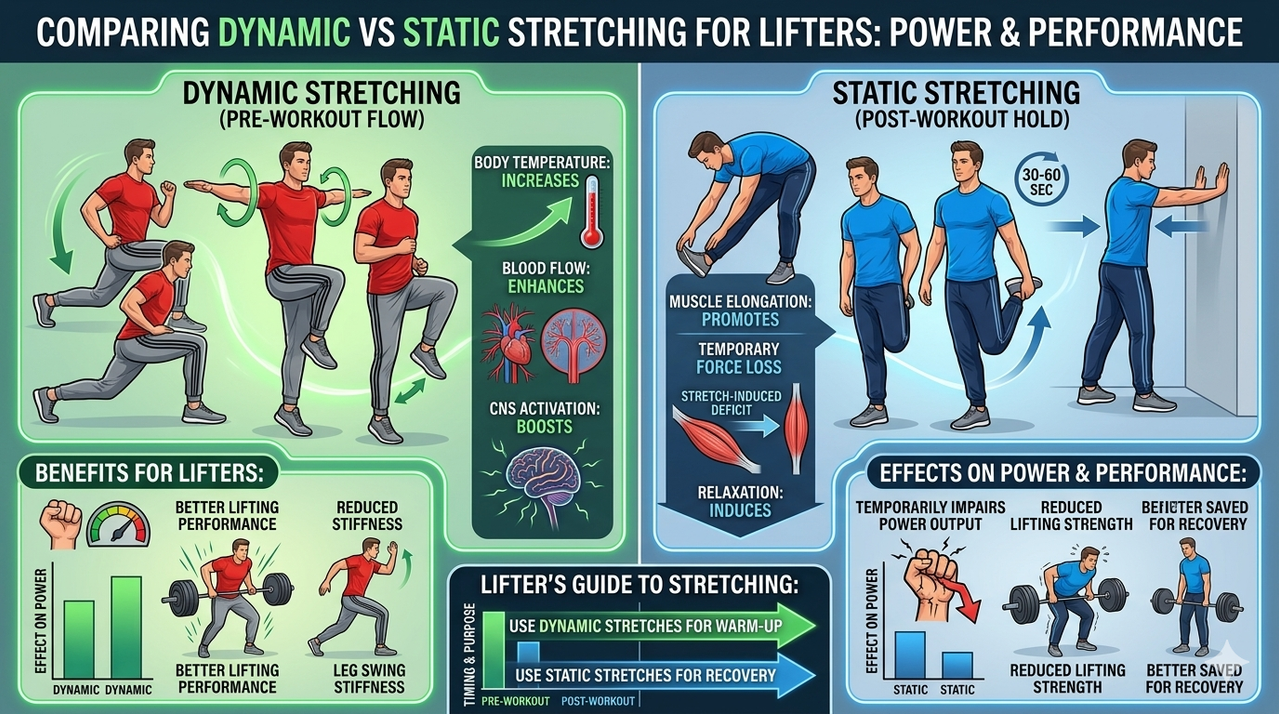
A proper morning stretching routine for better lifting performance is not about static holds—it's about dynamic movement. Research consistently shows that static stretching before strength work can temporarily decrease power and maximal strength by up to 5-15% . In contrast, dynamic stretching mimics the movements of your workout, increasing blood flow, muscle temperature, and neural activation, leading to acute improvements in power and performance . A 2025 NIH consensus statement confirmed that stretching improves range of motion but does not contribute substantively to muscle growth . This guide provides a science-backed 10-minute morning routine targeting key lifters' areas (hips, shoulders, spine), explains the critical difference between dynamic and static stretching, and includes nutrition advice to fuel your morning session.
1. Why Your Morning Stretching Routine Matters for Lifting
You wake up stiff. Your hips are tight, your shoulders feel restricted, and your lower back is calling for mercy. If you head straight to the barbell in this state, you're not just limiting your performance—you're inviting injury.
The solution isn't more coffee; it's a strategic morning stretching routine for better lifting performance. Research from the Florida Orthopaedic Institute shows that a proper warm-up can improve strength output by 5-15% compared to starting cold . But not all stretching is created equal. A 2024 Cleveland Clinic report highlights that dynamic stretching is superior for pre-workout preparation, while static stretching may actually hinder strength . This guide will teach you the science and provide a practical, time-efficient routine.
2. The Science: Why Dynamic Beats Static Pre-Workout
2.1. The 2025 NIH Consensus Statement
A landmark 2025 consensus statement from international experts, published in the Journal of Sport and Health Science, examined the full scope of stretching effects . Key findings relevant to lifters:
- Both acute and chronic stretching improve range of motion .
- Stretch training does not contribute substantively to muscle growth .
- Stretching does not serve as an all-encompassing injury prevention strategy .
- There is no acute benefit for post-exercise recovery .
This means that while stretching is valuable for mobility, it shouldn't be your primary tool for muscle building or injury prevention. Its role is to prepare your joints for the ranges of motion required in lifting .
2.2. The 2016 Study: Specific Warm-ups Win
A 2016 study in the Journal of Strength and Conditioning Research compared passive static stretching, proprioceptive neuromuscular facilitation (PNF), and a specific warm-up (SW) before a lower-body strength session . The results were clear: the specific warm-up (dynamic movements mimicking the workout) led to higher performance in exercises like the leg press and hack squat, while PNF stretching resulted in lower performance across the board . This reinforces that for lifting, you need to prime the muscles with movement, not relax them with prolonged holds .
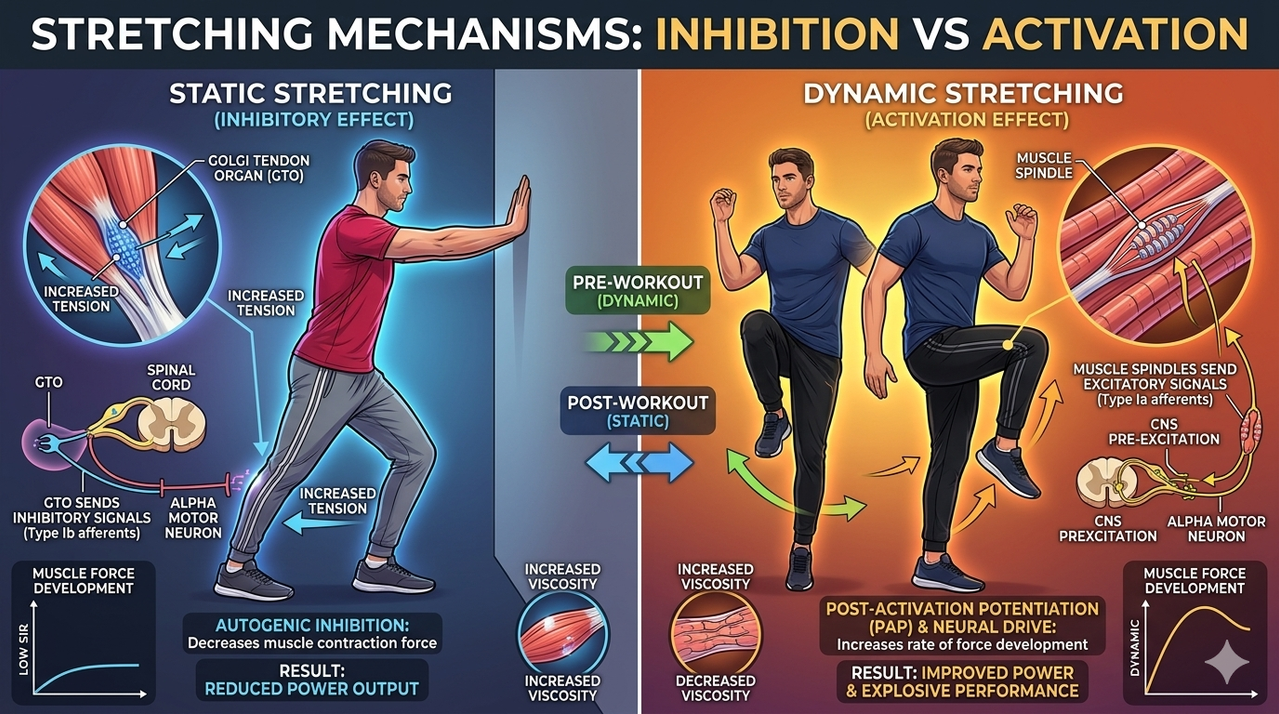
2.3. The Neural Explanation
Static stretching activates the Golgi tendon organ, which inhibits muscle contraction as a protective mechanism . This reduces neural drive to the muscle, making it harder to generate maximal force . Dynamic stretching, on the other hand, increases muscle temperature, blood flow, and excites the nervous system, enhancing power and coordination .
3. The 10-Minute Morning Routine for Lifters
This routine combines insights from physical therapists and strength coaches . Perform these exercises in order, moving smoothly through each.
3.1. Spine & Hip Mobilization Dynamic
Cat-Cow Stretch
- Start on hands and knees.
- Inhale, drop your belly, lift chest and tailbone (cow).
- Exhale, round spine toward ceiling, tuck chin and tailbone (cat).
- Repeat 10 slow, controlled breaths. This warms up the entire spine .
World's Greatest Stretch
- From a plank position, step your right foot outside your right hand.
- Drop your left knee to the floor.
- Reach your right arm toward the ceiling, rotating your torso to look at your hand.
- Hold for 2 seconds, then switch sides. Repeat 5 times per side. This opens hips and thoracic spine .
3.2. Lower Body Activation Dynamic
Leg Pendulums
- Stand next to a wall for support.
- Swing one leg forward and backward like a pendulum, keeping it relaxed .
- Perform 10-12 swings, then switch legs. This preps hamstrings and hip flexors .
Walking Lunges with Torso Twist
- Step forward into a lunge, keeping front knee aligned.
- As you lunge, twist your torso toward the front leg's side .
- Push off to step into the next lunge. Perform 10 lunges per leg.
Lateral Walking Lunges
- Step out to the side into a lunge, keeping the other leg straight .
- Push off to return to standing, then step to the other side .
- Perform 8-10 reps per side. This targets adductors and glutes .
3.3. Upper Body & Shoulder Prep Dynamic
PVC Pass-Throughs (or Towel)
- Hold a broomstick or towel with a wide overhand grip.
- Keeping arms straight, raise it overhead and pass it behind you as far as comfortable .
- Return to start. Perform 10 slow reps. This opens chest and shoulders .
Band Pull-Aparts (or Towel)
- Hold a resistance band or towel in front of you with straight arms.
- Pull it apart, squeezing shoulder blades together.
- Return with control. Perform 15 reps.
Thoracic Spine Rotation
- Lie on your side with both knees bent and arms stacked.
- Open your top arm toward the ceiling, rotating your torso while keeping knees together.
- Perform 8 reps per side.
3.4. Full Body Integration Dynamic
Bodyweight Squat
- Stand with feet shoulder-width apart.
- Lower into a squat, keeping chest up and weight in heels.
- Perform 10-15 reps, focusing on depth .
Good Mornings
- Stand with feet shoulder-width apart, hands behind head.
- Hinge at hips, keeping back straight, until torso is nearly parallel to floor .
- Return to standing. Perform 10 reps. This preps hamstrings and lower back .
4. What to Avoid in Your Morning Routine
4.1. Prolonged Static Stretching
Avoid holding static stretches for 30-90 seconds before lifting. A 2019 research summary cited by Cleveland Clinic found that static stretching can negatively affect maximal strength and power . If you must static stretch, limit holds to 15-30 seconds as part of a dynamic warm-up .
4.2. Stretching Cold Muscles
Never stretch "cold" muscles aggressively. Even dynamic movements should start small and increase in range of motion. Consider 2-3 minutes of light cardio (jumping jacks, jogging in place) to raise muscle temperature first .
4.3. Painful Overstretching
Stretching should feel like tension, not sharp pain. Pain indicates injury risk. If you have persistent tightness or pain, consult a physical therapist .
5. Nutrition: Fueling Your Morning Workout
Your morning stretching routine primes your muscles; now they need fuel.
5.1. Pre-Workout Nutrition Timing
If you train within an hour of waking, a light, easily digestible snack is ideal. Aim for 20-30g carbs and 10-15g protein . Examples: banana with peanut butter, a small smoothie, or a protein shake.
5.2. Sample 2500-Calorie Day for Morning Lifters
- Pre-Workout (6:30 AM): 1 banana + 1 tbsp almond butter. (200 kcal, 5g protein)
- Post-Workout Breakfast (8:00 AM): 3-egg scramble with spinach, 1 slice whole-grain toast, 1 cup Greek yogurt. (450 kcal, 35g protein)
- Lunch (12:30 PM): 150g grilled chicken breast, 1 cup quinoa, roasted broccoli with olive oil. (550 kcal, 40g protein)
- Afternoon Snack (4:00 PM): Apple with 2 tbsp peanut butter. (250 kcal, 8g protein)
- Dinner (7:00 PM): 150g salmon, 1 medium sweet potato, sautéed kale. (500 kcal, 35g protein)
- Evening Snack (optional): Cottage cheese (1 cup) with berries. (200 kcal, 25g protein)
5.3. Vegan/Vegetarian Options
- Pre-workout: Smoothie with banana, oat milk, and pea protein.
- Post-workout: Tofu scramble with black beans and avocado on whole-grain toast.
- Protein sources: Tofu, tempeh, lentils, chickpeas, edamame, pea protein powder.
6. Common Morning Stretching Mistakes
- Mistake #1: Holding static stretches too long. This can decrease strength for up to 30 minutes after .
- Mistake #2: Using stretching as a warm-up without raising heart rate. Add 2-3 minutes of light cardio first .
- Mistake #3: Bouncing (ballistic stretching). This can cause muscle strains. Keep movements controlled .
- Mistake #4: Ignoring pain or asymmetry. If one side is significantly tighter, it may indicate an imbalance .
- Mistake #5: Expecting stretching to prevent injury completely. The 2025 consensus found stretching isn't an all-encompassing injury prevention strategy . Use it as part of a complete program.
7. Related Resources
8. Scientific References
- Florida Orthopaedic Institute. (2025). 12 essential warm-ups before weight lifting. floridaortho.com. View Source
- Cleveland Clinic. (2024). Dynamic Stretching vs. Static Stretching. health.clevelandclinic.org. View Source
- Warneke, K., et al. (2025). Practical recommendations on stretching exercise: A Delphi consensus statement. Journal of Sport and Health Science. PubMed
- Sá, M. A., et al. (2016). Acute Effects of Different Methods of Stretching and Specific Warm-ups on Muscle Architecture and Strength Performance. Journal of Strength and Conditioning Research, 30(8), 2324-2329. View Source
- T3. (2025). Top strength coach Jeff Cavaliere shares 5 morning stretches. t3.com. View Source
- Healing Hands. (2025). Are You Stretching the Wrong Way Before Your Workout? healinghands.com.sg. View Source
- Muscle Insider. (2023). When To Stretch? muscleinsider.com. View Source
- StrongFirst Forums. (2019). Discussion on static vs dynamic stretching. strongfirst.com. View Source
- Warneke, K., et al. (2025). Acute and Chronic Effects of Stretching on Running Economy. Sports Medicine Open. PubMed
- Kof, B., & Strojnik, V. (2007). Effect of Two Warm-Up Protocols on Neuromuscular Parameters. Journal of Strength and Conditioning Research, 21(2), 394-399. View Source
Join the conversation