The Science of Rest Days: How Muscles Grow While You Sleep and Recover
The Science of Rest Days: Why Your Muscles Grow While You Sleep

🛌 TL;DR
The science of rest days: why your muscles grow while you sleep is rooted in cellular biology. During deep sleep, your body releases growth hormone, which drives muscle protein synthesis (MPS) to repair the microtears caused by training . MPS can remain elevated for up to 48 hours post-exercise, meaning rest days are when the real growth happens . A 2025 study found that taking periodic breaks (e.g., 3 weeks off after 6 weeks of training) can prevent plateaus and lead to similar long-term gains as continuous training . Even more concerning: sleep deprivation creates a catabolic state with higher cortisol and lower testosterone, potentially leading to muscle loss . This guide breaks down the hormones, the mTOR pathway, optimal rest periods, and nutrition strategies to maximize your recovery.
1. The Rest Day Paradox: Less Is More
You feel guilty skipping the gym. You think that taking a day off means losing progress. But what if the opposite were true? What if your muscles only grow when you stop training?
This is the paradox at the heart of the science of rest days: why your muscles grow while you sleep. Exercise physiologists have long known that training breaks down muscle tissue. It creates microtears in fibers, depletes energy stores, and stresses the nervous system. But the repair process—the adaptation that makes you stronger—happens during rest . A 2024 review in the Journal of Strength and Conditioning Research confirms that muscle protein synthesis (MPS) remains elevated for 24-48 hours after training . If you don't rest, you interrupt that growth window.
2. The Cellular Science: How Muscles Repair and Grow
2.1. Microtears and the mTOR Pathway
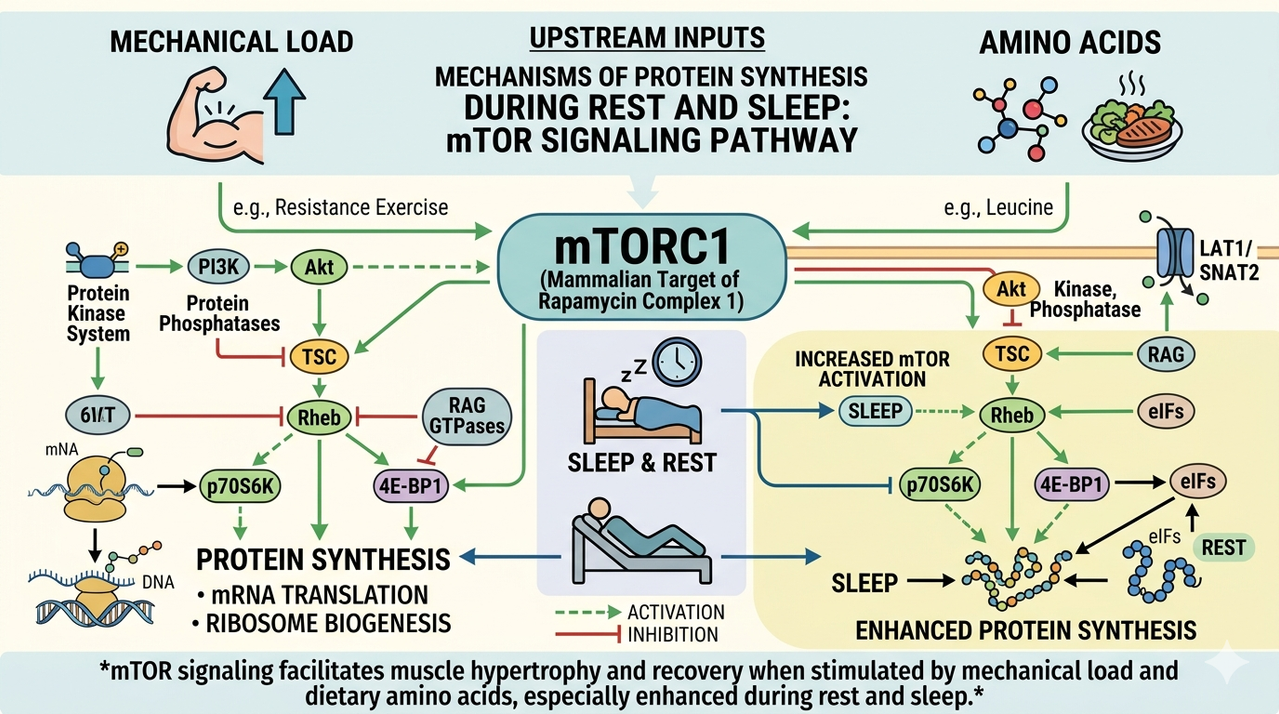
Resistance training creates microscopic damage to muscle fibers. This sounds bad, but it's exactly what you want. These microtears signal your body to initiate repair. The key player is a signaling molecule called mTOR (mechanistic target of rapamycin). When activated by mechanical load and amino acids, mTOR kicks off protein synthesis, building new muscle tissue to replace the damaged fibers . This process requires energy and raw materials—and it happens primarily during rest, not during your workout .
2.2. The Hormonal Shift: Anabolic vs. Catabolic
Your hormonal environment during sleep is primed for growth. A 2013 paper in Medical Hypotheses outlined how sleep deprivation creates a "proteolytic environment"—a fancy way of saying your body breaks down muscle . During deep sleep:
- Growth hormone (GH) surges: This anabolic hormone stimulates protein synthesis and muscle repair .
- Cortisol drops: The catabolic stress hormone decreases, reducing muscle breakdown .
- Testosterone production: Sleep supports healthy testosterone levels, crucial for recovery .
The study hypothesized that resistance exercise may be the best non-pharmacological strategy to counteract the muscle-wasting effects of poor sleep .
2.3. Glycogen Replenishment
During exercise, your muscles burn through glycogen (stored carbohydrates). On rest days, your body converts carbs from food back into glycogen, refilling your energy tanks for the next workout . Without adequate rest, glycogen stores remain depleted, leading to fatigue and poor performance .

3. The 2025 Breakthrough: Why Periodic Rests Boost Gains
3.1. The 24-Week Study on Training Breaks
A 2025 study published in the European Journal of Applied Physiology compared continuous training with periodic training (including breaks) . Fourteen young men followed the same bench press routine for 24 weeks. One group trained continuously; the other trained in three 6-week cycles with 3-week breaks in between. Results:
- After the first 6 weeks, both groups gained similarly.
- After that, the continuous group's progress slowed.
- The periodic group, however, saw greater increases after each retraining cycle .
The bottom line: Total muscle growth and strength gains were the same for both groups. But the group that took breaks achieved those results with less accumulated fatigue and, potentially, less psychological burnout . Dr Mike Israetel, who discussed the study, noted: "If you get a three-week break every now and again, you're going to be able to climb higher every single one of those little instances." .
3.2. Muscle "Sensitisation" Hypothesis
Researchers suggest that taking breaks may resensitise muscles to growth stimuli. Dr Israetel explains, "If you rest so long between sessions, your muscles get really sensitised to growth again." . Once muscle is built, it doesn't disappear quickly—it "hangs around just kind of waiting" .
4. Sleep: The Non-Negotiable Growth Hormone Trigger
4.1. How Much Sleep Do You Need?
Most adults need 7-9 hours of sleep per night for optimal recovery . Athletes and those training at high intensity may require more . A 2025 Health.com article emphasized that during deep sleep, growth hormone is released, directly supporting muscle repair .
4.2. What Happens When You Don't Sleep Enough
Inadequate sleep creates a cascade of negative effects:
- Reduced muscle protein synthesis .
- Increased cortisol, leading to muscle breakdown .
- Lowered testosterone and IGF-1 (insulin-like growth factor) .
- Increased risk of injury, slower reaction times, and poor coordination .
A 2013 study in Medical Hypotheses warned that sleep deprivation "can induce muscle atrophy by increasing glucocorticoids and decreasing testosterone, growth hormone and IGF-I" .
4.3. Pre-Sleep Protein: The 30-Gram Hack
Research cited by Health.com suggests that consuming about 30 grams of protein before bed may increase muscle protein synthesis during sleep by up to 22% . This is because it provides a steady stream of amino acids throughout the night, preventing a catabolic state . Good options: cottage cheese, casein protein shake, or Greek yogurt.
5. Nutrition on Rest Days: Don't Undereat
5.1. The Protein Continuum
A common mistake is slashing protein on rest days. But as NDL Pro-Health explains, muscle repair "remains active for 24 to 48 hours, even on days when you don't go to the gym" . Protein requirements on rest days are essentially the same as training days: 1.6–2.2 g per kg of body weight . Spreading protein evenly across 3-4 meals ensures a continuous supply of amino acids .
5.2. Carbohydrates: Adjust to Your Needs
While total calorie needs may be slightly lower on rest days, carbohydrates still play a role. The Michigan High School Athletic Association recommends adjusting your plate based on activity: on hard training days, up to half your plate should be carbs; on recovery or rest days, aim for about a quarter of your plate from carbs . Focus on complex carbs (whole grains, legumes, starchy vegetables) to support glycogen replenishment without spiking blood sugar .
5.3. Sample 2200-Calorie Rest Day Meal Plan (75 kg athlete)
- Breakfast (8 AM): 3 scrambled eggs with spinach, 1 slice whole-grain toast, 1 cup berries. (400 kcal, 30g protein)
- Lunch (1 PM): 150g grilled salmon, 1 cup quinoa, roasted broccoli with olive oil. (550 kcal, 35g protein)
- Afternoon Snack (4 PM): 1 apple with 2 tbsp peanut butter, 1 hard-boiled egg. (350 kcal, 15g protein)
- Dinner (7 PM): 150g chicken breast, 1 cup roasted sweet potato, large salad with vinaigrette. (500 kcal, 40g protein)
- Pre-Sleep (10 PM): 1 cup cottage cheese or 1 scoop casein protein. (200 kcal, 25g protein)
- Total: ~2,000 kcal, ~145g protein (adjust portions as needed)
5.4. Vegan/Vegetarian Options
- Protein sources: Tofu, tempeh, seitan, lentils, chickpeas, edamame, pea protein powder.
- Pre-sleep option: Soy yogurt with nuts and seeds, or pea protein shake with almond milk.
- Sample meal: Tofu stir-fry with brown rice and mixed vegetables.
6. Active Recovery vs Total Rest: What's the Difference?
6.1. Definitions
- Total rest: Minimal physical activity. Watching Netflix, reading, napping. This is essential after extremely taxing workouts .
- Active recovery: Low-intensity movement that increases blood flow without stressing muscles. Examples: walking, light cycling, yoga, swimming .
6.2. When to Use Each
A 2019 review in the Journal of Strength and Conditioning Research found that active recovery at 30-60% of max heart rate can enhance blood flow and reduce muscle soreness . The Australian Institute of Fitness recommends active recovery options like mobility sessions, foam rolling, and light cardio to "flush metabolic waste and keep joints mobile" .
For most lifters, a mix works best: 1-2 total rest days and 1-2 active recovery days per week .
| Recovery Type | Examples | Best For |
|---|---|---|
| Total Rest | Sleep, reading, sitting | Post-extreme fatigue, illness, or after 8+ weeks of intense training |
| Active Recovery | Walking, yoga, foam rolling | Between training days, mild soreness |
| Passive Recovery | Massage, ice baths, compression | Accelerating recovery after competition or very high volume |
7. Volume Cycling and Deloads: Advanced Rest Strategies
7.1. What Is Volume Cycling?
Volume cycling means alternating between periods of high and low training volume. This strategy allows muscles to recover fully and respond better to future stress . Dr Josh Pelland explains that incorporating "deloads or introductory weeks where you ease back up into training" is a smart long-term move .
7.2. How to Deload
A typical deload week involves reducing volume or intensity by 40-60%. You can:
- Keep the same weight but do half the sets.
- Reduce weight by 20-30% and keep reps/sets similar.
- Take 3-5 days completely off, as the 2025 study did .
Dr Israetel notes that "taking periods of lower training can allow long adapting structures like tendons to grow where usually they would just be like outpaced by muscle" .
8. Common Rest Day Mistakes
- Mistake #1: Zero movement. While total rest is fine, complete inactivity for days can increase stiffness. Light walking is beneficial .
- Mistake #2: Eating too little protein. Your muscles still need amino acids for repair. Don't drop protein on rest days .
- Mistake #3: Ignoring sleep. Skimping on sleep is the fastest way to sabotage recovery .
- Mistake #4: Guilt about resting. Rest is not laziness—it's a performance enhancer. Mental recovery is real .
- Mistake #5: No deloads. Training at max intensity year-round leads to burnout and injury. Plan deloads .
9. Related Resources
10. Scientific References
- Neudecker, K. (2025). Why periodic rests from training could be the key to boosting muscle growth. Men's Health Australia. View Source
- Dattilo, M., et al. (2013). Resistance exercise: A non-pharmacological strategy to minimize or reverse sleep deprivation-induced muscle atrophy. Medical Hypotheses, 80(6), 701-705. ScienceDirect
- Irwin, S. (2025). The Recovery Revolution: Maximizing Rest Days for Better Performance. Australian Institute of Fitness. View Source
- NDL Pro-Health. (2025). Protein on rest days? The science behind muscle recovery. ndlprohealth.com. View Source
- Health.com. (2025). How Much Sleep Should You Get After Exercise for Muscle Recovery? health.com. View Source
- Michigan High School Athletic Association. (2025). Coaches Guide to Nutrition: Underfueling. mhsaa.com. View Source
- Miller, K. (2025). 'Resting more between workouts changed my body. Here's how it could transform yours'. Women's Health Australia. View Source
- BBC Science Focus. (2025). The weird ways resting more can make you stronger, faster and fitter. sciencefocus.com. View Source
- Runner's World. (2025). Instead of Melting Into Your Couch on Rest Days, Try Doing One of These Recovery Habits. runnersworld.com. View Source
- Snijders, T., et al. (2019). The impact of pre-sleep protein ingestion on the skeletal muscle adaptive response to exercise in humans: An update. Frontiers in Nutrition, 6, 17. PubMed
Join the conversation