How to Do Your First Push-Up: Beginner Progression Guide to Build Strength Fast
How to Do Your First Push-Up: A Progression Guide

💪 TL;DR
Learning how to do your first push-up is a journey of progressive strength building, not willpower. A full push-up requires moving up to 75% of your bodyweight, which is equivalent to bench pressing significant weight . The key is following a structured progression: start with wall push-ups, then incline push-ups on higher surfaces, then knee push-ups, then concentric (half) push-ups, and finally full push-ups . Research shows that practicing the specific movement pattern with less load builds the necessary strength and neuromuscular coordination . A 4-week plan with 3-4 sessions per week can lead to a 20-50% improvement in push-up capacity . This guide provides the exact progressions, a 4-week workout plan, form cues, and beginner nutrition advice to fuel your success.
1. Why the Push-Up is So Hard (And Why You Can Do It)
You've seen people bang out push-ups like they're nothing. But when you try, you barely move an inch before collapsing. If this sounds familiar, you're not alone—and it's not a lack of effort. According to research in the Journal of Strength and Conditioning Research, a full push-up requires you to lift up to 75% of your bodyweight . For a 150-pound person, that's like bench pressing 112 pounds with no warm-up.
The good news? No one expects you to lift that much weight on your first try. The path to mastering how to do your first push-up is about progressive training—starting with easier variations that let you practice the movement while gradually building strength . This guide provides a science-backed roadmap to get you there.
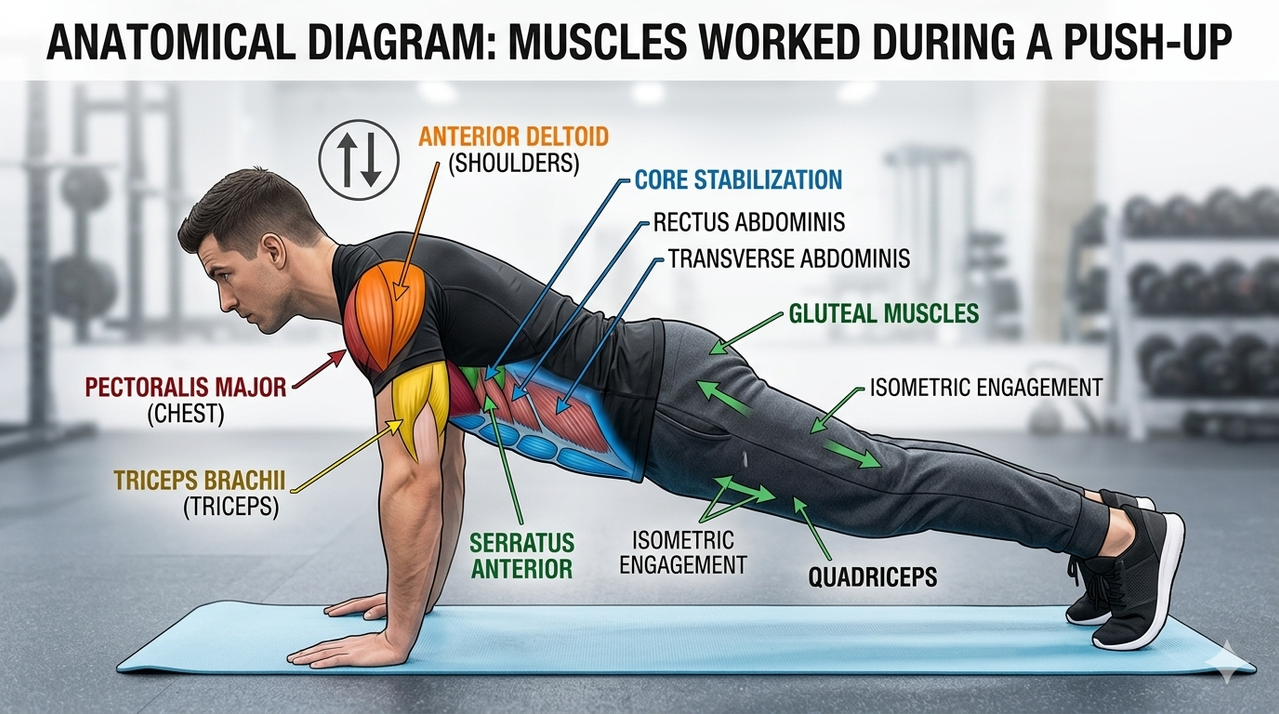
2. The 5-Step Push-Up Progression
Work through these steps in order. Don't move to the next level until you can complete 3 sets of 10-12 reps with perfect form .
Step 1: Wall Push-Ups Level 1
Why it works: The most upright position reduces the load to as low as 20-30% of your bodyweight, allowing you to practice the pushing motion without strain .
- Stand facing a wall, about 2-3 feet away.
- Place hands on the wall at shoulder height and width.
- Keeping your body straight, bend elbows to lean toward the wall.
- Push back to start. That's 1 rep .
Goal: 3 sets of 15-20 reps.
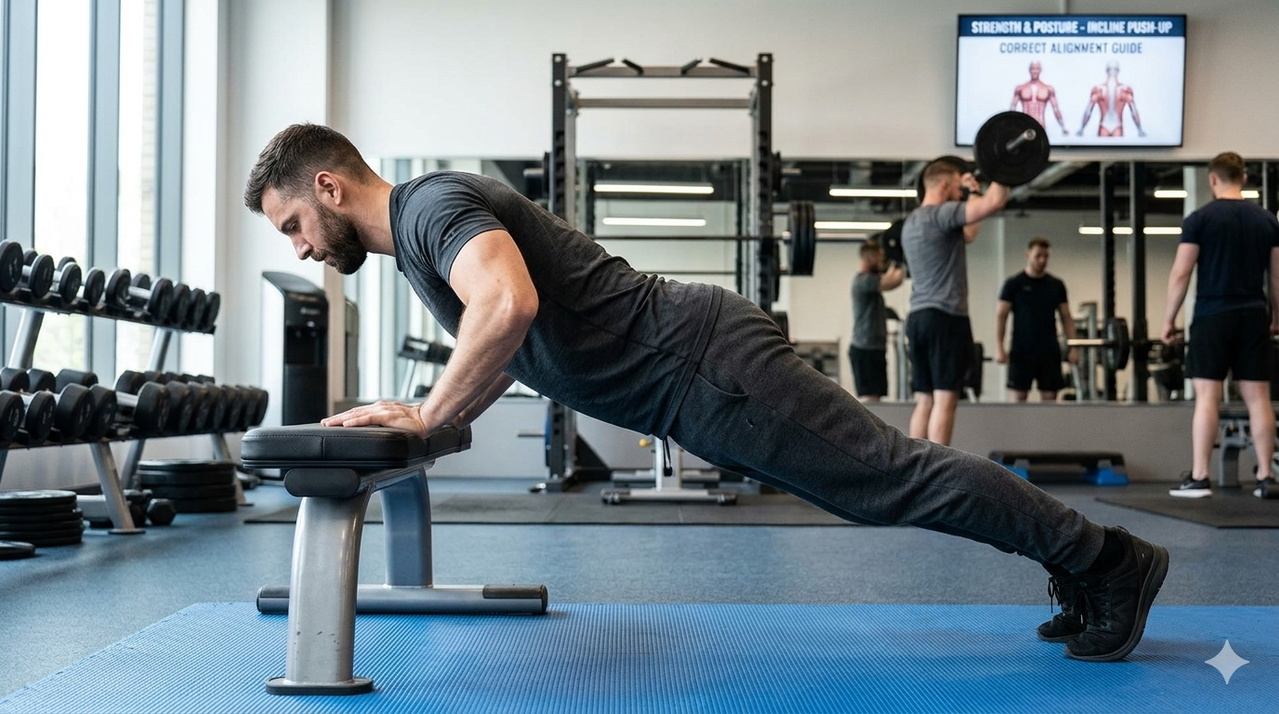
Step 2: Incline Push-Ups Level 2
Why it works: Elevating your hands on a surface reduces the load; the higher the surface, the easier the move. As you get stronger, use lower surfaces .
- Find a sturdy elevated surface—start with a kitchen counter, then a table, then a low bench.
- Place hands shoulder-width apart on the edge.
- Walk your feet back until your body forms a straight line from head to heels.
- Lower your chest toward the surface, then press back up .
Goal: 3 sets of 10-12 reps on a progressively lower surface .
Step 3: Knee Push-Ups Level 3
Why it works: By supporting your weight on your knees, you reduce the load to about 62% of your bodyweight, which is a significant jump from incline work .
- Start on hands and knees, hands under shoulders.
- Extend your body forward so your hips, shoulders, and knees form a straight line .
- Bend elbows to lower your chest toward the floor.
- Push back up .
Goal: 3 sets of 10-12 reps .
Step 4: Concentric (Half) Push-Ups Level 4
Why it works: This variation lets you practice the hardest part of the push-up—the push from the bottom—while using your knees for the easier lowering phase .
- Start in a full push-up position (on your toes).
- Lower yourself all the way down slowly (this is the eccentric phase).
- Once your chest touches the floor (or you're at bottom), drop your knees to the floor and push up from your knees .
- Return to the full starting position (on toes) and repeat .
Goal: 3 sets of 6-8 reps.
Step 5: Full Push-Ups Level 5
Why it works: You've built the strength; now it's time to put it all together.
- Start in high plank: hands under shoulders, body straight from head to heels .
- Bend elbows, keeping them at a 45-degree angle to your body.
- Lower until your chest hovers just above the floor.
- Push through your palms to return to start .
Goal: 1 rep with perfect form. Then work toward 3 sets of 5-10 reps.
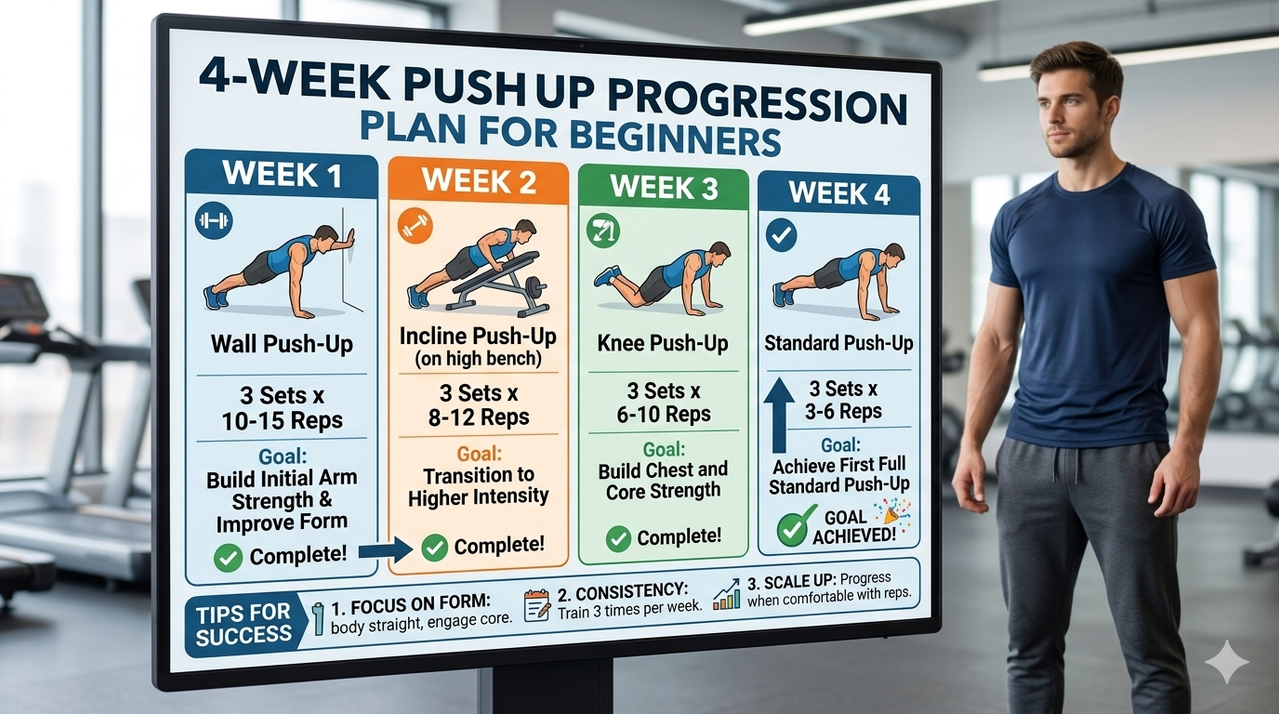
3. Your 4-Week Push-Up Training Plan
This plan is adapted from expert programming and research-backed progression methods. Train 3-4 days per week with at least one rest day between sessions .
Week 1: Foundation
- Day 1 & 3: Incline Push-Ups (on table/bench) 3x10-12, Knee Push-Ups 3x8-10, Plank Hold 3x30s.
- Day 2 & 4: Incline Push-Ups 3x12-15, High Plank Shoulder Taps 3x10 each side, Glute Bridges 3x15.
Week 2: Building Volume
- Day 1 & 3: Knee Push-Ups 3x10-12, Incline Push-Ups (on lower surface) 3x12-15, Plank 3x45s.
- Day 2 & 4: Concentric Push-Ups 3x6-8, Knee Push-Ups 3x10, Dumbbell Chest Press (light weight) 3x10 .
Week 3: Strength Focus
- Day 1 & 3: Concentric Push-Ups 3x8-10, Knee Push-Ups 3x12 (slow tempo), Plank 3x60s.
- Day 2 & 4: Attempt Full Push-Ups (as many as possible with good form, even if 1-2 reps), then Knee Push-Ups to complete 3 sets of 10 total reps .
Week 4: Peak Week
- Day 1 & 3: Full Push-Ups: 5-8 sets of 1-2 reps (if you can do 2, do them; if only 1, that's fine), rest 90 seconds.
- Day 2 & 4: Test Day: Rest 2 full days, then attempt your max continuous full push-ups .
Most beginners see a 20-50% improvement in their push-up capacity after this 4-week cycle .
4. Perfect Push-Up Form Checklist
Before every rep, run through this mental checklist to ensure proper form :
- Hands: Slightly wider than shoulder-width, fingers pointing forward.
- Elbows: At a 30-45 degree angle to your body—not flared out to 90 degrees.
- Body: Perfectly straight line from head to heels. Squeeze glutes and core.
- Neck: Neutral—look at a spot on the floor about 6 inches in front of you.
- Range of motion: Chest touches the floor (or as low as possible), arms fully extend at top .
5. Accessory Exercises to Accelerate Progress
These exercises strengthen the individual muscles used in push-ups, helping you progress faster .
- Plank Hold: Builds core stability essential for the straight-body position. Hold for 30-60 seconds, 3 sets.
- Dumbbell Chest Press: Mimics the pushing motion with adjustable weight. Lie on a bench or floor, press dumbbells up from chest .
- Triceps Dips (on bench): Strengthens the triceps, a primary push-up muscle. 3 sets of 8-10 reps.
- Scapular Push-Ups (in plank, just squeeze shoulder blades together and apart without bending elbows): Improves shoulder stability .
6. Beginner Nutrition to Fuel Your First Push-Up
Strength training requires fuel. Here's how to support your push-up journey with proper nutrition.
6.1. Protein: The Building Block
For muscle repair and growth, aim for 1.2–1.6 grams of protein per kg of body weight daily . Good sources: lean meats, eggs, dairy, tofu, beans, lentils .
6.2. Carbohydrates: Your Energy Source
Carbs fuel your workouts. Focus on complex carbs like oats, brown rice, sweet potatoes, and whole grains .
6.3. Healthy Fats: Hormone Support
Include avocados, nuts, seeds, and olive oil for overall health and recovery .
6.4. Sample 1800-Calorie Day for Beginners
- Breakfast (7 AM): Scrambled eggs (2 eggs) with spinach + 1 slice whole-grain toast + 1 banana. (350 kcal, 20g protein)
- Lunch (12 PM): Grilled chicken breast (120g) + quinoa (½ cup) + roasted broccoli. (450 kcal, 35g protein)
- Pre-Workout Snack (if training): Apple with 1 tbsp peanut butter. (200 kcal, 5g protein)
- Dinner (6 PM): Baked salmon (120g) + sweet potato (1 medium) + green beans. (500 kcal, 30g protein)
- Evening Snack (optional): Greek yogurt (½ cup) with berries. (150 kcal, 10g protein)
6.5. Vegan/Vegetarian Options
- Protein sources: Tofu, tempeh, lentils, chickpeas, seitan, pea protein powder.
- Sample meal: Tofu scramble with veggies + whole-grain toast + avocado.
- Post-workout shake: Pea protein powder + banana + oat milk.
7. Hydration and Recovery: The Unsung Heroes
7.1. Hydration
Dehydration impairs muscle function and recovery. Aim for 2-3 liters of water daily, more if you sweat heavily . A good rule: drink enough that your urine is pale yellow .
7.2. Sleep
Muscle repair happens during sleep. Aim for 7-9 hours per night to maximize strength gains .
7.3. Rest Days
Your muscles don't grow during workouts—they grow during rest. Take at least 2 full rest days per week, and don't train the same muscles intensely on consecutive days .
8. Common Push-Up Training Mistakes
- Mistake #1: Training every day. Muscles need recovery. Stick to 3-4 days per week .
- Mistake #2: Sacrificing form for reps. Five perfect push-ups build more strength than ten sloppy ones .
- Mistake #3: Staying in your comfort zone. If you can do 20 knee push-ups easily, it's time to move to the next progression .
- Mistake #4: Ignoring nutrition. You can't build muscle without fuel. Eat enough protein and total calories .
- Mistake #5: Neglecting core work. Push-ups require a strong core. Include planks and glute bridges in your routine .
9. Related Resources
10. Scientific References
- LSU Health Shreveport. (2025). Can't Do a Push-Up Yet? Start with These Foundational Exercises. lsuhs.edu. View Source
- Apollo 24|7. (2026). Gym Diet Plan for Beginners. apollo247.com. View Source
- Generation Iron. (2025). One-Month Beginner Push-Up Workout Plan for More Push-Ups. generationiron.com. View Source
- BodyKore. (2025). Diet for Gym Beginners: Fuel Your Workouts the Right Way. bodykore.com. View Source
- SELF Magazine. (2024). How to Get Better at Push-Ups So You Can Crush Your Very First One. self.com. View Source
- Proactive MD. (2024). Find Your Exercise Fit: Back to the Basics. proactive-md.com. View Source
- Mayo Clinic Health System. (2025). 5 nutrition tips to maximize your workouts. mayo.edu. View Source
- bumptup.org. (2025). Author: Rachel Tinius - Pushup. bumptup.org. View Source
- BOXROX. (2024). 10 Things Gym Beginners Should Think About When it Comes to Nutrition. boxrox.com. View Source
- Marathon Handbook. (2023). The Ultimate Push-Up Progression Plan. marathonhandbook.com. View Source
Join the conversation