How to Build a Powerful Chest at Home Without a Bench (Best Bodyweight Workouts)
How to Build a Powerful Chest at Home Without a Bench

🔥 TL;DR
You absolutely can build a powerful chest at home without a bench. Research confirms that when sets are taken close to failure, push-ups can activate the pectoralis major at levels comparable to the barbell bench press . The key is progressive overload—making exercises harder over time—which you can achieve through leverage changes, added weight, or increased range of motion . This guide provides a complete blueprint: 5 essential exercises (including deficit push-ups, ring flys, and dips), two sample workouts for beginners and advanced lifters, dumbbell alternatives using household items, and a nutrition plan to fuel muscle growth with 1.6–2.2 g/kg of protein daily . Whether you're stuck at home or just prefer bodyweight training, you'll learn to build chest size and strength with zero equipment.
1. The Bench Press Myth: Why You Don't Need One
The bench press has long been considered the king of chest exercises. It's the lift everyone asks about: "How much do you bench?" But if you train at home, travel frequently, or simply don't have access to a bench, you might feel like chest day is impossible.
The truth? The bench press is effective but not essential . A landmark study by Calatayud et al. found that push-ups, when performed at higher intensities or with appropriate variations, can activate the pectoralis major at levels comparable to the bench press . The key is understanding that your muscles don't know whether you're pushing a barbell or pushing the floor—they only know tension, fatigue, and mechanical load . This guide shows you exactly how to build a powerful chest at home without a bench, using science-backed methods.
2. Chest Anatomy: Know What You're Building
2.1. The Pectoralis Major
The primary chest muscle is the pectoralis major, which has two distinct heads :
- Clavicular head (upper chest): Originates from the clavicle and is involved in shoulder flexion (raising your arm forward). It's best targeted with incline or decline push-ups (feet elevated) .
- Sternal head (mid and lower chest): Originates from the sternum and ribs. It's responsible for horizontal adduction (bringing arms together) and is targeted by flat push-ups and dips .
2.2. Supporting Muscles
Effective chest training also recruits :
- Anterior deltoids: Front shoulders, assist in pressing.
- Triceps brachii: Responsible for elbow extension.
- Serratus anterior: The "boxer's muscle" that protracts the shoulder blade, crucial for shoulder health .
2.3. The Science of Muscle Growth
Hypertrophy is driven by three primary mechanisms: mechanical tension, muscle damage, and metabolic stress . Bodyweight exercises can produce all three when performed with proper technique, intensity, and volume. A 2016 meta-analysis by Schoenfeld et al. confirmed that 10–20 weekly sets per muscle group optimize growth—regardless of whether those sets come from barbells or bodyweight .
3. The 5 Best Bodyweight Chest Exercises (No Bench Needed)
3.1. Deficit Push-Ups Mid/Lower Chest
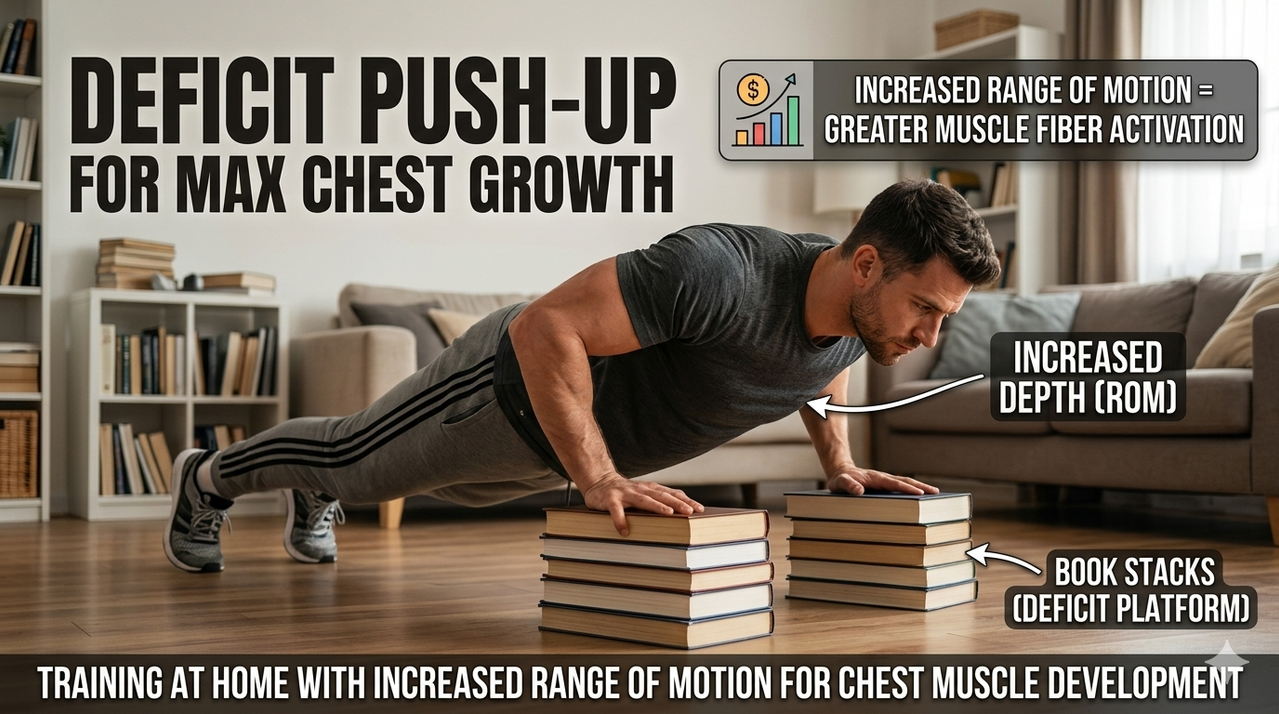
Why it works: By elevating your hands on books, blocks, or dumbbells, you increase the range of motion, allowing a deeper stretch at the bottom. Greater stretch under load has been linked to increased hypertrophy .
- Place two sturdy objects (books, push-up bars, dumbbells) shoulder-width apart.
- Assume a push-up position with hands on the elevated surfaces.
- Lower your chest as far as comfortable—ideally below the level of your hands.
- Push back up explosively, squeezing your chest at the top.
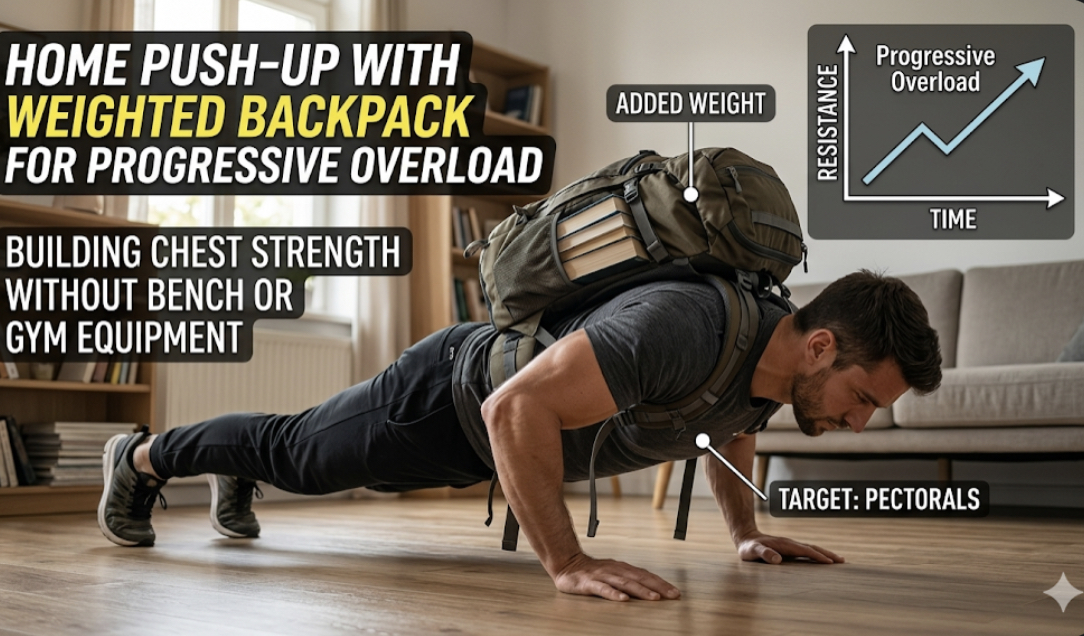
Progression: Add a weighted vest or backpack, or elevate your feet .
3.2. Ring or Suspension Push-Ups Full Chest & Stabilizers
Why it works: Gymnastic rings (or a suspension trainer) introduce instability, increasing motor unit recruitment and engaging stabilizer muscles . They also allow a deeper stretch than floor push-ups .
- Set rings to about ankle height.
- Assume a push-up position, gripping the rings.
- Lower your chest below the rings, stretching your pecs.
- Press back up, bringing your hands together at the top .
Progression: Elevate your feet, or add a weight vest .
3.3. Chest Dips (Between Chairs) Lower Chest & Triceps
Why it works: Dips produce high activation of the sternal head (lower chest) and are a proven mass-builder .
- Place two sturdy chairs parallel, backs facing each other.
- Grip the chair backs and support your weight, legs bent or straight.
- Lean forward slightly to emphasize chest (upright position targets triceps).
- Lower until shoulders are below elbows, then press up .
Safety: Ensure chairs are stable. Place them against a wall if needed.
3.4. Pseudo Planche Push-Ups Upper Chest & Shoulders
Why it works: Moving your hands back toward your hips shifts your center of gravity forward, increasing load on the upper chest and anterior deltoids . Lehman et al. found that forward hand placement increases activation of the clavicular head .
- Start in a push-up position with hands placed by your waist or lower stomach.
- Lean forward so your shoulders are ahead of your hands.
- Lower yourself while maintaining the forward lean.
- Push back up, keeping tension .
Progression: Gradually increase forward lean as you get stronger.
3.5. Wide-Grip Push-Ups Inner Chest
Why it works: A wider hand placement emphasizes the sternocostal head, which comprises the inner and lower chest . This helps build that "inner chest" definition .
- Assume a push-up position with hands significantly wider than shoulder-width.
- Lower your chest toward the floor, keeping elbows at about 45 degrees.
- Press back up, focusing on squeezing your chest together .
Progression: Elevate feet or add weight.
4. Dumbbell Alternatives (Using Household Items)
If you have access to dumbbells, you have even more options—even without a bench. Here's how to mimic bench press variations safely.
4.1. Floor Dumbbell Press
Lie on the floor with dumbbells. This limits range of motion, which is actually beneficial for shoulder health and allows you to use heavier weight safely . It targets the mid chest and triceps.
4.2. Dumbbell Pullover on Bed/Couch
Dumbbell pullovers target the lower chest and lats, building that "shelf" aesthetic . Lie perpendicular across a bed or couch with only your upper back supported, hips low. Hold one dumbbell with both hands and lower it behind your head, then pull back up.
4.3. Feet-Elevated Dumbbell Press (Makeshift Incline)
To mimic an incline press (upper chest), lie on the floor with your feet elevated on a chair or couch. This shifts the angle and increases upper chest activation .
4.4. Water Bottles or Backpack as Weights
No dumbbells? Fill two large water bottles or a sturdy backpack with books for added resistance during push-ups or floor presses.
5. Two Sample Chest Workouts (No Bench)
Workout A: Beginner Bodyweight
Perform 3-4 sets of each exercise, resting 60-90 seconds between sets. Focus on perfect form and a 2-3 second lowering phase .
- 1. Incline Push-Ups (on counter/table): 3 sets x 12-15 reps (warm-up)
- 2. Standard Push-Ups: 3 sets x 8-12 reps
- 3. Wide-Grip Push-Ups: 3 sets x 8-12 reps
- 4. Chair Dips: 3 sets x 8-15 reps
Workout B: Advanced/Progressive Overload
Rest 90-120 seconds between sets. Aim to increase weight, reps, or range of motion each week.
- 1. Weighted Deficit Push-Ups (backpack): 4 sets x 8-10 reps
- 2. Ring Push-Ups or Pseudo Planche Push-Ups: 4 sets x 8-12 reps
- 3. Feet-Elevated Dumbbell Press (if available): 3 sets x 10-12 reps
- 4. Chest Dips (weighted if possible): 3 sets to near failure
- 5. Valslide/Towel Fly (finisher): 2 sets x 10-15 reps
6. The Key: Progressive Overload Without a Bench
Strength and hypertrophy aren't exercise-specific—they're stimulus-specific . The critical factor is progressive overload: gradually increasing the demands on your muscles. Here's how to do it with bodyweight exercises:
- Add external weight: Wear a backpack filled with books or water bottles. Increase the weight by 2-5 lbs when you can hit your rep target .
- Increase range of motion: Use deficit push-ups (hands on books) or ring push-ups to stretch muscles further .
- Change leverage: Elevate your feet (decline push-ups) to shift more weight onto your hands .
- Manipulate tempo: Slow down the eccentric (lowering) phase to 3-4 seconds, increasing time under tension .
- Increase volume: Add more sets or reps over time. Aim for 10-20 weekly sets for chest .
7. Nutrition: Fueling Chest Growth at Home
You can't build muscle without fuel. Here's how to support your home chest workouts with proper nutrition.
7.1. Protein: The Building Block
For muscle repair and growth, aim for 1.6–2.2 grams of protein per kg of body weight daily . For a 75 kg (165 lb) person, that's 120-165 grams of protein per day. Spread this across 3-5 meals . Good sources: lean meats, eggs, dairy, tofu, lentils, beans .
7.2. Sample 2400-Calorie Chest-Building Day
- Breakfast (7 AM): 3-egg scramble with spinach, 1 slice whole-grain toast, 1 cup Greek yogurt. (450 kcal, 35g protein)
- Lunch (12 PM): 150g grilled chicken breast, 1 cup quinoa, roasted broccoli with olive oil. (550 kcal, 40g protein)
- Pre-Workout Snack (if training): Banana with 1 tbsp peanut butter. (200 kcal, 5g protein)
- Dinner (6 PM): 150g salmon, 1 medium sweet potato, sautéed kale. (500 kcal, 35g protein)
- Evening Snack (optional): Cottage cheese (1 cup) with pineapple. (200 kcal, 25g protein)
7.3. Vegan/Vegetarian Options
- Protein sources: Tofu, tempeh, seitan, lentils, chickpeas, edamame, pea protein powder.
- Sample meal: Tofu scramble with black beans and avocado on whole-grain toast.
- Post-workout shake: Pea protein powder + banana + oat milk + spinach.
8. Recovery and Common Mistakes
8.1. Recovery Essentials
Muscle grows during rest, not during workouts .
- Sleep: Aim for 7-9 hours per night to maximize muscle protein synthesis .
- Rest days: Take at least 48 hours between intense chest sessions .
- Hydration: Drink 2-3 liters of water daily for optimal muscle function.
8.2. Common Mistakes
- Mistake #1: Sagging hips. This disengages core and reduces chest activation. Keep body straight .
- Mistake #2: Half reps. Not lowering enough reduces range of motion and growth stimulus .
- Mistake #3: Flared elbows. Elbows at 90 degrees to body stresses shoulders. Keep them at 45 degrees .
- Mistake #4: Neglecting the eccentric. Dropping fast loses the muscle-damaging phase. Control the lowering .
- Mistake #5: No progressive overload. Doing the same push-ups for months leads to plateaus. Always aim to improve .
9. Related Resources
10. Scientific References
- BOXROX. (2025). Can You Build Chest Strength and Muscle without the Bench Press? A Realistic Guide. boxrox.com. View Source
- PureGym. (2024). Best Bodyweight Chest Workouts. puregym.com. View Source
- BOXROX. (2025). 3 Bodyweight Chest Exercises for a Jacked Chest Faster. boxrox.com. View Source
- Healthline. (2016). The Top 8 Chest Exercises for Strength and Shape. healthline.com. View Source
- Women's Health. (2025). 8 Easy High-Protein Bowls For Lunch Or Dinner. womenshealthmag.com. View Source
- BOXROX. (2024). How to Build Chest and Shoulders In Your 30s WITHOUT Gym. boxrox.com. View Source
- Endomondo. (2025). 36 Best Chest Workouts At Home Without Equipment For Strength. endomondo.com. View Source
- BarBend. (2025). No Bench? No Problem. Try Simeon Panda's Chest Exercise Swaps. barbend.com. View Source
- Everyday Health. (2010). Push-Ups That Target the Inner Chest. everydayhealth.com. View Source
- Men's Health. (2025). 15 High-Protein Meals That'll Fill You Up for Hours. menshealth.com. View Source
Join the conversation