Best Rest Time Between Sets for Muscle Growth (Science-Based Guide)
Best Rest Time Between Sets for Muscle Growth (Science-Based Guide)

⚡ TL;DR
The optimal rest time between sets for muscle growth is 60–90 seconds for hypertrophy (muscle growth). For strength training, rest 3–5 minutes to fully recover ATP and maximize neural drive. For muscular endurance, rest 30–60 seconds. Research shows that longer rest periods (3+ minutes) can produce similar hypertrophy if volume is matched, but 60–90 seconds balances fatigue, metabolic stress, and training efficiency . This guide breaks down optimal rest by goal, training style, and provides sample routines.
1. The Rest Interval Question: Why Timing Matters
You're in the gym, finishing a heavy set of squats. How long should you wait before the next set? Too short, and you compromise performance. Too long, and you might lose the metabolic "pump" that some believe drives growth. The rest time between sets is a critical variable that influences your results. This science-based guide will help you optimize rest periods for your goals.
How long should you rest between sets for muscle growth?
For muscle growth (hypertrophy), you should rest 60–90 seconds between sets. This range allows partial recovery of ATP (energy) while maintaining metabolic stress, which contributes to muscle growth. For strength (maximal force production), rest 3–5 minutes to fully replenish ATP and allow neural recovery. For endurance, rest 30–60 seconds. Research shows that both short (1 min) and long (3+ min) rests can build muscle when volume is matched, but 60–90 seconds offers the best balance of efficiency and results .
2. The Science: What Happens Between Sets
2.1. ATP Replenishment
Your muscles use adenosine triphosphate (ATP) for contraction. After a set, ATP stores are depleted. ATP replenishment follows a curve: about 50% after 30 seconds, 75% after 60 seconds, and nearly 100% after 3–5 minutes .
2.2. Metabolic Stress and Muscle Growth
Metabolic stress (the "pump") from short rests (30–90 seconds) contributes to hypertrophy through cellular swelling and anabolic signaling . Longer rests (3+ min) reduce metabolic stress but allow higher mechanical tension.
2.3. Neural Recovery
Heavy lifting (85%+ 1RM) requires central nervous system (CNS) recovery. Shorter rests can compromise neural drive, reducing force production .
2.4. Research Findings
A 2016 meta-analysis found that both short (1 min) and long (3 min) rest periods produce similar hypertrophy when total volume is matched . However, longer rests may be more efficient for strength gains.
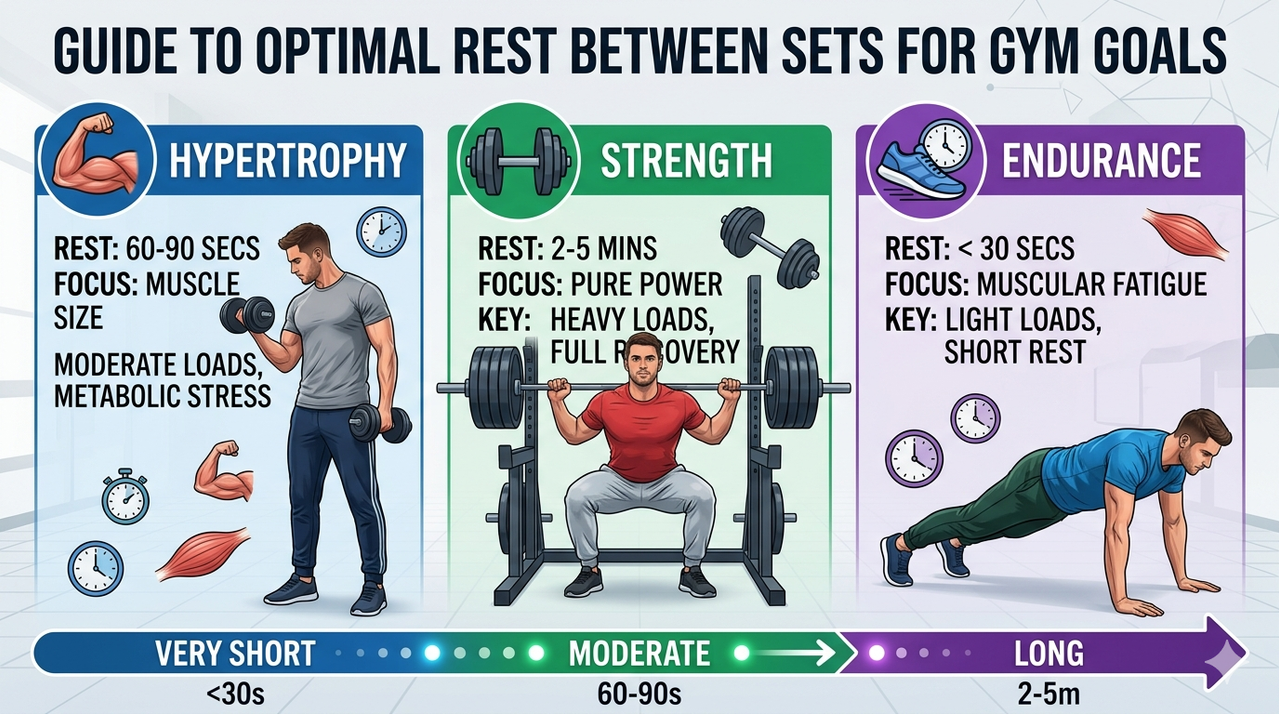
3. Rest Recommendations by Training Goal
3.1. Muscle Growth (Hypertrophy)
60–90 seconds is the sweet spot. This balances mechanical tension and metabolic stress. Studies show that 60-second rests produce similar hypertrophy to 3-minute rests when total volume is matched, but 60–90 seconds is more time-efficient .
- For compound lifts: 90–120 seconds
- For isolation exercises: 60–90 seconds
3.2. Strength Training
3–5 minutes between heavy sets (85%+ 1RM). This allows near-complete ATP replenishment and CNS recovery, maximizing force production for subsequent sets .
3.3. Muscular Endurance
30–60 seconds. Short rests increase metabolic stress and fatigue, which is the goal for endurance adaptations.
3.4. Power Training
2–5 minutes. Power output requires high CNS activation; full recovery between sets is essential .
4. Factors That Affect Your Ideal Rest Time
4.1. Exercise Type
- Compound lifts (squat, deadlift, bench): require more recovery (90–120 sec for hypertrophy, 3–5 min for strength).
- Isolation exercises (curls, lateral raises): 60–90 sec is sufficient.
4.2. Training Experience
- Beginners: 60–90 sec for most exercises. Focus on form and consistent rest.
- Advanced: May need longer rests (2–3 min) for heavy compound sets to maintain performance.
4.3. Training Volume
Higher volume (more sets) may require slightly longer rests to maintain intensity. Adjust based on performance—if reps drop significantly, increase rest .

5. Common Rest Time Mistakes
- Mistake #1: Resting too little for strength. 60-second rests on heavy squats will compromise performance. Use longer rests for compound strength work.
- Mistake #2: Resting too long for hypertrophy. 5-minute rests reduce metabolic stress and extend workout duration unnecessarily.
- Mistake #3: Inconsistent rest. Resting 30 seconds on one set, 2 minutes on the next makes progression tracking difficult.
- Mistake #4: Not timing rests. "Feeling ready" is subjective. Use a timer to standardize rest periods.
- Mistake #5: Same rest for all exercises. Heavy compounds need more rest than isolation exercises.
6. Sample Workouts with Rest Periods
6.1. Hypertrophy Workout (60–90 sec rest)
- Squat: 3 × 8–10 (90 sec rest)
- Bench Press: 3 × 8–10 (90 sec rest)
- Bent-Over Row: 3 × 8–10 (90 sec rest)
- Overhead Press: 3 × 8–10 (60 sec rest)
- Bicep Curl: 3 × 10–12 (60 sec rest)
- Tricep Pushdown: 3 × 10–12 (60 sec rest)
Total time: ~45–60 minutes
6.2. Strength Workout (3–5 min rest)
- Squat: 4 × 5 (4 min rest)
- Bench Press: 4 × 5 (4 min rest)
- Deadlift: 3 × 3 (5 min rest)
- Overhead Press: 3 × 5 (3 min rest)
Total time: ~60–75 minutes
6.3. Metabolic / Endurance Workout (30–45 sec rest)
- Goblet Squat: 3 × 15 (45 sec rest)
- Push-ups: 3 × 15 (45 sec rest)
- Dumbbell Row: 3 × 15 per arm (45 sec rest)
- Plank: 3 × 45 sec (45 sec rest)

7. Nutrition to Support Your Training
7.1. Pre-Workout Fuel
Eat a meal with carbs and protein 1–3 hours before training. This ensures glycogen stores are full for performance.
7.2. Post-Workout Recovery
Consume 20–40g protein within 2 hours after training. Carbs help replenish glycogen .
7.3. Sample Meal Plan (2,800 kcal, 160g Protein)
- Breakfast: 4 eggs, 1 cup oatmeal with 1 tbsp peanut butter, 1 banana (650 kcal, 40g protein)
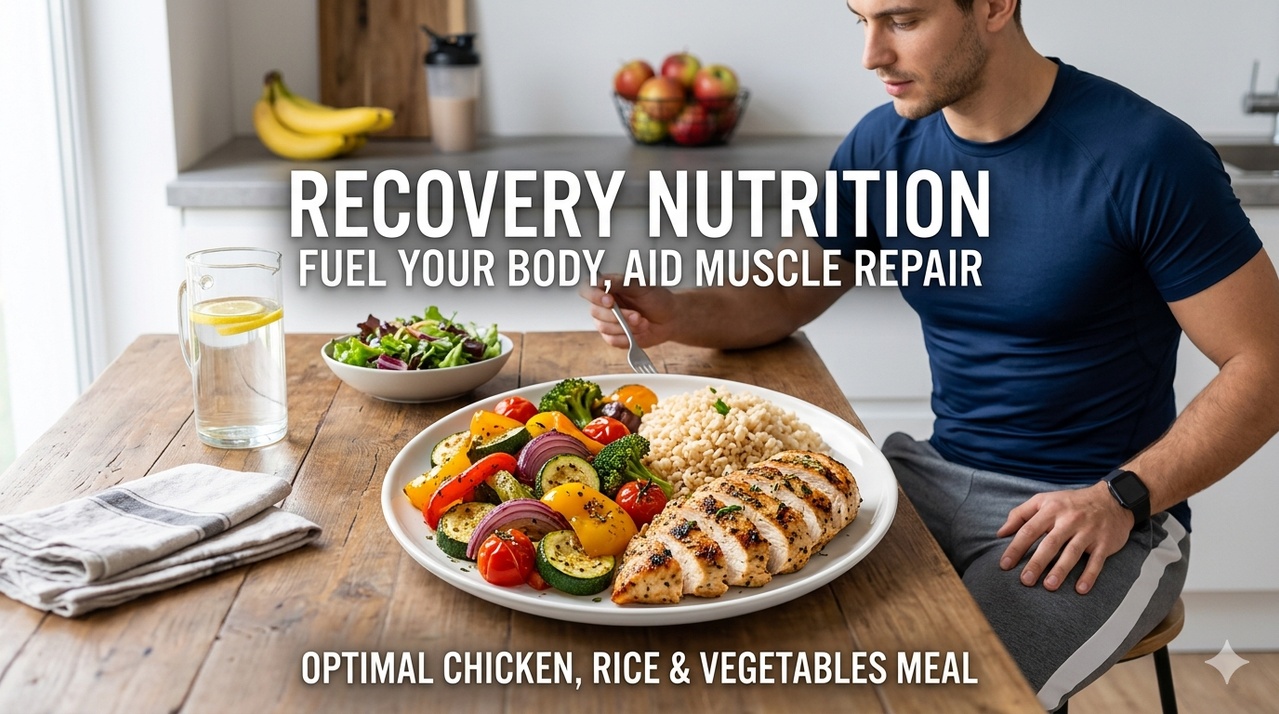
- Lunch: 200g chicken breast, 1.5 cups brown rice, 1 cup broccoli (650 kcal, 50g protein)
- Pre-workout: 1 banana + 1 scoop whey (250 kcal, 25g protein)
- Post-workout/Dinner: 200g salmon, 1.5 cups sweet potato, 2 cups greens (650 kcal, 45g protein)
- Evening: 200g Greek yogurt (200 kcal, 20g protein)
Vegan/Vegetarian Plan (2,800 kcal, 150g Protein)
- Breakfast: Tofu scramble (200g firm tofu), 1.5 cups oatmeal with 2 tbsp peanut butter, banana (700 kcal, 40g protein)
- Lunch: 200g tempeh, 1.5 cups quinoa, 1 cup roasted chickpeas (700 kcal, 45g protein)
- Snack: 1 cup edamame, 1 apple (200 kcal, 15g protein)
- Dinner: 1.5 cups cooked lentils, 1.5 cups sweet potato, 1 cup spinach (650 kcal, 35g protein)
- Evening: 1 cup unsweetened soy milk + 2 tbsp hemp seeds (200 kcal, 15g protein)
Gluten-Free Options
- Use certified gluten-free oats, quinoa, rice, or buckwheat.
- Ensure tempeh and tofu are gluten-free certified.
8. How to Adjust Rest Periods for Progress
- If you're not completing target reps: Increase rest by 30–60 seconds.
- If you're completing reps easily: Decrease rest by 15–30 seconds or increase weight.
- For strength plateaus: Use longer rests (3–5 min) to maximize neural drive.
- For hypertrophy plateaus: Vary rest periods—try 60 sec one week, 90 sec the next.
9. Frequently Asked Questions
How long should you rest between sets for muscle growth?
60–90 seconds is optimal for hypertrophy. This balances mechanical tension and metabolic stress while maintaining training efficiency.
Do longer rest periods build more muscle?
Research shows that both short (1 min) and long (3+ min) rests produce similar hypertrophy when total volume is matched. Longer rests may allow higher mechanical tension, which also stimulates growth.
Can I rest too long between sets?
For hypertrophy, resting >3 minutes reduces metabolic stress but doesn't harm growth if volume is maintained. It does, however, make workouts longer.
How much rest for compound lifts vs isolation?
Compound lifts (squat, deadlift, bench) often need more rest (90–120 sec for hypertrophy, 3–5 min for strength). Isolation exercises (curls, lateral raises) can use 60–90 sec.
What happens if I rest too little?
Insufficient rest compromises performance, leading to fewer reps or lower weight, which reduces total training volume and potentially limits growth.
Should I time my rests or go by feel?
Use a timer. "Feeling ready" is subjective and can vary day to day. Consistent rest periods help track progress and ensure adequate recovery.
Does rest time differ for beginners vs advanced?
Beginners can typically use 60–90 sec for most exercises. Advanced lifters may need longer rests for heavy compound work to maintain performance.
10. Related Resources
- The Science of Rest Days: How Muscles Grow While You Sleep and Recover
- Morning Stretching Routine to Improve Strength and Lifting Performance
- How to Build a Powerful Chest at Home Without a Bench (Best Bodyweight Workouts)
- Best Bodyweight Shoulder Exercises to Build Strong and Stable Shoulders
- How to Do Your First Push-Up: Beginner Progression Guide to Build Strength Fast
11. Scientific References
- Schoenfeld, B. J., et al. (2016). Effects of Different Rest Intervals on Muscle Hypertrophy: A Systematic Review and Meta-Analysis. Sports Medicine, 46(11), 1689–1697. PubMed
- Kraemer, W. J., & Ratamess, N. A. (2005). Hormonal responses and adaptations to resistance exercise and training. Sports Medicine, 35(4), 339–361. PubMed
- Ratamess, N. A., et al. (2009). American College of Sports Medicine position stand. Progression models in resistance training for healthy adults. Medicine & Science in Sports & Exercise, 41(3), 687–708. PubMed
- Grgic, J., et al. (2018). Effects of Rest Interval Duration on Resistance Training-Induced Muscle Hypertrophy: A Systematic Review and Meta-Analysis. Sports Medicine, 48(8), 1881–1890. PubMed
- Morton, R. W., et al. (2018). A systematic review, meta-analysis and meta-regression of the effect of protein supplementation on resistance training-induced gains in muscle mass and strength in healthy adults. British Journal of Sports Medicine, 52(6), 376–384. PubMed
- ACSM. (2021). Nutrition and Athletic Performance. Medicine & Science in Sports & Exercise, 53(3), 600–618. PubMed
Join the conversation