How Long Should a Workout Session Be? (Optimal Training Time Guide)
How Long Should a Workout Session Be? (Optimal Training Time Guide)
⚡ TL;DR
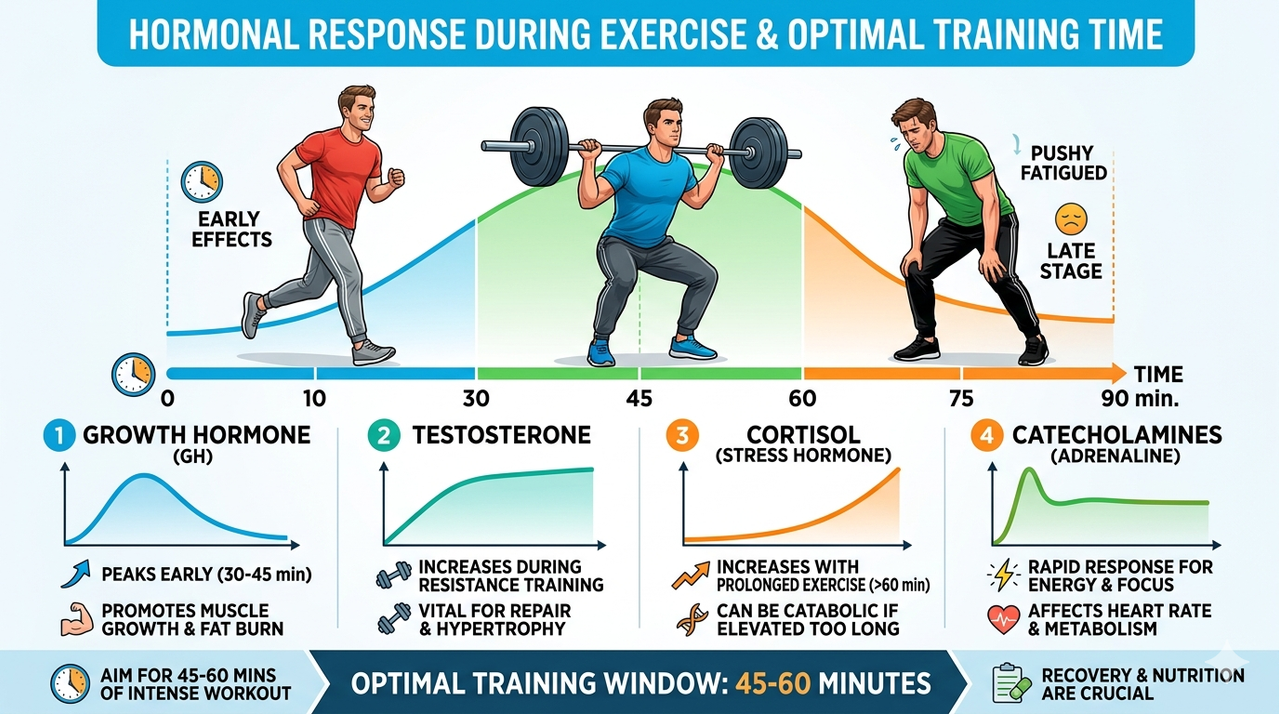
The optimal workout session duration is typically 45–75 minutes for most fitness goals. Research shows that training longer than 60–90 minutes can lead to diminishing returns due to hormonal responses and fatigue . For muscle growth, 45–60 minutes of focused work with 60–90 second rest periods is ideal. For strength training, sessions may be longer due to longer rest (3–5 minutes). Quality matters more than quantity—intensity and progressive overload are key, not time spent in the gym . This guide breaks down optimal durations by goal, training style, and experience level.
1. The Time Trap: Does Longer Mean Better?
You've seen them: the people who spend 2+ hours in the gym every day. But is that actually productive? Research suggests that beyond a certain point, longer workouts don't equal better results. The ideal workout time balances sufficient stimulus with adequate recovery. This guide will help you find your sweet spot.
How long should a workout last for best results?
For best results, a workout should last 45–75 minutes. This timeframe allows enough time to complete 15–25 quality sets with proper rest periods (60–90 seconds for hypertrophy, 3–5 minutes for strength). Studies show that cortisol (a catabolic hormone) rises significantly after 60–90 minutes of intense training, potentially reducing muscle-building benefits . Shorter, focused sessions with high intensity are more effective than long, drawn-out workouts .
2. The Science: What Happens During a Workout
2.1. Hormonal Response
During exercise, anabolic hormones like testosterone and growth hormone increase, but after 60–90 minutes of intense training, cortisol (a catabolic hormone) rises significantly, potentially impairing recovery and muscle growth .
2.2. Glycogen Depletion
Muscle glycogen stores are the primary fuel for intense training. After 60–90 minutes of sustained effort, glycogen becomes depleted, leading to decreased performance and increased fatigue .
2.3. Diminishing Returns
Research shows that muscle protein synthesis peaks after 45–60 minutes of resistance training. Additional time beyond this yields minimal additional stimulus but increases fatigue .
2.4. Quality vs. Quantity
A 2019 study found that shorter, higher-intensity workouts produced similar or better results than longer, lower-intensity sessions when volume was matched .

3. Optimal Duration by Fitness Goal
3.1. Muscle Growth (Hypertrophy)
45–60 minutes is ideal. With 60–90 second rest periods, you can complete 15–20 sets, which is within the optimal weekly volume range . Longer sessions often lead to junk volume—extra sets that don't contribute to growth but increase fatigue .
3.2. Strength Training
60–90 minutes. Strength training requires longer rest periods (3–5 minutes) between heavy sets. A typical session includes 5–8 working sets of compound lifts with adequate rest, naturally extending session length .
3.3. Fat Loss / Metabolic Conditioning
30–60 minutes. High-intensity interval training (HIIT) or circuit training can be highly effective in 20–30 minutes, while steady-state cardio may last 30–60 minutes .
3.4. Endurance Training
60–120+ minutes. Endurance athletes require longer sessions for cardiovascular adaptation, but these are typically at lower intensities .
4. Factors That Affect Your Ideal Workout Length
4.1. Training Experience
- Beginners: 30–45 minutes is sufficient. Quality > quantity. 2–3 sets per exercise with good form yields results .
- Intermediates: 45–60 minutes. Need more volume but still efficient.
- Advanced: 60–75 minutes. Higher volume requires more time, but still within optimal range.
4.2. Training Split
- Full Body: 45–60 minutes (5–7 exercises)
- Upper/Lower: 45–60 minutes per session
- Push/Pull/Legs: 45–60 minutes per session (more frequent, shorter sessions)
- Body Part Split: 45–60 minutes (e.g., chest day with 4–5 exercises)
4.3. Recovery Capacity
If you're consistently fatigued, sore for >72 hours, or experiencing sleep issues, your sessions may be too long or too frequent. Reduce duration or frequency .
5. Signs You're Working Out Too Long
- Persistent fatigue: Feeling exhausted rather than energized after workouts.
- Declining strength: Lifts aren't progressing despite consistent effort.
- Prolonged soreness: Muscle soreness lasting >72 hours.
- Poor sleep: Difficulty falling asleep or staying asleep.
- Loss of motivation: Dreading gym sessions.
- Plateau or regression: No progress for 4+ weeks.
6. Sample Workout Structures by Duration
6.1. 30-Minute Full Body (Beginner)
- Squat: 3 × 8–10 (10 min)
- Bench Press: 3 × 8–10 (10 min)
- Bent-Over Row: 3 × 8–10 (10 min)
- No rest between exercises, 60 sec between sets.
6.2. 45-Minute Upper/Lower (Intermediate)
- Upper: Bench Press 3×8–10, Bent-Over Row 3×8–10, Overhead Press 3×8–10, Pull-ups 3×8–10, Bicep Curls 2×10–12, Tricep Pushdowns 2×10–12
- Lower: Squat 3×8–10, Romanian Deadlift 3×8–10, Leg Press 3×10–12, Leg Curls 3×10–12, Calf Raises 3×12–15, Plank 3×45 sec
6.3. 60-Minute Full Body (Advanced)
- Squat: 4 × 6–8
- Bench Press: 4 × 6–8
- Bent-Over Row: 4 × 6–8
- Overhead Press: 3 × 8–10
- Pull-ups: 3 × 8–10
- Lateral Raises: 3 × 10–12
- Bicep Curls: 3 × 10–12
- Tricep Pushdowns: 3 × 10–12
- Plank: 3 × 60 sec

7. Nutrition to Fuel Your Workouts
7.1. Pre-Workout Nutrition
Eat a meal with carbs and protein 1–3 hours before training. For shorter sessions, a small snack 30–60 minutes before is sufficient.
7.2. Post-Workout Nutrition
Consume 20–40g protein within 2 hours after training to support recovery. Carbs help replenish glycogen .
7.3. Sample Meal Plan (2,200 kcal, 140g Protein)
- Breakfast: 3 eggs, 1 cup oatmeal with berries (450 kcal, 30g protein)
- Lunch: 150g chicken breast, 1.5 cups brown rice, 1 cup broccoli (550 kcal, 45g protein)
- Pre-workout: 1 banana + 1 tbsp peanut butter (200 kcal, 5g protein)
- Post-workout/Dinner: 150g salmon, 1.5 cups sweet potato, 2 cups greens (500 kcal, 35g protein)
- Evening: 200g Greek yogurt (200 kcal, 20g protein)
Vegan/Vegetarian Plan (2,200 kcal, 130g Protein)
- Breakfast: Tofu scramble (200g firm tofu), 1 cup oatmeal with 2 tbsp peanut butter (550 kcal, 35g protein)
- Lunch: 200g tempeh, 1.5 cups quinoa, 1 cup roasted chickpeas (600 kcal, 40g protein)
- Snack: 1 cup edamame, 1 apple (200 kcal, 15g protein)
- Dinner: 1.5 cups cooked lentils, 1.5 cups sweet potato, 1 cup spinach (550 kcal, 30g protein)
- Evening: 1 cup unsweetened soy milk + 1 tbsp chia seeds (150 kcal, 8g protein)
Gluten-Free Options
- Use certified gluten-free oats, quinoa, rice, or buckwheat.
- Ensure tempeh and tofu are gluten-free certified.
8. Common Time-Related Training Mistakes
- Mistake #1: Training too long. 2+ hour sessions often lead to overtraining and diminished returns.
- Mistake #2: Training too short. 20-minute sessions may not provide enough stimulus for advanced lifters.
- Mistake #3: Inefficient use of time. Long rest periods, chatting, or phone use extends session without benefit.
- Mistake #4: Not adjusting for intensity. Low-intensity sessions need more volume; high-intensity sessions need less.
- Mistake #5: Ignoring recovery. Session length is meaningless if you don't allow recovery between sessions.
9. Frequently Asked Questions
How long should a workout last for best results?
For most goals, 45–75 minutes is optimal. This allows enough time for quality sets without excessive fatigue or cortisol elevation.
Is 30 minutes of exercise enough?
Yes for beginners or HIIT workouts. 30 minutes of high-intensity training can be very effective. For muscle growth, 45–60 minutes is better.
Can I workout for 2 hours?
Possible, but not optimal for most. Unless you're an advanced lifter with high volume needs, 2-hour sessions often lead to overtraining and diminishing returns.
How long should I rest between sets?
60–90 seconds for hypertrophy, 3–5 minutes for strength, 30–60 seconds for endurance. Rest time affects total session length.
Does workout duration matter for fat loss?
Total calorie burn matters more than duration. High-intensity sessions (20–30 minutes) can burn as many calories as longer moderate sessions.
How often should I workout per week?
3–5 days per week is ideal for most people. Session length and frequency should balance total volume and recovery.
What if I only have 30 minutes to workout?
Use supersets, circuits, or compound movements to maximize efficiency. 30 minutes of focused training can be very effective.
10. Related Resources
- The Science of Rest Days: How Muscles Grow While You Sleep and Recover
- Morning Stretching Routine to Improve Strength and Lifting Performance
- How to Build a Powerful Chest at Home Without a Bench (Best Bodyweight Workouts)
- Best Bodyweight Shoulder Exercises to Build Strong and Stable Shoulders
- How to Do Your First Push-Up: Beginner Progression Guide to Build Strength Fast
11. Scientific References
- Hackney, A. C., & Lane, A. R. (2015). Exercise and the Regulation of Endocrine Hormones. Progress in Molecular Biology and Translational Science, 135, 293–311. PubMed
- Schoenfeld, B. J., et al. (2017). Effects of Resistance Training Frequency on Measures of Muscle Hypertrophy: A Systematic Review and Meta-Analysis. Sports Medicine, 46(11), 1689–1697. PubMed
- Kraemer, W. J., & Ratamess, N. A. (2005). Hormonal responses and adaptations to resistance exercise and training. Sports Medicine, 35(4), 339–361. PubMed
- Morton, R. W., et al. (2018). A systematic review, meta-analysis and meta-regression of the effect of protein supplementation on resistance training-induced gains in muscle mass and strength in healthy adults. British Journal of Sports Medicine, 52(6), 376–384. PubMed
- ACSM. (2021). Nutrition and Athletic Performance. Medicine & Science in Sports & Exercise, 53(3), 600–618. PubMed
Join the conversation