How to Build a Workout Plan for Muscle Growth (Step-by-Step Guide)
How to Build a Workout Plan for Muscle Growth (Step-by-Step Guide)

⚡ TL;DR
To build a workout plan for muscle growth, follow these 6 steps: 1) Choose your split (full body 3x/week or push/pull/legs 4x/week). 2) Select compound movements (squat, deadlift, bench, row) as your foundation. 3) Add isolation exercises for specific muscles. 4) Set volume (10–20 sets per muscle group weekly). 5) Determine rep ranges (6–12 reps for hypertrophy). 6) Plan progressive overload (add weight or reps weekly). Research shows that consistent application of these principles produces significant muscle growth . This guide provides templates, calculations, and nutrition support.
1. Why You Need a Structured Plan
Walking into the gym without a plan is like driving without a map. You might get somewhere eventually, but you'll waste time and likely hit plateaus. A structured muscle growth training plan ensures you're consistently applying the principles of progressive overload, adequate volume, and proper exercise selection—the key drivers of hypertrophy .
How do you create a workout plan for muscle growth?
To create a workout plan for muscle growth, follow these steps: 1) Choose exercises—prioritize compound movements (squat, bench, deadlift, row) then add isolation exercises. 2) Set sets and reps—aim for 3–5 sets of 6–12 reps per exercise. 3) Determine frequency—train each muscle group 2–3 times per week. 4) Plan progressive overload—increase weight, reps, or sets weekly. Research shows that applying these principles consistently leads to muscle hypertrophy .
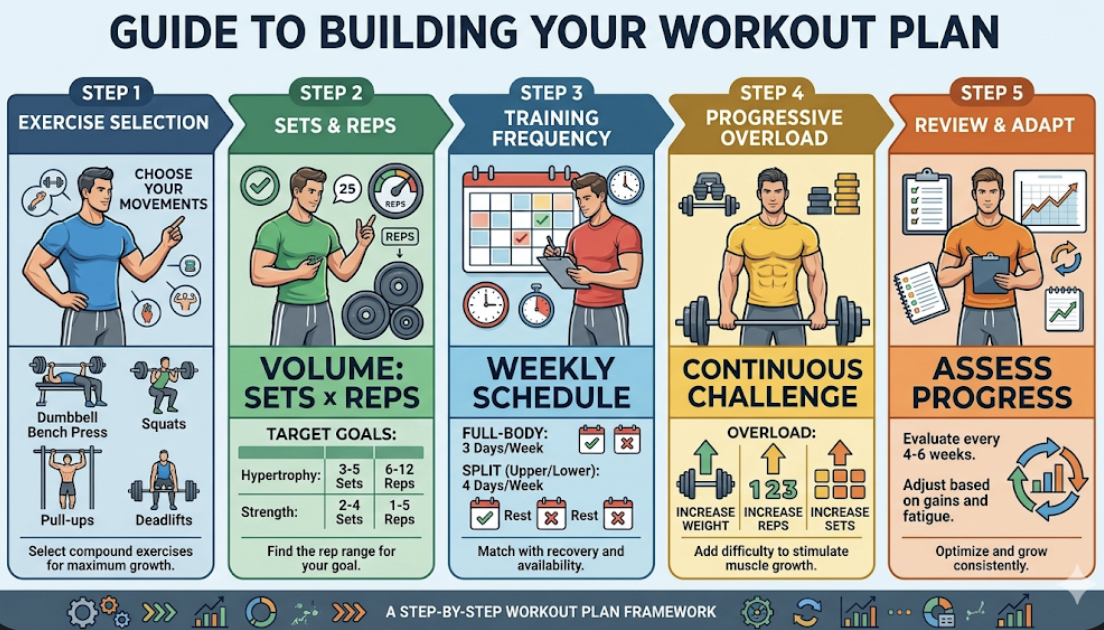
2. Step 1: Choose Your Training Split
2.1. What Is a Training Split?
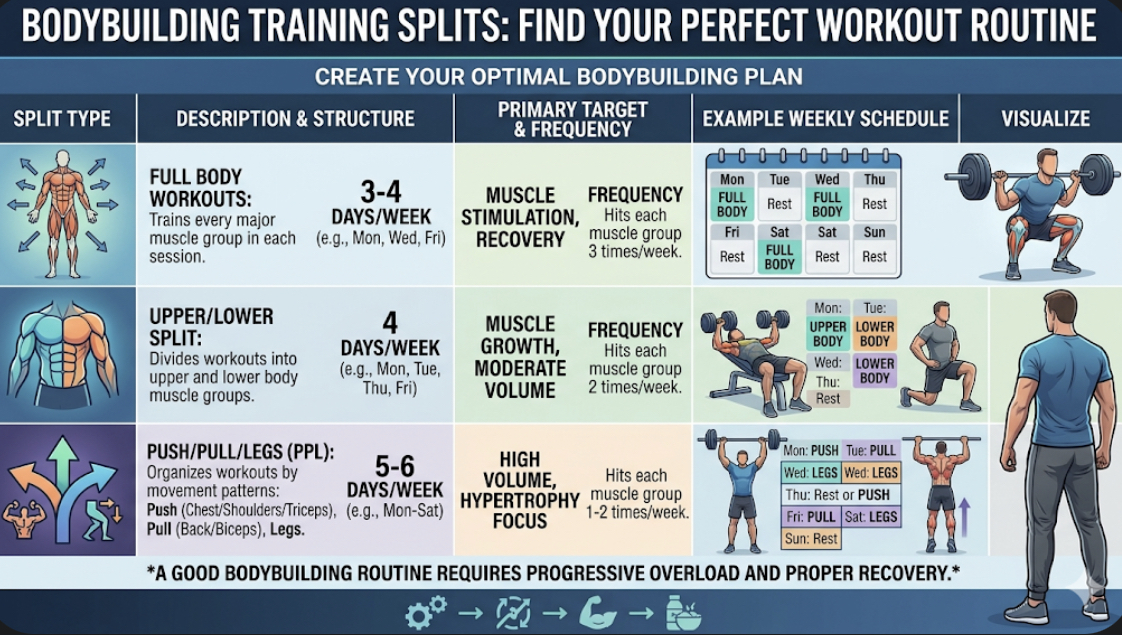
A training split determines how you organize your workouts across the week. The best split depends on your schedule, recovery ability, and training experience .
2.2. Popular Splits for Muscle Growth
- Full Body (3x/week): Train all muscle groups each session. Ideal for beginners and those with limited time. Research shows training each muscle group 2–3 times weekly is optimal .
- Upper/Lower (4x/week): Alternate upper body and lower body days. Great for intermediates.
- Push/Pull/Legs (PPL) (6x/week): Push day (chest, shoulders, triceps), pull day (back, biceps), legs day. Advanced split for those who can recover well.
- Body Part Split (5x/week): One muscle group per day (e.g., chest, back, legs, shoulders, arms). Less optimal for frequency but can work.
3. Step 2: Select Your Exercises
3.1. Compound vs. Isolation
- Compound exercises: Multi-joint movements that recruit multiple muscle groups (squat, deadlift, bench press, rows, overhead press). These should form the foundation of your program .
- Isolation exercises: Single-joint movements targeting specific muscles (bicep curls, tricep extensions, leg extensions). Use these to add volume to lagging muscles.
3.2. Essential Exercises by Muscle Group
- Legs: Squat, deadlift, leg press, Romanian deadlift, lunges
- Chest: Bench press (barbell/dumbbell), incline press, chest fly
- Back: Bent-over row, pull-ups, lat pulldown, seated cable row
- Shoulders: Overhead press, lateral raises, face pulls
- Arms: Barbell curl, dumbbell curl, tricep pushdown, skull crushers
- Core: Planks, hanging leg raises, cable crunches
4. Step 3: Determine Sets and Reps
4.1. Rep Ranges for Hypertrophy
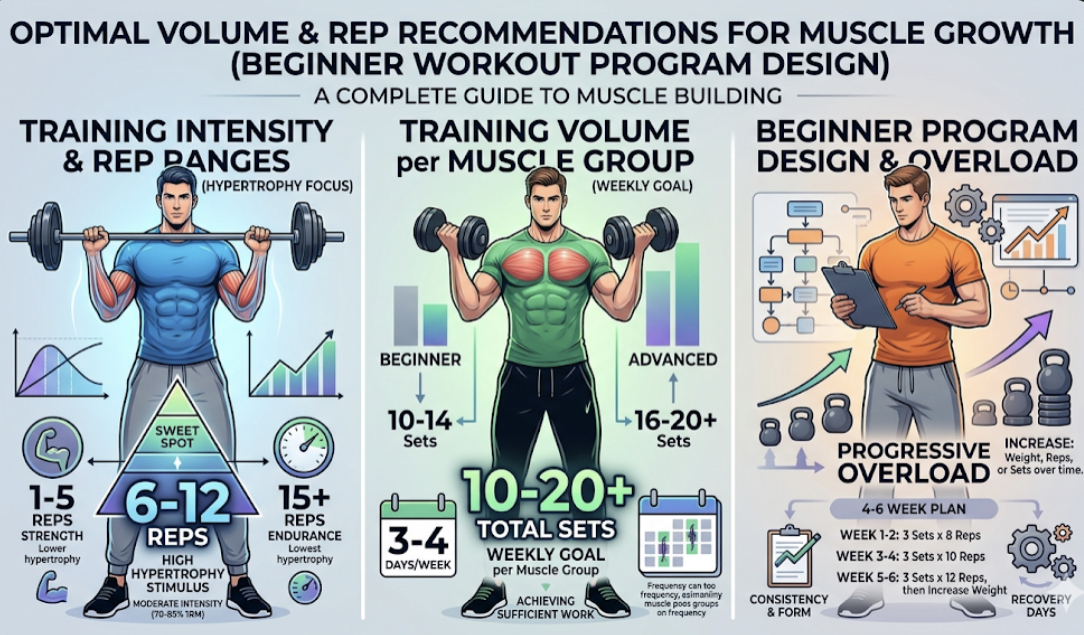
Research shows that hypertrophy (muscle growth) can occur across a wide rep range, but the 6–12 rep range is most commonly used and effective . Lower reps (1–5) build strength, higher reps (15+) build endurance, but all stimulate growth with sufficient volume.
4.2. Volume Recommendations
Aim for 10–20 sets per muscle group per week for optimal growth . For a 4-day upper/lower split:
- Upper body: 12–15 sets per week (spread across 2 sessions)
- Lower body: 10–14 sets per week
- Smaller muscles (arms, shoulders): 8–12 sets per week
5. Step 4: Plan Progressive Overload
5.1. What Is Progressive Overload?
Progressive overload is the gradual increase of stress placed on the body during exercise. Without it, muscles have no reason to grow .
5.2. How to Progress
- Add weight: Increase weight by 2.5–5 kg when you hit the top of your rep range.
- Add reps: Aim to add 1–2 reps per set before increasing weight.
- Add sets: Add an extra set to an exercise.
- Reduce rest time: Decrease rest between sets (advanced).
- Improve form/ROM: Deeper squats, fuller range of motion.
5.3. Tracking Progress
Log every workout. If you're not progressing on key lifts for 2–3 weeks, reassess nutrition, sleep, or programming.
6. Step 5: Set Frequency and Rest Days
6.1. Training Frequency
Research shows that training each muscle group 2–3 times per week is superior to once a week for hypertrophy .
6.2. Rest and Recovery
- Between sets: 60–90 seconds for hypertrophy.
- Between sessions: 48–72 hours for the same muscle group.
- Weekly rest: 1–2 full rest days per week.
7. Sample Workout Plans by Experience Level
7.1. Beginner Full Body (3 days/week)
Day 1, 3, 5 (Monday, Wednesday, Friday):
- Squat: 3 × 8–10
- Bench Press: 3 × 8–10
- Bent-Over Row: 3 × 8–10
- Overhead Press: 3 × 8–10
- Plank: 3 × 30–60 sec
7.2. Intermediate Upper/Lower (4 days/week)
Upper A: Bench Press 3×8–10, Bent-Over Row 3×8–10, Overhead Press 3×8–10, Pull-ups 3×8–10, Bicep Curls 3×10–12, Tricep Pushdowns 3×10–12
Lower A: Squat 3×8–10, Romanian Deadlift 3×8–10, Leg Press 3×10–12, Leg Curls 3×10–12, Calf Raises 3×12–15, Planks 3×45–60 sec
Upper B: Dumbbell Press 3×8–10, Seated Cable Row 3×8–10, Lateral Raises 3×10–12, Chin-ups 3×8–10, Hammer Curls 3×10–12, Tricep Extensions 3×10–12
Lower B: Deadlift 3×5–6, Leg Press 3×10–12, Lunges 3×10–12 per leg, Leg Extensions 3×10–12, Hanging Leg Raises 3×10–15
Vegan/Vegetarian Alternatives
- All exercises same—nutrition is the variable. Ensure adequate protein from tofu, tempeh, lentils, and plant-based sources.
8. Nutrition to Support Your Plan
8.1. Calorie and Protein Targets
- Calories: Eat at maintenance or a small surplus (250–500 kcal above maintenance) for muscle growth.
- Protein: 1.6–2.2 g per kg body weight daily .
- Carbs: 4–6 g per kg body weight for energy and recovery.
- Fats: 0.8–1.2 g per kg body weight for hormonal health.
8.2. Sample Meal Plan (2,800 kcal, 160g Protein)
- Breakfast: 4 eggs, 1 cup oatmeal with 1 tbsp peanut butter, 1 banana (650 kcal, 40g protein)
- Lunch: 200g chicken breast, 1.5 cups brown rice, 1 cup broccoli (650 kcal, 50g protein)
- Pre-workout: 1 banana + 1 scoop whey (250 kcal, 25g protein)
- Post-workout/Dinner: 200g salmon, 1.5 cups sweet potato, 2 cups greens (650 kcal, 45g protein)
- Evening: 200g Greek yogurt (200 kcal, 20g protein)
Vegan/Vegetarian Plan (2,800 kcal, 150g Protein)
- Breakfast: Tofu scramble (200g firm tofu), 1.5 cups oatmeal with 2 tbsp peanut butter, banana (700 kcal, 40g protein)
- Lunch: 200g tempeh, 1.5 cups quinoa, 1 cup roasted chickpeas (700 kcal, 45g protein)
- Snack: 1 cup edamame, 1 apple (200 kcal, 15g protein)
- Dinner: 1.5 cups cooked lentils, 1.5 cups sweet potato, 1 cup spinach (650 kcal, 35g protein)
- Evening: 1 cup unsweetened soy milk + 2 tbsp hemp seeds (200 kcal, 15g protein)
Gluten-Free Options
- Use certified gluten-free oats, quinoa, rice, or buckwheat.
- Ensure tempeh and tofu are gluten-free certified.
9. Common Mistakes to Avoid
- Mistake #1: Too much volume. >25 sets per muscle group weekly leads to overtraining.
- Mistake #2: Too little volume. <10 sets per muscle group weekly provides insufficient stimulus.
- Mistake #3: No progressive overload. Doing the same weight/reps for weeks = no growth.
- Mistake #4: Poor exercise selection. Skipping compound lifts reduces overall stimulus.
- Mistake #5: Inconsistent training. Missed workouts disrupt the adaptation cycle.
- Mistake #6: Ignoring nutrition and sleep. Training is only half the equation.
10. Frequently Asked Questions
How do you create a workout plan for muscle growth?
Choose exercises (compound + isolation), set sets (3–5) and reps (6–12), determine frequency (2–3x per muscle group weekly), and plan progressive overload (add weight or reps weekly).
How many exercises per workout?
For full body: 5–7 exercises. For upper/lower: 6–8 exercises per session. Quality over quantity.
How long should I rest between sets?
60–90 seconds for hypertrophy. Longer for strength (3–5 min), shorter for endurance (30–60 sec).
How often should I change my workout?
Stick with a program for 8–12 weeks. Only change if you plateau, not just because you're bored.
How much protein do I need for muscle growth?
1.6–2.2 grams per kilogram of body weight daily. For an 80 kg person, 128–176 grams of protein per day.
Can I build muscle with bodyweight only?
Yes, especially for beginners. Use progressive overload (more reps, harder variations) to continue growth.
How long until I see results?
Strength gains: 2–4 weeks. Visible muscle growth: 8–12 weeks with consistent training and nutrition.
11. Related Resources
- The Science of Rest Days: How Muscles Grow While You Sleep and Recover
- Morning Stretching Routine to Improve Strength and Lifting Performance
- How to Build a Powerful Chest at Home Without a Bench (Best Bodyweight Workouts)
- Best Bodyweight Shoulder Exercises to Build Strong and Stable Shoulders
- How to Do Your First Push-Up: Beginner Progression Guide to Build Strength Fast
12. Scientific References
- Schoenfeld, B. J., et al. (2017). Effects of Resistance Training Frequency on Measures of Muscle Hypertrophy: A Systematic Review and Meta-Analysis. Sports Medicine, 46(11), 1689–1697. PubMed
- Schoenfeld, B. J., et al. (2016). Resistance Training Volume Enhances Muscle Hypertrophy but Not Strength in Trained Men. Medicine & Science in Sports & Exercise, 48(8), 1530–1539. PubMed
- Morton, R. W., et al. (2018). A systematic review, meta-analysis and meta-regression of the effect of protein supplementation on resistance training-induced gains in muscle mass and strength in healthy adults. British Journal of Sports Medicine, 52(6), 376–384. PubMed
- Helms, E. R., et al. (2014). Evidence-based recommendations for natural bodybuilding contest preparation. Journal of the International Society of Sports Nutrition, 11(1), 20. PubMed
- ACSM. (2021). Nutrition and Athletic Performance. Medicine & Science in Sports & Exercise, 53(3), 600–618. PubMed
Join the conversation