How to Train Each Muscle Group Correctly (Complete Workout Guide)
How to Train Each Muscle Group Correctly (Complete Workout Guide)
⚡ TL;DR
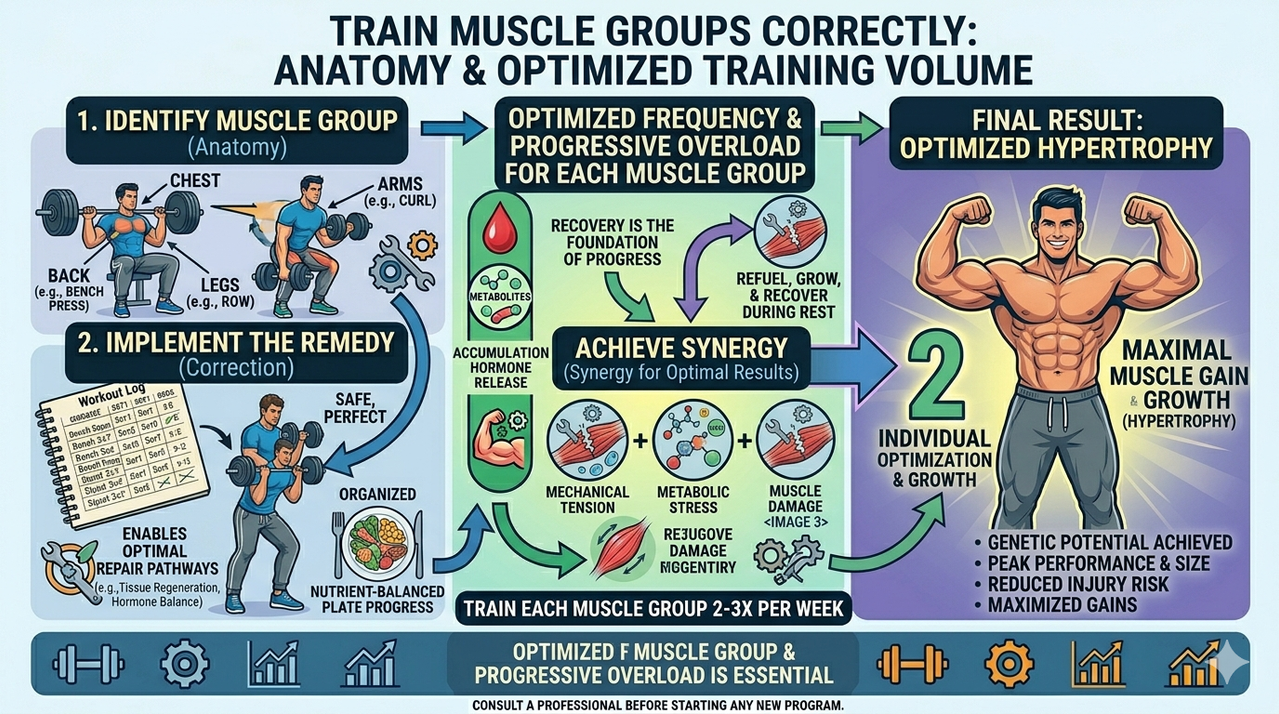
To train each muscle group correctly, focus on compound movements as your foundation, use proper form with full range of motion, and apply progressive overload. For chest: bench press and incline press. For back: rows and pull-ups. For legs: squat and deadlift. For shoulders: overhead press and lateral raises. For arms: curls and tricep extensions. Aim for 10–20 sets per muscle group weekly with 6–12 reps per set . This guide provides detailed form tips, exercise variations, and sample routines for every major muscle group.
1. Why Proper Muscle Training Matters
You can lift heavy weights for years and still have underdeveloped muscles if you're using poor form or incorrect exercise selection. Training each muscle group correctly ensures you're targeting the intended muscles, maximizing growth, and minimizing injury risk . This muscle group workout guide covers everything you need to know.
How do you train each muscle group effectively?
To train each muscle group effectively, you need proper form, adequate volume, and progressive overload. For each muscle group: 1) Choose compound movements as your primary exercises. 2) Use full range of motion with controlled tempo. 3) Perform 3–5 sets of 6–12 reps. 4) Train each muscle group 2–3 times per week. 5) Progressively add weight or reps over time . This approach ensures optimal muscle fiber recruitment and growth.
2. Chest (Pectorals) – Pressing Power
2.1. Anatomy & Function
The chest consists of the pectoralis major (upper, middle, lower fibers) and pectoralis minor. Its primary functions are horizontal adduction, flexion, and internal rotation of the shoulder .
2.2. Best Exercises
- Barbell Bench Press: Overall chest development, strength
- Incline Dumbbell Press: Upper chest focus
- Decline Press: Lower chest emphasis
- Chest Flyes (Dumbbell or Cable): Stretch and isolation
- Push-Ups: Bodyweight option with high rep potential
2.3. Proper Form Tips
- Bench Press: Keep shoulders pinned back, feet flat, lower bar to mid-chest, elbows at 45°.
- Incline Press: Angle bench to 30–45°, focus on upper chest squeeze.
- Flyes: Keep slight elbow bend, open arms like hugging a tree, squeeze at top.
2.4. Volume & Frequency
10–15 sets per week, trained 2x weekly. Beginners: 3–4 sets per session; advanced: 4–5 sets .

3. Back (Lats, Traps, Rhomboids) – The V-Taper
3.1. Anatomy & Function
The back includes the latissimus dorsi (width), trapezius (upper/middle/lower), rhomboids (retraction), and erector spinae (extension). Functions: pulling, retraction, extension .
3.2. Best Exercises
- Pull-Ups / Lat Pulldown: Width and vertical pulling
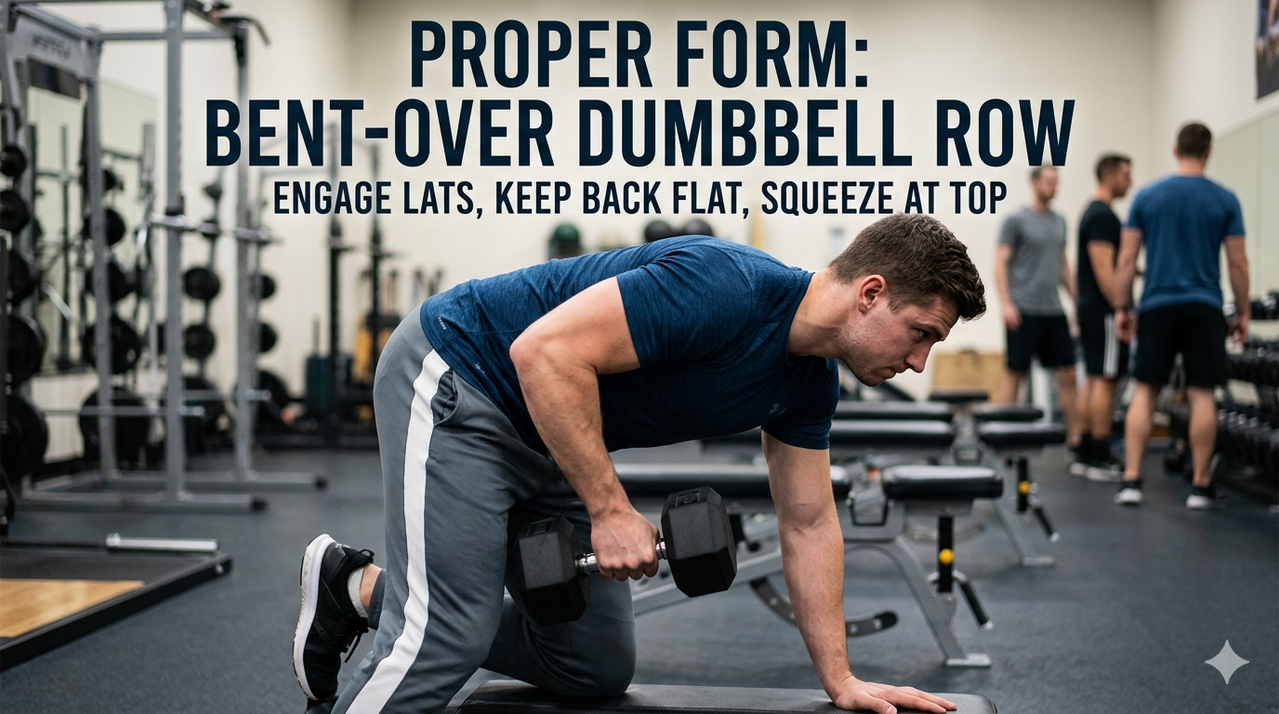
- Barbell Bent-Over Row: Thickness and overall back development
- Seated Cable Row: Mid-back and rhomboids
- Face Pulls: Rear delts and upper traps, shoulder health
- Deadlift: Full posterior chain, erector spinae
3.3. Proper Form Tips
- Rows: Hinge at hips, back flat, pull to lower chest, squeeze shoulder blades.
- Pull-Ups: Engage lats, avoid swinging, pull chest to bar.
- Deadlift: Hinge at hips, keep bar close, chest up, brace core.
3.4. Volume & Frequency
12–18 sets per week, trained 2x weekly. Focus on both vertical and horizontal pulling movements .
4. Legs (Quads, Hamstrings, Glutes, Calves) – The Foundation
4.1. Anatomy & Function
The legs include quadriceps (knee extension), hamstrings (knee flexion, hip extension), glutes (hip extension), and calves (ankle plantarflexion).
4.2. Best Exercises
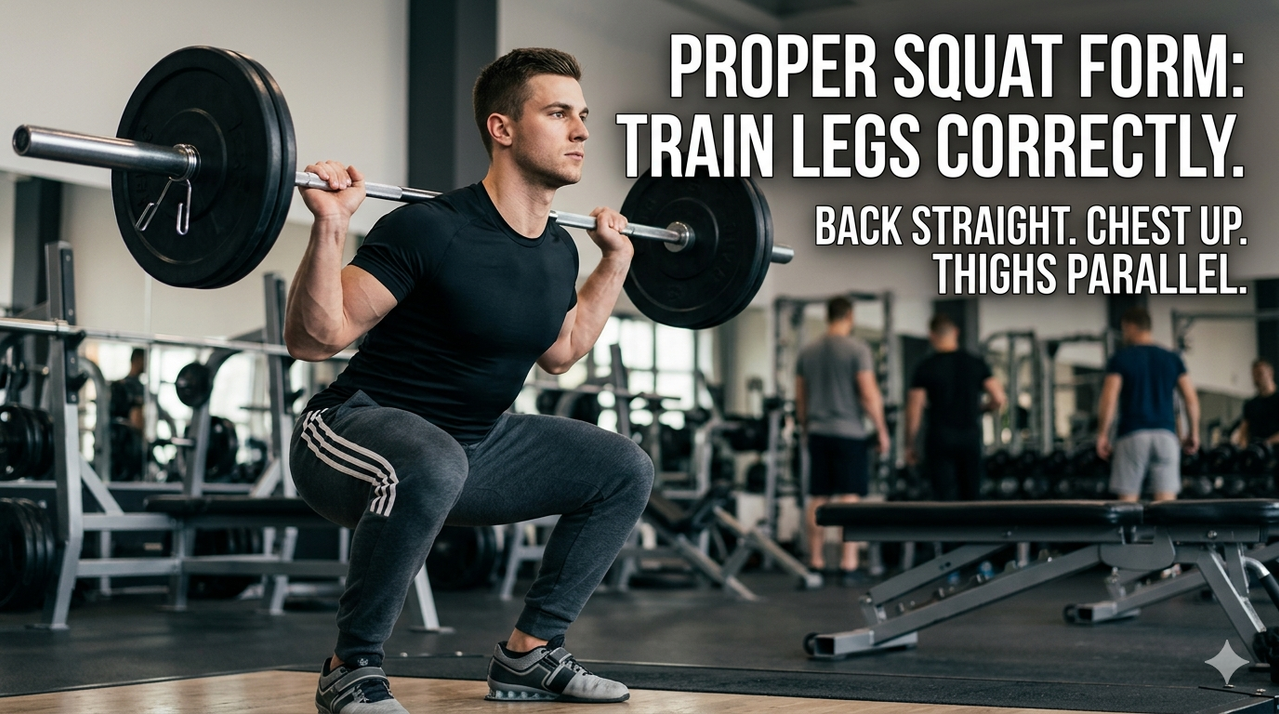
- Squat (Barbell or Goblet): Overall leg development, quads, glutes
- Deadlift (Conventional or Romanian): Hamstrings, glutes, posterior chain
- Leg Press: Quad and glute volume
- Lunges (Walking or Reverse): Unilateral strength and balance
- Calf Raises (Standing or Seated): Gastrocnemius and soleus
4.3. Proper Form Tips
- Squat: Chest up, back straight, knees track over toes, depth to parallel or below.
- Deadlift: Hinge at hips, keep back flat, drive through heels.
- Lunges: Keep front knee behind toes, lower until front thigh is parallel.
4.4. Volume & Frequency
12–16 sets per week for quads/hamstrings, trained 2x weekly. Calves: 8–12 sets weekly .
5. Shoulders (Deltoids) – 3D Cap
5.1. Anatomy & Function
The deltoid has three heads: anterior (front), lateral (side), and posterior (rear). Functions include flexion, abduction, and extension of the shoulder .
5.2. Best Exercises
- Overhead Press (Barbell or Dumbbell): Overall shoulder strength, front and lateral heads
- Lateral Raises: Lateral head emphasis, width
- Rear Delt Flyes (Dumbbell or Cable): Posterior head, shoulder health
- Face Pulls: Rear delts and external rotation
5.3. Proper Form Tips
- Overhead Press: Keep core braced, avoid excessive arch, press in line with ears.
- Lateral Raises: Slight elbow bend, lead with elbows, control the negative.
- Rear Delt Flyes: Hinge at hips, squeeze rear delts, avoid momentum.
5.4. Volume & Frequency
10–14 sets per week, trained 2x weekly. Prioritize lateral raises for width .
6. Arms (Biceps & Triceps) – Show Muscles
6.1. Anatomy & Function
Biceps: elbow flexion and supination. Triceps: elbow extension (2/3 of arm mass).
6.2. Best Exercises
- Barbell Curl / Dumbbell Curl: Biceps mass
- Incline Dumbbell Curl: Biceps stretch and peak
- Tricep Pushdown (Cable): Triceps lateral head
- Close-Grip Bench Press: Triceps mass
- Skull Crushers: Triceps long head
6.3. Proper Form Tips
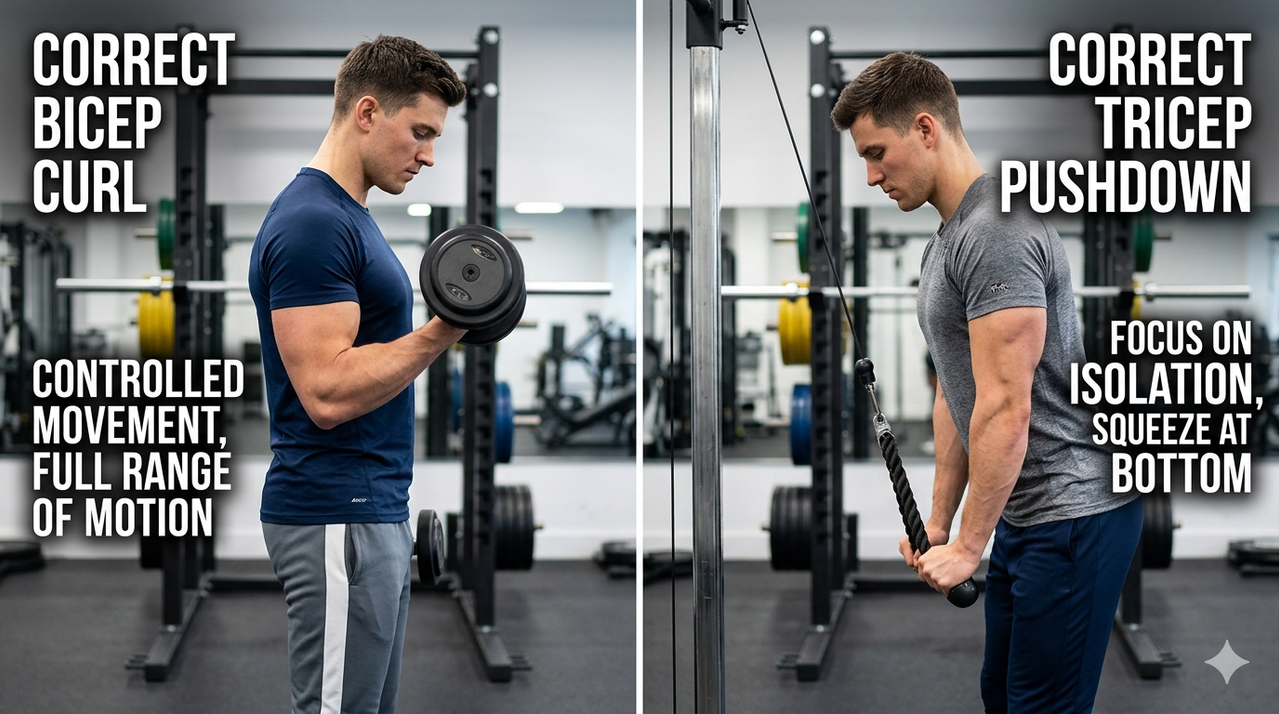
- Curls: Keep elbows stationary, avoid swinging, full range of motion.
- Tricep Pushdown: Elbows at sides, extend fully, avoid shoulder movement.
6.4. Volume & Frequency
8–12 sets per muscle group weekly, trained 2x weekly. Arms often respond well to high frequency .
7. Sample Full Body Routine (3x/Week)
- Workout A: Squat 3×8–10, Bench Press 3×8–10, Bent-Over Row 3×8–10, Overhead Press 3×8–10, Plank 3×45 sec
- Workout B: Deadlift 3×6–8, Pull-ups 3×8–10, Incline Dumbbell Press 3×8–10, Lateral Raises 3×10–12, Bicep Curl 2×10–12, Tricep Pushdown 2×10–12
- Alternate A/B throughout the week.
Progression: Add 2.5–5 lbs when you hit the top of your rep range.
8. Nutrition to Support Muscle Growth
8.1. Calorie and Protein Targets
- Calories: Eat at maintenance or a small surplus (250–500 kcal) for muscle growth.
- Protein: 1.6–2.2 g per kg body weight daily .
- Carbs: 4–6 g per kg for energy and recovery.
- Fats: 0.8–1.2 g per kg for hormonal health.
8.2. Sample Meal Plan (2,800 kcal, 160g Protein)
- Breakfast: 4 eggs, 1 cup oatmeal with 1 tbsp peanut butter, 1 banana (650 kcal, 40g protein)
- Lunch: 200g chicken breast, 1.5 cups brown rice, 1 cup broccoli (650 kcal, 50g protein)
- Pre-workout: 1 banana + 1 scoop whey (250 kcal, 25g protein)
- Post-workout/Dinner: 200g salmon, 1.5 cups sweet potato, 2 cups greens (650 kcal, 45g protein)
- Evening: 200g Greek yogurt (200 kcal, 20g protein)
Vegan/Vegetarian Plan (2,800 kcal, 150g Protein)
- Breakfast: Tofu scramble (200g firm tofu), 1.5 cups oatmeal with 2 tbsp peanut butter, banana (700 kcal, 40g protein)
- Lunch: 200g tempeh, 1.5 cups quinoa, 1 cup roasted chickpeas (700 kcal, 45g protein)
- Snack: 1 cup edamame, 1 apple (200 kcal, 15g protein)
- Dinner: 1.5 cups cooked lentils, 1.5 cups sweet potato, 1 cup spinach (650 kcal, 35g protein)
- Evening: 1 cup unsweetened soy milk + 2 tbsp hemp seeds (200 kcal, 15g protein)
Gluten-Free Options
- Use certified gluten-free oats, quinoa, rice, or buckwheat.
- Ensure tempeh and tofu are gluten-free certified.
9. Common Training Mistakes to Avoid
- Mistake #1: Poor form. Cheating reps reduce muscle activation and increase injury risk.
- Mistake #2: Ignoring compound movements. Isolation-only routines miss overall growth potential.
- Mistake #3: Too much volume. >20 sets per muscle group weekly can lead to overtraining.
- Mistake #4: Not training legs. Skipping leg day creates imbalance and limits overall growth.
- Mistake #5: No progressive overload. Doing the same weight/reps forever = no growth.
10. Frequently Asked Questions
How do you train each muscle group effectively?
Use proper form, adequate volume (10–20 sets per week), and progressive overload. Focus on compound movements and train each muscle group 2–3 times weekly.
How many exercises per muscle group?
2–4 exercises per muscle group per session. For example, chest: bench press + incline press + flyes.
How many sets per muscle group per week?
10–20 sets weekly is optimal. Beginners: 10–12; intermediates: 12–16; advanced: 16–20.
What's the best rep range for muscle growth?
6–12 reps per set is most commonly used and effective for hypertrophy.
How often should I train each muscle group?
2–3 times per week for optimal growth, based on research showing higher frequency yields better results.
How much protein do I need for muscle growth?
1.6–2.2 grams per kilogram of body weight daily. For an 80 kg person, 128–176 grams of protein per day.
Should I train to failure?
Training to failure occasionally can be beneficial, but not every set. Leave 1–2 reps in reserve for most sets to manage fatigue.
11. Related Resources
- The Science of Rest Days: How Muscles Grow While You Sleep and Recover
- Morning Stretching Routine to Improve Strength and Lifting Performance
- How to Build a Powerful Chest at Home Without a Bench (Best Bodyweight Workouts)
- Best Bodyweight Shoulder Exercises to Build Strong and Stable Shoulders
- How to Do Your First Push-Up: Beginner Progression Guide to Build Strength Fast
12. Scientific References
- Schoenfeld, B. J., et al. (2017). Effects of Resistance Training Frequency on Measures of Muscle Hypertrophy: A Systematic Review and Meta-Analysis. Sports Medicine, 46(11), 1689–1697. PubMed
- Schoenfeld, B. J., et al. (2016). Resistance Training Volume Enhances Muscle Hypertrophy but Not Strength in Trained Men. Medicine & Science in Sports & Exercise, 48(8), 1530–1539. PubMed
- Morton, R. W., et al. (2018). A systematic review, meta-analysis and meta-regression of the effect of protein supplementation on resistance training-induced gains in muscle mass and strength in healthy adults. British Journal of Sports Medicine, 52(6), 376–384. PubMed
- Helms, E. R., et al. (2014). Evidence-based recommendations for natural bodybuilding contest preparation. Journal of the International Society of Sports Nutrition, 11(1), 20. PubMed
- ACSM. (2021). Nutrition and Athletic Performance. Medicine & Science in Sports & Exercise, 53(3), 600–618. PubMed
Join the conversation