Push Pull Legs vs Full Body: Which Workout Split Is Better?
Push Pull Legs vs Full Body: Which Workout Split Is Better?
⚡ TL;DR
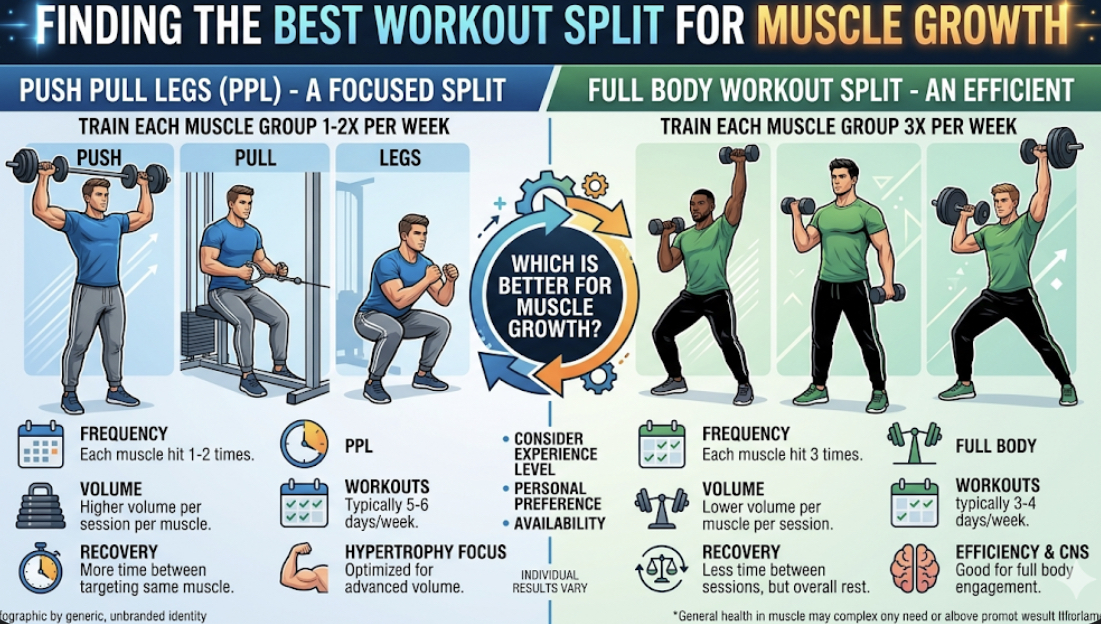
Push pull legs vs full body—both splits can build muscle effectively. Research shows that training each muscle group 2–3 times per week is optimal for hypertrophy . Full body (3x/week) is ideal for beginners and those with limited time, providing high frequency with lower weekly volume. Push pull legs (6x/week or 3x/week rotating) offers more volume per session and is better for intermediates/advanced lifters who can recover well. The best split is the one you can consistently follow while applying progressive overload .
1. The Great Training Split Debate
You walk into the gym and see people training differently: some do full body workouts three times a week, others follow a push pull legs routine six days a week. Which approach builds muscle faster? The answer isn't one-size-fits-all. Understanding the push pull legs vs full body comparison will help you choose the best split for your goals, schedule, and recovery capacity.
Is push pull legs better than full body?
It depends on your experience, schedule, and recovery ability. For beginners, full body (3x/week) is often better because it builds a foundation, teaches movement patterns, and provides optimal frequency with less risk of overtraining. For intermediate and advanced lifters, push pull legs (6x/week or 3x/week rotating) allows for higher weekly volume per muscle group and more targeted training. Research shows that both splits can produce significant muscle growth when volume and intensity are matched . The best split is the one you can consistently follow with progressive overload.
2. Full Body Workout Split: The Foundation Builder
2.1. What Is Full Body Training?
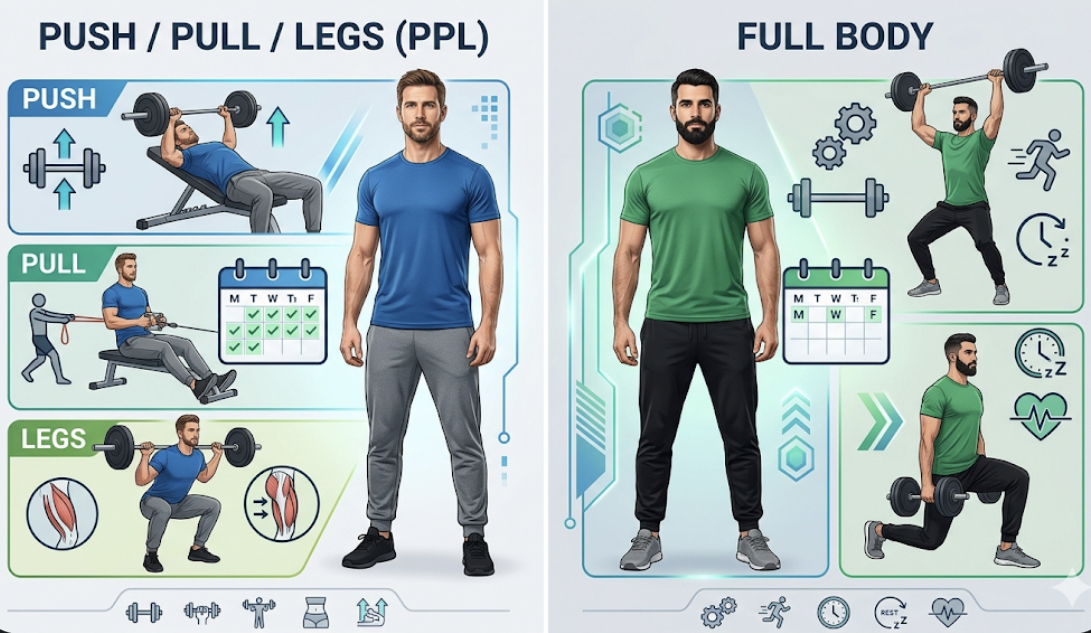
Full body training involves working all major muscle groups in a single session, typically performed 2–4 times per week. Each workout hits legs, chest, back, shoulders, and arms.
2.2. Pros of Full Body
- Optimal frequency: Trains each muscle group 2–4 times weekly—research shows 2–3 times is ideal for hypertrophy .
- Time-efficient: 3 sessions per week is perfect for busy schedules.
- Beginner-friendly: Builds movement patterns and neural adaptations quickly.
- Better recovery: 48–72 hours between sessions allows full recovery.
- Hormonal response: Compound lifts in each session may boost anabolic hormones.
2.3. Cons of Full Body
- Lower per-session volume: Limited time per muscle group per workout.
- Fatigue accumulation: Can be demanding if intensity is too high.
- Less specialization: Harder to focus on lagging body parts.
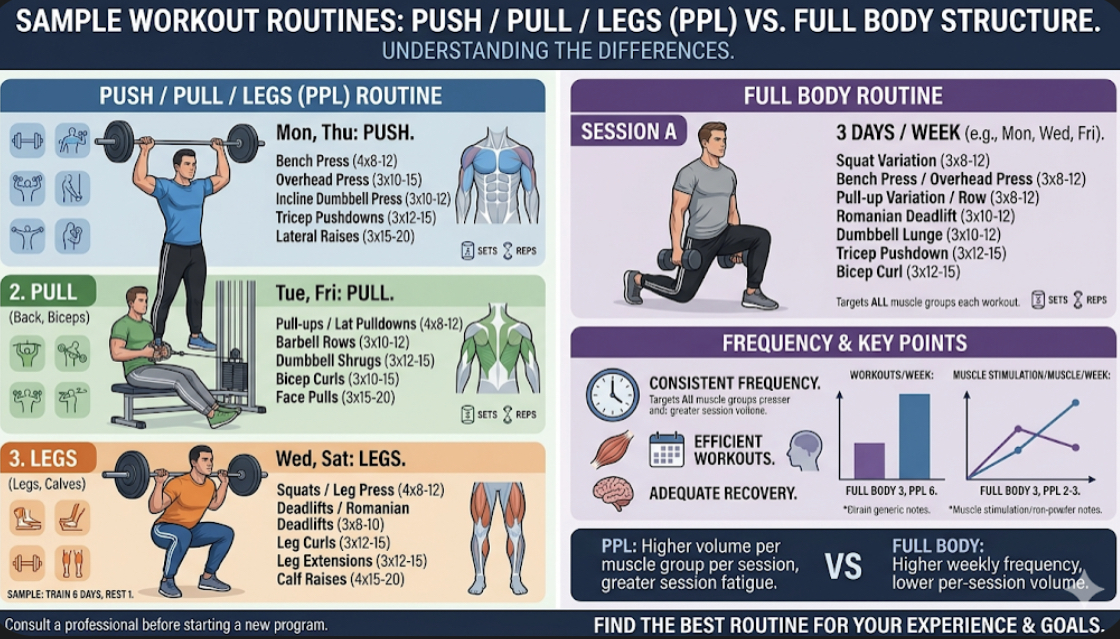
2.4. Sample Full Body Routine (3x/week)
- Squat: 3 × 8–10
- Bench Press: 3 × 8–10
- Bent-Over Row: 3 × 8–10
- Overhead Press: 3 × 8–10
- Plank: 3 × 45–60 sec
3. Push Pull Legs Split: The Volume Specialist
3.1. What Is Push Pull Legs (PPL)?
PPL divides training into three categories: push (chest, shoulders, triceps), pull (back, biceps), and legs (quads, hamstrings, glutes, calves). It's typically run as a 6-day cycle (PPLPPL rest) or 3-day rotating schedule.
3.2. Pros of Push Pull Legs
- Higher volume per muscle group: Each session allows 15–20 sets for main muscle groups.
- Better specialization: Easier to target lagging muscles.
- Less fatigue interference: Muscles worked in one session don't affect others (e.g., chest fatigue doesn't impact back training).
- Progressive overload friendly: Easier to add weight/reps consistently.
- Ideal for intermediates/advanced: Higher training age requires more volume .
3.3. Cons of Push Pull Legs
- Time commitment: 5–6 days per week may be too much for many.
- Recovery demands: Higher frequency requires excellent sleep and nutrition.
- Not beginner-optimal: Beginners may not need this much volume.
- Risk of overtraining: Without proper recovery, progress stalls.
3.4. Sample PPL Routine (6-day cycle)
- Push Day: Bench Press 3×8–10, Overhead Press 3×8–10, Incline Dumbbell Press 3×10–12, Lateral Raises 3×12–15, Tricep Pushdowns 3×10–12
- Pull Day: Bent-Over Row 3×8–10, Pull-ups 3×8–10, Seated Cable Row 3×10–12, Face Pulls 3×12–15, Barbell Curl 3×10–12
- Legs Day: Squat 3×8–10, Romanian Deadlift 3×8–10, Leg Press 3×10–12, Leg Curls 3×10–12, Calf Raises 3×12–15
4. Head-to-Head Comparison: Full Body vs PPL
5. The Science: What Research Says About Split Frequency
5.1. Frequency Matters More Than Split
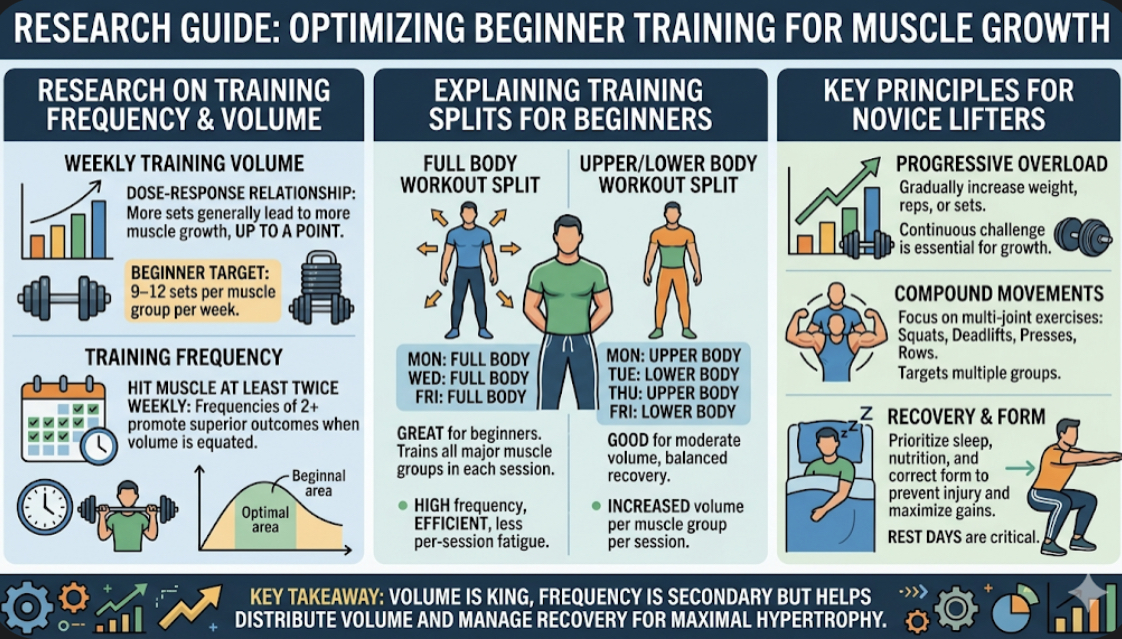
A 2017 meta-analysis found that training each muscle group 2–3 times per week produces greater hypertrophy than once per week . Both full body (3x/week) and PPL (2x/week per muscle group) achieve this optimal frequency.
5.2. Volume Is Key
Research shows that higher weekly volume (sets per muscle group) generally leads to more growth, up to a point . PPL allows for higher volume (12–18 sets per muscle group) compared to full body (6–9 sets). However, beginners need less volume to grow .
5.3. Individual Differences
Genetics, recovery capacity, and training age affect which split works best. A 2020 study found that both high and low frequency protocols produced similar results when volume was matched .
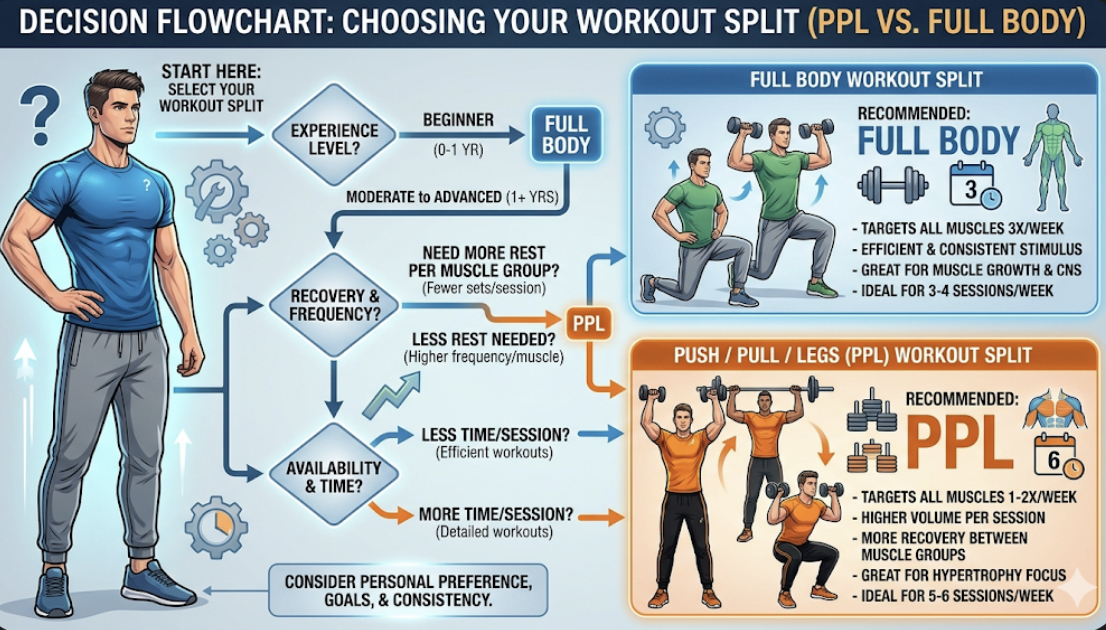
6. Which Split Should You Choose? Decision Guide
6.1. Choose Full Body If:
- You're a beginner (0–1 year of consistent training).
- You have limited time (can only train 2–3 days/week).
- You struggle with recovery or have high stress/poor sleep.
- You want a simple, sustainable routine.
- You're returning from a long break.
6.2. Choose Push Pull Legs If:
- You're an intermediate or advanced lifter (1+ years).
- You can commit to 5–6 days/week consistently.
- You have good recovery (sleep 8+ hours, low stress, adequate nutrition).
- You want to specialize in certain muscle groups.
- You've plateaued on full body and need more volume.
7. Nutrition to Support Your Training Split
7.1. General Nutrition Guidelines
- Calories: Eat at maintenance or a small surplus (250–500 kcal) for muscle growth.
- Protein: 1.6–2.2 g per kg body weight daily .
- Carbs: 4–6 g per kg for energy, especially important for higher frequency splits like PPL.
- Fats: 0.8–1.2 g per kg for hormonal health.
7.2. Sample Meal Plan (2,800 kcal, 160g Protein) – Works for Any Split
- Breakfast: 4 eggs, 1 cup oatmeal with 1 tbsp peanut butter, 1 banana (650 kcal, 40g protein)
- Lunch: 200g chicken breast, 1.5 cups brown rice, 1 cup broccoli (650 kcal, 50g protein)
- Pre-workout: 1 banana + 1 scoop whey (250 kcal, 25g protein)
- Post-workout/Dinner: 200g salmon, 1.5 cups sweet potato, 2 cups greens (650 kcal, 45g protein)
- Evening: 200g Greek yogurt (200 kcal, 20g protein)
Vegan/Vegetarian Plan (2,800 kcal, 150g Protein)
- Breakfast: Tofu scramble (200g firm tofu), 1.5 cups oatmeal with 2 tbsp peanut butter, banana (700 kcal, 40g protein)
- Lunch: 200g tempeh, 1.5 cups quinoa, 1 cup roasted chickpeas (700 kcal, 45g protein)
- Snack: 1 cup edamame, 1 apple (200 kcal, 15g protein)
- Dinner: 1.5 cups cooked lentils, 1.5 cups sweet potato, 1 cup spinach (650 kcal, 35g protein)
- Evening: 1 cup unsweetened soy milk + 2 tbsp hemp seeds (200 kcal, 15g protein)
Gluten-Free Options
- Use certified gluten-free oats, quinoa, rice, or buckwheat.
- Ensure tempeh and tofu are gluten-free certified.
8. Common Mistakes to Avoid
- Mistake #1: Too much volume for recovery. PPL with insufficient sleep leads to overtraining.
- Mistake #2: Too little volume in full body. Doing only 1 set per exercise may not provide enough stimulus.
- Mistake #3: Not progressing overload. Both splits require adding weight/reps over time.
- Mistake #4: Ignoring nutrition. PPL's higher frequency requires more calories and protein.
- Mistake #5: Switching splits too often. Stick with a split for 8–12 weeks to see results.
9. Frequently Asked Questions
Is push pull legs better than full body?
It depends on your experience level. Full body is better for beginners; PPL is better for intermediates and advanced lifters who can handle higher volume and frequency.
Can I build muscle with full body 3x a week?
Yes, absolutely. Research shows training each muscle group 2–3 times weekly is optimal for growth. Full body 3x/week is an excellent choice for building muscle.
How many days a week should I do PPL?
Most people run PPL as a 6-day cycle (PPLPPL rest) or 3-day rotating schedule. Beginners can start with 3 days/week and add days as recovery allows.
Is 6 days a week too much for PPL?
For beginners, yes. For intermediates with good recovery (sleep, nutrition), 6 days can be effective. Listen to your body—if you're constantly sore or fatigued, reduce frequency.
Can I switch from full body to PPL?
Yes. Many lifters start with full body for 6–12 months, then transition to PPL when they need more volume to continue progressing.
Which split is better for fat loss?
Both can work for fat loss with a calorie deficit. Full body may be easier to sustain due to lower frequency; PPL may burn more calories from extra sessions.
How much protein do I need for either split?
1.6–2.2 grams per kilogram of body weight daily. This supports muscle repair and growth regardless of split choice.
10. Related Resources
- The Science of Rest Days: How Muscles Grow While You Sleep and Recover
- Morning Stretching Routine to Improve Strength and Lifting Performance
- How to Build a Powerful Chest at Home Without a Bench (Best Bodyweight Workouts)
- Best Bodyweight Shoulder Exercises to Build Strong and Stable Shoulders
- How to Do Your First Push-Up: Beginner Progression Guide to Build Strength Fast
11. Scientific References
- Schoenfeld, B. J., et al. (2017). Effects of Resistance Training Frequency on Measures of Muscle Hypertrophy: A Systematic Review and Meta-Analysis. Sports Medicine, 46(11), 1689–1697. PubMed
- Schoenfeld, B. J., et al. (2016). Resistance Training Volume Enhances Muscle Hypertrophy but Not Strength in Trained Men. Medicine & Science in Sports & Exercise, 48(8), 1530–1539. PubMed
- Morton, R. W., et al. (2018). A systematic review, meta-analysis and meta-regression of the effect of protein supplementation on resistance training-induced gains in muscle mass and strength in healthy adults. British Journal of Sports Medicine, 52(6), 376–384. PubMed
- Helms, E. R., et al. (2014). Evidence-based recommendations for natural bodybuilding contest preparation. Journal of the International Society of Sports Nutrition, 11(1), 20. PubMed
- ACSM. (2021). Nutrition and Athletic Performance. Medicine & Science in Sports & Exercise, 53(3), 600–618. PubMed
Join the conversation