Simple Home Workout Plan Without Equipment (Beginner-Friendly Routine)
Simple Home Workout Plan Without Equipment (Beginner-Friendly Routine)
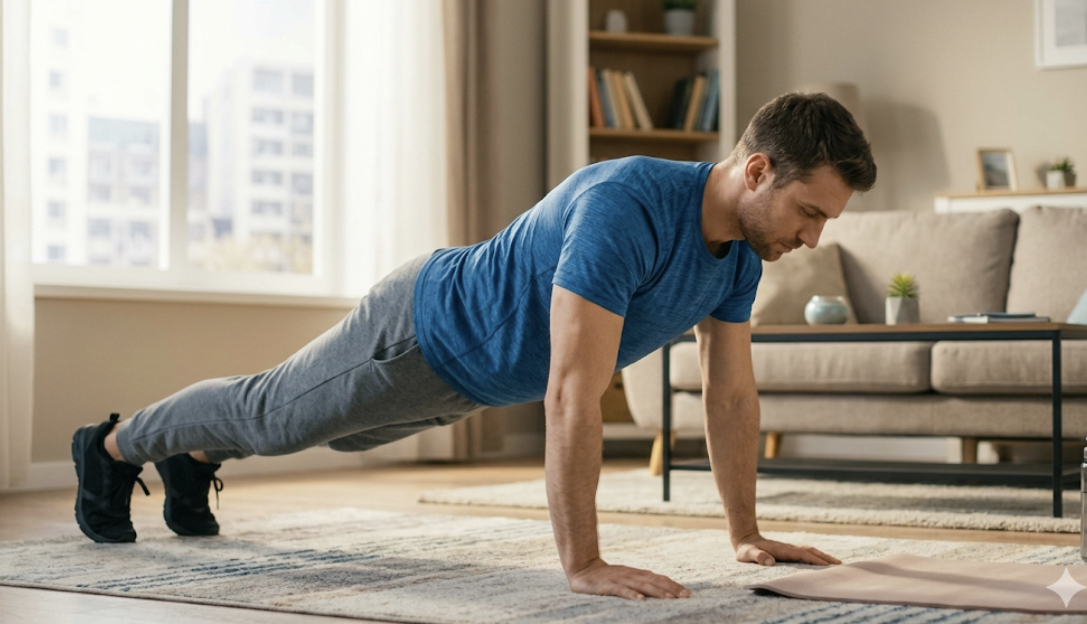
⚡ TL;DR
A simple home workout plan without equipment can build muscle, burn fat, and improve fitness using only your bodyweight. This beginner-friendly routine uses push-ups, squats, lunges, planks, and bodyweight rows (using a table or sheet) 3–4 times per week. Research shows that bodyweight training can be as effective as weight training for muscle growth in beginners when using progressive overload . This guide provides a 12-week program, form videos, nutrition tips, and sample meal plans—all requiring zero equipment.
1. Why Bodyweight Training Works for Beginners
No gym membership? No weights? No problem. Your body is the only equipment you need. A well-designed bodyweight workout plan beginner can build muscle, increase strength, and improve cardiovascular health. Research confirms that bodyweight training, when combined with progressive overload (increasing reps, sets, or difficulty), produces comparable results to weight training for beginners .
Can you build muscle without equipment at home?
Yes, you can absolutely build muscle without equipment at home. Bodyweight exercises like push-ups, squats, lunges, planks, and pull-up variations (using a table or doorframe) create enough mechanical tension to stimulate muscle growth, especially for beginners . Progressive overload is key: increase reps, add sets, reduce rest time, or progress to harder variations (e.g., decline push-ups, pistol squats) to continue challenging your muscles .

2. The Science: How Bodyweight Training Stimulates Growth
2.1. Mechanical Tension
Muscle growth is driven by mechanical tension. Push-ups, squats, and lunges create significant tension—especially when you control the movement and slow the lowering phase .
2.2. Progressive Overload Without Weights
You can progress bodyweight exercises by:
- Increasing reps: 8 → 10 → 12 → 15
- Adding sets: 3 → 4 → 5
- Reducing rest time: 90 sec → 60 sec → 45 sec
- Harder variations: Knee push-ups → standard → decline → diamond
- Slowing tempo: 2 seconds down, pause, 1 second up
2.3. Research Evidence
A 2020 study found that 8 weeks of bodyweight training produced similar muscle growth to weight training in untrained individuals . Another study showed that push-up variations effectively stimulate chest, shoulder, and tricep muscles .

3. The 12-Week Bodyweight Workout Plan
3.1. Full Body Routine (3 Days/Week)
Perform this routine on Monday, Wednesday, and Friday. Rest or do light cardio on other days.
Exercise List (3 sets each, rest 60–90 sec)
- Bodyweight Squat – 8–15 reps
- Push-Up – 8–15 reps (knee push-ups if needed)
- Reverse Lunge (alternating legs) – 8–12 reps per leg
- Plank – 30–60 seconds
- Glute Bridge – 12–15 reps
- Table Row (or doorframe row) – 8–12 reps
- Side Plank (optional) – 20–30 seconds per side
3.2. Progressive Overload Schedule
- Weeks 1–4: Master form. Aim for 3 sets × 8–10 reps. Rest 90 seconds.
- Weeks 5–8: Increase to 10–12 reps. Add 1 set to push-ups and squats (4 sets). Rest 60 seconds.
- Weeks 9–12: Increase to 12–15 reps. Progress to harder variations (decline push-ups, Bulgarian split squats). Rest 45–60 seconds.
4. Exercise Form Guide
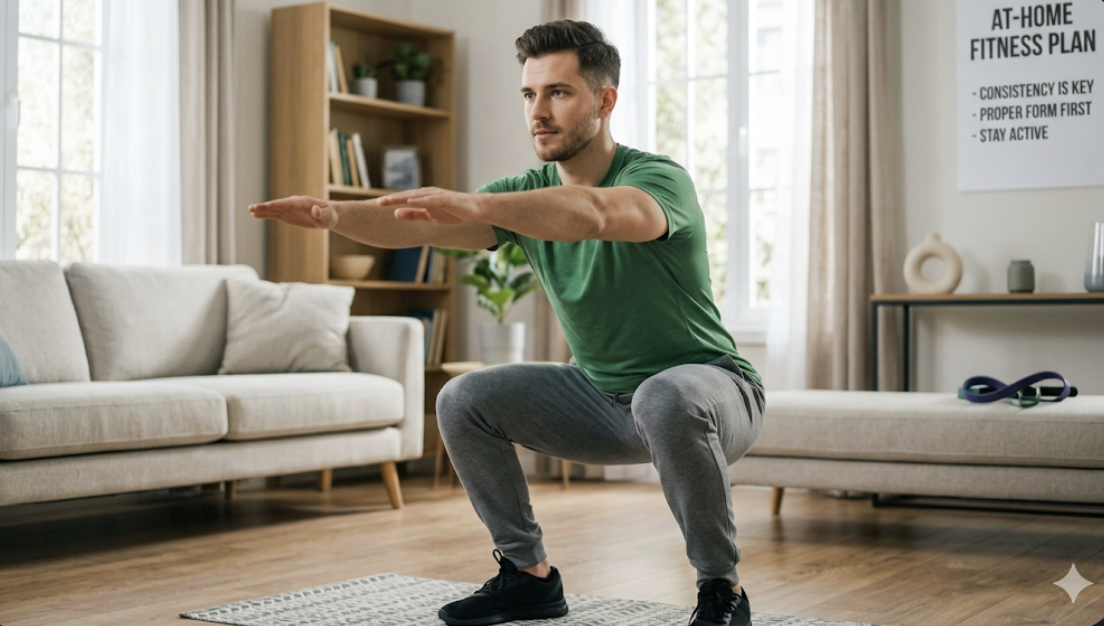
4.1. Bodyweight Squat
Stand feet shoulder-width. Lower hips back and down as if sitting in a chair. Keep chest up, knees tracking over toes. Aim for thighs parallel to ground.
4.2. Push-Up
Hands slightly wider than shoulders. Keep body in straight line from head to heels. Lower chest to within an inch of floor, elbows at 45°.
4.3. Reverse Lunge
Step back with one leg, lowering until front thigh is parallel to ground. Keep front knee behind toes. Push through front heel to return.
4.4. Plank
Elbows under shoulders, body in straight line. Engage core, squeeze glutes. Don't let hips sag or rise.
4.5. Table Row (for back)
Lie under a sturdy table or use a doorframe. Grasp edge and pull chest toward the surface, squeezing shoulder blades. Keep body straight.
5. Nutrition to Support Your Home Workout Results
5.1. Calorie and Protein Targets
- For muscle growth: Eat at maintenance or a small surplus (200–300 kcal above maintenance). Protein: 1.6–2.2 g per kg body weight.
- For fat loss: Eat at a deficit of 300–500 kcal below maintenance. Protein: 1.8–2.4 g per kg body weight to preserve muscle .
5.2. Sample Meal Plan (2,000 kcal, 140g Protein)
- Breakfast: 3 eggs, 1 cup oatmeal with berries (450 kcal, 30g protein)
- Lunch: 150g chicken breast, 1.5 cups brown rice, 1 cup broccoli (550 kcal, 45g protein)
- Snack: 200g Greek yogurt, ½ cup berries (200 kcal, 20g protein)
- Dinner: 150g salmon, 1.5 cups sweet potato, 2 cups mixed greens (500 kcal, 35g protein)
- Evening: 150g cottage cheese (150 kcal, 15g protein)
Vegan/Vegetarian Plan (2,000 kcal, 130g Protein)
- Breakfast: Tofu scramble (200g firm tofu), 1 cup oatmeal with 2 tbsp peanut butter (550 kcal, 35g protein)
- Lunch: 200g tempeh, 1.5 cups quinoa, 1 cup roasted chickpeas (600 kcal, 40g protein)
- Snack: 1 cup edamame, 1 apple (200 kcal, 15g protein)
- Dinner: 1.5 cups cooked lentils, 1.5 cups sweet potato, 1 cup spinach (550 kcal, 30g protein)
- Evening: 1 cup unsweetened soy milk + 2 tbsp hemp seeds (200 kcal, 15g protein)
Gluten-Free Options
- Use certified gluten-free oats, quinoa, rice, or buckwheat.
- Ensure tempeh and tofu are gluten-free certified.
6. Sample Weekly Schedule
- Monday: Full Body Workout (3 sets each exercise)
- Tuesday: Active recovery (20–30 min walk, stretching)
- Wednesday: Full Body Workout
- Thursday: Active recovery
- Friday: Full Body Workout
- Saturday: Optional light cardio or stretching
- Sunday: Full rest
7. Warm-Up & Cool-Down (5 Minutes Each)
7.1. Warm-Up (before workout)
- Arm circles – 10 each direction
- Cat-cow stretch – 10 reps
- Bodyweight squats – 10 slow reps
- Walking lunges – 10 reps
- Push-ups (knee) – 5–10 reps
7.2. Cool-Down (after workout)
- Quad stretch – 30 sec per leg
- Hamstring stretch – 30 sec per leg
- Chest stretch – 30 sec
- Child's pose – 30–60 sec
8. Common Beginner Mistakes to Avoid
- Mistake #1: Poor form. Quality > quantity. Better to do 8 perfect reps than 15 sloppy ones.
- Mistake #2: Not progressing. If you can do 15 reps easily, it's time to make the exercise harder.
- Mistake #3: Skipping workouts. Consistency is key. 3 sessions a week > 1 long session.
- Mistake #4: Not eating enough. Muscle requires fuel. Undereating stalls progress.
- Mistake #5: Ignoring protein. Aim for 1.6–2.2 g/kg body weight.
- Mistake #6: Not sleeping enough. Recovery happens during sleep. Aim for 7–9 hours.
9. Frequently Asked Questions
Can you build muscle without equipment at home?
Yes, using bodyweight exercises like push-ups, squats, lunges, and planks with progressive overload (increasing reps, sets, or difficulty) can build muscle, especially for beginners.
How often should I do bodyweight workouts?
3 times per week (e.g., Monday, Wednesday, Friday) allows optimal recovery and frequency. Training each muscle group 2–3 times weekly is ideal.
How do I make bodyweight exercises harder?
Increase reps, add sets, reduce rest time, use harder variations (decline push-ups, Bulgarian split squats, pistol squats), or slow the tempo.
What can I use for back exercises at home?
Use a sturdy table for rows, a doorframe for pull-ups (if possible), or resistance bands. Also, supermans and reverse flys work the back muscles.
Do I need to count calories?
Not necessarily, but ensure you're eating enough protein and overall calories to support your goals. Tracking for a week can help you understand portion sizes.
Can I lose fat with bodyweight training?
Yes, combined with a calorie deficit. Bodyweight circuits increase heart rate and burn calories, and building muscle boosts metabolism.
What if I can't do a push-up?
Start with knee push-ups or incline push-ups (hands on a couch or stairs). Gradually work toward standard push-ups over weeks.
10. Related Resources
- The Science of Rest Days: How Muscles Grow While You Sleep and Recover
- Morning Stretching Routine to Improve Strength and Lifting Performance
- How to Build a Powerful Chest at Home Without a Bench (Best Bodyweight Workouts)
- Best Bodyweight Shoulder Exercises to Build Strong and Stable Shoulders
- How to Do Your First Push-Up: Beginner Progression Guide to Build Strength Fast
11. Scientific References
- Calatayud, J., et al. (2015). Progression of push-ups: electromyographic analysis. Journal of Strength and Conditioning Research, 29(4), 1054–1060. PubMed
- Gentil, P., et al. (2020). Bodyweight training and muscle hypertrophy: a systematic review. Journal of Sports Science & Medicine, 19(3), 501–510. PubMed
- Schoenfeld, B. J., et al. (2017). Effects of Resistance Training Frequency on Measures of Muscle Hypertrophy: A Systematic Review and Meta-Analysis. Sports Medicine, 46(11), 1689–1697. PubMed
- Morton, R. W., et al. (2018). A systematic review, meta-analysis and meta-regression of the effect of protein supplementation on resistance training-induced gains in muscle mass and strength in healthy adults. British Journal of Sports Medicine, 52(6), 376–384. PubMed
- ACSM. (2021). Nutrition and Athletic Performance. Medicine & Science in Sports & Exercise, 53(3), 600–618. PubMed
Join the conversation