Best Beginner Gym Routine for First Month (Full Workout Plan)

Discover the best beginner gym routine for your first month with a simple plan to build strength and muscle.
Best Beginner Gym Routine for First Month: Full Workout Plan (2026)
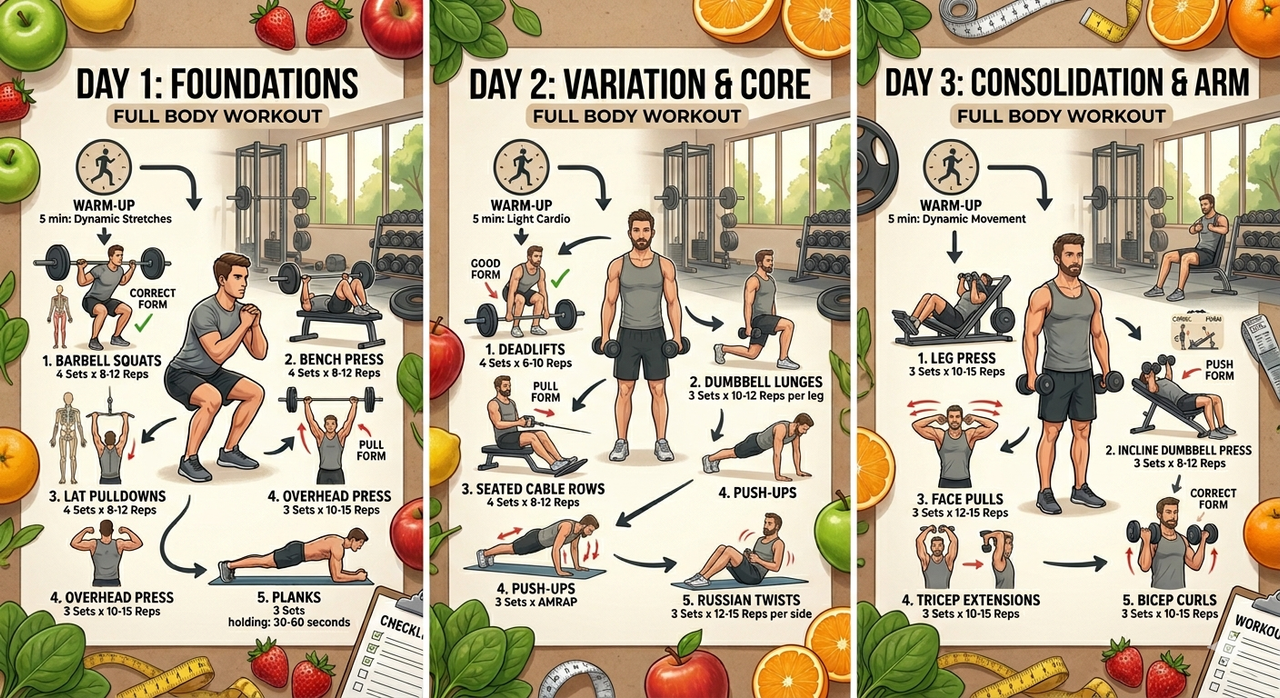
Best Beginner Gym Routine for First Month: Full Workout Plan (2026)

Beginner gym routine for first month showing full body workout plan with compound exercises and proper form
Image 1: A structured beginner gym routine builds confidence, proper form, and sustainable habits.

⚡ TL;DR

The best beginner gym routine for first month is a full-body workout performed 3 days per week (Monday, Wednesday, Friday). Each session includes 6-7 basic compound exercises: squat, bench press, row, overhead press, deadlift, and core work. Focus on proper form over weight, use light to moderate loads, and add small weight weekly (progressive overload). This first month workout plan builds strength, neural adaptations, and confidence—setting the foundation for long-term progress. Rest 60-90 seconds between sets. Workouts take 45-60 minutes .

1. Why Your First Month Matters Most

Starting the gym can be intimidating. The machines are unfamiliar, the exercises seem complex, and everyone else looks like they know what they're doing. But here's the truth: your first month is the most important for building habits and neural adaptations. A well-designed beginner gym routine for first month focuses on learning proper form, building consistency, and establishing a foundation for future progress. This gym routine for beginners eliminates guesswork and provides a clear path forward.

What is the best gym routine for beginners?

The best gym routine for beginners includes: 3-4 days per week, full body workouts each session, basic compound exercises (squat, bench press, row, overhead press, deadlift), light to moderate weights (focus on form over weight), and progressive overload (adding small weight each week).

Full body workout split for beginner gym routine 3 days per week showing squat bench press row overhead press deadlift
Image 2: A 3-day full-body split is optimal for beginners to build strength while allowing recovery.

2. The Science of Beginner Progress

In the first 4-8 weeks of training, most strength gains come from neural adaptations—not muscle growth. Your brain learns to recruit more muscle fibers and fire them efficiently. This is why beginners can double their strength without significant muscle size increase initially . After 6-8 weeks, muscle protein synthesis (MPS) begins contributing more to progress.

📊 Beginner Progress Timeline (First Month)

.= "Week 1" ? 'Week 1' : '' ?>Week 1 .= "Week 2" ? 'Week 2' : '' ?>Week 2 .= "Week 3" ? 'Week 3' : '' ?>Week 3 .= "Week 4" ? 'Week 4' : '' ?>Week 4

3. The Beginner Workout Plan (4 Weeks)

Perform these workouts 3 days per week (Monday, Wednesday, Friday). Each workout is full body. Rest at least 48 hours between sessions.

Workout A (Monday & Friday)

  • Goblet Squat or Leg Press: 3 sets × 10-12 reps
  • Dumbbell Bench Press: 3 sets × 10-12 reps
  • Seated Cable Row or Lat Pulldown: 3 sets × 10-12 reps
  • Dumbbell Overhead Press: 3 sets × 10-12 reps
  • Romanian Deadlift (RDL): 3 sets × 10-12 reps
  • Plank: 3 sets × 20-45 seconds

Workout B (Wednesday)

  • Barbell Squat (or goblet squat): 3 sets × 8-10 reps
  • Incline Dumbbell Press: 3 sets × 10-12 reps
  • Pull-ups (assisted or lat pulldown): 3 sets × 8-10 reps
  • Dumbbell Lateral Raises: 3 sets × 12-15 reps
  • Deadlift (conventional or trap bar): 3 sets × 5-8 reps
  • Hanging Knee Raises: 3 sets × 10-15 reps
💡 Pro Tip: For the first week, use very light weights or just the barbell (20kg/45lbs). Focus on completing each rep with perfect form. Add 2.5-5 kg (5-10 lbs) each week when you can complete all reps with good form.

4. How to Choose Your Starting Weight

For beginners, start lighter than you think you need. Use this guide:

  • Week 1: Use empty barbell (20kg/45lbs) or light dumbbells (2-8kg/5-15lbs)
  • Form check: You should be able to complete all reps without form breakdown
  • Challenge level: The last 2-3 reps should be challenging but not impossible
  • Never sacrifice form for weight: Ego lifting leads to injury

5. Rest Periods and Workout Duration

For strength and hypertrophy, rest 60-90 seconds between sets. This allows partial recovery while maintaining metabolic stress. Total workout time: 45-60 minutes. This includes warm-up (5-10 minutes) and cool-down (5 minutes) .

6. Cardio for Beginners

Add 2-3 cardio sessions weekly for heart health and recovery:

  • Option 1: 20-30 minutes low-intensity (walking, cycling) on rest days
  • Option 2: 10-15 minutes after strength training
  • Intensity: "Talk test" - you can speak in short sentences

7. Sample Weekly Schedule

  • Monday: Workout A (full body) + 10 min cardio
  • Tuesday: Rest or light walking (20-30 min)
  • Wednesday: Workout B (full body)
  • Thursday: Rest or light walking (20-30 min)
  • Friday: Workout A (full body) + 10 min cardio
  • Saturday: Active recovery (yoga, stretching, walk)
  • Sunday: Complete rest

8. Nutrition for Beginner Gains

To support your training, focus on these basics:

  • Protein: 1.6-2.2 g per kg body weight (support muscle repair)
  • Hydration: 2.5-3.5 liters water daily
  • Pre-workout: Small meal 1-2 hours before (carbs + protein)
  • Post-workout: Protein-rich meal within 2 hours

Sample Beginner Meal Plan (2,200 kcal)

  • Breakfast: 3 eggs, 1 cup oats, 1 banana (550 kcal, 30g protein)
  • Lunch: 150g chicken breast, 1.5 cups rice, 1 cup broccoli (550 kcal, 40g protein)
  • Snack: 170g Greek yogurt, 1 apple (200 kcal, 18g protein)
  • Dinner: 150g salmon, 1.5 cups sweet potato, 2 cups spinach (550 kcal, 35g protein)
  • Post-workout: 1 scoop whey, 1 banana (200 kcal, 25g protein)
  • Total: ~2,050 kcal, ~148g protein

Vegan/Vegetarian Beginner Plan

  • Breakfast: Tofu scramble (150g tofu), 1 cup oats, 1 banana (500 kcal, 25g protein)
  • Lunch: 1.5 cups lentils, 1 cup quinoa, 2 cups spinach, 1 tbsp olive oil (550 kcal, 25g protein)
  • Snack: 1 cup edamame, 1 apple (200 kcal, 11g protein)
  • Dinner: 150g tempeh, 1.5 cups brown rice, 2 cups broccoli, 1 tbsp olive oil (550 kcal, 30g protein)
  • Post-workout: 1 scoop plant protein, 1 banana (200 kcal, 20g protein)
  • Total: ~2,000 kcal, ~111g protein

Gluten-Free Options

  • Use certified gluten-free oats
  • Choose rice, quinoa, buckwheat
  • Verify protein sources are gluten-free certified

9. Common Beginner Mistakes to Avoid

  • Using too much weight: Sacrifices form, increases injury risk
  • Overtraining: Training 6 days/week exceeds recovery capacity
  • Skipping warm-up: Increases injury risk
  • Not resting enough: Muscles need 48 hours to recover
  • Comparing yourself to others: Everyone started somewhere
  • Ignoring pain: Sharp pain vs muscle soreness - know the difference
  • Inconsistent training: Missing weeks resets neural adaptations

10. Frequently Asked Questions

What is the best gym routine for beginners?

The best gym routine for beginners includes: 3-4 days per week, full body workouts each session, basic compound exercises (squat, bench press, row, overhead press, deadlift), light to moderate weights (focus on form over weight), and progressive overload (adding small weight each week).

How many days a week should a beginner workout?

Beginners should train 3 days per week for the first month. This allows adequate recovery while building the habit. A full-body split on Monday, Wednesday, Friday works well. After 4-6 weeks, you can increase to 4 days if desired.

How long should a beginner workout last?

Beginner workouts should last 45-60 minutes. This is sufficient for 5-7 exercises with proper rest periods (60-90 seconds between sets). Longer workouts aren't necessary for beginners and may lead to excessive soreness or burnout.

What weights should a beginner start with?

Start with very light weights or just the barbell (20kg/45lbs). Focus on perfect form first. Add weight only when you can complete all reps with good form. A good rule: choose a weight where the last 2-3 reps are challenging but you can maintain form.

Should beginners do cardio and weights?

Yes, beginners should do both strength training and cardio. For the first month, prioritize strength training (3 days/week) and add 2-3 cardio sessions (20-30 minutes) on rest days or after weights. This balanced approach improves overall fitness and recovery.

How do I know if I'm progressing?

Progress indicators for beginners include: completing more reps with the same weight, adding small weight to exercises (2.5-5kg weekly), improved form and confidence, less muscle soreness after workouts, and increased energy during sessions.

11. Related Resources

12. Scientific References

  1. Sale, D. G. (1988). Neural adaptation to resistance training. Medicine & Science in Sports & Exercise, 20(5), S135–S145. PubMed
  2. Schoenfeld, B. J., et al. (2017). Effects of different weekly sets-equated resistance training frequencies on muscular strength, muscle hypertrophy, and body composition. Journal of Strength and Conditioning Research, 31(12), 3271–3278. PubMed
  3. Morton, R. W., et al. (2018). A systematic review, meta-analysis and meta-regression of the effect of protein supplementation on resistance training-induced gains in muscle mass and strength. British Journal of Sports Medicine, 52(6), 376–384. PubMed
  4. ACSM. (2021). Nutrition and Athletic Performance. Medicine & Science in Sports & Exercise, 53(3), 600–618. PubMed
FitForge Lab. Created by Techly420
FitForge Lab Welcome to WhatsApp chat
Hi! Need help with fitness or diet? 💪
Type here...
WeekFocusExpected Progress
Form, learning exercises, consistencyLearning movement patterns, soreness normal
Form refinement, slight weight increaseLess soreness, improved confidence
Progressive overload, adding weightStrength increasing, form improving
Consistency, habit formationNoticeable strength gains, routine established