Signs You Are Losing Fat (Not Muscle) – How to Track Real Progress
Signs You Are Losing Fat (Not Muscle) – How to Track Real Progress

⚡ TL;DR
The signs of fat loss not muscle loss include: strength maintenance or improvement, waist measurement decrease, visible leanness (more definition), slow steady weight loss (0.5-1% body weight weekly), and muscles that still feel full. Losing fat vs muscle signs differ dramatically – muscle loss shows as strength decline, flat muscles, and fatigue. The best fat loss progress signs are measurements and photos, not scale weight. Use these cutting progress indicators to track real body recomposition signs and adjust your fat loss tracking methods for optimal results.
1. The Scale Lie: Why Weight Alone Deceives You
You step on the scale. It dropped 2 pounds. You celebrate. But what did you actually lose? Water? Muscle? Fat? The scale cannot tell you. This is the fundamental problem with weight-based progress tracking.
Understanding the signs of fat loss not muscle loss requires moving beyond the scale. Many dieters lose significant muscle during calorie restriction, which lowers metabolic rate and guarantees weight regain (Helms et al., 2014). This guide teaches you exactly how to know if you are losing fat while preserving hard-earned muscle.
How do I know if I’m losing fat and not muscle?
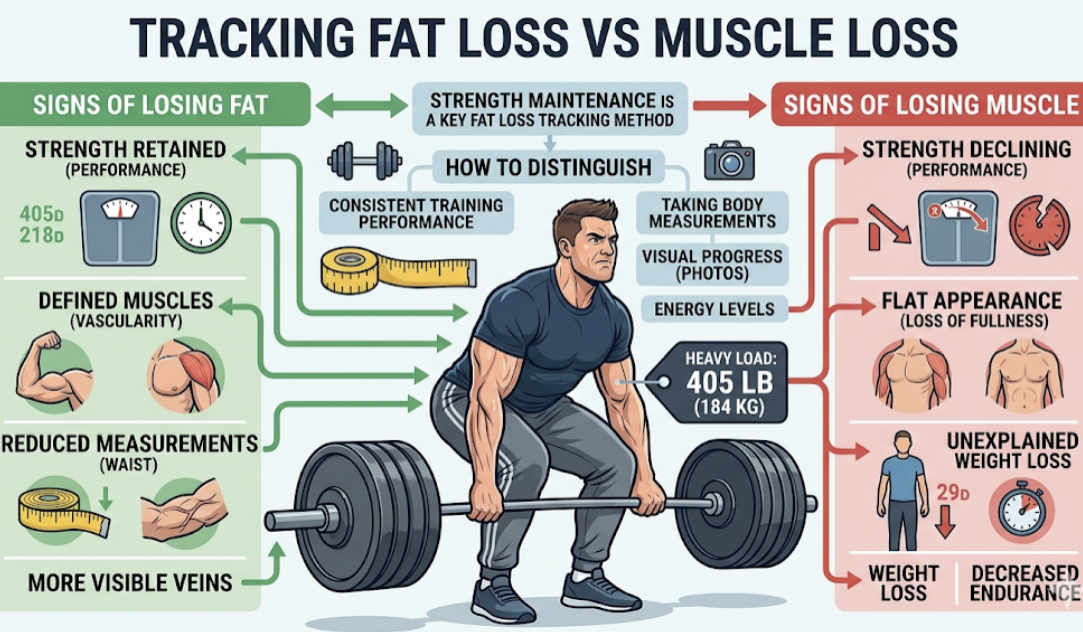
How do I know if I’m losing fat and not muscle? Here are the clearest fat loss progress signs: strength is maintained or improving, your body looks leaner (more definition), waist and hip measurements decrease, weight loss is slow and steady (0.5-1% body weight weekly), your muscles still feel full and firm, and you have stable energy levels.
2. The Science: Fat Loss vs Muscle Loss Physiology
To identify losing fat vs muscle signs, you must understand the biological difference between adipose tissue and muscle tissue during caloric restriction.
- Fat loss: Adipocytes release stored triglycerides as free fatty acids for energy. This occurs when you maintain a moderate deficit and adequate protein intake.
- Muscle loss: Myofibrillar proteins break down when energy deficit is too severe, protein intake insufficient, or resistance training absent (Carbone et al., 2019).
Research shows that muscle protein synthesis (MPS) decreases during calorie restriction, but adequate protein and training can maintain MPS near baseline (Hector et al., 2015). This is why fat loss tracking methods must include strength and measurement data, not just weight.
📊 Fat Loss vs Muscle Loss: Key Differences
| Indicator | Fat Loss (Good) | Muscle Loss (Bad) | What to Do |
|---|---|---|---|
| Strength level | Maintained or increasing | Decreasing (10%+ drop) | Increase protein, reduce deficit |
| Muscle fullness | Muscles feel firm/full | Flat, deflated appearance | Check carbs and hydration |
| Waist measurement | Decreasing (0.5-1" monthly) | Stable or increasing | Continue current plan |
| Energy levels | Stable, good workouts | Chronic fatigue, poor recovery | Take a diet break |
| Weight loss rate | 0.5-1% body weight weekly | 1.5%+ body weight weekly | Increase calories by 200-300 |
3. Top 7 Signs You Are Losing Fat (Not Muscle)
Sign #1: Your Strength Is Maintaining or Improving
The single most reliable cutting progress indicator is strength. If you can lift the same weight (or more) while in a calorie deficit, you are preserving muscle. A 2016 study by Garthe et al. found that athletes who maintained strength during cutting lost 80% less muscle than those who lost strength.
Sign #2: Your Waist Measurement Is Decreasing
Waist circumference is the best proxy for visceral fat loss. Measure weekly at the navel. A decrease of 0.5-1 inch per month indicates healthy fat loss progress signs. If waist drops but scale weight stays same, you are experiencing body recomposition.
Sign #3: You See More Muscle Definition
Visible veins, muscle striations, or clearer separation between muscle groups (e.g., deltoids from biceps) indicate subcutaneous fat reduction. This is one of the most satisfying signs of fat loss not muscle loss.
Sign #4: Your Clothes Fit Looser, Especially Around Waist
Your belt needs a new notch. Pants feel looser. Shirts fit better around arms and shoulders but looser around midsection. This indicates you are losing fat vs muscle signs favor fat loss.
Sign #5: Weight Loss Is Slow and Steady (0.5-1% Weekly)
Rapid weight loss (over 1.5% body weight weekly) almost always includes significant muscle loss (Helms et al., 2014). Aim for 0.5-1% weekly for muscle-sparing fat loss.
Sign #6: Your Muscles Still Feel Full and Firm
Muscle glycogen depletion causes flat, deflated muscles. If your muscles feel full despite a deficit, you are likely preserving muscle tissue and maintaining adequate carbohydrate intake.
Sign #7: You Have Stable Energy and Good Workouts
Chronic fatigue, brain fog, and poor workout performance are signs of losing muscle, not fat. Stable energy indicates your deficit is appropriate.
4. Fat Loss Tracking Methods: What Actually Works
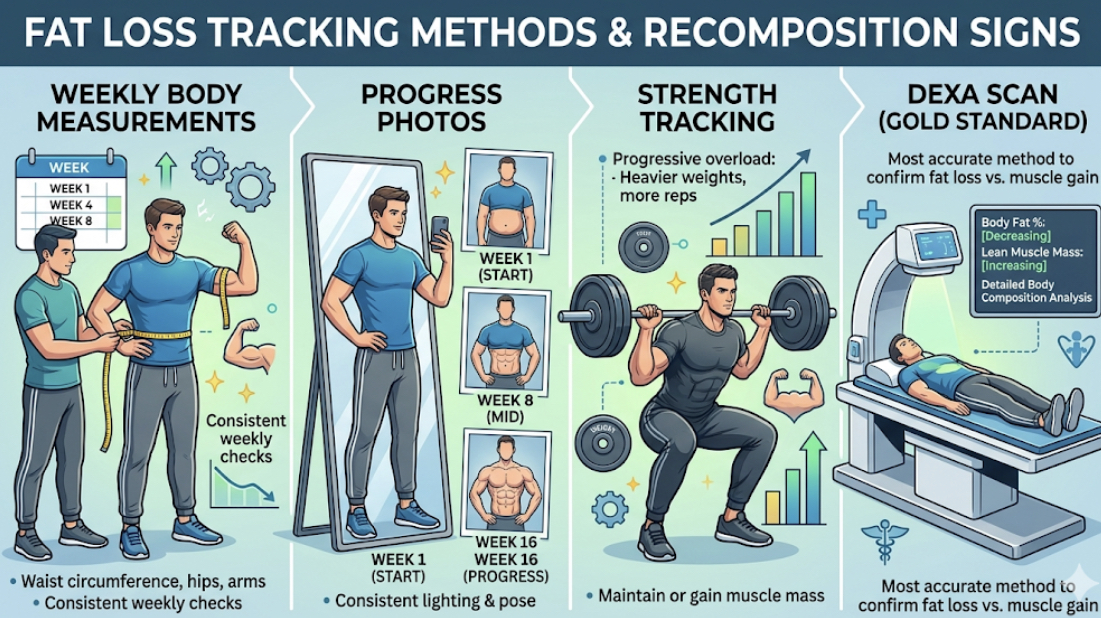
Not all fat loss tracking methods are equal. Here is the hierarchy from most to least reliable:
Most Reliable Methods
- Weekly waist and hip measurements: Most accurate for tracking fat loss (0.5-1% accuracy)
- Progress photos (same lighting, pose, clothing): Visual confirmation every 2-4 weeks
- Strength tracking: If strength holds, muscle is preserved
- DEXA scan (every 8-12 weeks): Gold standard for body composition
Moderately Reliable Methods
- Body fat calipers (7-site measurement): Good for trends, accuracy ±3-4%
- How clothes fit: Subjective but practical
- Bioelectrical impedance scales: Not accurate for absolute values, okay for trends
Least Reliable Methods
- Daily scale weight: Fluctuates 2-5 lbs from water, food, hormones
- BMI: Does not distinguish fat from muscle
- Single-site caliper measurement: Poor accuracy
5. Sample Meal Plan to Preserve Muscle During Fat Loss
Sample Day (2,100 kcal, 170g Protein, 220g Carbs, 60g Fat)
- Breakfast (7:00 AM): 4 eggs + 1.5 cups oatmeal + 1/2 cup berries + 1 tbsp honey (600 kcal, 40g protein)
- Lunch (12:00 PM): 170g chicken breast + 1.5 cups jasmine rice + 2 cups mixed vegetables (550 kcal, 50g protein)
- Pre-workout Snack (3:00 PM): 1 banana + 1 scoop whey (250 kcal, 25g protein)
- Dinner (7:00 PM): 170g lean beef or salmon + 300g sweet potato + 2 cups asparagus + 1 tbsp olive oil (600 kcal, 45g protein)
- Evening Snack (9:00 PM): 1 cup Greek yogurt + 1 tbsp peanut butter (250 kcal, 20g protein)
Vegan Body Recomposition Meal Plan
- Breakfast: 1.5 cups tofu scramble + 1.5 cups oats + 1 cup soy milk (550 kcal, 45g protein)
- Lunch: 200g tempeh + 1.5 cups quinoa + 2 cups roasted broccoli (550 kcal, 50g protein)
- Dinner: 1.5 cups lentils + 2 cups brown rice + 2 cups spinach + avocado (600 kcal, 40g protein)
- Protein target: 160-170g from tofu, tempeh, seitan, lentils, pea protein
Vegetarian Cutting Meal Plan
- Breakfast: 4 eggs + 1.5 cups cottage cheese + 1 cup oats (600 kcal, 55g protein)
- Lunch: 200g paneer or halloumi + 1.5 cups quinoa + vegetables (550 kcal, 45g protein)
- Dinner: 2 scoops whey + 1 cup Greek yogurt + 1 cup berries (400 kcal, 50g protein)
Gluten-Free Fat Loss Meal Plan
- Carb sources: Rice, quinoa, buckwheat, sweet potatoes, gluten-free oats, corn
- Sample meal: 170g chicken + 1.5 cups quinoa + 2 cups roasted vegetables + avocado (550 kcal, 50g protein)
6. Red Flags: Signs You Are Losing Muscle Instead of Fat
- Strength drops significantly (10%+ on major lifts over 2-4 weeks)
- Muscles look flat, deflated, or smaller despite similar body weight
- Weight loss exceeds 1.5% body weight weekly for more than 2 weeks
- Chronic fatigue, poor sleep, low libido
- Poor workout recovery – muscles stay sore for 3+ days
- Hair thinning or nail brittleness (advanced signs)
If you experience these signs of losing muscle, immediately: increase calories by 200-300 daily, increase protein to 2.5-3.0 g/kg, reduce cardio, and consider a 1-2 week diet break.
7. Body Recomposition: When You Lose Fat and Gain Muscle Simultaneously
Body recomposition signs include: scale weight stays stable, waist measurement decreases, strength increases, and you look leaner. This is ideal progress, especially for beginners, detrained individuals, or those returning from a diet break (Barakat et al., 2020).
Body recomposition occurs when you are in a slight deficit (200-300 calories) or maintenance with high protein (2.4-2.8 g/kg) and progressive overload training. During this phase, how to know if you are losing fat becomes tricky because scale weight doesn't change – this is where measurements and photos become essential.
8. Weekly Progress Tracking Template
Use this fat loss tracking methods template every week:
- Monday morning (fasted): Scale weight, waist measurement (navel), hip measurement
- Monday (during workout): Test strength on squat, bench press, or deadlift
- Every 2 weeks: Progress photos (front, side, back, same lighting and clothing)
- Every 4 weeks: Body fat caliper measurement (7-site) or DEXA scan
- Daily (optional): Energy level (1-10), hunger rating (1-10), sleep quality (1-10)
9. Frequently Asked Questions
How do I know if I'm losing fat and not muscle?
Key signs you are losing fat not muscle include: strength is maintained or improving, body looks leaner, waist measurements decrease, slow steady weight loss (0.5-1% body weight per week), muscles still feel full, and you see more muscle definition without losing size.
What are the signs of losing fat vs muscle?
Signs of losing fat: waist measurement decreases, clothes fit looser, more muscle definition, stable or increasing strength. Signs of losing muscle: strength decreases, muscles look flatter or smaller, fatigue increases, weight loss exceeds 1.5% body weight weekly, poor recovery.
How can I track fat loss progress accurately?
Best fat loss tracking methods: weekly waist and hip measurements (most accurate), progress photos (same lighting/pose every 2 weeks), strength tracking (if strength holds, you're preserving muscle), body fat calipers or DEXA scans, and how clothes fit. Avoid daily weigh-ins as they fluctuate.
Can you lose fat without losing muscle?
Yes, you can lose fat without losing muscle through: moderate calorie deficit (300-500 below maintenance), high protein intake (2.2-2.8 g/kg body weight), strength training 3-4 times weekly, adequate sleep (7-9 hours), and not cutting for more than 16 weeks without a diet break.
Why is my weight not changing but I look leaner?
This is called body recomposition – you are losing fat and gaining muscle simultaneously. Muscle is denser than fat, so you look leaner and measurements decrease even if scale weight stays the same. This is ideal progress. Focus on measurements, photos, and strength gains rather than scale weight.
How often should I take progress photos?
Take progress photos every 2-4 weeks under identical conditions: same time of day (morning fasted), same lighting, same poses (front, side, back), same clothing (underwear or swimsuit). Weekly photos show too little change and may cause unnecessary anxiety.
10. Related Resources
- Best Evening Habits for Fat Loss (Simple Night Routine That Works)
- How to Burn More Calories Without Cardio (Simple Fat Loss Strategies)
- Why You Lose Weight Then Gain It Back Quickly (Yo-Yo Dieting Explained)
- How to Avoid Binge Eating During Fat Loss (Control Cravings & Stay on Track)
- Does Drinking Water Help You Lose Fat Faster? (Science-Based Answer)
- How to Reduce Cravings While Dieting (Control Hunger & Stay Consistent)
11. Scientific References
- Helms, E. R., et al. (2014). Evidence-based recommendations for natural bodybuilding contest preparation. Journal of the International Society of Sports Nutrition, 11(1), 20. PubMed
- Carbone, J. W., et al. (2019). Dietary protein and muscle mass: translating science to application. Nutrition Reviews, 77(9), 637-651. PubMed
- Hector, A. J., et al. (2015). Protein supplementation augments muscle fiber hypertrophy but does not modulate satellite cell content during prolonged resistance training. American Journal of Physiology, 309(1), E72-E83. PubMed
- Garthe, I., et al. (2018). Effect of two different weight-loss rates on body composition and strength and power-related performance in elite athletes. International Journal of Sport Nutrition and Exercise Metabolism, 28(5), 466-474. PubMed
- Barakat, C., et al. (2020). Body recomposition: can trained individuals build muscle and lose fat at the same time? Strength and Conditioning Journal, 42(5), 7-21. PubMed
- Morton, R. W., et al. (2018). A systematic review, meta-analysis and meta-regression of the effect of protein supplementation on resistance training-induced gains in muscle mass and strength. British Journal of Sports Medicine, 52(6), 376-384. PubMed
Join the conversation