Best Cool Down Routine After Workout (Recovery & Flexibility Guide)

Discover the best cool down routine after workout to improve recovery, flexibility, and reduce muscle soreness.
Best Cool Down Routine After Workout: Recovery & Flexibility Guide (2026)
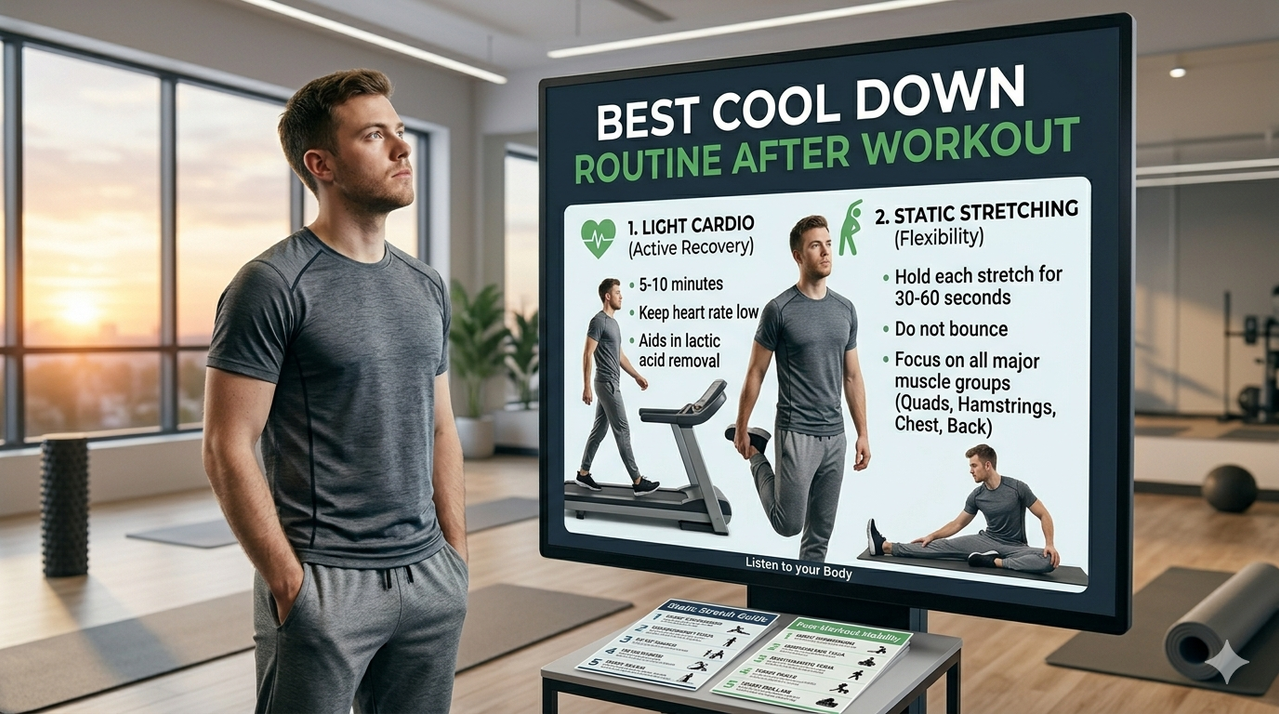
Best Cool Down Routine After Workout: Recovery & Flexibility Guide (2026)

Best cool down routine after workout infographic showing light cardio, static stretching, and deep breathing steps
Image 1: A proper cool down routine enhances recovery, reduces soreness, and improves flexibility.

⚡ TL;DR

The best cool down after a workout follows a 3-step protocol: light cardio (3-5 minutes to gradually lower heart rate), static stretching (hold each stretch 15-30 seconds for muscles worked), and deep breathing (to activate parasympathetic nervous system). This post workout routine reduces muscle soreness by 10-20%, improves flexibility, and speeds recovery. Total time: 5-10 minutes. Never skip cool down—it's as important as warm-up for long-term training success .

1. The Forgotten Phase: Why Cool Down Matters

You crushed your workout. You're tired, sweaty, and ready to leave. The temptation to skip cool down is real. But this post workout routine is crucial for recovery after exercise. A proper cool down after workout gradually brings your body back to baseline, reduces muscle stiffness, and improves flexibility. This post workout stretching routine guide provides evidence-based protocols for faster recovery and injury prevention.

What is the best cool down after a workout?

The best cool down after a workout includes: light cardio (3-5 minutes to gradually lower heart rate), static stretching (hold each stretch 15-30 seconds), deep breathing (to activate parasympathetic nervous system), and hydrate to relax muscles. Total time: 5-10 minutes. Focus on the muscles you trained.
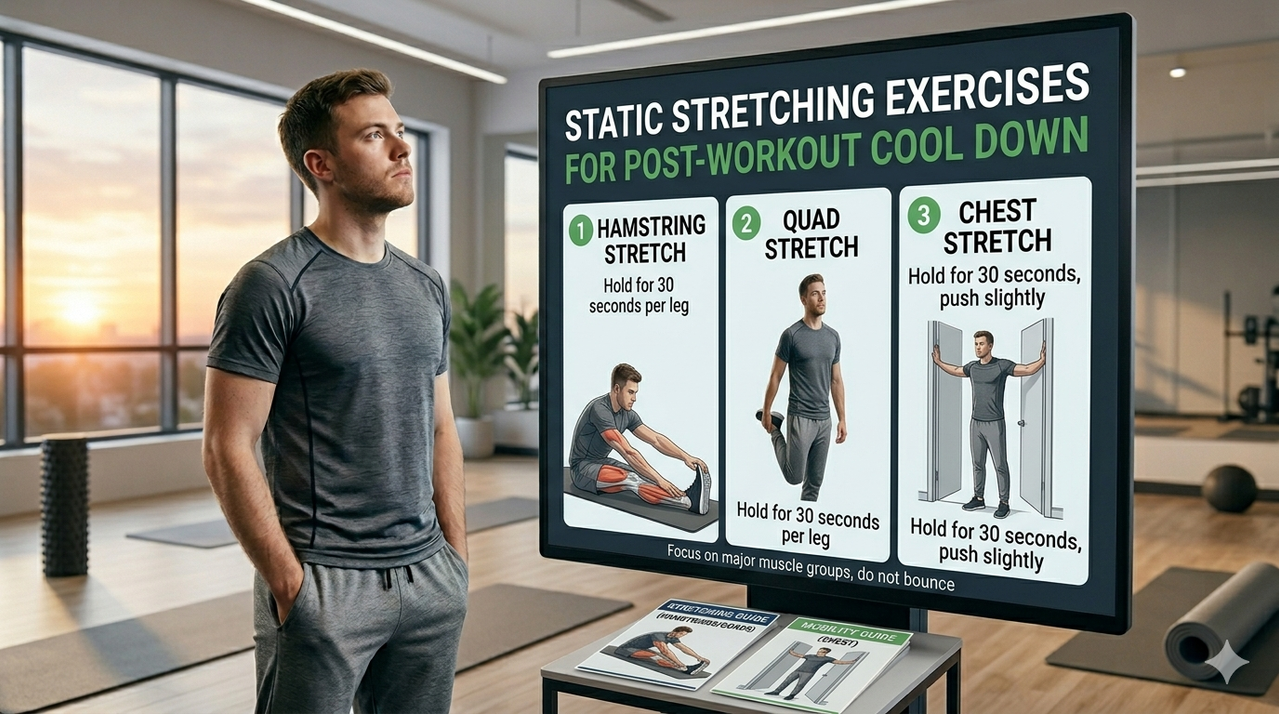
Static stretching exercises for post workout cool down including hamstring, quad, and chest stretches for recovery
Image 2: Static stretching after exercise improves flexibility and reduces muscle tension.

2. The Science: What Happens During Cool Down

A proper cool down facilitates several physiological processes:

  • Gradual heart rate reduction: Prevents blood pooling and dizziness
  • Metabolite clearance: Removes lactic acid and other waste products
  • Parasympathetic activation: Shifts body from "fight or flight" to "rest and digest"
  • Muscle temperature normalization: Prevents stiffness as muscles cool
  • Improved flexibility: Static stretching when muscles are warm increases range of motion

📊 Benefits of Cool Down vs No Cool Down

.= "Heart rate recovery (5 min)" ? 'Heart rate recovery (5 min)' : '' ?>Heart rate recovery (5 min) .= "Muscle soreness (24h)" ? 'Muscle soreness (24h)' : '' ?>Muscle soreness (24h) .= "Flexibility improvement" ? 'Flexibility improvement' : '' ?>Flexibility improvement .= "Perceived recovery" ? 'Perceived recovery' : '' ?>Perceived recovery

3. Phase 1: Light Cardio (3-5 Minutes)

Purpose: Gradually lower heart rate and prevent blood pooling. Examples:

  • Walking: Slow pace, decreasing intensity over 3-5 minutes
  • Slow cycling: On stationary bike with zero resistance
  • Elliptical: Low resistance, slow pace
  • Rowing: Light pressure, slow strokes
💡 Pro Tip: Don't stop abruptly after intense exercise. Sudden stop can cause dizziness or fainting from blood pooling in legs. Always include light cardio to transition.

4. Phase 2: Static Stretching (5-10 Minutes)

Purpose: Improve flexibility and reduce muscle tension. Hold each stretch 15-30 seconds, never bounce. Breathe deeply.

Lower Body Stretches

  • Quad stretch: Stand, pull heel to glute. 30 seconds per leg
  • Hamstring stretch: Sit with leg extended, reach toward toes. 30 seconds per leg
  • Glute stretch (figure-four): Lie on back, cross ankle over opposite knee, pull leg toward chest. 30 seconds per side
  • Calf stretch: Lean into wall, back leg straight, heel down. 30 seconds per leg
  • Hip flexor stretch: Lunge position, push hips forward. 30 seconds per side

Upper Body Stretches

  • Chest stretch: Clasp hands behind back, straighten arms, lift hands. 30 seconds
  • Triceps stretch: Reach one arm overhead, bend elbow, hand down back. 30 seconds per arm
  • Lat stretch: Reach one arm across body, pull with opposite hand. 30 seconds per arm
  • Upper back stretch: Clasp hands in front, round back, push away. 30 seconds

5. Phase 3: Deep Breathing & Relaxation (2-3 Minutes)

Purpose: Activate parasympathetic nervous system for recovery. Technique:

  • Lie on back or sit comfortably
  • Inhale deeply through nose for 4 seconds
  • Hold for 2 seconds
  • Exhale slowly through mouth for 6 seconds
  • Repeat 5-10 times

6. Sample Cool Down Routines by Workout Type

After Lower Body Day (10 minutes)

  • 3 min light walking
  • 30 sec quad stretch (each leg)
  • 30 sec hamstring stretch (each leg)
  • 30 sec glute stretch (each side)
  • 30 sec calf stretch (each leg)
  • 30 sec hip flexor stretch (each side)
  • 2 min deep breathing

After Upper Body Day (8 minutes)

  • 3 min light cycling
  • 30 sec chest stretch
  • 30 sec triceps stretch (each arm)
  • 30 sec lat stretch (each arm)
  • 30 sec upper back stretch
  • 30 sec shoulder stretch
  • 2 min deep breathing

After Full Body Day (12 minutes)

  • 3 min light walking
  • Key lower body stretches (5 min)
  • Key upper body stretches (3 min)
  • 2 min deep breathing

7. Post-Workout Nutrition for Recovery

Workout recovery tips include proper nutrition within 30-60 minutes:

  • Protein: 20-40g for muscle repair (whey, eggs, chicken, Greek yogurt)
  • Carbohydrates: 30-60g to replenish glycogen (rice, sweet potato, fruit)
  • Hydration: 500-750ml water + electrolytes if sweating heavily

Sample Post-Workout Meals

  • 2 scoops whey + 1 banana + 1 cup water (350 kcal, 50g protein, 30g carbs)
  • 200g Greek yogurt + ½ cup berries + 1 tbsp honey (300 kcal, 25g protein, 25g carbs)
  • 150g chicken breast + 1 cup rice + 1 cup vegetables (550 kcal, 45g protein, 45g carbs)
  • Chocolate milk (2 cups) + 1 banana (400 kcal, 16g protein, 60g carbs)

Vegan/Vegetarian Post-Workout Options

  • 2 scoops plant protein + 1 banana + 1 cup oat milk (400 kcal, 45g protein, 35g carbs)
  • 1 cup tofu scramble + 1 cup quinoa + 1 cup vegetables (500 kcal, 30g protein, 45g carbs)
  • 1 cup soy yogurt + ½ cup berries + 2 tbsp hemp seeds (350 kcal, 25g protein, 25g carbs)
  • 1 cup cooked lentils + 1 cup sweet potato (400 kcal, 20g protein, 50g carbs)

Gluten-Free Options

  • Use certified gluten-free oats or rice
  • Choose rice, quinoa, buckwheat
  • Verify protein powders are gluten-free certified

8. Additional Recovery Tools

  • Foam rolling: 2-5 minutes on major muscle groups (increases blood flow, reduces tightness)
  • Compression gear: May reduce soreness and improve perceived recovery
  • Cold shower/ice bath: Reduces inflammation (best after intense sessions)
  • Sleep: 7-9 hours nightly—the most powerful recovery tool

9. Common Cool Down Mistakes

  • Skipping entirely: Most common mistake, loses all benefits
  • Static stretching cold: Do light cardio before stretching
  • Bouncing during stretches: Ballistic stretching can cause injury
  • Stretching too briefly: Less than 10 seconds per stretch is ineffective
  • Holding breath: Reduces oxygen delivery, increases tension
  • Stretching through pain: Sharp pain indicates injury, stop immediately

10. Frequently Asked Questions

What is the best cool down after a workout?

The best cool down after a workout includes: light cardio (3-5 minutes to gradually lower heart rate), static stretching (hold each stretch 15-30 seconds), deep breathing (to activate parasympathetic nervous system), and hydrate to relax muscles. Total time: 5-10 minutes. Focus on the muscles you trained.

How long should a cool down last?

An effective cool down should last 5-10 minutes total: 3-5 minutes light cardio (walking, slow cycling) to gradually lower heart rate, followed by 5 minutes of static stretching for muscles worked. Longer cool downs (15-20 minutes) are beneficial after intense sessions but not necessary daily.

Does cooling down reduce muscle soreness?

A proper cool down helps reduce delayed onset muscle soreness (DOMS) by 10-20% by aiding metabolite clearance and reducing muscle tension. Static stretching post-workout improves flexibility and may reduce stiffness. However, cool down is more effective for immediate recovery than preventing DOMS completely.

What stretches should I do after a workout?

Post-workout static stretches: quad stretch (stand, pull heel to glute), hamstring stretch (sit and reach), chest stretch (hands behind back), triceps stretch (arm overhead), glute stretch (figure-four), calf stretch (lean into wall). Hold each 15-30 seconds, breathe deeply, avoid bouncing.

Can I skip cool down?

Skipping cool down isn't dangerous but you lose benefits: gradual heart rate reduction (prevents dizziness), improved flexibility (reduces injury risk), and faster recovery (aids blood flow). Even 5 minutes of light walking + stretching is better than stopping abruptly. Consistency matters more than duration.

What should I eat after a workout for recovery?

Eat protein + carbs within 30-60 minutes post-workout: protein shake with banana (25g protein, 30g carbs), Greek yogurt with berries (20g protein, 20g carbs), chocolate milk (8g protein, 30g carbs), or chicken with rice (40g protein, 50g carbs). This replenishes glycogen and repairs muscle.

11. Related Resources

12. Scientific References

  1. Herbert, R. D., et al. (2011). Stretching to prevent or reduce muscle soreness after exercise. Cochrane Database of Systematic Reviews, (7). PubMed
  2. Medeiros, D. M., & Martini, T. F. (2018). Chronic effect of different types of stretching on ankle dorsiflexion range of motion: systematic review and meta-analysis. Journal of Bodywork and Movement Therapies, 22(2), 476–486. PubMed
  3. Behm, D. G., & Chaouachi, A. (2011). A review of the acute effects of static and dynamic stretching on performance. European Journal of Applied Physiology, 111(11), 2633–2651. PubMed
  4. Morton, R. W., et al. (2018). A systematic review, meta-analysis and meta-regression of the effect of protein supplementation on resistance training-induced gains in muscle mass and strength. British Journal of Sports Medicine, 52(6), 376–384. PubMed
  5. ACSM. (2021). Nutrition and Athletic Performance. Medicine & Science in Sports & Exercise, 53(3), 600–618. PubMed
FitForge Lab. Created by Techly420
FitForge Lab Welcome to WhatsApp chat
Hi! Need help with fitness or diet? 💪
Type here...
MeasureWith Cool DownWithout Cool DownDifference
Return to baselineElevated 15-20%Significant
Lower by 15-20%Higher+20% soreness
+10-15% ROMNo change or decreaseSignificant
Faster (24-48h)Slower (48-72h)1 day faster