Best Exercises for Each Muscle Group at Home (Full Body Guide)
Best Exercises for Each Muscle Group at Home: Full Body Guide (2026)
⚡ TL;DR
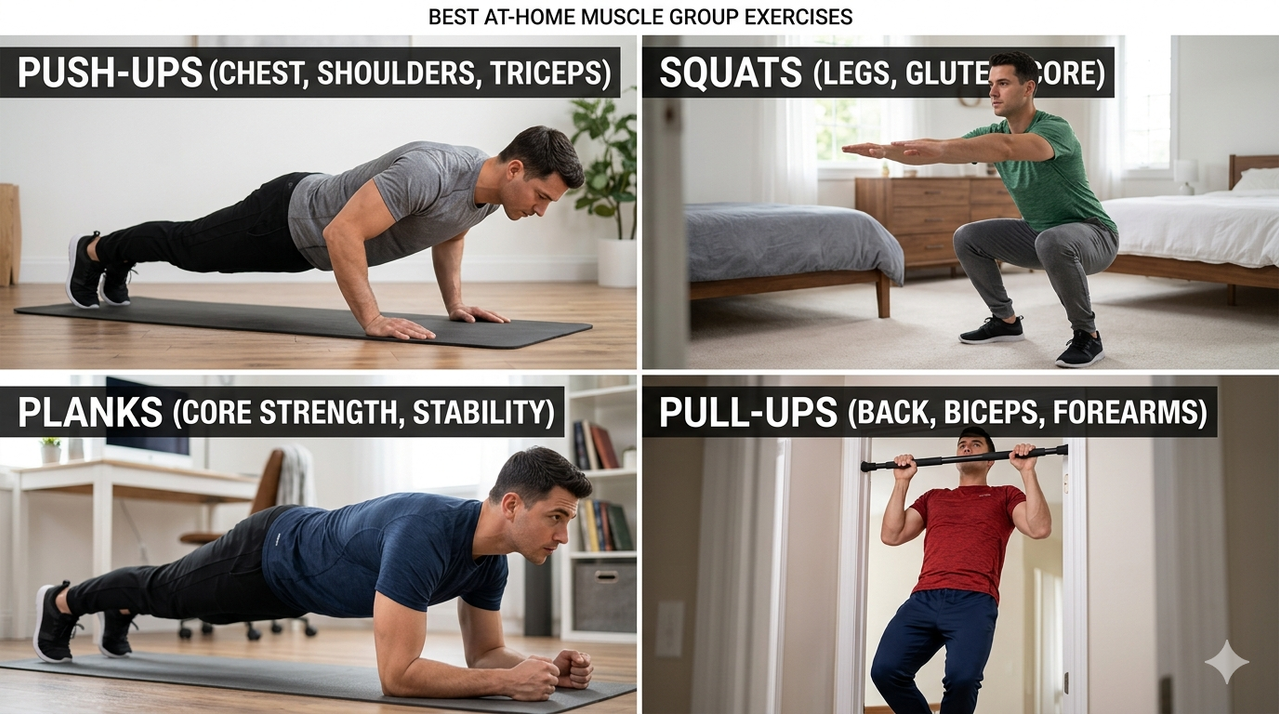
The best exercises for each muscle group at home require no equipment: Chest (push-ups), Back (inverted rows using a table), Legs (squats, lunges), Shoulders (pike push-ups), Arms (chair dips, triceps push-ups), Core (plank, leg raises). This home workout full body guide covers beginner to advanced variations, rep ranges, and sample routines. Bodyweight exercises for all muscles can build significant muscle when combined with progressive overload (adding reps, sets, or difficulty). Train each muscle group 2-3 times weekly for best results .
1. The Home Workout Revolution
Gym not accessible? No equipment? No problem. Learning exercises for each muscle group at home empowers you to build muscle anywhere. Bodyweight training, when done with progressive overload, can produce impressive results. This full body workout at home guide covers every major muscle group—chest, back, legs, shoulders, arms, and core—using only your bodyweight and common household items. Whether you're a beginner or advanced, these best home exercises no equipment will help you build a balanced physique.
What are the best exercises for each muscle group at home?
🔹 Chest
push-ups (standard, incline, decline, diamond)
🔹 Back
pull-ups (if bar available) or inverted rows (using table), towel rows
🔹 Legs
squats, lunges, Bulgarian split squats, glute bridges
🔹 Shoulders
pike push-ups, handstand push-ups (advanced)
🔹 Arms
dips (using chair), triceps push-ups, chin-ups for biceps
🔹 Core
plank, side plank, leg raises, Russian twists
2. Chest Exercises at Home
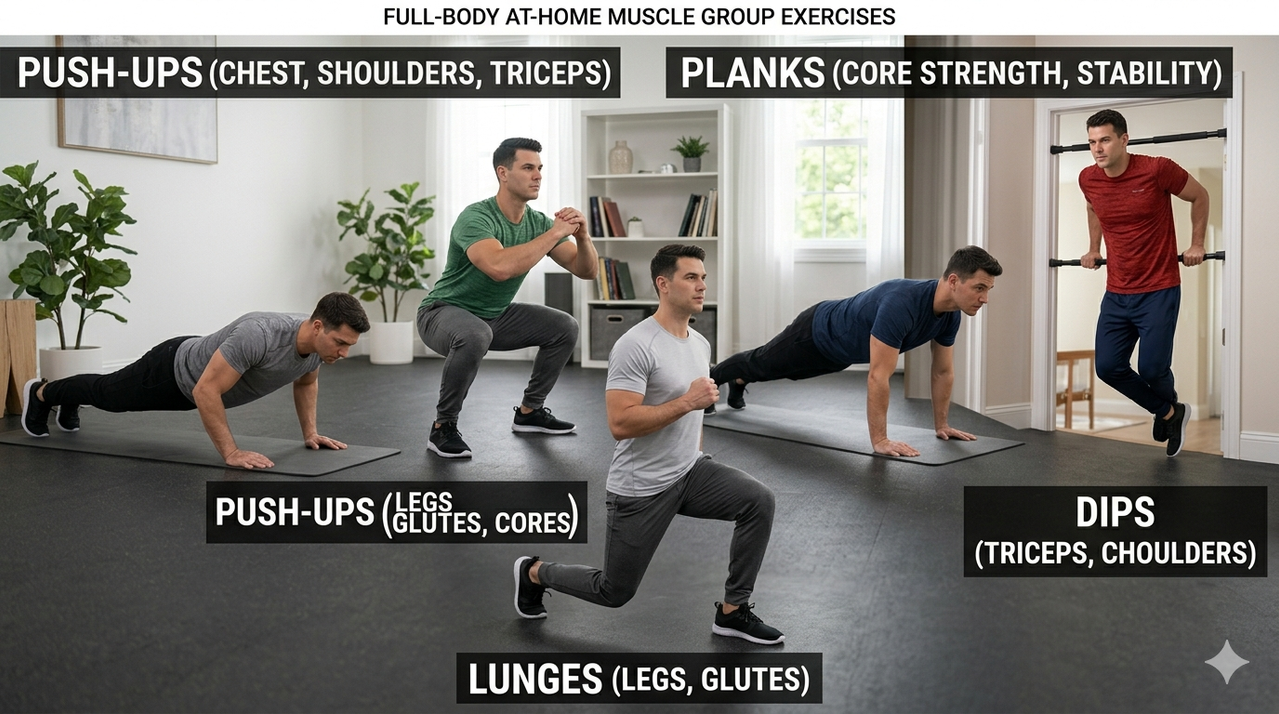
The push-up is the king of chest exercises. Variations increase difficulty:
- Standard push-up: 3 sets × 10-15 reps
- Incline push-up (hands on elevated surface): Easier, good for beginners
- Decline push-up (feet elevated): More upper chest activation
- Diamond push-up (hands together): Emphasizes triceps and inner chest
- Archer push-up: Advanced, one-arm emphasis
3. Back Exercises at Home
The back is hardest to train without equipment, but possible:
- Inverted rows (using a sturdy table): Lie under a table, grab the edge, pull chest to table. 3 sets × 8-12 reps
- Towel rows: Loop a towel over a door, pull as if rowing. 3 sets × 10-15 reps
- Pull-ups (if you have a bar): Best back exercise. 3 sets × max reps
- Superman holds: Lie face down, lift arms and legs. 3 sets × 30-60 sec
4. Leg Exercises at Home
Legs are easy to train with bodyweight:
- Squats: 3 sets × 15-20 reps
- Lunges (forward, reverse, walking): 3 sets × 10-12 reps per leg
- Bulgarian split squats: Rear foot elevated on chair. 3 sets × 8-12 reps/leg
- Glute bridges: 3 sets × 15-20 reps
- Pistol squats (advanced): Single-leg squat. 3 sets × 5-8 reps/leg
5. Shoulder Exercises at Home
- Pike push-ups: Hips up, form an inverted V, lower head toward ground. 3 sets × 8-12 reps
- Handstand push-ups (advanced): Against a wall. 3 sets × 3-8 reps
- Lateral raises with resistance band (if available)
- Plank shoulder taps: 3 sets × 30 sec
6. Arm Exercises at Home
- Triceps dips (using chair): 3 sets × 10-15 reps
- Diamond push-ups: 3 sets × 8-12 reps
- Close-grip push-ups: 3 sets × 10-15 reps
- Chin-ups (if bar available): 3 sets × max reps (biceps focus)
- Towel curls: Step on a towel, curl up. 3 sets × 12-15 reps
7. Core Exercises at Home
- Plank: 3 sets × 30-60 seconds
- Side plank: 3 sets × 20-40 seconds per side
- Leg raises: 3 sets × 12-15 reps
- Russian twists: 3 sets × 15-20 reps
- Bicycle crunches: 3 sets × 15-20 reps
- Hollow body hold: 3 sets × 20-40 seconds
8. Sample Full Body Home Workout Routine
Beginner Routine (3 days/week)
- Bodyweight squats: 3×15
- Push-ups (incline if needed): 3×10
- Inverted rows (table): 3×8
- Plank: 3×30 seconds
- Glute bridges: 3×15
- Rest 60 seconds between sets. Workout time: 30-40 minutes.
Intermediate Routine (4 days/week - Upper/Lower Split)
Upper Body Day: Push-ups 4×12, Pike push-ups 3×10, Inverted rows 4×10, Dips 3×12, Plank 3×45 sec
Lower Body Day: Bulgarian split squats 3×10/leg, Lunges 3×12/leg, Glute bridges 4×15, Leg raises 3×15
9. Progressive Overload Without Equipment
To build muscle, you must increase difficulty over time. Methods for train all muscle groups at home progression:
- Increase reps: 10 → 12 → 15 → 20
- Increase sets: 3 → 4 → 5 sets
- Slow tempo: 3-5 second lowering phase
- Add pauses: 1-2 seconds at hardest point
- Advance variations: Push-up → decline push-up → archer push-up
- Add weight: Backpack with books or water bottles
10. Nutrition for Home Workout Success
To support muscle growth from home training:
- Protein: 1.6-2.2 g per kg body weight
- Calories: Slight surplus for muscle gain (250-500 kcal above maintenance)
- Hydration: 2.5-3.5 liters water daily
Sample Meal Plan (2,200 kcal, 140g Protein)
- Breakfast: 3 eggs, 1 cup oats, 1 banana (550 kcal, 30g protein)
- Lunch: 150g chicken breast, 1.5 cups rice, 1 cup broccoli (550 kcal, 40g protein)
- Snack: 170g Greek yogurt, 1 apple (200 kcal, 18g protein)
- Dinner: 150g tofu or tempeh, 1.5 cups sweet potato, 2 cups spinach (550 kcal, 35g protein)
- Post-workout: 1 scoop plant protein, 1 banana (200 kcal, 20g protein)
- Total: ~2,050 kcal, ~143g protein
Gluten-Free Options
- Use certified gluten-free oats
- Choose rice, quinoa, buckwheat
- Verify protein sources are gluten-free certified
11. Common Mistakes When Working Out at Home
- No progressive overload: Doing same reps every workout leads to plateaus
- Poor form: Without mirrors or coaches, form can suffer—record yourself
- Skipping legs: Don't neglect lower body training
- Inconsistent schedule: Treat home workouts like gym appointments
- Not warming up: 5-10 minutes dynamic stretching prevents injury
12. Frequently Asked Questions
What are the best exercises for each muscle group at home?
🔹 Chest: push-ups (standard, incline, decline, diamond)
🔹 Back: pull-ups (if bar available) or inverted rows (using table), towel rows
🔹 Legs: squats, lunges, Bulgarian split squats, glute bridges
🔹 Shoulders: pike push-ups, handstand push-ups (advanced)
🔹 Arms: dips (using chair), triceps push-ups, chin-ups for biceps
🔹 Core: plank, side plank, leg raises, Russian twists
Can I build muscle with bodyweight exercises at home?
Yes, bodyweight exercises can build significant muscle when combined with progressive overload. Increase difficulty by adding reps, sets, slowing tempo, or advancing variations (e.g., decline push-ups, pistol squats, archer pull-ups). Research shows bodyweight training produces comparable hypertrophy to weighted exercises when intensity is matched.
How many sets and reps should I do at home?
For muscle growth, aim for 8-15 reps per set, 3-4 sets per exercise. Perform each set close to failure (last 1-3 reps challenging). Train each muscle group 2-3 times per week. Beginners start with 2 sets, advanced can do 4-5 sets.
How can I progress without weights at home?
Progress without weights by: increasing reps (e.g., 10 to 15 reps), increasing sets (3 to 5 sets), slowing tempo (3-5 second lowering), adding pauses (1-2 seconds at hardest point), advancing variations (push-up → decline push-up → archer push-up), or adding resistance with a backpack full of books.
What is the best home workout schedule?
For beginners: full body 3 days/week (e.g., Monday, Wednesday, Friday). For intermediates: upper/lower split 4 days/week. Sample schedule: Day 1 upper body, Day 2 lower body + core, Day 3 rest, Day 4 upper body, Day 5 lower body, Weekend rest.
Do I need equipment to hit all muscle groups?
No, you can hit all major muscle groups with bodyweight exercises. However, a pull-up bar ($20-40) significantly improves back development. Resistance bands are affordable options that add variety. Without equipment, focus on push-ups (chest), rows using table (back), squats/lunges (legs), pike push-ups (shoulders), dips (triceps), and planks (core).
13. Related Resources
- Best Rest Time Between Sets for Muscle Growth (Science-Based Guide)
- How Long Should a Workout Session Be? (Optimal Training Time Guide)
- How to Train Each Muscle Group Correctly (Complete Workout Guide)
- Beginner Mistakes in Workout Programs (Avoid These Common Errors)
- How Many Sets and Reps for Muscle Growth? (Optimal Training Guide)
- Best Weekly Workout Split for Beginners (Simple Training Plan)
14. Scientific References
- Calatayud, J., et al. (2015). Muscle activity during push-ups with different suspension training systems. Journal of Sports Science & Medicine, 14(3), 502–508. PubMed
- Kikuchi, N., & Nakazato, K. (2017). Low-load bench press and push-up induce similar muscle hypertrophy and strength gains. Journal of Sports Science & Medicine, 16(3), 344–350. PubMed
- Schoenfeld, B. J., et al. (2017). Effects of different weekly sets-equated resistance training frequencies on muscular strength, muscle hypertrophy, and body composition. Journal of Strength and Conditioning Research, 31(12), 3271–3278. PubMed
- Morton, R. W., et al. (2018). A systematic review, meta-analysis and meta-regression of the effect of protein supplementation on resistance training-induced gains in muscle mass and strength. British Journal of Sports Medicine, 52(6), 376–384. PubMed
- ACSM. (2021). Nutrition and Athletic Performance. Medicine & Science in Sports & Exercise, 53(3), 600–618. PubMed
Join the conversation