Best Warm-Up Routine Before Workout (Improve Performance & Prevent Injuries)
Best Warm-Up Routine Before Workout: Improve Performance & Prevent Injuries (2026)
⚡ TL;DR
The best warm-up routine before workout follows a 3-phase structure: light cardio (5 minutes to increase heart rate), dynamic stretching (5 minutes of leg swings, arm circles, torso twists), and warm-up sets (50%, 70%, 85% of working weight). This injury prevention warm-up increases muscle temperature, blood flow, and joint mobility while activating the nervous system. A proper pre-workout warm-up improves performance by 10-20% and reduces injury risk by up to 50% . Total time: 10-15 minutes. Never skip it.
1. The Cost of Skipping Your Warm-Up
You're short on time, so you skip the warm-up and jump straight into heavy lifts. This is one of the most common training mistakes. Research shows that cold muscles are 30% more susceptible to strain . A proper warm-up before workout isn't optional—it's essential for performance and safety. This workout preparation routine guide provides a science-backed dynamic warm-up protocol used by elite athletes.
What is the best warm-up before a workout?
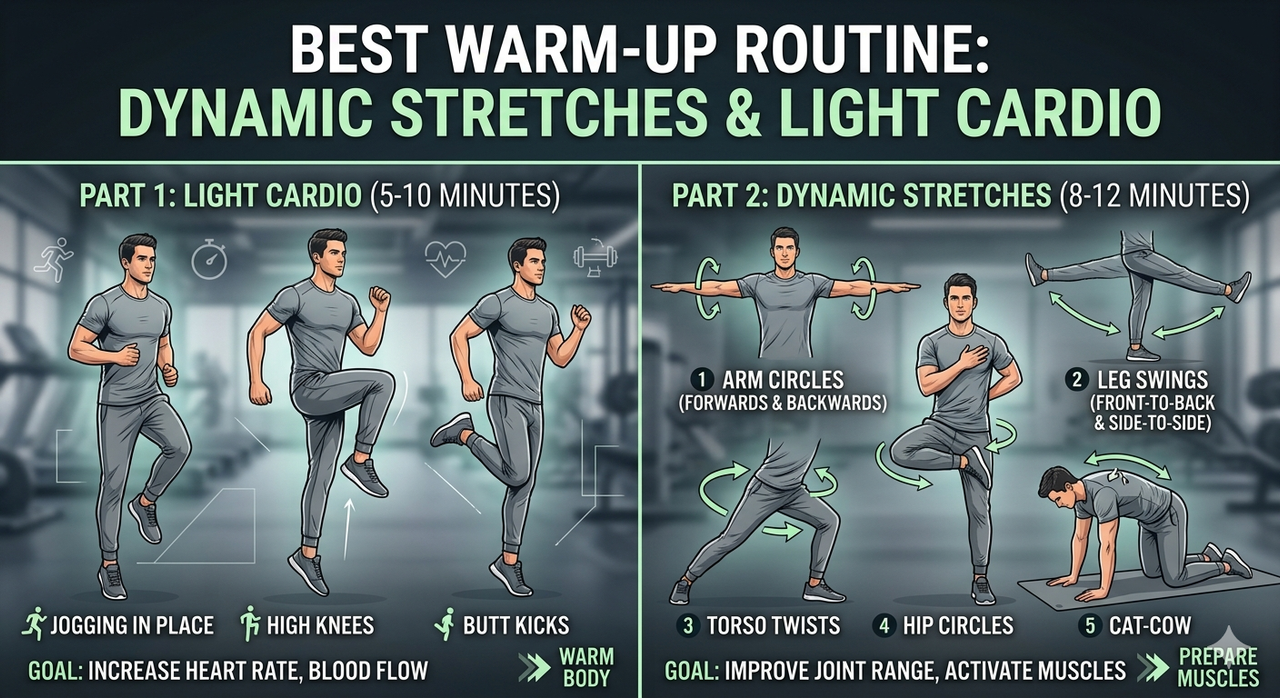
The best warm-up before a workout includes: light cardio (5-10 minutes) to increase heart rate and blood flow, dynamic stretching (leg swings, arm circles, torso twists) to improve range of motion, mobility exercises (hip circles, cat-cow, thoracic rotations) for joint preparation, and warm-up sets with light weights (50% of working weight) for specific movement patterns.
2. The Science: Why Warm-Ups Work
A proper warm-up creates several physiological benefits:
- Increased muscle temperature: Warmer muscles contract more forcefully and relax more quickly
- Improved blood flow: More oxygen and nutrients delivered to working muscles
- Enhanced nerve transmission: Faster signal conduction improves reaction time and coordination
- Increased joint mobility: Synovial fluid viscosity decreases, improving range of motion
- Mental preparation: Focuses attention on the upcoming workout
📊 Physiological Effects of Warm-Up
3. Phase 1: Light Cardio (5-10 Minutes)
Purpose: Increase heart rate, blood flow, and core temperature. Examples:
- Jumping jacks: 2-3 minutes
- Jogging in place: 2-3 minutes
- Rowing machine or stationary bike: 5 minutes
- Skipping rope: 3-5 minutes
- Walking briskly on treadmill: 5 minutes at incline
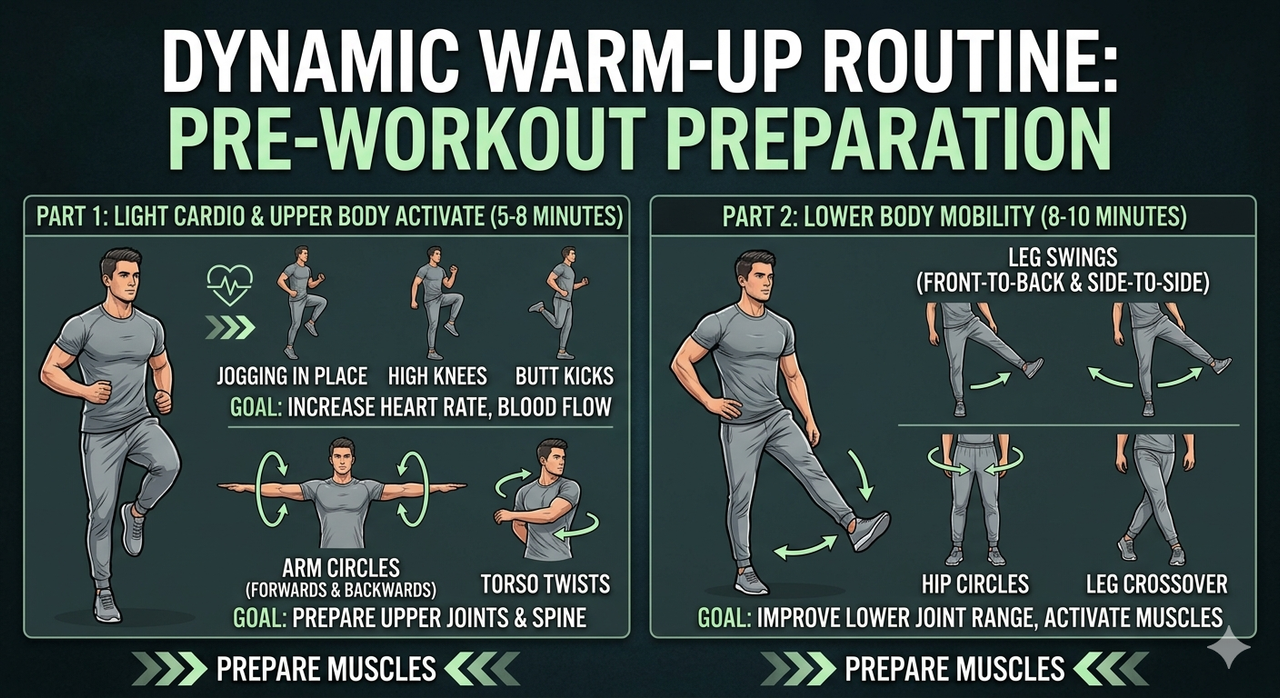
4. Phase 2: Dynamic Stretching & Mobility (5-10 Minutes)
Purpose: Improve range of motion and activate muscles. Never static stretch before training—it reduces power output by 5-15% .
Upper Body Dynamic Stretches
- Arm circles: 30 seconds forward, 30 seconds backward
- Torso twists: 30 seconds each side
- Cat-cow stretch: 10-15 reps
- Thoracic rotations: 10 per side
Lower Body Dynamic Stretches
- Leg swings (forward/back): 30 seconds per leg
- Leg swings (side-to-side): 30 seconds per leg
- Walking lunges: 10-12 reps per leg
- High knees: 30 seconds
- Butt kicks: 30 seconds
- Hip circles: 30 seconds each direction
5. Phase 3: Specific Warm-Up Sets (5-8 Minutes)
Purpose: Practice movement patterns and activate nervous system for specific exercises. Use this progression:
- Set 1: 50% of working weight × 8-10 reps (rest 30 sec)
- Set 2: 70% of working weight × 5-6 reps (rest 45 sec)
- Set 3: 85% of working weight × 2-3 reps (rest 60 sec)
- Then: Begin working sets
6. Sample Full Warm-Up Routine (15 Minutes)
- 0:00-5:00: Light cardio (jumping jacks, jogging)
- 5:00-7:00: Arm circles, torso twists, cat-cow
- 7:00-10:00: Leg swings, walking lunges, hip circles
- 10:00-12:00: Specific warm-up set 1 (50%)
- 12:00-13:00: Specific warm-up set 2 (70%)
- 13:00-14:00: Specific warm-up set 3 (85%)
- 14:00-15:00: Rest, hydrate, begin working sets
7. Warm-Up by Workout Type
Strength Training (Full Body)
5 min cardio + 5 min dynamic stretching + 5 min specific warm-up sets (squat, bench, row)
Upper Body Day
5 min cardio + 3 min upper body dynamic (arm circles, torso twists) + specific warm-up for bench, rows, OHP
Lower Body Day
5 min cardio + 5 min lower body dynamic (leg swings, lunges, hip circles) + specific warm-up for squat, deadlift
Cardio Only (Running, Cycling)
5-10 minutes at very low intensity, gradually increasing to target pace. Add leg swings and lunges before running.
8. Common Warm-Up Mistakes
- Static stretching before strength training: Reduces power output
- Too short: Less than 5 minutes doesn't raise core temperature enough
- Too intense: Fatiguing yourself before working sets
- Skipping specific warm-up sets: Doesn't prepare nervous system for the movement
- Same warm-up for every workout: Different exercises need specific preparation
- Rushing through warm-up: Quality matters as much as quantity
9. Nutrition for Warm-Up & Performance
What you eat before training affects warm-up effectiveness and workout performance:
- Pre-workout meal (2-3 hours before): Carbs + protein (400-600 kcal)
- Pre-workout snack (30-60 min before): Light carbs (banana, toast) for energy
- Hydration: 500ml water 1-2 hours before training
Sample Pre-Workout Meals
- 2 hours before: 150g chicken + 1 cup rice + vegetables (500 kcal)
- 1 hour before: 1 banana + 1 tbsp peanut butter (200 kcal)
- 30 minutes before: 1 scoop protein + 1 cup water + 1 banana (250 kcal)
Vegan/Vegetarian Pre-Workout Options
- 2 hours before: Tofu scramble with quinoa and vegetables (500 kcal)
- 1 hour before: 1 banana + 1 tbsp almond butter (200 kcal)
- 30 minutes before: 1 scoop plant protein + 1 cup oat milk + 1 date (250 kcal)
Gluten-Free Options
- Use certified gluten-free oats
- Choose rice, quinoa, buckwheat
- Verify protein sources are gluten-free certified
10. Frequently Asked Questions
What is the best warm-up before a workout?
The best warm-up before a workout includes: light cardio (5-10 minutes) to increase heart rate and blood flow, dynamic stretching (leg swings, arm circles, torso twists) to improve range of motion, mobility exercises (hip circles, cat-cow, thoracic rotations) for joint preparation, and warm-up sets with light weights (50% of working weight) for specific movement patterns.
How long should a warm-up last?
An effective warm-up should last 10-15 minutes total: 5 minutes light cardio, 5 minutes dynamic stretching and mobility, then specific warm-up sets (3-5 minutes). Avoid exceeding 20 minutes to prevent fatigue. Adjust based on workout intensity: longer for heavy compound lifts, shorter for light isolation work.
Should I stretch before working out?
Yes, but only dynamic stretching, not static. Dynamic stretching (moving stretches like leg swings) improves performance and reduces injury risk. Static stretching (holding a stretch) before training can temporarily reduce strength and power by 5-15%. Save static stretches for after your workout (cool-down).
What are dynamic warm-up exercises?
Dynamic warm-up exercises include: leg swings (forward/back, side-to-side), arm circles (forward/reverse), torso twists, walking lunges, high knees, butt kicks, hip circles, cat-cow stretch, thoracic rotations, and inchworms. Perform each for 30-60 seconds or 10-15 reps per side.
Do I need to warm up before every workout?
Yes, every workout requires a proper warm-up. Skipping warm-up increases injury risk by up to 50% and reduces performance. Even light workouts benefit from 5-10 minutes of preparation. Cold muscles are less elastic and more prone to strains. Always warm up, regardless of workout intensity.
How do warm-up sets work?
Warm-up sets are lighter weight sets performed before working sets. Protocol: 1st set: 50% of working weight for 5-8 reps, 2nd set: 70% for 3-5 reps, 3rd set: 85% for 2-3 reps. This prepares the nervous system and practices movement patterns without fatigue. Rest 30-60 seconds between warm-up sets.
11. Related Resources
- Best Rest Time Between Sets for Muscle Growth (Science-Based Guide)
- How Long Should a Workout Session Be? (Optimal Training Time Guide)
- How to Train Each Muscle Group Correctly (Complete Workout Guide)
- Beginner Mistakes in Workout Programs (Avoid These Common Errors)
- How Many Sets and Reps for Muscle Growth? (Optimal Training Guide)
- Best Weekly Workout Split for Beginners (Simple Training Plan)
12. Scientific References
- Woods, K., et al. (2007). Warm-up and stretching in the prevention of muscular injury. Sports Medicine, 37(12), 1089–1099. PubMed
- Fradkin, A. J., et al. (2010). A review of the effects of warm-up on performance. Strength and Conditioning Journal, 32(4), 83–87. PubMed
- Behm, D. G., & Chaouachi, A. (2011). A review of the acute effects of static and dynamic stretching on performance. European Journal of Applied Physiology, 111(11), 2633–2651. PubMed
- Morton, R. W., et al. (2018). A systematic review, meta-analysis and meta-regression of the effect of protein supplementation on resistance training-induced gains in muscle mass and strength. British Journal of Sports Medicine, 52(6), 376–384. PubMed
- ACSM. (2021). Nutrition and Athletic Performance. Medicine & Science in Sports & Exercise, 53(3), 600–618. PubMed
Join the conversation