How to Build Strength at Home (No Equipment Workout Guide)

Learn how to build strength at home with effective workouts, no equipment needed, and proven training tips.
How to Build Strength at Home: No Equipment Workout Guide (2026)
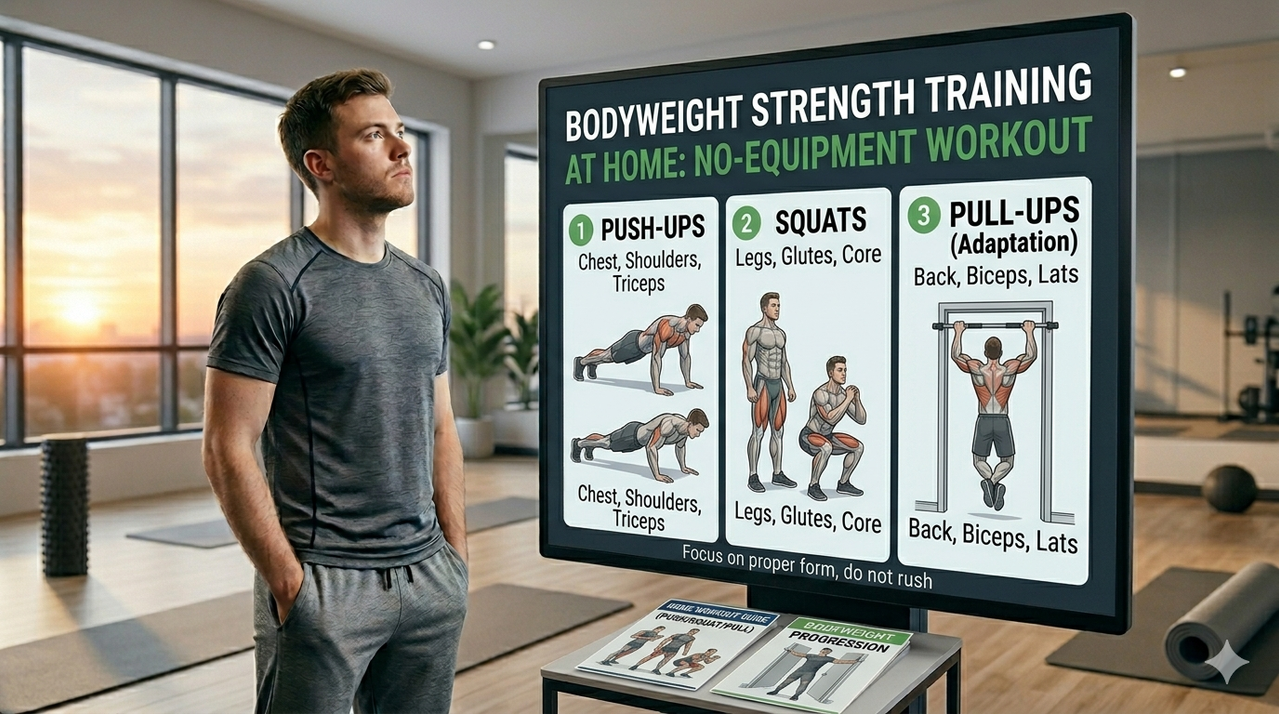
How to Build Strength at Home: No Equipment Workout Guide (2026)

Bodyweight strength training infographic showing push-ups, squats, pull-ups, and planks for no equipment workout at home
Image 1: Build functional strength at home using only your bodyweight and progressive overload.

⚡ TL;DR

To build strength at home without equipment, focus on bodyweight strength exercises with progressive overload. Key movements: push-ups (chest), squats/lunges (legs), pull-ups or rows (back), pike push-ups (shoulders), and dips (triceps). Increase difficulty by adding reps, slowing tempo (3-5 seconds lowering), using unilateral variations (pistol squats, one-arm push-ups), or adding a weighted backpack. Train 3-4 times weekly, prioritize protein intake (1.6-2.2 g/kg), and track progress. Calisthenics strength training builds real-world strength—research shows bodyweight training produces comparable results to gym training when intensity is matched .

1. The No-Equipment Myth: Can You Really Build Strength at Home?

No gym? No weights? No problem. Learning how to build strength at home is not only possible but highly effective when done correctly. Bodyweight training, or calisthenics, has been used for centuries to build impressive strength. This no equipment strength workout guide provides a complete system for home strength training using progressive overload—the same principle used in gyms. Whether you're a beginner or advanced, these bodyweight strength exercises will help you get stronger.

How can I build strength at home without equipment?

Build strength at home without equipment by: using bodyweight exercises (push-ups, squats, lunges, pull-ups if available), increasing reps and difficulty over time (progressive overload), using slow tempo training (3-5 second lowering), adding advanced variations (pistol squats, archer push-ups), and staying consistent with 3-4 workouts weekly. Bodyweight training can build significant strength with proper progression.
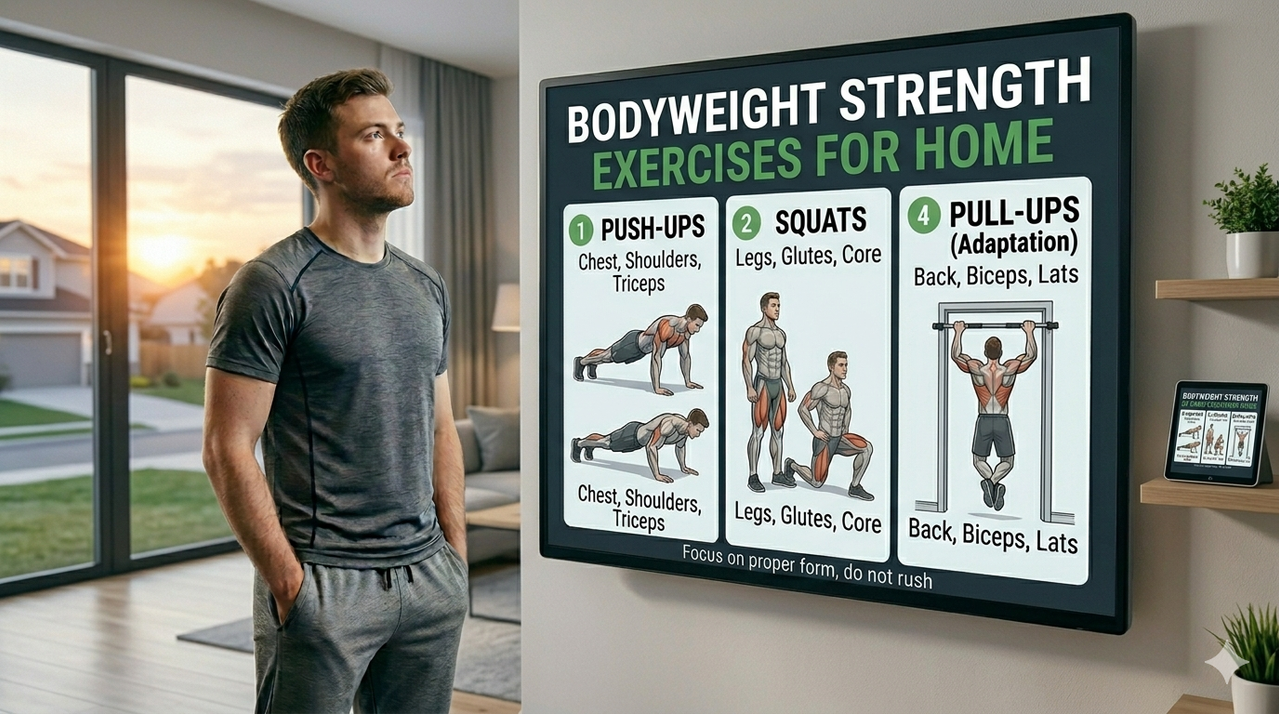
Bodyweight strength exercises for home including push-ups, squats, lunges, pull-ups, and planks for calisthenics training
Image 2: Bodyweight exercises target all major muscle groups effectively.

2. The Science: Progressive Overload Without Weights

Strength gains require progressive overload—continually challenging muscles beyond current capacity. Without weights, use these methods:

  • Increase reps: 10 → 12 → 15 → 20
  • Increase sets: 3 → 4 → 5
  • Slow tempo: 3-5 second lowering phase (increases time under tension)
  • Advance variations: Push-up → decline → archer → one-arm
  • Add pauses: 1-2 seconds at hardest point
  • Add weight: Backpack with books or water bottles

📊 Progressive Overload Without Equipment

.= "Push-ups" ? 'Push-ups' : '' ?>Push-ups .= "Squats" ? 'Squats' : '' ?>Squats .= "Pull-ups" ? 'Pull-ups' : '' ?>Pull-ups .= "Rows" ? 'Rows' : '' ?>Rows

3. Best Bodyweight Exercises for Strength

Chest & Triceps

  • Push-ups: Standard, incline, decline, diamond, archer, one-arm
  • Dips: Use two chairs or a counter corner

Back & Biceps

  • Pull-ups: If you have a bar (or use a tree branch)
  • Inverted rows: Under a sturdy table
  • Towel rows: Loop towel over door, pull

Legs & Glutes

  • Squats: Standard, narrow, wide, pistol (single-leg)
  • Lunges: Forward, reverse, walking, Bulgarian split squats
  • Glute bridges: Single-leg for advanced

Shoulders

  • Pike push-ups: Hips up, inverted V position
  • Handstand push-ups (advanced): Against wall

Core

  • Plank: Front, side, weighted
  • Leg raises: Lying, hanging
  • Russian twists: Add weight with backpack

4. Sample Home Strength Workout Routines

Beginner Full Body (3 days/week)

  • Bodyweight squats: 3×15
  • Incline push-ups (hands on elevated surface): 3×10
  • Inverted rows (under table): 3×8
  • Plank: 3×30 seconds
  • Lunges: 3×10/leg
  • Rest 60 seconds between sets. Progress by adding reps each week.

Intermediate Full Body (3-4 days/week)

  • Bulgarian split squats: 3×12/leg
  • Standard push-ups: 3×15
  • Pull-ups or inverted rows: 3×10
  • Pike push-ups: 3×10
  • Dips (chairs): 3×12
  • Leg raises: 3×15
  • Rest 90 seconds between sets. Add weight with backpack when possible.

Advanced Calisthenics (4 days/week - Upper/Lower)

Upper Body Day: Archer push-ups 4×8, Pull-ups 4×10, Handstand push-ups 4×5, Dips 4×12, Plank 4×60 sec

Lower Body Day: Pistol squats 4×8/leg, Bulgarian split squats 4×12/leg, Single-leg glute bridges 4×15/leg, Hanging leg raises 4×15

5. Progression: From Beginner to Advanced

Follow this 12-week progression for continuous strength gains:

  • Weeks 1-4: Master basic form, 3 sets of 8-12 reps, 60 sec rest
  • Weeks 5-8: Increase volume to 4 sets, add tempo (3 sec lowering), reduce rest to 45 sec
  • Weeks 9-12: Advance variations (decline push-ups, Bulgarian split squats), add pauses, use weighted backpack

6. Nutrition for Home Strength Gains

To maximize gain strength without gym, support training with proper nutrition:

  • Protein: 1.6-2.2 g per kg body weight (muscle repair and growth)
  • Calories: Slight surplus for muscle gain (250-500 kcal above maintenance)
  • Hydration: 2.5-3.5 liters water daily

Sample Meal Plan for Strength (2,500 kcal, 150g Protein)

  • Breakfast: 4 eggs, 1 cup oats, 1 banana, 1 cup milk (650 kcal, 40g protein)
  • Lunch: 200g chicken breast, 1.5 cups rice, 1 cup broccoli (550 kcal, 50g protein)
  • Snack: 200g Greek yogurt, 30g almonds, 1 tbsp honey (350 kcal, 22g protein)
  • Dinner: 200g lean beef or salmon, 1.5 cups sweet potato, 2 cups spinach (600 kcal, 45g protein)
  • Post-workout: 1 scoop whey, 1 banana (200 kcal, 25g protein)
  • Total: ~2,350 kcal, ~182g protein

Vegan/Vegetarian Strength Plan

  • Breakfast: Tofu scramble (200g tofu), 1.5 cups oats, 2 tbsp peanut butter (700 kcal, 40g protein)
  • Lunch: 1.5 cups lentils, 1.5 cups quinoa, 1 cup edamame, 1 tbsp olive oil (650 kcal, 35g protein)
  • Snack: 1 cup soy yogurt, 1 scoop pea protein, 30g walnuts (400 kcal, 30g protein)
  • Dinner: 200g tempeh, 1.5 cups brown rice, 2 cups broccoli, 1 tbsp olive oil (600 kcal, 35g protein)
  • Total: ~2,350 kcal, ~140g protein (add another shake for higher)

Gluten-Free Options

  • Use certified gluten-free oats
  • Choose rice, quinoa, buckwheat
  • Verify protein sources are gluten-free certified

7. Tracking Progress at Home

Measure strength gains without equipment:

  • Reps: Can you do more reps than last week?
  • Difficulty: Have you advanced to harder variations?
  • Tempo: Can you control the eccentric phase longer?
  • Rest time: Can you maintain performance with less rest?
  • Subjective feel: Do exercises feel easier?

8. Common Mistakes in Home Strength Training

  • No progressive overload: Doing same reps every workout leads to plateaus
  • Poor form: Ego lifting (even bodyweight) with bad technique
  • Inconsistent schedule: Treat home workouts like gym appointments
  • Not enough protein: Muscle repair requires adequate protein
  • Skipping legs: Lower body strength is essential for functional fitness
  • No rest days: Muscles need 48 hours recovery

9. Equipment That Helps (Optional but Useful)

  • Pull-up bar ($20-40): Best for back strength
  • Resistance bands ($10-30): Add variable resistance to bodyweight exercises
  • Backpack with books: Free weighted vest alternative
  • Parallettes ($30-50): For dips, L-sits, push-ups

10. Frequently Asked Questions

How can I build strength at home without equipment?

Build strength at home without equipment by: using bodyweight exercises (push-ups, squats, lunges, pull-ups if available), increasing reps and difficulty over time (progressive overload), using slow tempo training (3-5 second lowering), adding advanced variations (pistol squats, archer push-ups), and staying consistent with 3-4 workouts weekly. Bodyweight training can build significant strength with proper progression.

Can you really build strength with bodyweight exercises?

Yes, bodyweight exercises can build significant strength when combined with progressive overload. Research shows calisthenics training produces comparable strength gains to weighted exercises in beginners and intermediates. Advanced athletes can continue progressing with harder variations (one-arm push-ups, pistol squats, handstand push-ups).

What are the best bodyweight exercises for strength?

Best bodyweight exercises for strength: push-ups (chest, triceps), pull-ups or rows (back, biceps), squats and lunges (legs), pike push-ups (shoulders), dips (triceps), pistol squats (advanced legs), and planks (core). Focus on compound movements that work multiple joints.

How often should I train at home to build strength?

Train 3-4 times per week for strength gains. Full body workouts 3 times weekly (e.g., Monday, Wednesday, Friday) are optimal for beginners. Advanced trainees can use an upper/lower split 4 times weekly. Allow 48 hours recovery between training the same muscle groups.

How do I make bodyweight exercises harder?

Make bodyweight exercises harder by: slowing down the tempo (3-5 second lowering), adding pauses at the hardest point, increasing range of motion (deeper squats, deficit push-ups), using unilateral variations (single-leg squats, one-arm push-ups), adding weight with a backpack, or increasing volume (more reps, sets).

Do I need a pull-up bar to build back strength?

A pull-up bar is helpful but not essential. Without one, use inverted rows under a sturdy table, towel rows over a door, or resistance bands. These effectively target back muscles. For advanced strength, consider investing in a bar ($20-40) for pull-ups and chin-ups.

11. Related Resources

12. Scientific References

  1. Calatayud, J., et al. (2015). Muscle activity during push-ups with different suspension training systems. Journal of Sports Science & Medicine, 14(3), 502–508. PubMed
  2. Kikuchi, N., & Nakazato, K. (2017). Low-load bench press and push-up induce similar muscle hypertrophy and strength gains. Journal of Sports Science & Medicine, 16(3), 344–350. PubMed
  3. Morton, R. W., et al. (2018). A systematic review, meta-analysis and meta-regression of the effect of protein supplementation on resistance training-induced gains in muscle mass and strength. British Journal of Sports Medicine, 52(6), 376–384. PubMed
  4. ACSM. (2021). Nutrition and Athletic Performance. Medicine & Science in Sports & Exercise, 53(3), 600–618. PubMed
FitForge Lab. Created by Techly420
FitForge Lab Welcome to WhatsApp chat
Hi! Need help with fitness or diet? 💪
Type here...
ExerciseBeginnerIntermediateAdvanced
Knee push-ups 3×10Standard 3×15Decline 3×12 or Archer
Bodyweight 3×15Bulgarian split 3×12/legPistol squats 3×8/leg
Negatives 3×5Standard 3×8Weighted 3×5
Inverted (table) 3×8Inverted 3×12Archer rows 3×10