How to Stay Consistent With Your Workout Plan (Proven Motivation Tips)
How to Stay Consistent With Your Workout Plan: Proven Motivation Tips (2026)
⚡ TL;DR
To stay consistent with your workout plan, focus on systems over motivation. Key fitness consistency tips: set realistic goals (not perfection), follow a simple routine (3-4 days/week), schedule workouts like appointments, track progress weekly, and avoid overtraining (rest is essential). How to stick to a workout routine isn't about willpower—it's about building habits. Start small, prepare your gear the night before, and use the "5-minute rule" on low-motivation days. Consistency compounds: showing up 80% of the time beats perfect attendance for 2 weeks .
1. The Consistency Paradox: Why Motivation Fails
You start Monday with enthusiasm. By Thursday, you're skipping workouts. By next week, you're back to old habits. This cycle isn't a personal failure—it's the reality of relying on motivation. Motivation is fleeting; habits are enduring. Learning how to stay consistent with your workout plan requires building systems that work even when you don't feel like it. This guide provides science-backed workout motivation tips that create lasting discipline.
How can I stay consistent with my workout plan?
Stay consistent with your workout plan by: setting realistic goals (specific, achievable), following a simple routine (don't overcomplicate), scheduling workouts like appointments, tracking progress weekly, and avoiding overtraining (rest days are essential). Also: find activities you enjoy, start small, and focus on habit formation over motivation.
2. The Science of Habit Formation
Research shows forming a new exercise habit takes an average of 66 days (range: 18-254 days depending on complexity) . The habit loop consists of:
- Cue: Trigger that initiates behavior (time of day, alarm, gym bag visible)
- Routine: The workout itself
- Reward: Positive reinforcement (endorphins, sense of accomplishment)
3. Common Reasons People Skip Workouts
Understanding how to stick to a workout routine starts with identifying obstacles:
- Unrealistic expectations: Expecting fast results or perfect attendance
- Overcomplicated routines: Too many exercises, too much time
- Lack of scheduling: Leaving workouts to "when I have time"
- All-or-nothing thinking: "If I can't do the full workout, why bother?"
- No enjoyment: Doing activities you hate
- Poor recovery: Overtraining leads to burnout and missed sessions
4. Practical Strategies for Workout Consistency
4.1. Start Small and Progress Gradually
Beginners should start with 20-30 minute workouts, 3 days per week. This is manageable and builds confidence. Increase duration or frequency only after 4-6 weeks of consistency .
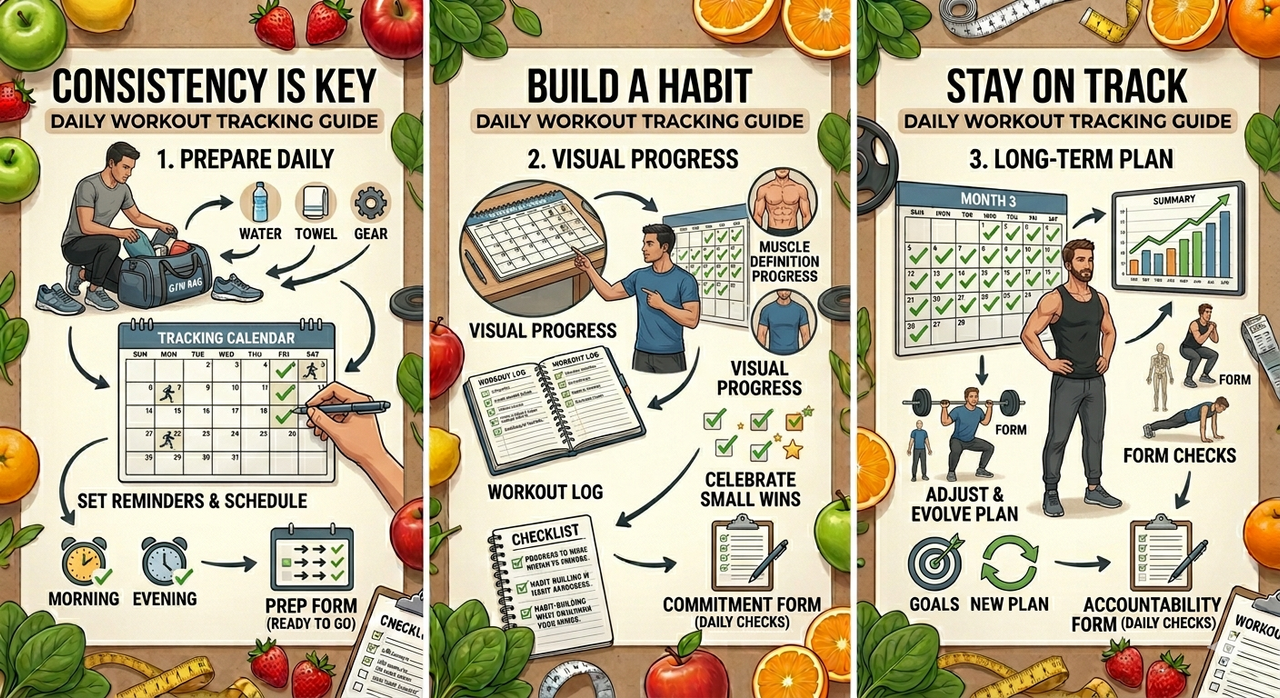
4.2. Schedule Workouts Like Appointments
Put workouts in your calendar with reminders. Treat them as non-negotiable as a work meeting. Studies show scheduling increases adherence by 2-3x .
4.3. Prepare the Night Before
Lay out gym clothes, pack your bag, prep your pre-workout snack. Removing friction increases the likelihood of following through.
4.4. Track Your Streak
Use a calendar to mark workout days. Don't break the chain. Visual progress is powerful motivation. Research shows tracking increases adherence by 30% .
4.5. Have a Backup Plan
For busy days: a 10-minute home workout (bodyweight circuit). Something is always better than nothing. This prevents all-or-nothing thinking.
4.6. Find Activities You Enjoy
If you hate running, don't run. Try cycling, swimming, classes, sports, or strength training. Enjoyment is the #1 predictor of long-term adherence .
5. The 5-Minute Rule for Low-Motivation Days
When you don't feel like working out, commit to just 5 minutes. After 5 minutes, you're allowed to stop. Most people continue because starting is the hardest part. This technique overcomes initial resistance and builds momentum .
6. How to Get Back on Track After Missing Workouts
How to stay disciplined in gym includes a recovery plan:
- Forgive immediately: One missed workout doesn't erase progress
- Return to your normal schedule: Don't double up workouts to "make up"
- Identify the trigger: Fatigue? Lack of time? Boredom?
- Adjust your plan: Shorten workouts, change activities, or shift schedule
- Focus on the next workout: What matters is what you do next
7. Sample Weekly Workout Schedule for Consistency
This simple 3-day schedule is sustainable for most beginners:
- Monday: Full body strength (45 minutes)
- Tuesday: Rest or active recovery (walk 20-30 min)
- Wednesday: Full body strength (45 minutes)
- Thursday: Rest
- Friday: Full body strength (45 minutes)
- Saturday: Cardio or activity you enjoy (30 minutes)
- Sunday: Complete rest
8. Quick At-Home Workout (No Equipment, 15 Minutes)
- Bodyweight squats: 45 seconds on, 15 seconds rest
- Push-ups (knee or regular): 45s on, 15s rest
- Reverse lunges: 45s on, 15s rest
- Plank: 45s on, 15s rest
- Jumping jacks: 45s on, 15s rest
- Repeat circuit 2-3 times. Total: 10-15 minutes.
9. Common Consistency Mistakes to Avoid
- Starting too intense: 6 days/week, 90-minute workouts lead to burnout
- No rest days: Recovery prevents injury and overtraining
- Comparing to others: Your journey is unique
- Perfectionism: Missing one day doesn't ruin progress
- No flexibility: Life happens—have a backup plan
- Not tracking progress: What gets measured gets managed
10. Frequently Asked Questions
How can I stay consistent with my workout plan?
Stay consistent with your workout plan by: setting realistic goals (specific, achievable), following a simple routine (don't overcomplicate), scheduling workouts like appointments, tracking progress weekly, and avoiding overtraining (rest days are essential). Also: find activities you enjoy, start small, and focus on habit formation over motivation.
Why is it so hard to stick to a workout routine?
People struggle with workout consistency due to: unrealistic expectations (expecting fast results), overcomplicated routines (too many exercises), lack of scheduling (leaving workouts to chance), all-or-nothing thinking (missing one day = failure), and not enjoying the activities chosen. Consistency breaks when motivation fades and habit isn't established.
How long does it take to build a workout habit?
Research shows forming a new exercise habit takes 18-254 days, with an average of 66 days. Simple habits (walking daily) take less time; complex gym routines take longer. Consistency, not intensity, determines habit formation speed. Start with small, achievable goals (10-minute workouts) to build momentum.
What should I do when I don't feel like working out?
When motivation is low: reduce the workout (just start with 10 minutes), change the activity to something fun, workout with a friend, remind yourself why you started, use the '5-minute rule' (just do 5 minutes—you'll likely continue), or take a scheduled rest day if truly needed. One missed workout isn't failure—two in a row is a pattern to watch.
How do I stop skipping workouts?
Stop skipping workouts by: scheduling them in your calendar like meetings, preparing your gym bag the night before, starting with shorter workouts (30 minutes is enough), tracking your streak (don't break the chain), having a backup plan for busy days (10-minute home workout), and rewarding consistency (not just results).
Does working out at the same time each day help consistency?
Yes, exercising at the same time daily significantly improves consistency. This creates a habit loop: cue (time of day) → routine (workout) → reward (feeling accomplished). Morning workouts have higher adherence rates because fewer conflicts arise. Choose a time that fits your schedule and protect it.
11. Related Resources
- Best Rest Time Between Sets for Muscle Growth (Science-Based Guide)
- How Long Should a Workout Session Be? (Optimal Training Time Guide)
- How to Train Each Muscle Group Correctly (Complete Workout Guide)
- Beginner Mistakes in Workout Programs (Avoid These Common Errors)
- How Many Sets and Reps for Muscle Growth? (Optimal Training Guide)
- Best Weekly Workout Split for Beginners (Simple Training Plan)
12. Scientific References
- Lally, P., et al. (2010). How are habits formed: Modelling habit formation in the real world. European Journal of Social Psychology, 40(6), 998–1009. PubMed
- Gardner, B., et al. (2012). Making health habitual: the psychology of 'habit-formation' and general practice. British Journal of General Practice, 62(605), 664–666. PubMed
- Michie, S., et al. (2009). Effective techniques in healthy eating and physical activity interventions: a meta-regression. Health Psychology, 28(6), 690–701. PubMed
- Rhodes, R. E., & Dickau, L. (2012). Experimental evidence for the intention-behavior relationship in the physical activity domain: A meta-analysis. Health Psychology, 31(6), 724–727. PubMed
- ACSM. (2021). Nutrition and Athletic Performance. Medicine & Science in Sports & Exercise, 53(3), 600–618. PubMed
Join the conversation