What to Do If You Miss a Workout Day (Don’t Lose Progress Guide)
What to Do If You Miss a Workout Day: Don't Lose Progress Guide (2026)
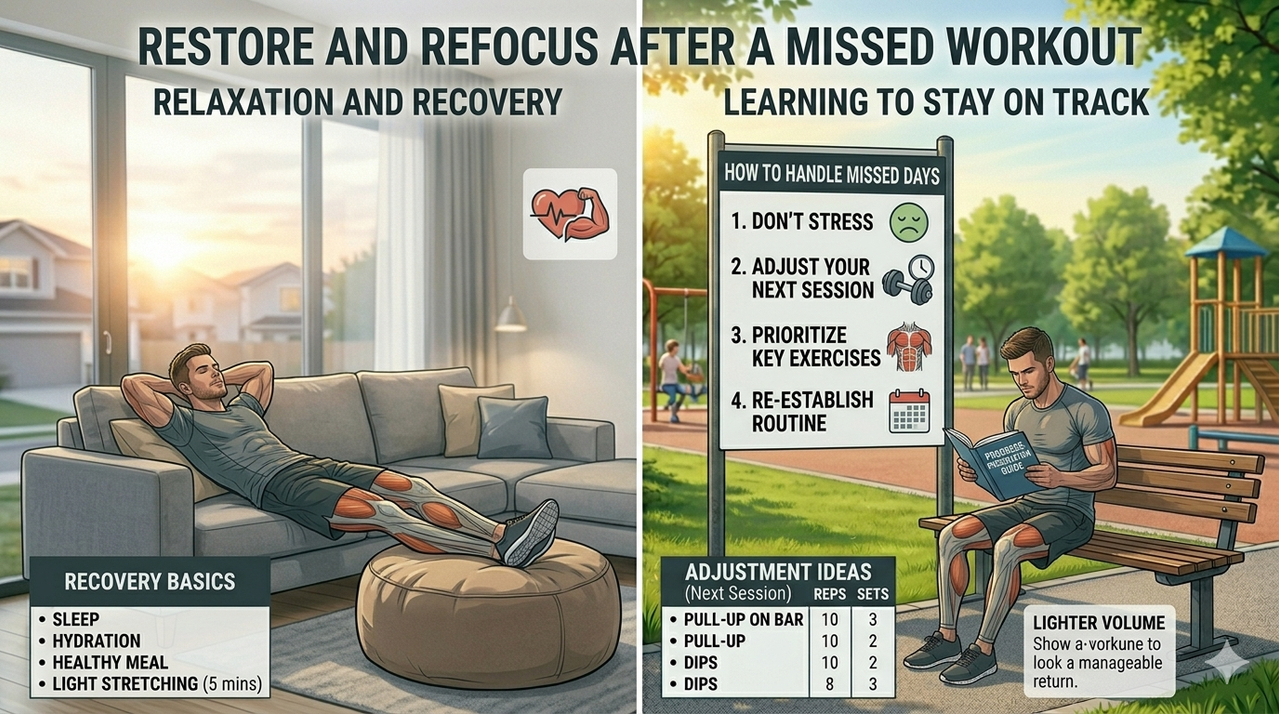
⚡ TL;DR
If you miss a workout day, don't panic—one missed session has virtually zero impact on progress. Research shows muscle doesn't atrophy until 2-3 weeks of complete inactivity. The key is what to do after skipping a workout: continue your normal schedule, avoid doubling workouts (increases injury risk), and focus on consistency over perfection. This missed workout recovery guide provides science-backed strategies to get back on track without overcompensating. Remember: one missed workout doesn't ruin progress—quitting does .
1. The Guilt Trap: Why Missing One Workout Feels Worse Than It Is
You missed a workout. Now guilt creeps in. You consider doubling up tomorrow. This reaction—while common—is counterproductive. Understanding what happens if you skip workout sessions is crucial for long-term success. Fitness routine mistakes often stem from overreaction, not the missed session itself. This guide provides a rational, science-based approach to missed workout recovery that prevents one missed day from derailing your entire routine.
What should I do if I miss a workout day?
What should I do if I miss a workout day? Don't panic or overcompensate (one missed day doesn't ruin progress), continue your normal schedule (return to your regular plan), avoid doubling workouts (increases injury risk), stay consistent long-term (consistency over months matters more than perfection), and focus on your next session (what you do next is what counts).
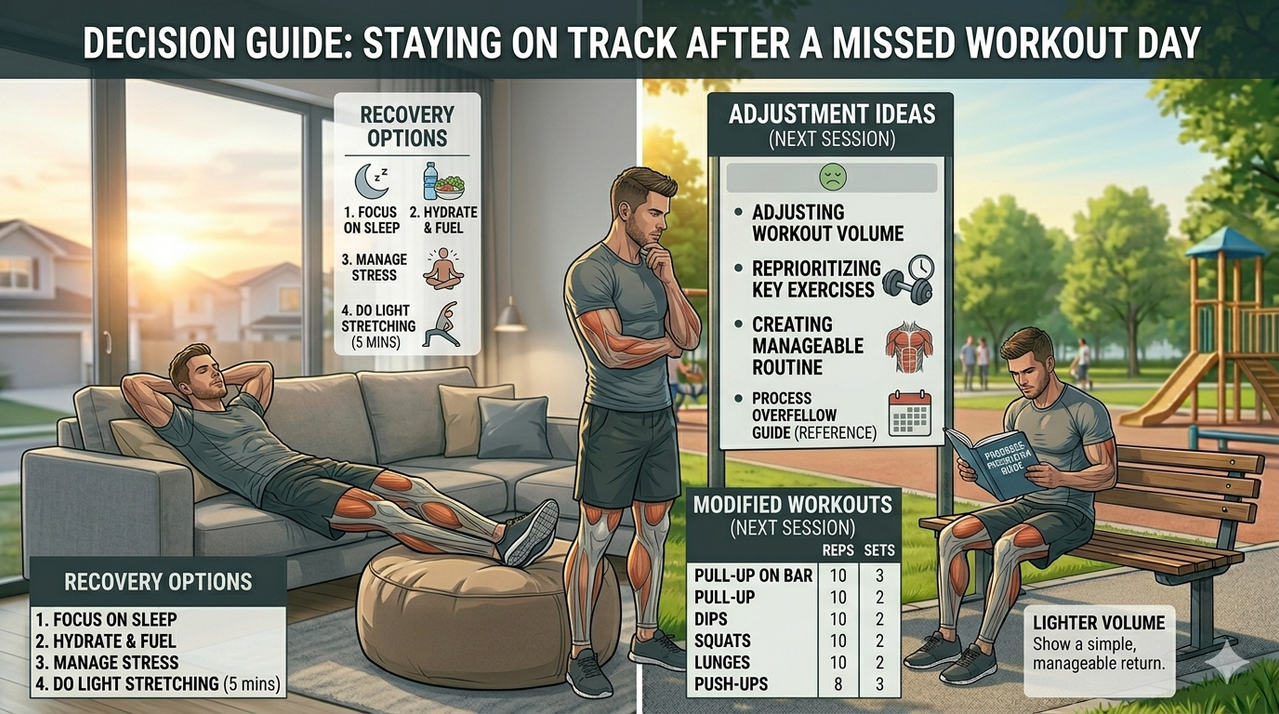
2. The Science: How Long Until You Lose Progress?
Understanding detraining timelines reduces unnecessary panic:
- 1-7 days missed: No significant loss. Muscle glycogen may decrease slightly, but returns quickly.
- 7-14 days missed: Minimal strength loss (2-5%). Cardiovascular fitness declines slightly.
- 14-21 days missed: Noticeable strength loss (5-10%). Muscle mass stable.
- 21+ days missed: Significant detraining begins. Muscle atrophy starts after 3 weeks.
3. The Golden Rule: Never Double Workouts
After missing a workout, the urge to "make up" for it is strong. But doubling workouts is counterproductive:
- Injury risk increases: Doubling volume in one day increases injury risk by 50%
- Poor recovery: Two workouts in one day impair muscle repair
- Mental burnout: Creates punishment mindset, reducing long-term adherence
- No physiological benefit: Your body can't "catch up" on missed volume
4. How to Get Back on Track
Skip gym day what to do follow this protocol:
- Forgive yourself immediately: Guilt is unproductive. One missed workout doesn't erase weeks of progress.
- Return to normal schedule: Do your next scheduled workout as planned. Don't add extra.
- Start with lighter intensity (if 5+ days missed): After extended breaks, reduce weight by 10-20% for first session.
- Review the cause: Illness? Schedule conflict? Low motivation? Address the root cause.
- Focus on habit, not perfection: 80% consistency over 6 months beats 100% for 2 weeks.
5. Sample Recovery Plan by Missed Days
Missed 1-3 Days
- Action: Continue normal schedule. Do not add extra workouts.
- Adjustments: None needed. Return to regular intensity.
Missed 4-7 Days
- Action: Continue normal schedule.
- Adjustments: Reduce weight by 10% for first session back. Expect slight soreness.
Missed 1-2 Weeks
- Action: Resume normal schedule.
- Adjustments: Reduce weight by 15-20% first session. Increase gradually over 1-2 weeks.
Missed 3+ Weeks
- Action: Return to training, but expect reduced performance.
- Adjustments: Reduce weight by 25-30%. Rebuild slowly over 2-4 weeks. Muscle memory will accelerate progress.
6. Prevention: How to Avoid Missing Workouts
Workout consistency tips to prevent future misses:
- Schedule workouts like appointments: Put them in your calendar with reminders
- Have a backup plan: 10-15 minute home workout for busy days
- Prepare the night before: Lay out clothes, pack gym bag
- Track your streak: Mark workout days on a calendar (don't break the chain)
- Find enjoyable activities: You're more likely to do what you enjoy
- Start with manageable goals: 3 days/week is sustainable; 6 days/week leads to burnout
7. Nutrition During Missed Workout Periods
Adjust nutrition when not training to prevent fat gain:
- Reduce calories slightly: If missing 3+ days, reduce intake by 100-200 calories daily
- Maintain protein: Keep protein at 1.6-2.2 g/kg to preserve muscle
- Stay hydrated: 2.5-3.5 liters water daily
Sample Maintenance Day Meal Plan (2,000 kcal)
- Breakfast: 3 eggs, ½ cup oats, ½ cup berries (450 kcal, 25g protein)
- Lunch: 150g chicken breast, 1 cup rice, 2 cups spinach (450 kcal, 40g protein)
- Snack: 170g Greek yogurt, 1 apple (200 kcal, 18g protein)
- Dinner: 150g white fish or tofu, 1 cup sweet potato, 2 cups broccoli (450 kcal, 35g protein)
- Total: ~1,550 kcal, ~118g protein
8. Quick At-Home Workout (15 Minutes, No Excuses)
For days when gym isn't possible, this backup workout keeps momentum:
- Bodyweight squats: 45 seconds on, 15 seconds rest
- Push-ups: 45s on, 15s rest
- Reverse lunges: 45s on, 15s rest
- Plank: 45s on, 15s rest
- Jumping jacks: 45s on, 15s rest
- Repeat circuit 2-3 times. Total: 10-15 minutes.
9. Common Mental Traps After Missing Workouts
- All-or-nothing thinking: "I already missed Monday, so week is ruined" → False. Just go Tuesday.
- Perfectionism: "If I can't do full workout, why bother?" → Something beats nothing. 10 minutes is better than 0.
- Punishment mentality: "I'll double workouts to punish myself" → Leads to burnout and injury.
- Catastrophizing: "I'll lose all my gains" → False. One week has minimal effect.
10. Frequently Asked Questions
What should I do if I miss a workout day?
If you miss a workout day: don't panic or overcompensate (one missed day doesn't ruin progress), continue your normal schedule (return to your regular plan), avoid doubling workouts (increases injury risk), stay consistent long-term (consistency over months matters more than perfection), and focus on your next session (what you do next is what counts).
Does missing one workout day matter?
No, missing one workout day has virtually no impact on strength or muscle gains. Research shows muscle doesn't start atrophying until 2-3 weeks of complete inactivity. What matters is not letting one missed day turn into a missed week. Return to your normal schedule immediately.
Should I workout twice the next day?
No, never double workouts to 'make up' for a missed day. Doubling increases injury risk by 50% and impairs recovery. It also creates an unhealthy mindset (punishment mentality). Simply continue your normal schedule. One missed day is insignificant; overcompensating is counterproductive.
How do I get back on track after missing workouts?
Get back on track by: forgiving yourself immediately (guilt doesn't help), returning to your normal schedule (don't skip more days), starting with lighter intensity if you missed 5+ days, focusing on habit not perfection, and reviewing what caused the break (illness? schedule? motivation?) to prevent recurrence.
How long does it take to lose fitness after stopping?
Fitness loss begins after 2-3 weeks of complete inactivity. Cardiovascular fitness declines first (10-15% after 3-4 weeks). Strength is more resilient (minimal loss in 3-4 weeks). Muscle mass starts decreasing after 3 weeks. One missed week has negligible effects. The key is returning before significant detraining occurs.
How can I stay consistent with workouts?
Stay consistent by: scheduling workouts like appointments, having a backup plan for busy days (10-15 min home workout), tracking your streak (don't break the chain), preparing gear the night before, finding activities you enjoy, starting with manageable goals (3 days/week), and forgiving slip-ups immediately (perfection isn't required).
11. Related Resources
- Best Rest Time Between Sets for Muscle Growth (Science-Based Guide)
- How Long Should a Workout Session Be? (Optimal Training Time Guide)
- How to Train Each Muscle Group Correctly (Complete Workout Guide)
- Beginner Mistakes in Workout Programs (Avoid These Common Errors)
- How Many Sets and Reps for Muscle Growth? (Optimal Training Guide)
- Best Weekly Workout Split for Beginners (Simple Training Plan)
12. Scientific References
- Mujika, I., & Padilla, S. (2000). Detraining: loss of training-induced physiological and performance adaptations. Sports Medicine, 30(2), 79–87. PubMed
- Lally, P., et al. (2010). How are habits formed: Modelling habit formation in the real world. European Journal of Social Psychology, 40(6), 998–1009. PubMed
- Morton, R. W., et al. (2018). A systematic review, meta-analysis and meta-regression of the effect of protein supplementation on resistance training-induced gains in muscle mass and strength. British Journal of Sports Medicine, 52(6), 376–384. PubMed
- ACSM. (2021). Nutrition and Athletic Performance. Medicine & Science in Sports & Exercise, 53(3), 600–618. PubMed
Join the conversation