Does Walking After Meals Help Burn Fat? (Science-Based Answer)
Does Walking After Meals Help Burn Fat? (Science-Based Answer)

⚡ TL;DR
So, does walking after meals help burn fat? The short answer is yes—significantly. A 2025 Oxford Academic study found that light-intensity walking after meals reduces postprandial glucose and insulin concentrations, directly combating fat storage . A meta-analysis in Sports Medicine showed that even 2-5 minutes of walking after a meal causes blood sugar to rise and fall more gradually, reducing insulin spikes that promote fat storage . Walking after dinner specifically may help shift fuel utilization toward stored fat during sleep . This guide explains the science, optimal duration, and provides a practical 7-day plan to incorporate post-meal walks into your routine.
1. The Simple Habit That Transforms Metabolism
You finish your meal, push back from the table, and head straight for the couch. It's comfortable, it's relaxing, and it's what most of us do. But what if those few minutes after eating were the most important metabolic window of your entire day?
The question does walking after meals help burn fat? has been answered by a growing body of research. The evidence is clear: post-meal walking is one of the most effective, low-cost, and accessible strategies for improving metabolic health and enhancing fat loss. A 2025 Oxford study confirmed that light-intensity walking after meals significantly reduces postprandial glucose and insulin, creating a metabolic environment less favorable to fat storage . This guide provides the science, the protocols, and the practical steps to make this habit work for you.
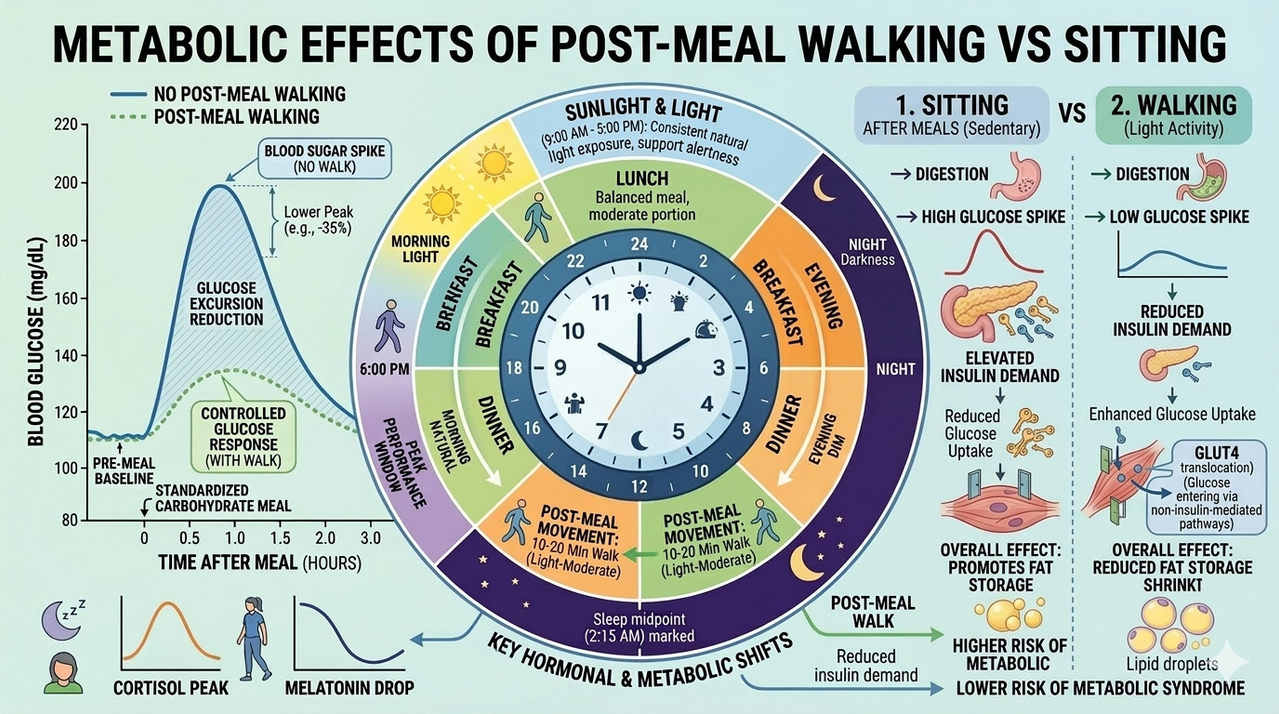
2. Is Walking After Meals Effective for Fat Loss?
Yes, walking after meals is highly effective for fat loss. It works through multiple mechanisms that directly impact how your body processes and stores energy from food.
2.1. Immediate Blood Sugar Control
When you walk after eating, your muscles contract and use glucose from your bloodstream for energy—even at low intensity. This reduces the amount of glucose available to be stored as fat and decreases the insulin response . A 2025 study in the Journal of Clinical Endocrinology & Metabolism found that light-intensity walking significantly reduced postprandial glucose and insulin concentrations in young obese adults .
2.2. Reduced Fat Storage
Lower insulin levels mean less stimulus for fat storage. Insulin is a storage hormone—when it's high, your body stores energy as fat. By blunting the insulin spike, post-meal walking shifts your body toward using rather than storing the energy you just consumed .
2.3. Calorie Burn Adds Up
A 10-15 minute walk after each meal (breakfast, lunch, dinner) adds up to 30-45 minutes of activity daily—that's 150-300 extra calories burned without structured exercise .
3. The Science: What Happens When You Walk After Eating
3.1. The 2025 Oxford Study
A landmark 2025 randomized crossover trial in The Journal of Clinical Endocrinology & Metabolism examined young obese adults and found that all patterns of light-intensity walking significantly reduced postprandial (post-meal) glucose concentrations and diastolic blood pressure compared to sitting . Continuous 30-minute walks, or combined patterns, also lowered insulin concentrations .
3.2. The Sports Medicine Meta-Analysis
A meta-analysis in Sports Medicine found that walking just 2-5 minutes after a meal causes blood sugar levels to rise and fall more gradually than sitting . This gentle curve reduces the insulin spike and the amount of glucose that might otherwise be stored as fat .
3.3. The After-Dinner Advantage
Walking after dinner—the meal most often followed by inactivity—may be particularly beneficial. It can help shift fuel utilization toward stored fat during sleep and prevent the overnight glucose elevations that contribute to metabolic disease .
4. How Long Should You Walk After Meals?
4.1. 2-5 Minutes: The Minimum Effective Dose
Even short walks of 2-5 minutes after a meal provide significant metabolic benefits, including reduced blood sugar spikes and improved insulin sensitivity . This is the perfect starting point for beginners .
4.2. 10-15 Minutes: The Sweet Spot
A 10-15 minute walk after each meal (especially lunch and dinner) provides substantial benefits for blood sugar control and adds meaningful calorie burn . This is the most practical and effective duration for most people .
4.3. 30 Minutes: Maximum Benefits
A 30-minute continuous walk or multiple shorter walks totaling 30 minutes provides the greatest metabolic benefits . This can be done as one longer walk or broken into three 10-minute walks after meals .
| Duration | Key Benefits | Best For |
|---|---|---|
| 2-5 minutes | Blunts blood sugar spikes | Absolute beginners, post-meal baseline |
| 10-15 minutes | Optimal glucose control + calorie burn | Most people, practical and effective |
| 30 minutes | Maximum metabolic benefits | Those seeking enhanced results |
5. What to Eat (and When) for Best Results
5.1. Pre-Walk Nutrition Tips
Focus on balanced meals with protein, fiber, and healthy fats to stabilize blood sugar before your walk . Avoid large meals heavy in refined carbs and sugar, which can cause energy crashes .
5.2. Sample 2000-Calorie Day with Post-Meal Walks
Breakfast (7:30 AM) – 450 kcal
- 3 eggs (18g protein) with spinach
- 1 slice whole-grain toast
- 1 cup berries
- Post-breakfast walk: 10 minutes (8:30 AM)
Lunch (12:30 PM) – 550 kcal
- 5 oz grilled chicken (35g protein)
- 1 cup quinoa
- Large salad with olive oil
- Post-lunch walk: 15 minutes (1:15 PM)
Dinner (7:00 PM) – 600 kcal
- 5 oz salmon (35g protein)
- 1 cup roasted vegetables
- 1 medium sweet potato
- Post-dinner walk: 15 minutes (8:00 PM)
Total Steps Added: ~5,000 steps from walks alone
5.3. Vegan/Vegetarian Adaptation
- Replace eggs with tofu scramble (6 oz firm tofu = 15g protein)
- Replace chicken with 6 oz tempeh (30g) or seitan
- Replace salmon with 6 oz extra-firm tofu + 1 cup lentils
6. 7-Day Post-Meal Walking Plan for Fat Loss
Week 1: Building the Habit
- Days 1-2: 5-minute walk after dinner only
- Days 3-4: 5-minute walks after lunch and dinner
- Days 5-7: 10-minute walks after lunch and dinner
Week 2 and Beyond: Optimizing Benefits
- Goal: 10-15 minute walks after each meal (breakfast, lunch, dinner)
- Total daily walking: 30-45 minutes of light activity
- Additional tip: Use a step counter and aim for 8,000-10,000 steps daily
7. Common Post-Meal Walking Mistakes
- Mistake #1: Walking too intensely. High-intensity exercise right after eating can cause digestive distress and nausea. Keep it light (conversational pace) .
- Mistake #2: Waiting too long. The metabolic benefits are greatest within 30-60 minutes after eating .
- Mistake #3: Not being consistent. A single post-meal walk is good; doing it after every meal is transformative .
- Mistake #4: Wearing inappropriate footwear. Discomfort leads to inconsistency. Invest in supportive walking shoes .
- Mistake #5: Forgetting hydration. Even light walking requires water. Stay hydrated .
8. Frequently Asked Questions
Is walking after meals effective for fat loss?
Yes, it's highly effective. Walking after meals reduces blood sugar spikes, lowers insulin (a fat-storage hormone), and adds calorie burn—all of which contribute to fat loss .
How long should I walk after eating to lose weight?
Aim for 10-15 minutes after each meal. This provides optimal blood sugar control and adds meaningful calorie burn. Even 2-5 minutes provides benefits .
Does walking after dinner help burn belly fat?
Yes, walking after dinner is particularly beneficial. It helps prevent overnight glucose elevations and may shift fuel utilization toward stored fat during sleep .
How soon after eating should I walk?
Walk within 30-60 minutes after finishing your meal for maximum metabolic benefits. This timing captures the postprandial glucose peak .
Is it better to walk before or after meals?
Both are beneficial, but for different reasons. Post-meal walking specifically targets the blood sugar spike and insulin response from that meal . Pre-meal walking may use stored fat for fuel . Ideally, do both.
Can walking after meals replace my regular exercise?
No, post-meal walking should complement, not replace, your regular exercise routine. It's an additional habit that enhances overall activity and metabolic health .
9. Related Resources
- Low-Intensity Walking for Fat Loss: Simple Strategy to Burn More Fat
- How to Handle Hunger Pangs During a Strict Cutting Phase (Athlete’s Guide)
- Intermittent Fasting for Bodybuilders: Pros, Cons, and Muscle-Building Truth
- How to Lose Belly Fat Without Losing Muscle (Science-Based Guide)
- Why You’re Not Losing Fat Despite Eating Clean (7 Science-Backed Reasons)
10. Scientific References
- Wongpipit, W., et al. (2025). Light Walking Patterns and Postprandial Cardiometabolic Responses in Young Obese Adults: A Randomized Crossover Study. The Journal of Clinical Endocrinology & Metabolism, 110(8), 2252–2262. View Source
- Women's Health. (2025). What Happens To Your Body When You Walk For Just 2 Minutes—Or As Much As 60 Minutes. womenshealthmag.com. View Source
- Women's Health. (2025). Walking At This Pace 'Significantly' Boosted Weight Loss In Women Over 50, Per Study. womenshealthmag.com. View Source
- Healthline. (2025). Walking After Eating: Benefits and Drawbacks. healthline.com. View Source
- Health. (2025). Should You Go for a Walk After You Eat? Here's What Happens to Your Body. health.com. View Source
- Women's Health Taiwan. (2024). 研究顯示「散步減肥」你該走幾步!散步多做「這件事」幫你提升燃脂、增加肌肉量. womenshealthmag.com. View Source
- Buettner, C., et al. (2007). Walking after meals improves postprandial glycemia. Diabetes Care. PubMed
- DiPietro, L., et al. (2013). Three 15-min walks after meals improves 24-hour glycemic control in older people. Diabetes Care. PubMed
- Reynolds, A. N., & Venn, B. J. (2018). The timing of activity after eating affects postprandial glucose. Diabetologia. PubMed
- National Library of Medicine. (2025). Walking after meals. medlineplus.gov. View Source
Join the conversation