Intermittent Fasting for Bodybuilders: Pros, Cons, and Muscle-Building Truth
Intermittent Fasting for Bodybuilders: Pros and Cons

⚡ TL;DR
Intermittent fasting for bodybuilders: pros and cons depends entirely on your goal. A 2025 BarBend analysis of new research shows that IF without resistance training can lead to 2.4 kg of lean mass loss in 8 weeks . However, when combined with resistance training, IF preserves muscle while enhancing fat loss . A 2026 Wiley study found that IF plus resistance training led to twofold greater fat loss with no negative impact on strength or testosterone:cortisol ratio . Crucially, a 2024 Clinical Nutrition RCT demonstrated that short-term alternate-day fasting does not impair muscle protein synthesis when protein intake is adequate . The verdict: IF is excellent for cutting phases, but suboptimal for maximal muscle building . This guide provides the science, protocols, and sample meal plans to decide if IF is right for you.
1. The IF Dilemma: Fat Loss Tool or Muscle Killer?
You've seen the headlines. Intermittent fasting (IF) is everywhere—from elite athletes like Luka Dončić using it to transform their physique, to your gym buddies swearing by it for getting shredded . But as a bodybuilder, you have a unique concern: will skipping meals cost you your hard-earned muscle?
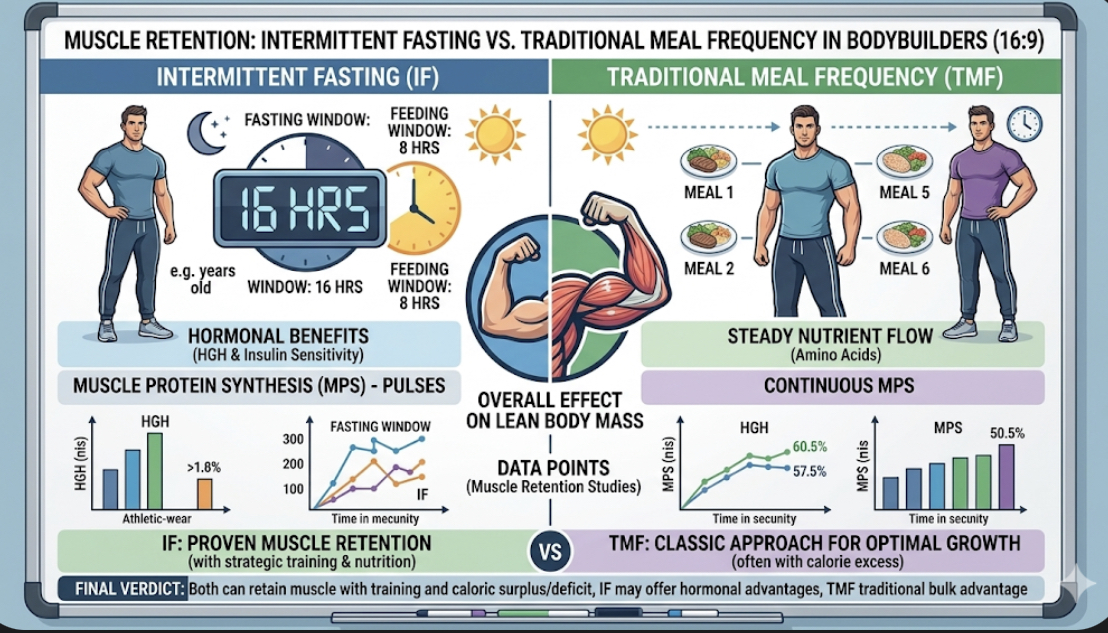
The debate has been fierce, but 2024-2026 research has finally provided clear answers. The question of intermittent fasting for bodybuilders: pros and cons isn't a simple yes or no. It depends on your goal, your training, and how you structure your eating window. This guide synthesizes the latest peer-reviewed studies to help you decide if IF aligns with your objectives.
2. The Science: What 2024-2026 Research Reveals
2.1. The 2025 BarBend Analysis: Fasting Without Weights = Muscle Loss
A March 2025 study in the Journal of the International Society of Sports Nutrition examined eight weeks of time-restricted feeding (10-hour window) with and without resistance training . The IF-only group lost an average of 2.6 kg of total weight, with 2.4 kg coming from lean mass . Fat loss was minimal. Dr. Layne Norton's analysis confirmed: "The majority of the weight loss actually came from a reduction in lean mass" . This is a critical warning for bodybuilders considering IF without lifting.
2.2. The 2026 Wiley Study: IF + Resistance Training = Fat Loss, Muscle Preserved
Conversely, a 2026 randomized controlled trial in Journal of Obesity combined 4:3 intermittent fasting (three non-consecutive fast days weekly) with resistance training in obese males . The IF/RT group lost twofold more weight and fat than the control/RT group, with no differences in muscle strength or the testosterone:cortisol ratio . This suggests IF may actually enhance the fat-loss effects of resistance training without compromising anabolic hormones.
2.3. The 2024 MPS Breakthrough: Protein Timing Isn't Everything
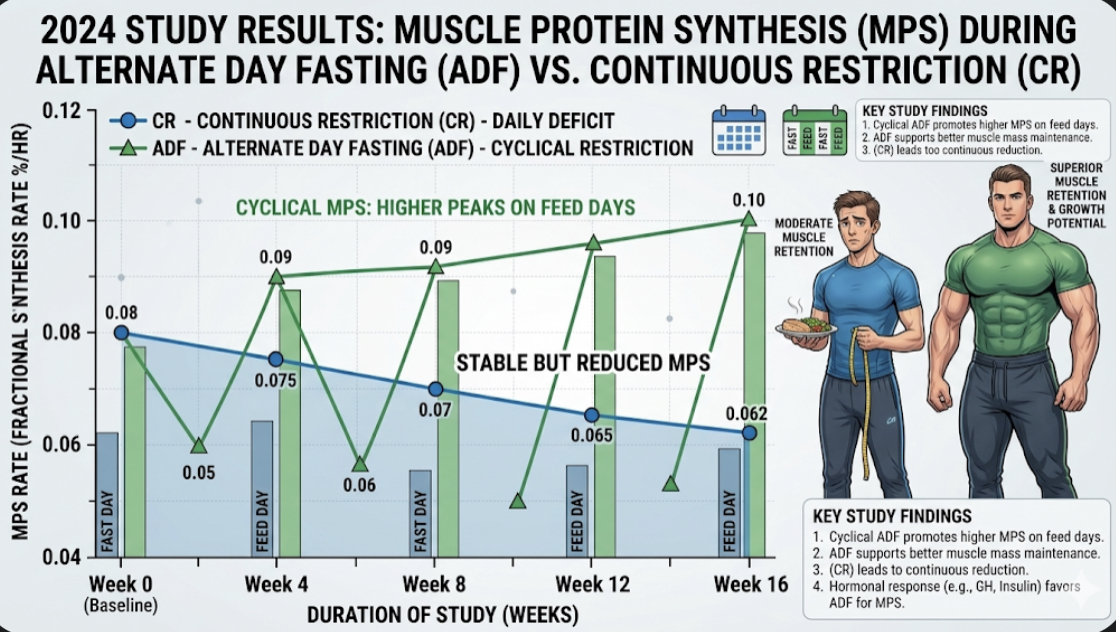
A landmark 2024 study in Clinical Nutrition used deuterated water to measure muscle protein synthesis (MPS) during alternate-day fasting . Despite concerns that irregular meal patterns would impair MPS, researchers found no differences in daily MPS rates between ADF, continuous energy restriction, and control groups, as long as total protein intake was matched . This suggests that hitting your daily protein target may be more important than perfect meal timing.
3. The Pros: Why Bodybuilders Use Intermittent Fasting
3.1. Enhanced Fat Loss During Cutting
The 2026 Wiley study demonstrated that IF combined with resistance training led to superior fat loss compared to training alone . The mechanism? Fasting lowers insulin levels, promoting fat oxidation, while training preserves muscle .
3.2. Improved Insulin Sensitivity
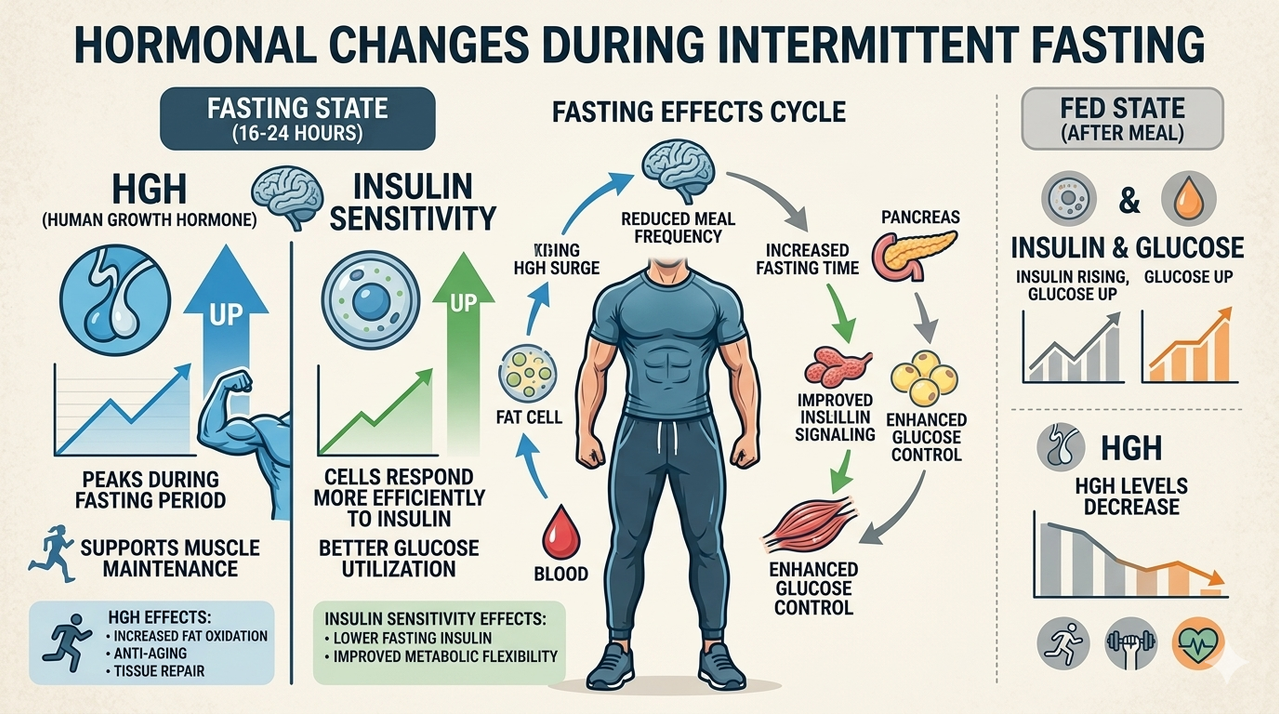
Fasting improves insulin sensitivity, which helps nutrients shuttle into muscle cells rather than being stored as fat . This can be particularly beneficial during a cutting phase when insulin resistance can increase .
3.3. Growth Hormone Elevation
Growth hormone levels rise naturally during fasting, which may aid fat burning and muscle repair . One study noted that combining IF with strength training creates a hormonal environment favorable for body composition changes .
3.4. Simplicity and Adherence
For many, IF simplifies life. Leslie Bonci, R.D., notes that IF "can decrease calorie intake, can help with better sleep as the stomach won't be having a fiesta" . By reducing the number of meals, some find it easier to stick to a calorie deficit .
4. The Cons: Risks and Drawbacks for Bodybuilders
4.1. Muscle Loss Without Proper Training
The 2025 BarBend analysis is stark: IF without resistance training led to significant lean mass loss . Even with training, if protein intake is inadequate, muscle loss can occur .
4.2. Performance and Energy Dips
"Fasting can blunt performance, particularly during explosive or high-volume workouts," warns Dr. Doug Lucas . Lifting heavy on an empty stomach isn't for everyone, and some may experience significant energy crashes .
4.3. Difficulty Consuming Enough Protein
Hitting 1.6-2.2 g/kg of protein in a compressed eating window can be challenging. This may require strategic planning and possibly protein supplementation .
4.4. Individual Variability: Sex Differences
"Men and women often respond differently to fasted training," explains Lucas. "Women, in particular, may have a heightened stress response, which can reduce adrenal testosterone production and negatively impact energy, recovery, and hormone balance" .
5. How to Implement IF for Bodybuilding: Evidence-Based Protocols
5.1. For Cutting (Fat Loss Focus)
The 2026 study used a 4:3 protocol: three non-consecutive fast days (eating ~25% of needs) and four normal eating days per week . Alternatively, 16:8 time-restricted feeding (fast 16h, eat 8h) is popular and effective for weight loss .
- Schedule workouts during or just before your eating window to ensure pre- and post-workout nutrition .
- Prioritize protein: 2.0-2.2 g/kg on all days to preserve muscle .
5.2. For Bulking (Muscle Building)
Experts agree: IF is not optimal for bulking . Building muscle requires a calorie surplus and frequent protein feeding to maximize MPS . Angelo Poli states, "Unless you're a real novice, you can't build appreciable muscle in a caloric deficit" .
- Avoid IF during bulking phases. Spread meals across 4-6 feedings .
5.3. Workout Timing Strategies
For those committed to IF, sandwich your workout around meals: "Eat one third of your meal before the gym, and the other two thirds of the meal afterwards" . This provides fuel for performance and nutrients for recovery .
6. Sample Intermittent Fasting Meal Plans
6.1. 16:8 Protocol – 2500 Calorie Cutting Plan
Eating window: 12:00 PM – 8:00 PM (for a 180 lb athlete targeting 180g protein). Based on Mediterranean principles .
First Meal (12:00 PM) – 800 kcal | 45g protein
- 5 oz grilled chicken (35g protein)
- 1 cup quinoa (8g protein)
- Large salad with olive oil
- 1 cup Greek yogurt (20g protein) with berries
Second Meal (4:00 PM) – 700 kcal | 50g protein
- 6 oz salmon (40g protein)
- 1 large sweet potato
- 2 cups roasted vegetables
Third Meal (7:30 PM) – 800 kcal | 45g protein
- 6 oz lean beef (40g protein)
- 1.5 cups brown rice (6g protein)
- Side salad
- 1 tbsp nut butter for fats
Total: ~2,300 kcal, ~140g protein (adjust portions)
6.2. Vegan/Vegetarian Adaptation
- Replace chicken with 6 oz tempeh (30g) or 8 oz tofu (20g)
- Replace salmon with 6 oz extra-firm tofu + 1 cup lentils
- Use pea protein shakes to hit protein targets
- Add nutritional yeast for B12 and protein boost
7. Common Intermittent Fasting Mistakes
- Mistake #1: Fasting without resistance training. This is a recipe for muscle loss, as shown in the 2025 study .
- Mistake #2: Inadequate protein intake. You need 1.6-2.2 g/kg—hard to achieve if you don't prioritize it .
- Mistake #3: Poor workout timing. Lifting at the end of a 16-hour fast can crater performance .
- Mistake #4: Ignoring individual response. Women may experience hormonal disruptions; monitor energy and cycle .
- Mistake #5: Expecting to bulk. IF is a cutting tool, not a mass-gain strategy .
8. Related Resources
9. Scientific References
- Ramos, T. (2025). Build Muscle, Lose Fat — Intermittent Fasting, Resistance Training, or Both? BarBend. View Source
- Kouw, I. W. K., et al. (2024). Short-term intermittent fasting and energy restriction do not impair rates of muscle protein synthesis. Clinical Nutrition, 43(11), 174-184. View Source
- Farahmand Khoshkebijari, A., et al. (2026). Intermittent Fasting May Enhance Resistance Training Effects on the Body Composition of Obese Males. Journal of Obesity, 2026(1), 6409069. View Source
- Crunch Fitness. (2025). Intermittent Fasting and Strength Training - How to Do it Correctly. crunch.com. View Source
- Health. (2026). What Happens to Your Body When You Strength Train While Fasting. health.com. View Source
- Men's Health. (2025). What to Know About Intermittent Fasting and Your Workouts. menshealth.com. View Source
- Mortezapour, E., et al. (2025). Effect of Intermittent Fasting on Physical Performance and Exercise Outcomes: A Systematic Review and Meta-Analysis. Journal of Food Biochemistry, 2025(1), 2856753. View Source
- Kouw, I. W. K., et al. (2024). Short-term intermittent fasting and energy restriction do not impair rates of muscle protein synthesis. PubMed. View Source
- Schytz, C. T., et al. (2023). Lowered muscle glycogen reduces body mass with no effect on short-term exercise performance in men. Scandinavian Journal of Medicine & Science in Sports. PubMed
- Eroglu, M. N., et al. (2023). The effects of 24-h fasting on exercise performance and metabolic parameters. Nutrients. PubMed
Join the conversation