Low-Intensity Walking for Fat Loss: Simple Strategy to Burn More Fat
The Benefits of Low-Intensity Walking for Fat Loss

⚡ TL;DR
The benefits of low-intensity walking for fat loss are backed by decades of research. Walking at a slow to moderate pace (around 3.2 mph) preferentially burns fat for fuel, as your body has enough oxygen to break down fatty acids through beta-oxidation . A 2025 Oxford Academic study found that light-intensity walking significantly reduces post-meal blood sugar and insulin levels, directly combating fat storage . A 30-minute walk burns 100-200 calories, and a daily 45-minute routine can add up to 2,000 calories weekly—enough for meaningful fat loss without increasing hunger . This guide explains the science, optimal duration, and how to pair walking with nutrition for maximum results.
1. The Most Underrated Fat Loss Tool
In a world obsessed with high-intensity interval training (HIIT), CrossFit, and grueling workouts, the simple act of walking has been pushed to the sidelines. It's often viewed as "not enough"—something you do only when you can't do "real" exercise. But this perception misses the point entirely.
The truth is, the benefits of low-intensity walking for fat loss are profound, sustainable, and accessible to almost everyone. Unlike high-intensity exercise that can burn out your nervous system and joints, walking is an activity you can perform daily, for years, without injury . Research confirms that total daily movement—especially low-intensity movement like walking—often matters more for fat loss than any single heroic workout . This guide explores the science, the strategies, and the practical steps to harness the power of walking.
2. The Science: How Walking Burns Fat
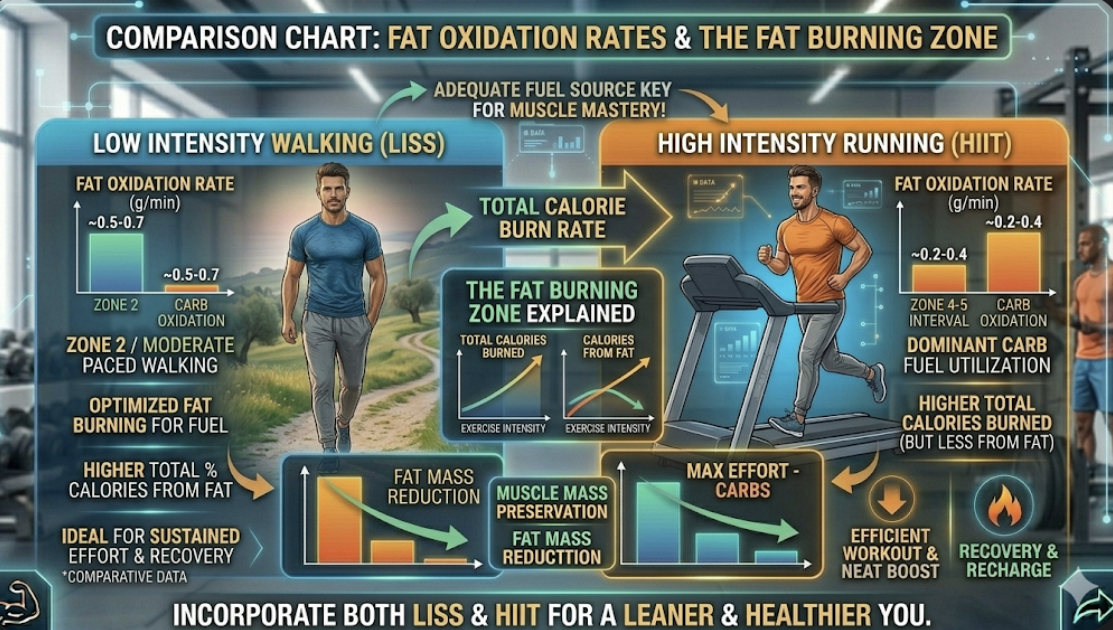
2.1. The Fat-Burning Zone Explained
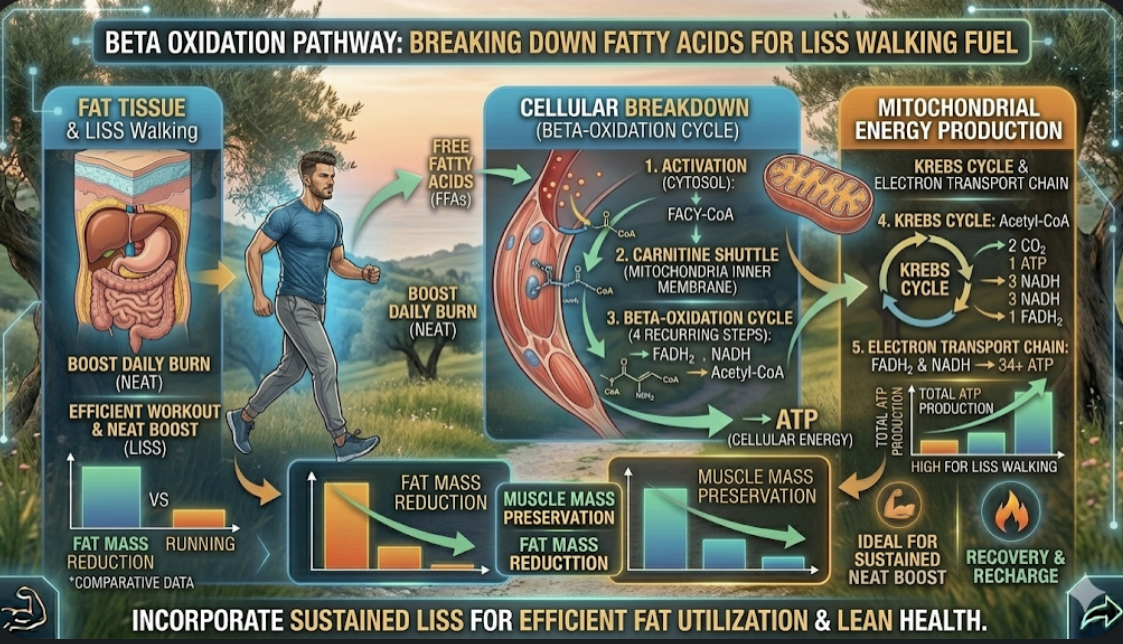
The concept of a "fat-burning zone" comes from exercise physiology. At lower intensities, your body has enough oxygen to break down fatty acids through a process called beta-oxidation . This requires time and oxygen, which is readily available during a leisurely walk. As intensity increases, your body needs energy faster and shifts to burning carbohydrates (glycogen), which are quicker to access .
2.2. The 2013 Fatmax Study
Research published in the Journal of Exercise Physiology found that sedentary women naturally self-selected a walking pace that corresponded to their maximal fat oxidation rate (Fatmax)—around 51% of VO₂ max . This suggests that your body intuitively knows the right pace for burning fat; you don't need to force it.
2.3. The 2025 Oxford Study: Metabolic Benefits
A landmark 2025 randomized crossover trial in the Journal of Clinical Endocrinology & Metabolism examined young obese adults and found that all patterns of light-intensity walking significantly reduced postprandial (post-meal) glucose concentrations and diastolic blood pressure compared to sitting . Continuous 30-minute walks, or combined patterns, also lowered insulin concentrations, highlighting walking's role in improving glycemic control .
3. How Much Walking Do You Need?
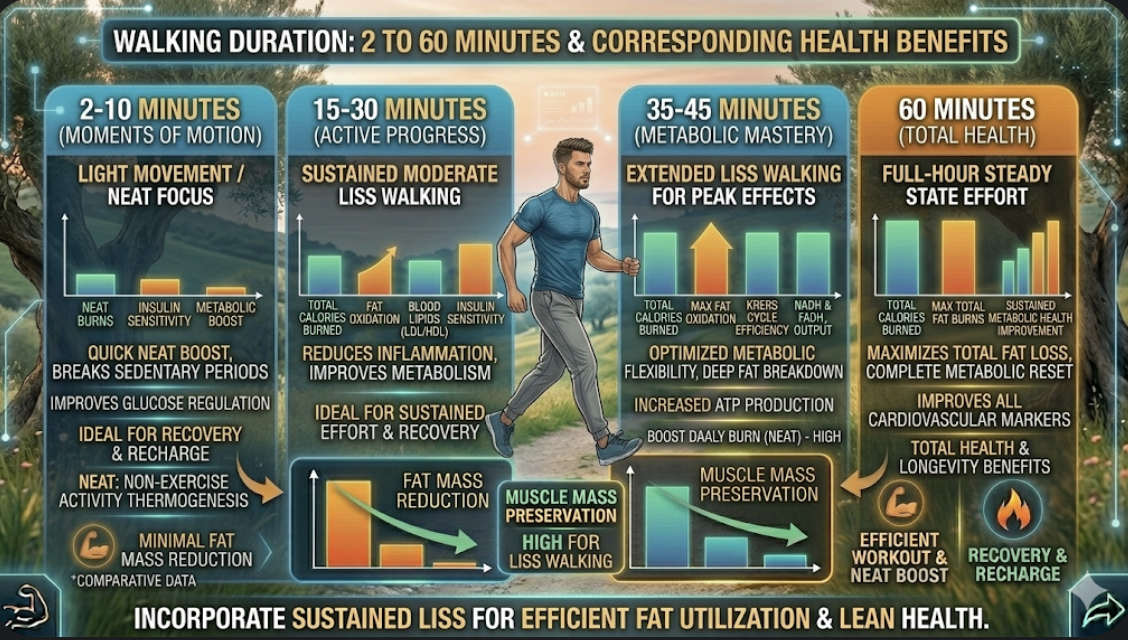
3.1. 2-5 Minutes: Post-Meal Blood Sugar Control
A meta-analysis in Sports Medicine found that walking just 2-5 minutes after a meal causes blood sugar levels to rise and fall more gradually than sitting . This reduces the insulin spike and the amount of glucose that might otherwise be stored as fat .
3.2. 30 Minutes: The Daily Baseline
Walking for 30 minutes daily burns approximately 100-200 calories . Over a week, that's 700-1,400 calories. NASM-certified trainer Susane Pata notes that for those who are overweight and previously sedentary, this cumulative deficit can lead to meaningful weight loss over time .
3.3. 45-60 Minutes: Maximum Fat Loss
A 45-60 minute daily walk can burn roughly 1,500-2,000 calories per week . This is enough to produce significant fat loss without dramatically increasing hunger, making it highly sustainable .
| Duration | Calories Burned* | Primary Benefit |
|---|---|---|
| 2-5 min (post-meal) | ~15-40 | Blunts blood sugar spikes, reduces fat storage |
| 30 min | 100-200 | Daily baseline, 700-1,400 kcal/week |
| 45-60 min | 200-400 | 1,500-2,000 kcal/week, sustainable fat loss |
| 200 min (extreme) | ~1,000+ | Clinically significant weight loss (case study) |
*Based on a 150 lb person. Actual burn varies by weight and pace.
4. Pace Matters: Why Slower Can Be Better
4.1. The 2022 Study on Women Over 50
A study published in Nutrients followed postmenopausal women for 30 weeks. Those who walked at a slower pace (3.2 mph, about 54 min/day) lost 2.73 times more fat than those who walked faster (4.1 mph) . The researchers theorized that faster walking may shift fuel utilization toward glucose, while slower walking keeps you in the fat-burning zone .
4.2. Finding Your Fatmax Pace
Research shows that maximal fat oxidation (Fatmax) occurs at around 51% of VO₂ max for sedentary women . For most people, this translates to a pace where you can still hold a conversation, but might be breathing slightly heavier than at rest—roughly 5.0 km/h (3.1 mph) .
4.3. The Incline Advantage
Trainer Holly Perkins recommends walking on an incline to increase heart rate without needing to speed up . "I have all my clients walk on an incline because they can walk slower but still get their heart rate high, which will minimize the potential for soreness and injury," she explains .
5. NEAT: The Hidden Fat Loss Variable
5.1. What is NEAT?
NEAT (Non-Exercise Activity Thermogenesis) is the energy you burn doing everything that isn't sleeping, eating, or formal exercise—walking to the car, fidgeting, standing, even shopping. It can account for a 2,000 calorie per day difference between sedentary and active individuals .
5.2. Walking and NEAT
Walking is the most effective way to increase your NEAT. Unlike structured workouts that last 45 minutes, NEAT accumulates throughout the day. Parking farther away, taking stairs, and walking during phone calls all contribute to your total energy expenditure .
5.3. The 2024 German Case Study
A fascinating feasibility study from the German Cancer Research Center followed one subject who walked 200 minutes daily on a desk treadmill while working. The intervention led to substantial weight loss, comparable to bariatric surgery, and activated fatty acid beta-oxidation that persisted for 1.5 days after exercise . While extreme, it illustrates the power of consistent low-intensity movement.
6. Nutrition: Fueling Your Walks
6.1. Pre-Walk Nutrition
Because walking is low-intensity, you don't need a large pre-workout meal. A small piece of fruit 30 minutes before can provide a gentle energy boost without spiking insulin.
6.2. Post-Walk Recovery
For walks under 60 minutes, water is sufficient. For longer walks (60+ minutes), consider a snack with protein and carbs to support muscle repair. Registered dietitian Alissa Palladino recommends combining walking with a balanced, high-protein diet for optimal fat loss .
6.3. Sample 1800-Calorie Walking Day
- Breakfast (7:30 AM): 3 eggs (18g protein), 1 slice whole-grain toast, 1 cup berries → 400 kcal
- Morning Walk (9:00 AM): 30 min brisk walk
- Lunch (12:30 PM): 5 oz grilled chicken (35g), large salad with olive oil, ½ cup quinoa → 500 kcal
- Afternoon Walk (3:00 PM): 15 min walk after snack
- Snack (4:00 PM): 1 cup Greek yogurt (20g) with berries → 200 kcal
- Dinner (7:30 PM): 5 oz salmon (35g), 1 cup roasted vegetables, 1 medium sweet potato → 550 kcal
- Evening Walk (8:30 PM): 10 min gentle walk post-dinner
- Total: ~1,650 kcal, ~120g protein
6.4. Vegan/Vegetarian Adaptation
- Replace eggs with tofu scramble (6 oz = 15g protein)
- Replace chicken with 6 oz tempeh (30g) or seitan
- Replace salmon with 6 oz extra-firm tofu + 1 cup lentils
- Use pea protein shakes as needed
7. Real-World Results: Walking Works
7.1. Christie's 100-Day Challenge
Christie Pham, a 45-year-old mother, started a "one mile a day" challenge. After 100 days, she had lost 16 pounds (7.2 kg), reduced her cholesterol from 240 to 198 mg/dL, and improved her sleep quality so much she no longer needed morning coffee .
7.2. Beatrice's 21-Day Transformation
Beatrice Caruso, a young woman who struggled with her weight, committed to walking or running one mile daily for 21 days. She lost 5.4 pounds (2.45 kg) and 2 inches from her hips, proving that even short-term consistency yields results .
8. Common Walking Mistakes
- Mistake #1: Not walking consistently. A 5-mile walk once a week is less effective than 1 mile daily. Consistency trumps intensity .
- Mistake #2: Walking in poor footwear. Invest in supportive walking shoes to prevent injury and make the experience enjoyable .
- Mistake #3: Forgetting hydration. Even low-intensity exercise requires water. Dehydration reduces energy and performance .
- Mistake #4: Never increasing challenge. As you get fitter, add inclines, intervals, or wear a weighted vest to increase calorie burn .
- Mistake #5: Ignoring post-meal walks. A 2-5 minute walk after eating is one of the most powerful tools for blood sugar control .
9. Related Resources
10. Scientific References
- 健康遠見. (2024). 中年也有效!她們每天做走路運動竟更好入睡還減肥,研究:輕鬆走有助睡眠. gvm.com.tw. View Source
- Women's Health. (2025). What Happens To Your Body When You Walk For Just 2 Minutes—Or As Much As 60 Minutes. womenshealthmag.com. View Source
- Elsangedy, H. M., et al. (2013). Are sedentary women able to self-select a walking intensity that corresponds to maximal fat oxidation (Fatmax)? Journal of Exercise Physiology Online, 16(2), 32-39. View Source
- Women's Health Taiwan. (2024). 研究顯示「散步減肥」你該走幾步!散步多做「這件事」幫你提升燃脂、增加肌肉量. womenshealthmag.com. View Source
- Women's Health. (2025). Walking At This Pace 'Significantly' Boosted Weight Loss In Women Over 50, Per Study. womenshealthmag.com. View Source
- Men's Health. (2021). What to Expect if You're Walking to Burn Fat. menshealth.com. View Source
- Men's Fitness. (2026). Why Walking Is the Most Underrated Fat Loss Tool. mensfitness.com. View Source
- Wongpipit, W., et al. (2025). Light Walking Patterns and Postprandial Cardiometabolic Responses in Young Obese Adults: A Randomized Crossover Study. The Journal of Clinical Endocrinology & Metabolism, 110(8), 2252–2262. View Source
- POPSUGAR UK. (2019). Yes, You Can Burn Fat Walking — Here's Exactly How to Do It, According to a Trainer. popsugar.co.uk. View Source
- Pfaff, D., et al. (2023). Walking 200 min per day keeps the bariatric surgeon away. Heliyon, 9(6), e16556. View Source
Join the conversation