How to Break a Fat Loss Plateau Quickly (Proven Strategies That Work)
How to Break a Fat Loss Plateau Quickly (Proven Strategies That Work)

⚡ TL;DR
If you're wondering how to break a fat loss plateau quickly, the first step is understanding why it happens. When you lose weight, your body's calorie needs drop—a phenomenon called metabolic adaptation . The LION study found that resting metabolic rate can drop by an average of 70 kcal/day more than predicted after weight loss . Your NEAT (non-exercise activity) also unconsciously decreases . To break the plateau, you need to: 1) Recalculate your calorie needs, 2) Adjust macros (increase protein), 3) Use refeed days or diet breaks, 4) Change up your training, and 5) Optimize sleep and stress. This guide provides proven, science-backed strategies to get the scale moving again.
1. The Plateau Reality: Why Progress Stops
You've been diligent. You're eating clean, tracking calories, and hitting the gym consistently. Yet for the past two, three, even four weeks, the scale hasn't budged. Your measurements are the same. The mirror hasn't changed.
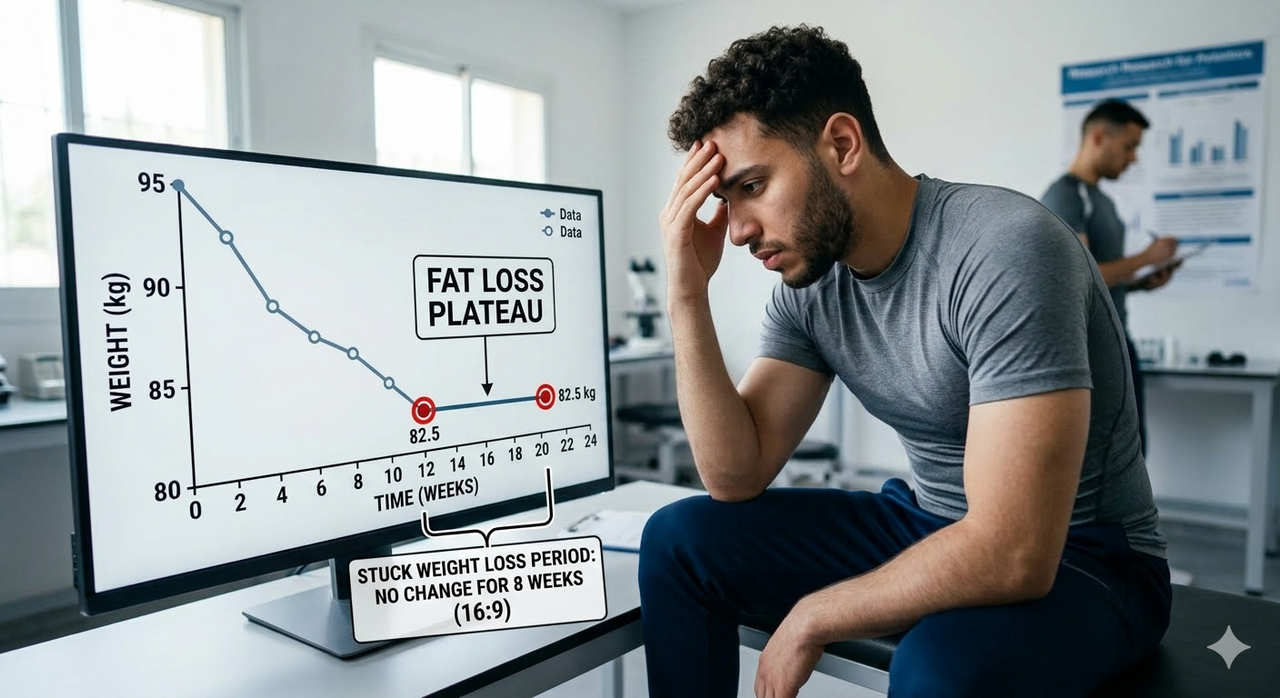
Welcome to the fat loss plateau—one of the most frustrating experiences in any weight loss journey. But here's the crucial truth: a plateau isn't a sign that you've failed. It's a sign that your body has adapted to your current strategy. Understanding how to break a fat loss plateau quickly requires understanding the science of metabolic adaptation and using targeted interventions to reset your progress. This guide provides 7 proven strategies, backed by the latest 2025/2026 research, to get you unstuck.
2. Why Does Fat Loss Plateau Happen?
2.1. Metabolic Adaptation: The LION Study
When you lose weight, your body fights back. The LION study, published in 2025, tracked 234 participants through weight loss and found that after an 8-week intervention, resting metabolic rate dropped by 70.9 kcal/day more than predicted based on new body composition . This metabolic adaptation is directly associated with the amount of weight lost . Your body becomes more efficient at using fewer calories.
2.2. The NEAT Crash
Your Non-Exercise Activity Thermogenesis (NEAT)—the calories you burn from fidgeting, walking, and daily movement—can unconsciously drop when you diet. Japanese research confirms that this "micro-movement" reduction can cost you 200-300 calories daily .
2.3. Hormonal Changes
Dieting increases ghrelin (hunger hormone) and decreases leptin (satiety hormone) . This makes you hungrier while feeling less satisfied—a double whammy that can lead to unintentional overeating .
2.4. Your Calorie Deficit Shrinks
The lighter you get, the fewer calories you burn at rest and during exercise. A 500-calorie deficit at 200 lbs becomes a 300-calorie deficit at 180 lbs . If you haven't adjusted your intake, you're no longer in a deficit.
3. Strategy #1: Recalculate Your Calorie Needs
3.1. Your New Body Needs Fewer Calories
If you've lost significant weight, your maintenance calories have dropped. You can no longer eat what you did when you started. Use an online calculator or work with a professional to find your new maintenance, then subtract 300-500 calories for a fresh deficit .
3.2. Sample Recalculation
For a person who started at 200 lbs (91 kg) and is now 180 lbs (82 kg):
- Original maintenance: ~2,800 kcal
- New maintenance: ~2,600 kcal
- New deficit target: 2,100-2,300 kcal
4. Strategy #2: Adjust Macronutrients
4.1. Increase Protein
Protein has the highest thermic effect of food (TEF)—you burn 20-30% of its calories during digestion . Higher protein also preserves muscle, which is metabolically active. Aim for 1.6-2.2g per kg of body weight . For a 180 lb person, that's 130-180g daily.
4.2. Cycle Carbohydrates
Refeeds—planned increases in carbs—can boost leptin and provide mental relief . Try adding 200-300g of carbs on one or two training days per week .
4.3. Don't Fear Healthy Fats
Fats support hormone function. Keep them at 20-30% of total calories .
5. Strategy #3: Use Refeeds and Diet Breaks
5.1. What is a Refeed?
A refeed is a planned increase in calories—primarily from carbohydrates—for one or two days. This can boost leptin levels, increase metabolism, and provide psychological relief .
5.2. What is a Diet Break?
A diet break involves eating at maintenance calories for 1-2 weeks. Research suggests this can mitigate metabolic adaptation and improve adherence .
5.3. How to Implement
- Refeed: On heavy training days, add 200-400 calories from carbs (e.g., rice, potatoes, oats).
- Diet break: After 8-12 weeks of dieting, take 1-2 weeks at maintenance before resuming your deficit .
6. Strategy #4: Change Your Training
6.1. Increase NEAT
Add more daily movement without formal cardio: park farther, take stairs, walk during phone calls. Aim for 8,000-10,000 steps daily .
6.2. Try HIIT
High-Intensity Interval Training (HIIT) can increase EPOC (afterburn effect) and preserve muscle . Add 2-3 HIIT sessions weekly .
6.3. Progressive Overload in the Gym
If your strength hasn't increased, you may be losing muscle. Focus on adding weight or reps to signal muscle preservation .
7. Strategy #5: Track More Accurately
7.1. The Hidden Calories Trap
Research suggests people underreport calorie intake without realizing it . Cooking oils, condiments, and "bites" add up. Try a "calibration week" with a food scale .
7.2. Don't Eat Back Exercise Calories
Fitness trackers often overestimate burn. If you're eating back exercise calories, you might be eliminating your deficit .
8. Strategy #6: Optimize Sleep and Stress
8.1. The Sleep-Hunger Connection
Even one night of poor sleep can increase ghrelin by up to 15% and decrease leptin by 26% . Sleep-deprived individuals eat an average of 300 more calories per day .
8.2. Cortisol and Fat Storage
Chronic stress elevates cortisol, which promotes fat storage—especially around the midsection . Aim for 7-9 hours of quality sleep and incorporate stress-management practices .
9. Sample 1800-Calorie Plateau-Breaking Meal Plan
This sample plan prioritizes protein (140g) and nutrient density to combat metabolic adaptation .
Breakfast (7 AM) – 400 kcal | 35g protein
- 3 eggs scrambled with spinach (18g protein)
- 1 slice whole-grain toast (3g protein)
- 1 cup Greek yogurt (20g protein)
- ½ cup berries
Lunch (12 PM) – 450 kcal | 35g protein
- 5 oz grilled chicken breast (35g protein)
- 2 cups mixed greens with lemon juice
- ½ cup quinoa (4g protein)
- 1 tbsp olive oil
Snack (4 PM) – 200 kcal | 20g protein
- 1 cup cottage cheese (25g protein) or 1 scoop protein shake
Dinner (7 PM) – 500 kcal | 40g protein
- 5 oz salmon or lean beef (35g protein)
- 1 cup roasted broccoli
- 1 medium sweet potato (4g protein)
Total: ~1,550 kcal, ~130g protein (adjust portions to hit 1,800)
9.1. Vegan/Vegetarian Adaptation
- Replace eggs with tofu scramble (6 oz firm tofu = 15g protein)
- Replace chicken with 6 oz tempeh (30g) or seitan
- Replace salmon with 6 oz extra-firm tofu + 1 cup lentils
- Use pea protein shakes to hit protein targets
- Add nutritional yeast for B12 and protein boost
10. Frequently Asked Questions
What is a fat loss plateau and why does it happen?
A fat loss plateau occurs when weight loss stalls for several weeks despite continued efforts. It happens primarily due to metabolic adaptation (your body burns fewer calories), a drop in NEAT (unconscious movement), and hormonal changes that increase hunger .
How long should a plateau last before I change something?
Give it 2-3 weeks. Weight can fluctuate due to water retention. If after 3 weeks there's no downward trend, it's time to implement strategies like recalculating calories or adding a refeed .
What is metabolic adaptation and how much does it slow metabolism?
Metabolic adaptation is the body's tendency to reduce energy expenditure during weight loss. The LION study found an average adaptation of 70 kcal/day after 11.7 kg weight loss, but individual responses vary .
How many calories should I add for a refeed?
Add 200-400 calories from carbohydrates on a heavy training day. This can boost leptin and provide mental relief without significant fat gain .
Should I increase cardio to break a plateau?
Increasing NEAT (steps) is often more sustainable than adding more cardio. Aim for 8,000-10,000 steps daily before adding extra cardio sessions .
What if I've tried everything and still not losing?
Consult a healthcare provider to check for underlying conditions like hypothyroidism, PCOS, or medication side effects that can impact weight loss .
11. Related Resources
- Low-Intensity Walking for Fat Loss: Simple Strategy to Burn More Fat
- How to Handle Hunger Pangs During a Strict Cutting Phase (Athlete’s Guide)
- Intermittent Fasting for Bodybuilders: Pros, Cons, and Muscle-Building Truth
- How to Lose Belly Fat Without Losing Muscle (Science-Based Guide)
- Why You’re Not Losing Fat Despite Eating Clean (7 Science-Backed Reasons)
12. Scientific References
- Blanken, C., et al. (2025). Caloric restriction-induced metabolic adaptation associated with amount of body weight lost – results from the LION study. Adipositas, 19(03), 186. View Source
- 五藤良將 (Goto, Y.). (2025). 減少內臟脂肪不靠運動也可以!醫推「NEAT減重技巧」. 元氣網. View Source
- Rosenbaum, M., & Leibel, R. L. (2010). Adaptive thermogenesis in humans. International Journal of Obesity, 34(S1), S47-S55. PubMed
- Treuth, M. S., et al. (1996). Effects of resistance training on total energy expenditure in young adults. Journal of Applied Physiology, 81(6), 2409-2414. PubMed
- Morton, R. W., et al. (2018). A systematic review of protein supplementation on resistance training-induced gains. British Journal of Sports Medicine, 52(6), 376-384. PubMed
- Ro. (2025). Why Am I Not Losing Weight in a Calorie Deficit? 10 Possible Reasons. ro.co. View Source
- Healthgrades. (2024). Why Am I Not Losing Weight in a Calorie Deficit? healthgrades.com. View Source
- Verywell Health. (2025). Why Am I Not Losing Weight? 10 Reasons and What to Do. verywellhealth.com. View Source
- Trepanowski, J. F., et al. (2017). Effect of alternate-day fasting on weight loss, weight maintenance, and cardioprotection among metabolically healthy obese adults. JAMA Internal Medicine, 177(7), 930-938. PubMed
- Women's Health Taiwan. (2026). 日本研究證實!這「1 個習慣」比跑步更燃脂. womenshealthmag.com. View Source
Join the conversation