How to Fix a Failed Bulking Phase (Step-by-Step Recovery Guide)
How to Fix a Failed Bulking Phase (Step-by-Step Recovery Guide)
⚡ TL;DR
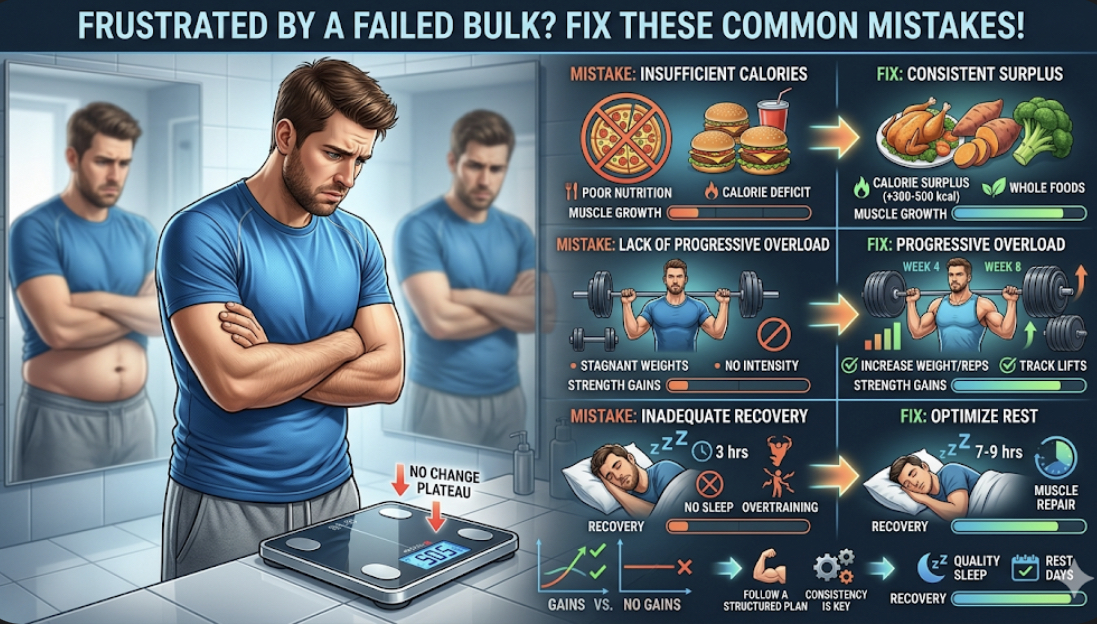
A failed bulking phase is characterized by excessive fat gain, little muscle growth, and stalled strength. To fix it: 1) Enter a maintenance or mini-cut phase (2–4 weeks) to reset insulin sensitivity and lose excess fat. 2) Recalculate your calorie needs based on current body weight. 3) Increase protein intake to 1.6–2.2 g/kg. 4) Fix training intensity—ensure progressive overload. 5) Prioritize sleep and recovery. This step-by-step guide will help you diagnose why your bulk failed and how to restart successfully .
1. The Failed Bulk: When More Isn't Better
You ate big. You trained hard. But instead of packing on muscle, you packed on fat. Your waist expanded, your lifts stalled, and you're left feeling soft and frustrated. You're not alone. Many lifters experience a failed bulking phase. The good news: it's fixable. This guide will help you diagnose the problems and implement a step-by-step recovery plan.
Why does a bulking phase fail?
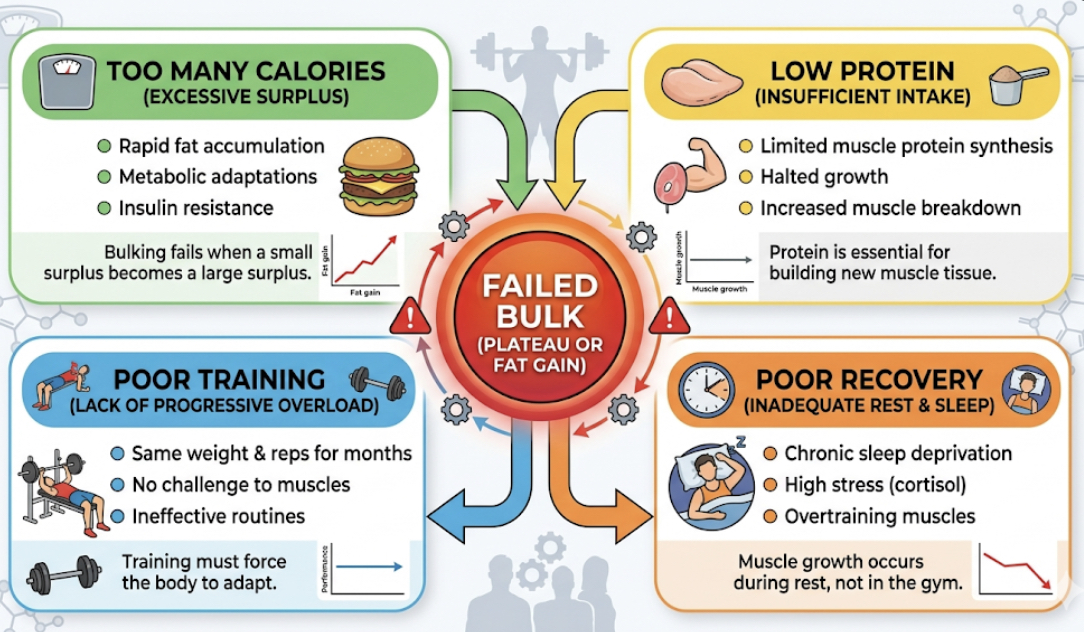
A bulking phase fails due to three primary reasons: 1) Poor calorie control—too large a surplus (500+ kcal) leads to excessive fat gain. 2) Low protein intake—below 1.6 g/kg limits muscle protein synthesis. 3) Ineffective training—lack of progressive overload or insufficient intensity means the surplus calories are stored as fat, not muscle . Additionally, poor sleep and recovery can sabotage results.
2. Step 1: Diagnose Why Your Bulk Failed
2.1. The Calorie Autopsy
Look at your weight gain rate. If you gained >0.5–1% body weight per week, your surplus was too large. For an 80 kg person, that's >0.4–0.8 kg per week. This almost always means excessive fat gain .
2.2. The Protein Check
Were you consistently hitting 1.6–2.2 g protein per kg body weight? If not, muscle protein synthesis was suboptimal, and more calories went to fat .
2.3. The Training Audit
Were your lifts increasing? If strength didn't improve or actually decreased during the bulk, your training wasn't providing enough stimulus for muscle growth .
2.4. Recovery Assessment
Were you sleeping 7–9 hours? High stress levels? Poor recovery impairs muscle growth and worsens nutrient partitioning .
- ☐ Weight gain >0.5% per week → surplus too large
- ☐ Protein <1.6 g/kg → too low
- ☐ Strength plateau or decline → training ineffective
- ☐ Sleep <7 hours → insufficient recovery
3. Step 2: Reset – Maintenance or Mini-Cut (2–4 Weeks)
3.1. Why a Reset Is Essential
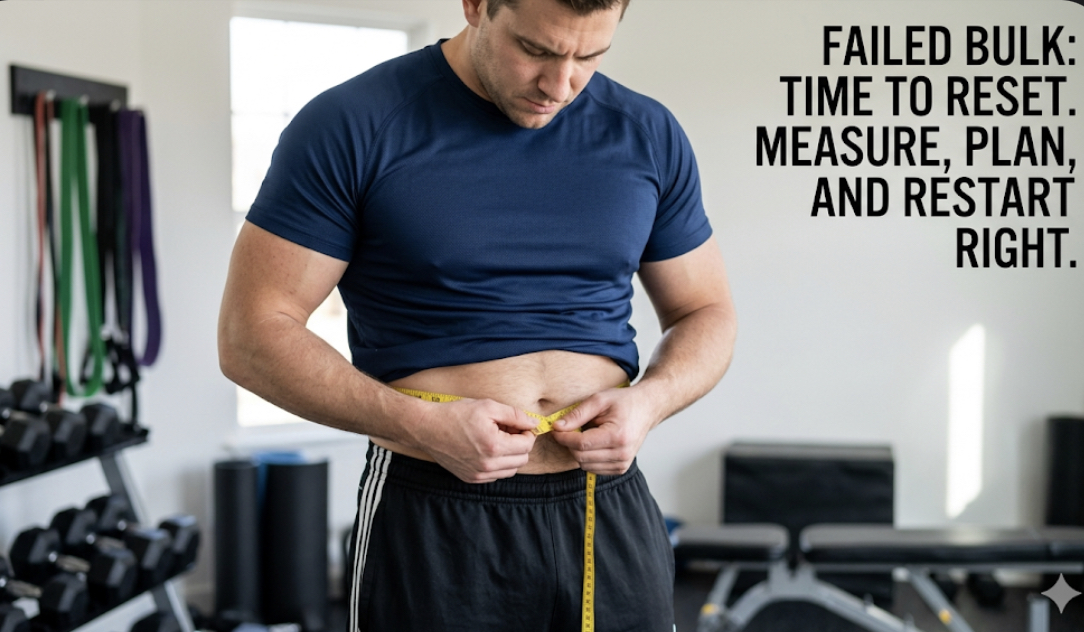
After a failed bulk, your body may have reduced insulin sensitivity and elevated fat mass. A maintenance phase (or short mini-cut) resets metabolic rate, improves insulin sensitivity, and reduces excess fat before restarting .
3.2. Option A: Maintenance Phase
Eat at maintenance calories for 2–4 weeks. Keep protein high (1.6–2.2 g/kg). Maintain training intensity. This allows your body to normalize without adding more fat.
3.3. Option B: Mini-Cut (4–6 weeks)
If you gained significant fat, a short cutting phase can help. Aim for a deficit of 300–500 kcal, losing 0.5–1% body weight per week. Preserve muscle with high protein and continued strength training .
📉 When to Choose a Mini-Cut
- Waist circumference increased >2–3 inches
- Visible loss of muscle definition
- Scale weight gain >8–10% of starting weight
- Feeling soft and sluggish
4. Step 3: Recalculate Your Calorie Needs for a New Bulk
4.1. Find Your New Maintenance
After a failed bulk and reset, your maintenance calories may have changed. Track your intake for 1–2 weeks while weight stays stable to find your new maintenance.
4.2. Start with a Conservative Surplus
Instead of a large surplus, start with 250–350 kcal above maintenance. Monitor weight gain for 2 weeks. Aim for 0.25–0.5% body weight per week .
4.3. Adjust Based on Progress
- If gaining too fast (>0.5% per week) → reduce surplus by 100–150 kcal.
- If gaining too slow (<0.25% per week) and strength stalls → increase surplus by 100–150 kcal.
5. Step 4: Optimize Protein and Macronutrient Intake
5.1. Protein – Non-Negotiable
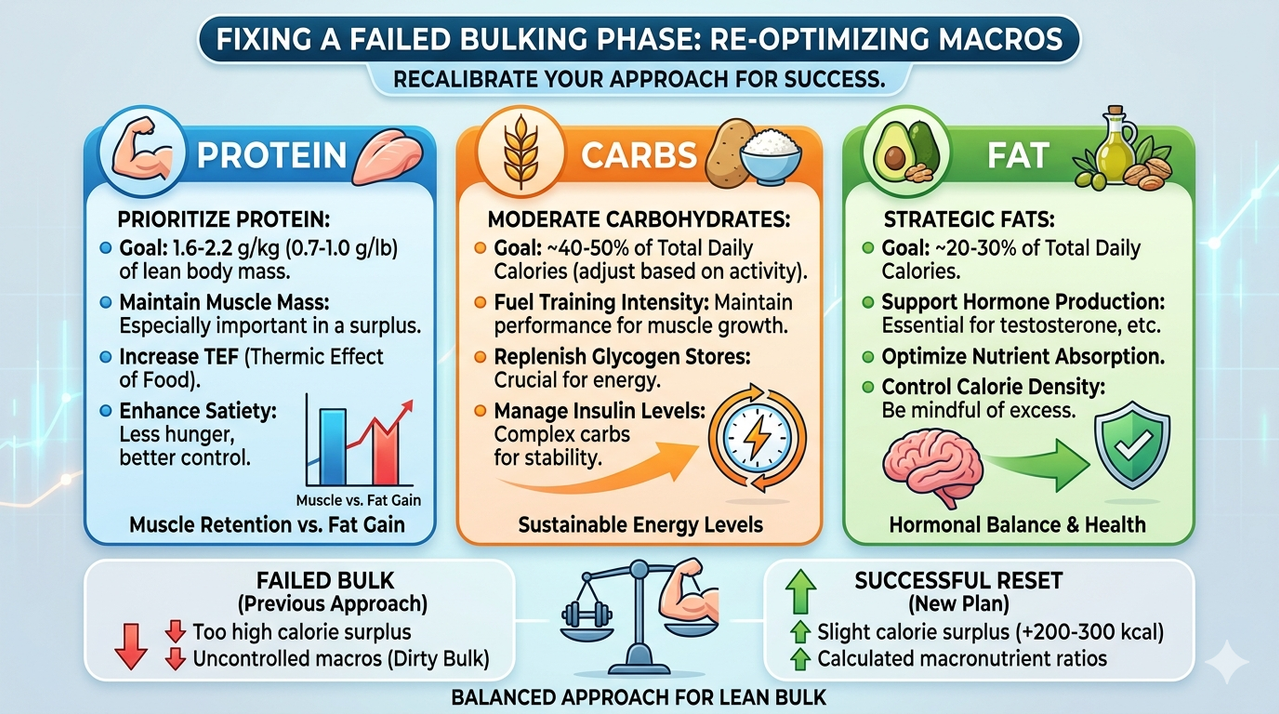
1.6–2.2 g per kg body weight daily. For an 80 kg person: 128–176 g protein. Spread across 3–5 meals (20–40 g per meal) .
5.2. Fats and Carbs
- Fats: 20–30% of total calories (0.8–1.1 g/kg). Essential for hormone production.
- Carbs: Fill remaining calories. Prioritize whole grains, fruits, vegetables, and legumes for sustained energy.
5.3. Sample Macros for a New Bulk (2,800 kcal, 80 kg person)
- Protein: 160 g (640 kcal)
- Fat: 75 g (675 kcal)
- Carbs: 420 g (1,685 kcal)
6. Step 5: Fix Training – Progressive Overload Is Non-Negotiable
6.1. Audit Your Program
- Are you using compound lifts (squat, deadlift, bench, rows, overhead press)?
- Are you adding weight, reps, or sets over time?
- Are you training with sufficient intensity (RPE 7–9)?
6.2. Recommended Restart Program
- Full-body 3x/week or upper/lower 4x/week
- Focus on progressive overload: aim to add 2.5–5 kg to main lifts every 1–2 weeks
- Track every workout—if you're not progressing, adjust volume or intensity

7. Step 6: Prioritize Sleep and Stress Management
7.1. Sleep – The Growth Hormone Factory
Aim for 7–9 hours of quality sleep nightly. Poor sleep impairs muscle protein synthesis, increases cortisol, and reduces testosterone .
7.2. Stress Reduction
Chronic stress elevates cortisol, which promotes fat storage and muscle breakdown. Incorporate walking, meditation, or simply taking rest days .
7.3. Recovery Schedule
- Take at least 1–2 full rest days per week.
- Listen to your body—if you're constantly sore or fatigued, add an extra rest day.
8. Sample Mini-Cut Meal Plan (1,800 kcal, 140g Protein) for Reset Phase
Omnivore Plan
- Breakfast: 3 eggs, 1 cup oatmeal with berries (450 kcal, 30g protein)
- Lunch: 150g chicken breast, 1 cup brown rice, 1 cup broccoli, 1 tsp olive oil (450 kcal, 40g protein)
- Snack: 150g Greek yogurt, ½ cup berries (150 kcal, 15g protein)
- Dinner: 150g white fish, 1.5 cups sweet potato, 2 cups greens, 1 tsp olive oil (450 kcal, 40g protein)
- Evening: 150g cottage cheese (150 kcal, 15g protein)
Vegan/Vegetarian Plan (1,800 kcal, 130g Protein)
- Breakfast: Tofu scramble (150g firm tofu), 1 cup oatmeal with berries (450 kcal, 30g protein)
- Lunch: 150g tempeh, 1 cup quinoa, 1 cup mixed greens (450 kcal, 35g protein)
- Snack: 150g silken tofu with berries (150 kcal, 15g protein)
- Dinner: 1 cup cooked lentils, 1.5 cups sweet potato, 150g edamame (450 kcal, 35g protein)
- Evening: 1 cup unsweetened soy milk (100 kcal, 8g protein)
Gluten-Free Options
- Use certified gluten-free oats, quinoa, rice, or buckwheat.
- Ensure tempeh and tofu are gluten-free certified.
9. Sample New Bulk Meal Plan (2,800 kcal, 160g Protein) After Reset
Omnivore Plan
- Breakfast: 4 eggs, 1 cup oatmeal with 1 tbsp peanut butter, 1 banana (650 kcal, 40g protein)
- Lunch: 200g chicken breast, 1.5 cups brown rice, 1 cup broccoli, 1 tbsp olive oil (650 kcal, 50g protein)
- Snack: 200g Greek yogurt, 1 cup berries, 1 oz almonds (350 kcal, 25g protein)
- Dinner: 200g salmon, 1.5 cups sweet potato, 2 cups greens (650 kcal, 45g protein)
- Evening: 200g cottage cheese, 1 tbsp honey (250 kcal, 20g protein)
Vegan/Vegetarian Plan (2,800 kcal, 150g Protein)
- Breakfast: Tofu scramble (200g firm tofu), 1.5 cups oatmeal with 2 tbsp peanut butter, banana (700 kcal, 40g protein)
- Lunch: 200g tempeh, 1.5 cups quinoa, 1 cup roasted chickpeas, mixed greens (700 kcal, 45g protein)
- Snack: 200g silken tofu with berries, 2 tbsp hemp seeds (300 kcal, 20g protein)
- Dinner: 1.5 cups cooked lentils, 1.5 cups sweet potato, 150g edamame, 1 tbsp olive oil (650 kcal, 35g protein)
- Evening: 1 cup unsweetened soy milk + 1 tbsp chia seeds (150 kcal, 10g protein)
10. Frequently Asked Questions
Why does a bulking phase fail?
A bulking phase fails due to poor calorie control (too large a surplus), low protein intake (<1.6 g/kg), ineffective training (lack of progressive overload), or poor recovery (sleep/stress).
How do I fix a failed bulk?
First, diagnose the problem. Then, take a reset phase (maintenance or mini-cut), recalculate calories, optimize protein, fix training intensity, and prioritize recovery.
Should I cut after a failed bulk?
If you gained excessive fat (waist up 2–3+ inches), a 4–6 week mini-cut is recommended to reset before restarting a proper lean bulk.
How much weight should I gain on a restart bulk?
0.25–0.5% of body weight per week. For an 80 kg person, that's 0.2–0.4 kg per week.
How much protein do I need after a failed bulk?
1.6–2.2 grams per kilogram of body weight daily. This supports muscle repair and growth.
Can I restart bulking immediately after a failed bulk?
It's better to take a 2–4 week reset (maintenance or mini-cut) to improve insulin sensitivity and reduce fat before restarting.
How long does it take to fix a failed bulk?
Reset phase: 2–6 weeks (depending on fat gain). Then a new bulk can start with proper parameters. Results from the new bulk may take 8–12 weeks to see.
11. Related Resources
- Can You Build Muscle Without Supplements? (Natural Muscle Growth Guide)
- How to Know If You’re Gaining Muscle or Fat (Simple Tracking Guide)
- Best Weekly Weight Gain Rate for Muscle Growth (Lean Bulk Guide)
- How to Increase Strength Without Gaining Fat (Lean Strength Guide)
- How Long Does It Take to Build Noticeable Muscle? (Real Timeline Explained)
- Beginner Mistakes That Kill Muscle Growth (Avoid These 7 Errors)
12. Scientific References
- Slater, G. J., et al. (2019). Is an Energy Surplus Required to Maximize Skeletal Muscle Hypertrophy Associated With Resistance Training? Frontiers in Nutrition, 6, 131. PubMed
- Morton, R. W., et al. (2018). A systematic review, meta-analysis and meta-regression of the effect of protein supplementation on resistance training-induced gains in muscle mass and strength in healthy adults. British Journal of Sports Medicine, 52(6), 376–384. PubMed
- Helms, E. R., et al. (2014). Evidence-based recommendations for natural bodybuilding contest preparation. Journal of the International Society of Sports Nutrition, 11(1), 20. PubMed
- Schoenfeld, B. J., et al. (2017). Effects of Resistance Training Frequency on Measures of Muscle Hypertrophy: A Systematic Review and Meta-Analysis. Sports Medicine, 46(11), 1689–1697. PubMed
- Nedeltcheva, A. V., et al. (2010). Insufficient sleep undermines dietary efforts to reduce adiposity. Annals of Internal Medicine, 153(7), 435–441. PubMed
- Peos, J. J., et al. (2019). Intermittent dieting: theoretical considerations for the athlete. Sports Medicine, 49(Suppl 2), 135–144. PubMed
- ACSM. (2021). Nutrition and Athletic Performance. Medicine & Science in Sports & Exercise, 53(3), 600–618. PubMed
Join the conversation