How to Lose Fat Without Cardio for Beginners (Easy & Effective Guide)
How to Lose Fat Without Cardio for Beginners

⚡ TL;DR
Learning how to lose fat without cardio for beginners is simpler than you think. The key is understanding that fat loss comes from a calorie deficit, not from exercise . Cardio burns calories, but it's not the only—or even the most efficient—way to create that deficit. Research shows that resistance training can increase resting metabolic rate for up to 48 hours post-workout . Combined with a moderate protein intake of 1.6-2.2 g/kg and a focus on NEAT (Non-Exercise Activity Thermogenesis), you can lose significant fat without a single minute on the treadmill . This beginner's guide provides the exact nutrition plan, sample workouts, and vegan options to help you lose fat sustainably—no cardio required.
1. The Cardio Myth: Why You Don't Need It to Lose Fat
You hate cardio. The treadmill feels like a hamster wheel, the elliptical bores you to tears, and running just isn't your thing. Yet everywhere you look, the message is the same: "If you want to lose fat, you have to do cardio."
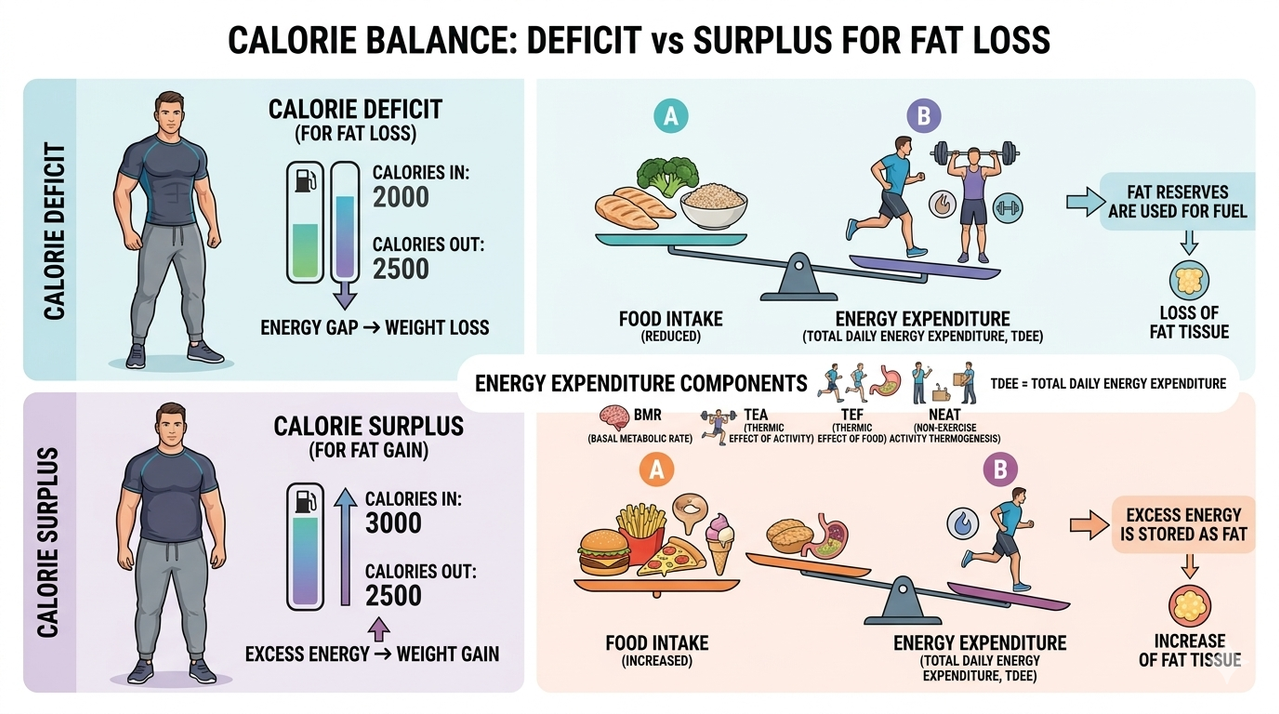
Here's the liberating truth: that's not accurate. How to lose fat without cardio for beginners is a question with a clear, science-backed answer. Fat loss is fundamentally about energy balance—consuming fewer calories than you burn . Cardio is just one tool to increase the "calories out" side of the equation. Nutrition and resistance training are far more powerful, sustainable tools. This guide will show you exactly how to structure your diet, training, and daily movement to shed fat effectively—without a single minute of cardio.
2. The Science: How Fat Loss Works Without Cardio
2.1. The Calorie Deficit Equation
Fat loss occurs when you consistently consume fewer calories than your body expends. This deficit can be created through diet alone, exercise alone, or a combination . For beginners, the diet side is often easier to control and more sustainable .
2.2. The Afterburn Effect (EPOC)
Resistance training creates Excess Post-Exercise Oxygen Consumption (EPOC)—your body continues burning calories at an elevated rate for hours after your workout . Studies show that EPOC can increase metabolic rate by 5-15% for up to 48 hours after a resistance training session . Cardio, especially steady-state, has a much smaller afterburn effect.
2.3. Muscle's Metabolic Advantage
Muscle tissue is metabolically active, burning about 13-15 calories per pound per day at rest, compared to fat which burns only about 4-5 calories . By building or even just preserving muscle during a cut, you maintain a higher resting metabolic rate . This is why resistance training is superior to cardio for long-term fat loss.
3. Nutrition: The 80% Solution
3.1. Calculate Your Calories
Start by finding your maintenance calories using the Mifflin-St Jeor equation. For fat loss, subtract 300-500 calories to create a moderate deficit . For a 180 lb beginner, this typically falls between 2,000-2,300 calories .
3.2. Protein: The Fat Loss Macronutrient
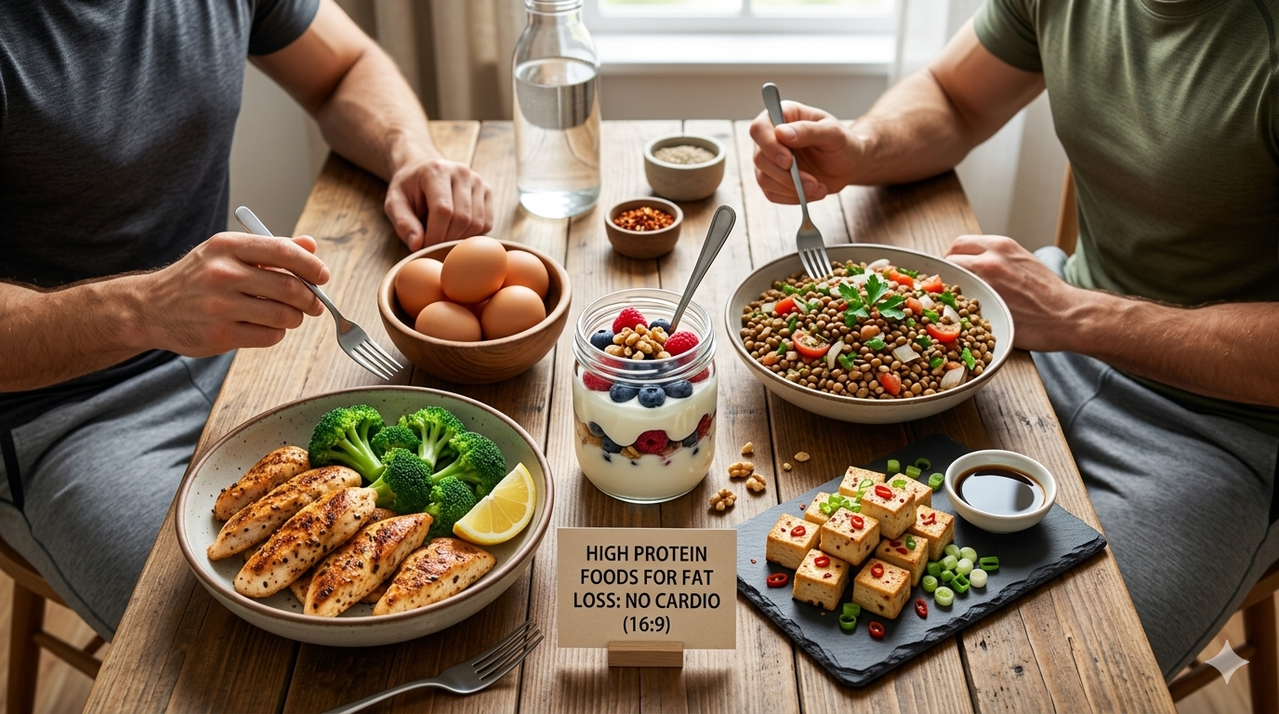
Protein is your most important ally. Aim for 1.6-2.2 grams per kg of body weight (0.7-1.0 g/lb) . Protein increases satiety, preserves muscle during a deficit, and has the highest thermic effect of food (TEF), meaning you burn calories digesting it .
3.3. Sample 2000-Calorie Fat Loss Day (No Cardio)
- Breakfast (7 AM): 3 eggs scrambled (18g protein) + 1 cup spinach + 1 slice whole-grain toast (3g) → 400 kcal, 25g protein
- Lunch (12 PM): 5 oz grilled chicken (35g) + 2 cups mixed greens + ½ cup quinoa (4g) + 1 tbsp olive oil → 500 kcal, 40g protein
- Snack (4 PM): 1 cup Greek yogurt (20g) + ½ cup berries → 200 kcal, 20g protein
- Dinner (7 PM): 5 oz salmon (35g) + 1 cup roasted broccoli + 1 medium sweet potato (4g) → 550 kcal, 40g protein
- Evening Snack (optional): 1 scoop casein protein (25g) → 150 kcal, 25g protein
- Total: ~1,800 kcal, ~150g protein
3.4. Vegan/Vegetarian Adaptation
- Replace eggs with tofu scramble (6 oz firm tofu = 15g protein)
- Replace chicken with 6 oz tempeh (30g) or seitan
- Replace salmon with 6 oz extra-firm tofu + 1 cup lentils
- Use pea protein shakes to hit protein targets
- Add nutritional yeast for B12 and protein boost
4. Resistance Training: Your Cardio Replacement
4.1. Why Resistance Training Beats Cardio
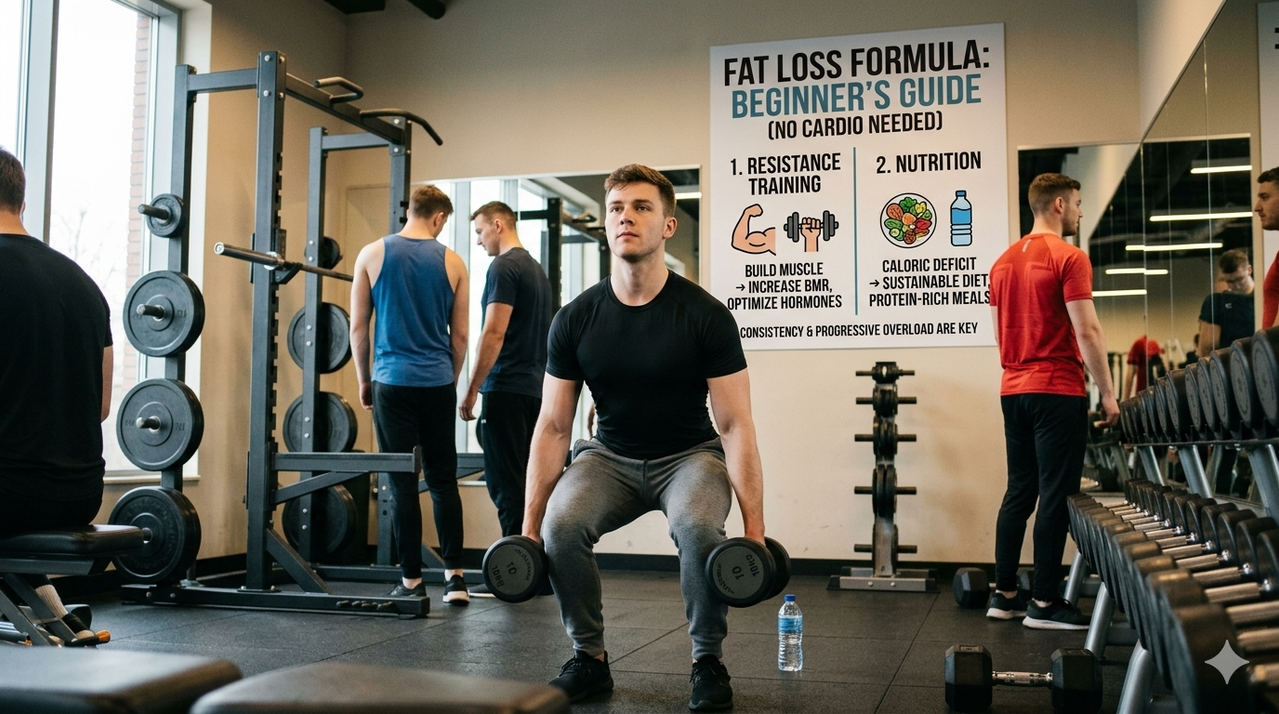
Resistance training builds and preserves muscle, creating the afterburn effect and elevating your metabolism long after you leave the gym . It also improves insulin sensitivity, making it easier for your body to use fat for fuel .
4.2. Sample Beginner Full-Body Workout (3x/week)
- Workout A (Monday): Goblet squats 3x10, Dumbbell bench press 3x10, Seated cable rows 3x12, Plank 3x30s
- Workout B (Wednesday): Deadlifts 3x8, Dumbbell overhead press 3x10, Lat pulldowns 3x12, Hanging leg raises 3x10
- Workout C (Friday): Lunges 3x10 each leg, Incline dumbbell press 3x10, Face pulls 3x15, Farmer's walk 3x30s
4.3. Progressive Overload for Beginners
To keep losing fat without losing muscle, you need to challenge your muscles. Aim to add a small amount of weight or an extra rep each week . This signals your body to retain muscle despite the calorie deficit .
5. NEAT: The Secret Weapon
5.1. What is NEAT?
NEAT (Non-Exercise Activity Thermogenesis) is the energy you burn doing everything that isn't sleeping, eating, or formal exercise . This includes walking, fidgeting, standing, shopping, and even typing. NEAT can account for 15-50% of your daily energy expenditure .
5.2. How to Increase NEAT Without Cardio
- Park farther away from store entrances
- Take the stairs instead of elevators
- Use a standing desk for part of your workday
- Pace during phone calls
- Walk while you listen to podcasts or audiobooks
- Take short walking breaks every hour
Aim for 8,000-10,000 steps daily. This can add 200-400 calories to your daily burn without structured cardio .
6. Sample 7-Day No-Cardio Fat Loss Plan
Day 1 (Monday): Full Body Workout A + 10,000 steps
- Breakfast: 3 eggs, 1 slice toast, 1 cup berries
- Lunch: 5 oz chicken, quinoa, mixed greens
- Snack: 1 cup Greek yogurt
- Dinner: 5 oz salmon, sweet potato, broccoli
Day 2 (Tuesday): Active Recovery (NEAT focus) + 10,000 steps
- Breakfast: Protein oatmeal (1 cup oats + 1 scoop protein)
- Lunch: Tuna salad with whole-grain crackers
- Snack: Apple + 1 tbsp peanut butter
- Dinner: 6 oz lean beef stir-fry with vegetables
Day 3 (Wednesday): Full Body Workout B + 10,000 steps
Repeat meal structure with similar protein targets.
Continue this pattern, alternating resistance training days with NEAT-focused active recovery days.
7. Common Mistakes When Losing Fat Without Cardio
- Mistake #1: Cutting calories too low. This triggers muscle loss and metabolic adaptation. Stick to 300-500 below maintenance .
- Mistake #2: Not eating enough protein. Protein needs increase during a deficit. Don't drop below 1.6g/kg .
- Mistake #3: Neglecting resistance training. Without it, you'll lose muscle along with fat .
- Mistake #4: Being too sedentary outside workouts. Low NEAT can undo your calorie deficit .
- Mistake #5: Expecting overnight results. Fat loss takes time—be patient and consistent .
8. Frequently Asked Questions
Can I really lose fat without any cardio?
Yes, absolutely. Fat loss comes from being in a calorie deficit. If you create that deficit through diet alone and preserve muscle with resistance training, you'll lose fat without a single minute of cardio .
How many calories should I cut?
Start with a moderate deficit of 300-500 calories below maintenance. This allows for steady fat loss of 0.5-1 lb per week without triggering excessive hunger or muscle loss .
Will I lose muscle without cardio?
No. Cardio doesn't preserve muscle—resistance training does. As long as you're lifting weights 3x weekly and eating adequate protein (1.6-2.2 g/kg), you can maintain or even build muscle while losing fat .
What's the minimum protein I need?
For fat loss, aim for at least 1.6g per kg of body weight. For a 180 lb person, that's about 130g daily. Higher intakes (up to 2.2g/kg) can provide additional satiety benefits .
Do I need to track my steps?
Tracking steps is a simple way to ensure your NEAT doesn't drop. Aim for 8,000-10,000 steps daily. This can be achieved through daily activities—no structured cardio required .
What if I hit a plateau?
If fat loss stalls for 2-3 weeks, slightly reduce calories by 100-200 more, or increase your daily steps. Make small adjustments and be patient .
9. Related Resources
- Low-Intensity Walking for Fat Loss: Simple Strategy to Burn More Fat
- How to Handle Hunger Pangs During a Strict Cutting Phase (Athlete’s Guide)
- Intermittent Fasting for Bodybuilders: Pros, Cons, and Muscle-Building Truth
- How to Lose Belly Fat Without Losing Muscle (Science-Based Guide)
- Why You’re Not Losing Fat Despite Eating Clean (7 Science-Backed Reasons)
10. Scientific References
- Hall, K. D., et al. (2012). Energy balance and its components: implications for body weight regulation. American Journal of Clinical Nutrition, 95(4), 989-994. PubMed
- Treuth, M. S., et al. (1996). Effects of resistance training on total energy expenditure in young adults. Journal of Applied Physiology, 81(6), 2409-2414. PubMed
- Morton, R. W., et al. (2018). A systematic review of protein supplementation on resistance training-induced gains. British Journal of Sports Medicine, 52(6), 376-384. PubMed
- Donnelly, J. E., et al. (2009). American College of Sports Medicine Position Stand: appropriate physical activity intervention strategies for weight loss and prevention of weight regain. Medicine & Science in Sports & Exercise, 41(2), 459-471. PubMed
- Hackney, K. J., et al. (2008). Resting energy expenditure and delayed-onset muscle soreness after a bout of full-body resistance exercise. Journal of Strength and Conditioning Research, 22(5), 1447-1452. PubMed
- Levine, J. A. (2004). Non-exercise activity thermogenesis (NEAT). Nutrition Reviews, 62(7), S82-S97. PubMed
- Phillips, S. M., & Van Loon, L. J. (2011). Dietary protein for athletes: from requirements to optimum adaptation. Journal of Sports Sciences, 29(sup1), S29-S38. PubMed
- Schoenfeld, B. J., et al. (2016). Effects of resistance training frequency on measures of muscle hypertrophy: a systematic review and meta-analysis. Sports Medicine, 46(11), 1689-1697. PubMed
- Helms, E. R., et al. (2014). Evidence-based recommendations for natural bodybuilding contest preparation. Journal of the International Society of Sports Nutrition, 11, 20. View Source
- Westerterp, K. R. (2013). Physical activity and physical activity induced energy expenditure in humans: measurement, determinants, and effects. Frontiers in Physiology, 4, 90. PubMed
Join the conversation