Signs Your Bulk Is Working (Or Failing): How to Track Progress Correctly
Signs Your Bulk Is Working (Or Failing): How to Track Progress Correctly
⚡ TL;DR
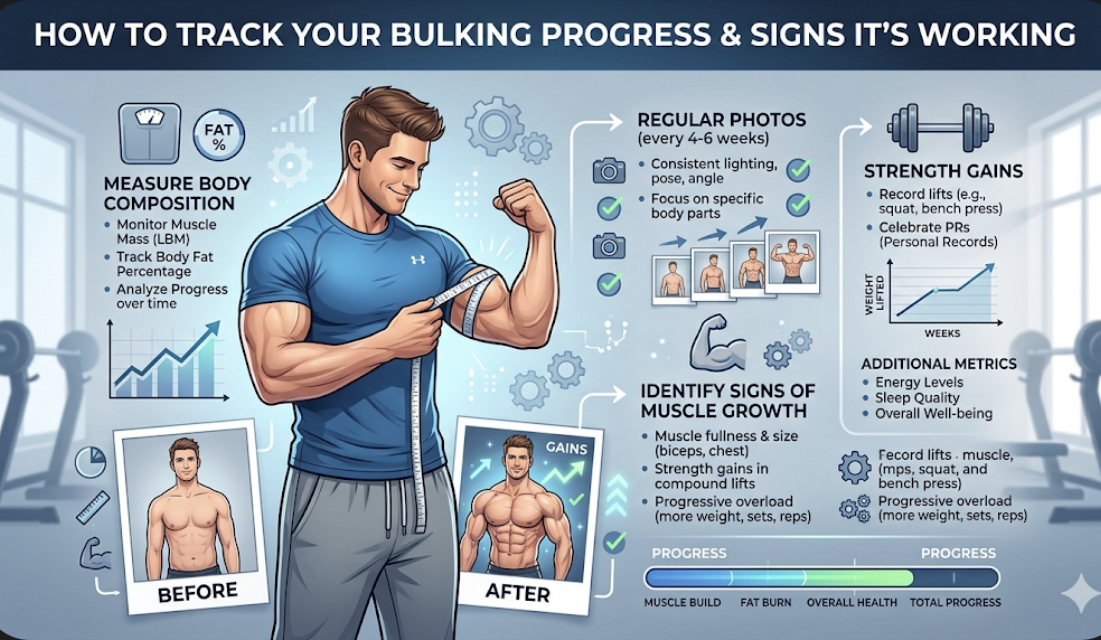
To know if your bulk is working, track these 5 metrics: 1) Strength progression—lifts going up = muscle gain. 2) Weight gain rate—0.25–0.5% body weight per week is ideal. 3) Body measurements—stable waist + growing arms/chest = lean gains. 4) Progress photos—visual proof of muscle development. 5) How clothes fit—looser waist + tighter sleeves = success . If strength stalls or waist expands too fast, your bulk is failing. This guide breaks down exactly how to track each metric and when to adjust.
1. The Bulking Blindness: Are You Gaining Muscle or Fat?
You step on the scale. The number went up. Should you celebrate or worry? Without context, you have no idea if your bulk is working or if you're just getting fat. This is the most common pitfall in bulking—gaining weight without knowing what kind of tissue you're adding. This guide will teach you exactly how to track progress and recognize the signs your bulk is working before it's too late.
How do you know if your bulk is working?
You know your bulk is working when you see: 1) Steady strength increases on key lifts (squat, bench, deadlift). 2) Appropriate weight gain of 0.25–0.5% body weight per week. 3) Minimal fat gain—waist circumference stable or growing slowly. 4) Visual improvements in muscle definition in progress photos. If strength is increasing and waist isn't ballooning, you're gaining muscle .
2. Sign #1: Strength Is Going Up (The #1 Indicator)
2.1. The Strength-Muscle Connection
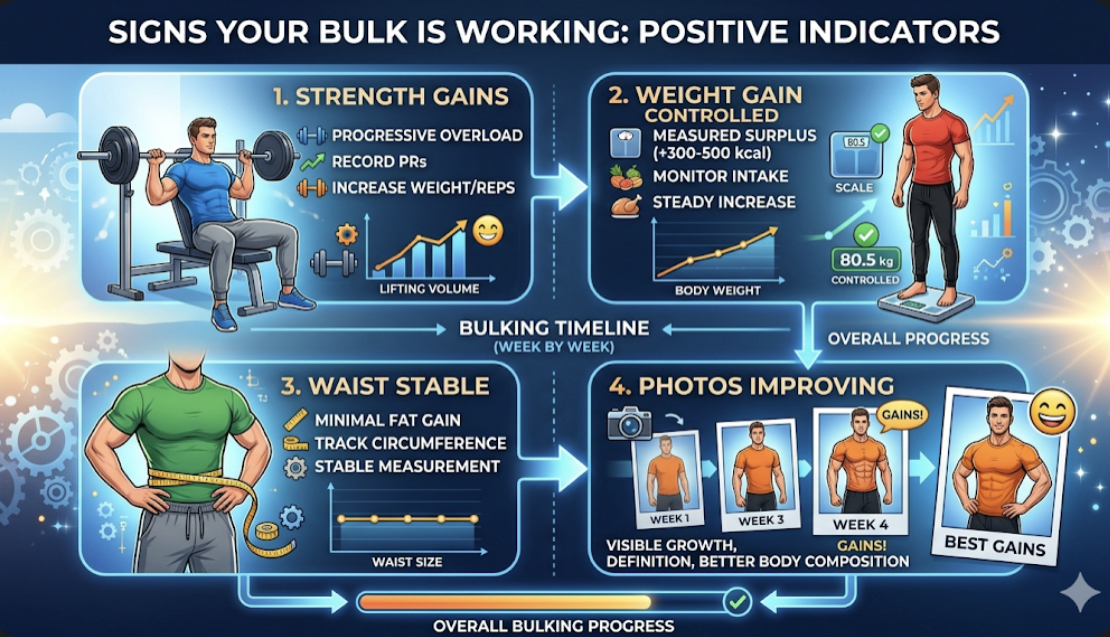
Research consistently shows a strong correlation between strength gains and muscle growth . If your lifts are going up—especially on compound movements like squat, bench press, deadlift, and rows—you are almost certainly building muscle. This is the most reliable sign your bulk is working.
2.2. What to Track
- Log every workout: exercise, weight, reps, sets.
- Track main lifts weekly: squat, bench, deadlift, overhead press, rows.
- Look for progressive overload: adding weight or reps over time.
2.3. Warning Signs
- Strength plateauing or decreasing despite weight gain → you're likely gaining fat, not muscle.
- No strength gains for 2–3 weeks → reassess nutrition, recovery, or training program.
3. Sign #2: Weight Gain Rate Is On Target (0.25–0.5% Per Week)
3.1. The Sweet Spot
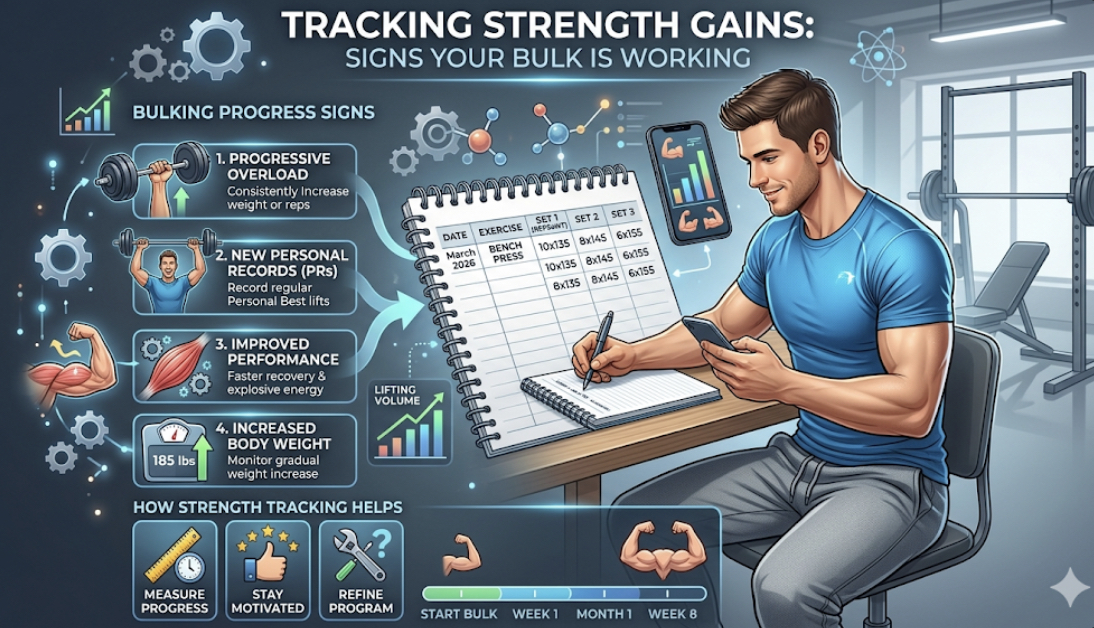
The optimal rate of weight gain during a bulk is 0.25–0.5% of body weight per week. For an 80 kg (176 lb) person, that's 0.2–0.4 kg (0.4–0.9 lb) per week . This rate maximizes muscle growth while minimizing fat accumulation.
3.2. How to Track
- Weigh yourself daily (morning, after bathroom, before food).
- Calculate a 7-day rolling average.
- Compare weekly averages to see the trend.
3.3. Warning Signs
- Gaining >0.5–1% per week → you're adding too much fat. Reduce surplus by 100–200 kcal.
- Gaining <0.25% per week → you may not be in a sufficient surplus. Add 100–200 kcal.
- Weight stable for 2+ weeks → no surplus, no growth.
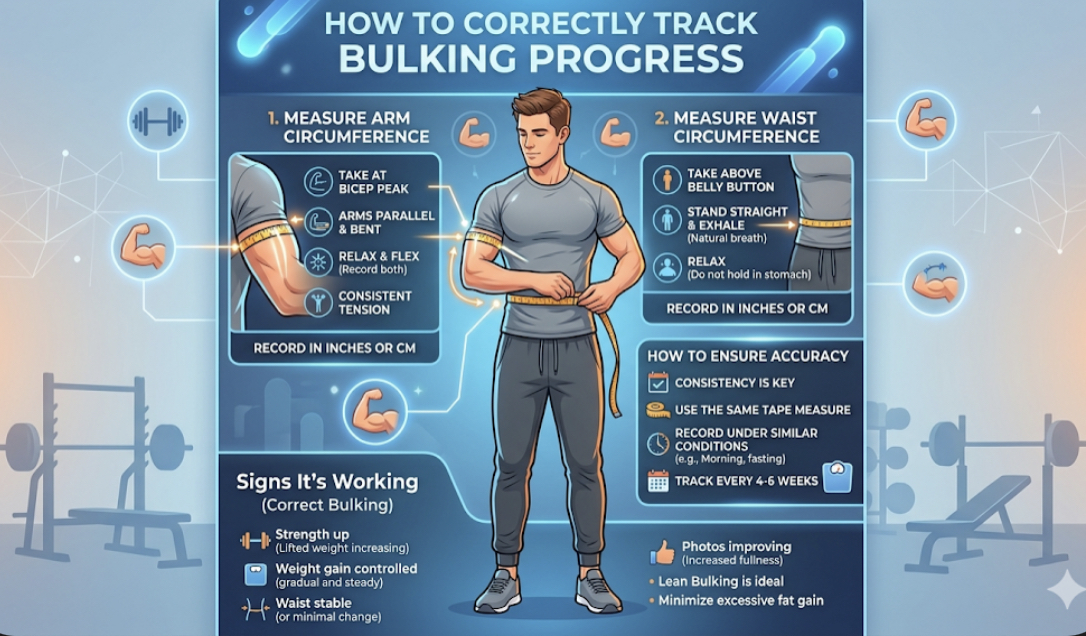
4. Sign #3: Body Measurements – Waist vs. Arms/Chest
4.1. What to Measure
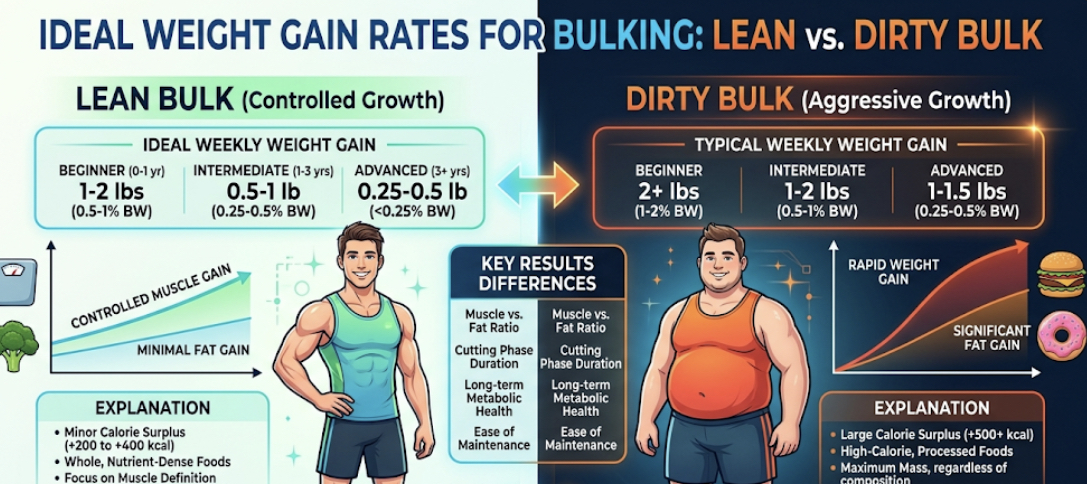
- Waist: At the narrowest point (or navel). This is the best indicator of fat gain.
- Arms: Mid-bicep, flexed and relaxed.
- Chest: At nipple line.
- Thighs: Mid-point between hip and knee.
4.2. Good Signs
- Waist stable or growing slowly (<0.5 inch per month) → minimal fat gain.
- Arms/chest/thighs growing → muscle gain.
- Waist-to-height ratio stable → good body composition.
4.3. Warning Signs
- Waist expanding >0.5–1 inch per month → excessive fat gain. Reduce surplus.
- Arms/chest not growing while waist expands → poor nutrient partitioning.
5. Sign #4: Progress Photos – The Visual Proof
5.1. Why Photos Matter
Your eyes can deceive you day-to-day. But side-by-side photos taken under consistent conditions reveal changes you might miss. Progress photos are often the most motivating evidence of a successful bulk .
5.2. How to Take Effective Photos
- Same location, same lighting (natural light ideal).
- Same time of day (morning fasted recommended).
- Three poses: front, side, back.
- Minimal clothing (shorts/swimsuit).
- Take every 2–4 weeks.
5.3. Good Signs
- Broader shoulders, fuller arms, more defined chest.
- Waist looks similar or slightly larger but in proportion.
- Improved muscle separation.
5.4. Warning Signs
- Softer appearance, loss of definition, love handles appearing.
- Waist visibly expanding faster than shoulders/chest.

6. Sign #5: How Clothes Fit – The Real-World Test
Pick a pair of "reference jeans" and a fitted shirt. Try them on every 2 weeks. If they feel looser around the waist but tighter around the shoulders/chest, you're winning—you're gaining muscle and minimal fat. If they're tight everywhere, you're gaining too much fat. If they're loose everywhere, you're not gaining muscle.
⚠️ Red Flags: Signs Your Bulk Is Failing
- Strength plateauing or decreasing despite weight gain → fat gain.
- Waist expanding >0.5–1 inch per month → too much fat.
- Weight gain >0.5–1% per week → excessive surplus.
- Progress photos showing loss of definition → fat accumulation.
- Clothes tight everywhere → not just shoulders/chest.
- Feeling constantly bloated, lethargic, or having digestive issues → poor food choices or surplus too large.
7. Sample Meal Plan for a Successful Lean Bulk (2,800 kcal, 160g Protein)
Omnivore Plan (for 75–80 kg person)
- Breakfast (7:30): 4 eggs, 1 cup oatmeal with 1 tbsp peanut butter, 1 banana (650 kcal, 40g protein)
- Lunch (12:30): 200g grilled chicken breast, 1.5 cups brown rice, 1 cup broccoli, 1 tbsp olive oil (650 kcal, 50g protein)
- Snack (4:00): 200g Greek yogurt, 1 cup berries, 1 oz almonds (350 kcal, 25g protein)
- Dinner (7:30): 200g salmon or lean beef, 1.5 cups sweet potato, 2 cups mixed greens (650 kcal, 45g protein)
- Evening (10:00): 200g cottage cheese, 1 tbsp honey (250 kcal, 20g protein)
Vegan/Vegetarian Plan (2,800 kcal, 150g Protein)
- Breakfast: Tofu scramble (200g firm tofu), 1.5 cups oatmeal with 2 tbsp peanut butter, banana (700 kcal, 40g protein)
- Lunch: 200g tempeh, 1.5 cups quinoa, 1 cup roasted chickpeas, mixed greens (700 kcal, 45g protein)
- Snack: 200g silken tofu with berries, 2 tbsp hemp seeds (300 kcal, 20g protein)
- Dinner: 1.5 cups cooked lentils, 1.5 cups sweet potato, 150g edamame, 1 tbsp olive oil (650 kcal, 35g protein)
- Evening: 1 cup unsweetened soy milk + 1 tbsp chia seeds (150 kcal, 10g protein)
Gluten-Free Options
- Use certified gluten-free oats, quinoa, rice, or buckwheat.
- Ensure tempeh and tofu are gluten-free certified (most are).
8. Simple Bulking Tracking Template
- Weekly (same time, morning): Weight, waist measurement, arm measurement.
- Every workout: Log main lifts (squat, bench, deadlift, rows).
- Bi-weekly: Try on reference clothes.
- Monthly: Progress photos (front/side/back).
9. Frequently Asked Questions
How do you know if your bulk is working?
You know your bulk is working when strength increases, weight gain is 0.25–0.5% per week, waist isn't expanding too fast, and progress photos show muscle development.
How much weight should I gain per week on a bulk?
0.25–0.5% of body weight per week. For an 80 kg person, that's 0.2–0.4 kg per week.
How can I tell if I'm gaining muscle or fat?
Track strength (if lifts go up = muscle), waist measurement (stable = good), and progress photos. Use all three methods together.
What if I'm gaining weight but my lifts aren't increasing?
You're likely gaining fat, not muscle. Reduce calorie surplus by 150–200 kcal and reassess in 2 weeks.
How long should a bulk last?
Typically 8–16 weeks. Stop when you've gained 8–12% of body weight or when waist circumference has increased more than 2–3 inches.
Should I bulk if I have a lot of belly fat?
Consider body recomposition (small deficit or maintenance) or a lean bulk with a very small surplus (150–250 kcal). Monitor waist closely.
How much protein do I need while bulking?
1.6–2.2 grams per kilogram of body weight daily. For an 80 kg person, that's 128–176 grams of protein per day.
10. Related Resources
- Can You Build Muscle Without Supplements? (Natural Muscle Growth Guide)
- How to Know If You’re Gaining Muscle or Fat (Simple Tracking Guide)
- Best Weekly Weight Gain Rate for Muscle Growth (Lean Bulk Guide)
- How to Increase Strength Without Gaining Fat (Lean Strength Guide)
- How Long Does It Take to Build Noticeable Muscle? (Real Timeline Explained)
- Beginner Mistakes That Kill Muscle Growth (Avoid These 7 Errors)
11. Scientific References
- Morton, R. W., et al. (2018). A systematic review, meta-analysis and meta-regression of the effect of protein supplementation on resistance training-induced gains in muscle mass and strength in healthy adults. British Journal of Sports Medicine, 52(6), 376–384. PubMed
- Slater, G. J., et al. (2019). Is an Energy Surplus Required to Maximize Skeletal Muscle Hypertrophy Associated With Resistance Training? Frontiers in Nutrition, 6, 131. PubMed
- Helms, E. R., et al. (2014). Evidence-based recommendations for natural bodybuilding contest preparation. Journal of the International Society of Sports Nutrition, 11(1), 20. PubMed
- Schoenfeld, B. J., et al. (2017). Effects of Resistance Training Frequency on Measures of Muscle Hypertrophy: A Systematic Review and Meta-Analysis. Sports Medicine, 46(11), 1689–1697. PubMed
- Areta, J. L., et al. (2013). Timing and distribution of protein ingestion during prolonged recovery from resistance exercise alters myofibrillar protein synthesis. Journal of Physiology, 591(9), 2319–2331. PubMed
- Pouliot, M. C., et al. (1994). Waist circumference and abdominal sagittal diameter: best simple anthropometric indexes of abdominal visceral adipose tissue. American Journal of Cardiology, 73(7), 460–468. PubMed
- ACSM. (2021). Nutrition and Athletic Performance. Medicine & Science in Sports & Exercise, 53(3), 600–618. PubMed
Join the conversation