Signs You’re Losing Fat But Not Weight (Real Progress Indicators)
Signs You’re Losing Fat But Not Weight (Real Progress Indicators)

⚡ TL;DR – Fat loss without scale movement
If the scale is stuck but your clothes fit better, you’re likely experiencing body recomposition: losing fat while gaining or retaining muscle. This is common when you start strength training or increase protein intake. Key signs: looser waistband, visible muscle definition, improved performance, and better sleep. The scale is a poor indicator of fat loss because it measures everything – water, glycogen, muscle, and food waste. Use measurements, photos, and how you feel instead. This guide breaks down 7 science-backed signs you’re losing fat but not weight and how to track real progress.
1. The Scale Lies: Why Weight Stalls While Fat Drops
You’ve been eating in a deficit, training hard, yet the scale hasn’t budged for two weeks. Frustrating, right? But here’s the truth: losing fat but not weight is not only possible – it’s a sign of healthy adaptation. The number on the scale is a sum of bone, muscle, fat, water, glycogen, and even the food in your digestive tract . A stable weight often masks a decrease in fat mass paired with an increase in muscle or water retention.
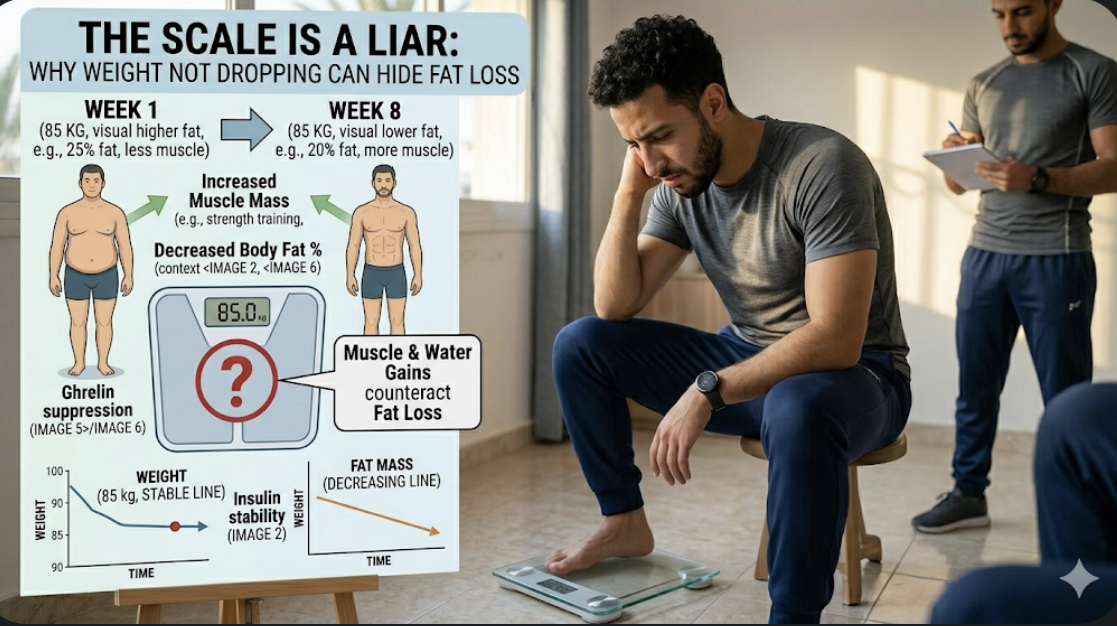
When you begin a resistance training program, your body increases intramuscular glycogen and water storage. Each gram of glycogen binds about 3-4 grams of water . This can offset fat loss on the scale for weeks, especially for beginners. This phenomenon is called body recomposition signs – and it’s a milestone, not a failure.
2. Can you lose fat without losing weight?
Yes, absolutely. This is known as body recomposition – simultaneously losing fat and gaining muscle. It’s most common in beginners, people returning after a break, or those with higher body fat percentages . Even with a stable weight, your body composition shifts: fat mass decreases, lean mass increases. The scale doesn’t capture this. In fact, research shows that body weight changes explain only part of the variance in fat loss; other markers are far more reliable .
3. The Science of Body Recomposition
3.1. Muscle Protein Synthesis vs. Fat Oxidation
Muscle tissue is metabolically active. When you strength train, you stimulate muscle protein synthesis (MPS). If you provide adequate protein, MPS increases, and over time you build lean mass. At the same time, a calorie deficit forces your body to oxidize fat stores for energy . These processes can occur concurrently, especially in untrained individuals .
3.2. Glycogen and Water Fluctuations
A single pound of muscle holds about 0.5 pounds of water and glycogen . When you start training, your muscles supercompensate glycogen stores, leading to a water weight increase of 2–4 pounds. This masks fat loss on the scale .
4. 7 Signs You’re Losing Fat But Not Weight
4.1. Your Clothes Fit Differently (Especially the Waist)
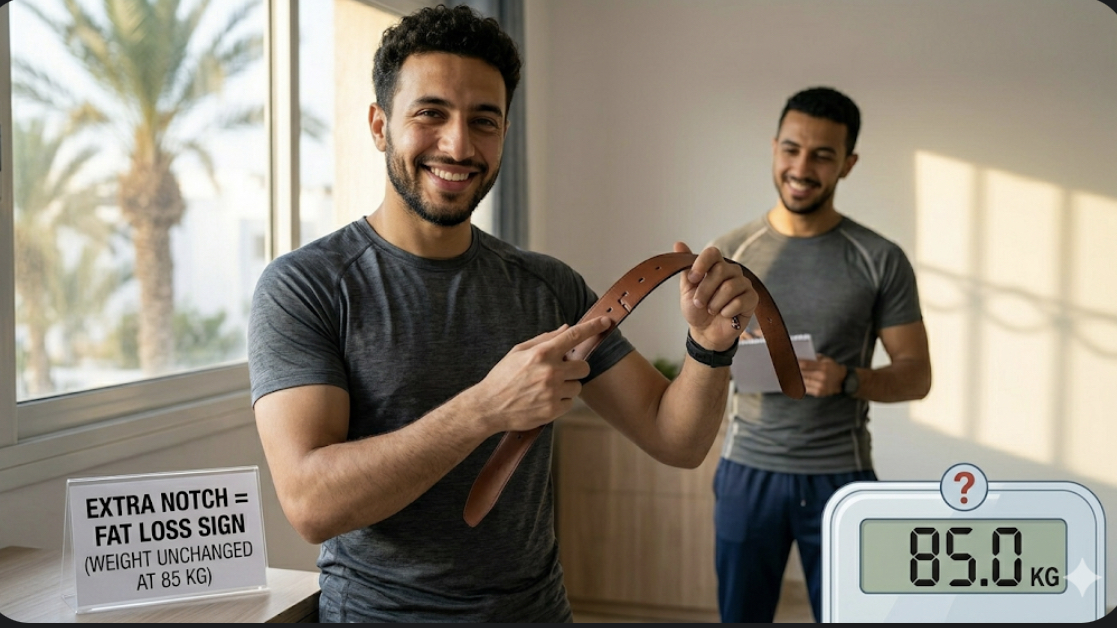
The most reliable indicator: your jeans feel looser around the waist, or you’ve gone down a belt notch. Fat takes up more space than muscle. A pound of fat has a volume about 18% larger than a pound of muscle . If your waist circumference shrinks, you’re losing visceral and subcutaneous fat.
4.2. You See More Muscle Definition
Look in the mirror. Can you see the outline of your shoulders, biceps, or quads more clearly? Maybe your collarbone is more prominent. Increased muscle definition means body fat percentage has decreased, even if total weight hasn’t changed .
4.3. You’re Getting Stronger or More Endurance
Progressive overload in the gym (lifting heavier or more reps) indicates muscle gain or neural adaptation. Strength gains while dieting signal that you’re preserving – and possibly building – muscle .
4.4. Measurements Are Shrinking (But Scale Isn’t)
Take weekly measurements: waist, hips, chest, arms, thighs. If numbers drop but weight holds, you’re in recomposition. Studies show that waist-to-hip ratio is a stronger health marker than BMI .
4.5. Your Body Fat Percentage Is Dropping (If Tracked)
Methods like DEXA scans, bioimpedance scales (with caution), or skinfold calipers can show fat loss independent of weight. A decrease of 1-2% body fat with stable weight means you’ve gained muscle .
4.6. You Have More Energy and Sleep Better
Improved body composition often correlates with better sleep quality and daytime energy, due to hormonal regulation (leptin sensitivity) .
4.7. Progress Photos Reveal a Leaner You
Take front, side, and back photos monthly. Visual changes are often visible long before the scale moves. This is the most motivating sign of fat loss without scale change.
5. How to Track Real Fat Loss (Beyond the Scale)
- Weekly waist and hip measurements: Use a flexible tape at the narrowest point of waist and widest of hips.
- Progress photos: Same lighting, same time of day, once every 2-4 weeks.
- How clothes fit: Pick a pair of “reference jeans” and try them on weekly.
- Strength progression: Log your lifts – if they go up, you’re likely gaining muscle.
- Bioimpedance scale trends: Use under consistent conditions (morning, fasted) and look at long-term trends, not daily.
6. Mistakes That Hide Fat Loss
- Weighing daily and panicking: Water weight fluctuates 2-4 pounds daily. Focus on weekly averages.
- Not measuring or taking photos: If you don’t track other metrics, you’ll miss the signs.
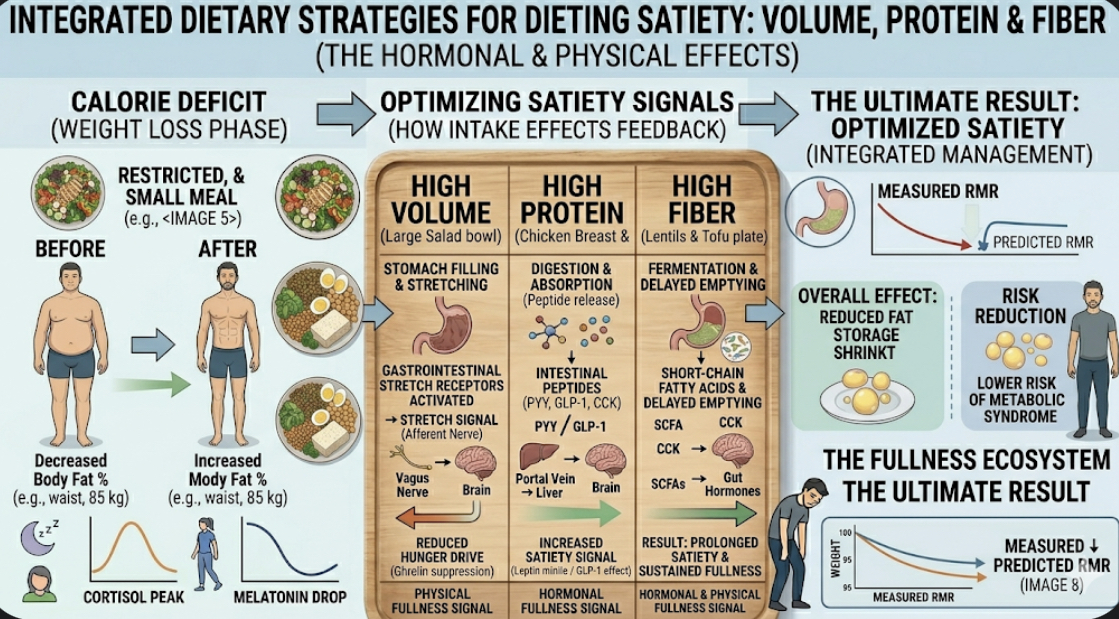
- Eating too little: Severe deficits increase cortisol and water retention, masking fat loss.
- Ignoring sleep and stress: High cortisol causes water retention and blunts fat loss .
7. Sample Daily Nutrition to Promote Fat Loss + Muscle Retention
Goal: Moderate deficit (300-400 below maintenance), high protein (1.6-2.2 g/kg body weight), adequate fiber.
Sample 2000 kcal day for a 70 kg person (approx. 150g protein)
- Breakfast (7:30): 3 eggs (18g protein), 1 cup spinach, 1 slice whole-grain toast, 1 tbsp olive oil – ~400 kcal.
- Lunch (12:30): 150g grilled chicken (35g protein), 2 cups mixed salad, 100g quinoa, lemon juice – ~450 kcal.
- Snack (16:00): 200g Greek yogurt (20g protein) + 100g berries – ~200 kcal.
- Dinner (19:30): 150g salmon (30g protein), 200g roasted sweet potato, 150g broccoli – ~550 kcal.
- Evening (optional): 1 scoop casein protein (25g protein) – ~120 kcal.
Vegan/Vegetarian adaptation
- Replace eggs with 200g firm tofu (20g protein).
- Replace chicken/salmon with 200g tempeh or seitan (30-35g protein).
- Add lentils, chickpeas, and pea protein to meet protein targets.
Gluten-free options
- Use quinoa, buckwheat, or gluten-free oats instead of bread.
- Ensure protein sources are unflavored or certified GF.
8. Frequently Asked Questions
Can you lose fat without losing weight?
Yes, through body recomposition. When you build muscle while losing fat, weight may stay the same but body composition improves. This is common for beginners or those returning to training .
Why am I not losing weight but losing inches?
Muscle is denser than fat. If you're strength training, you may be gaining muscle mass while losing fat. The scale doesn't reflect this positive change .
How long does the scale stay stuck during recomposition?
It varies: beginners may see the scale stall for 4-8 weeks while still losing fat. Focus on non-scale victories.
What are the first signs of fat loss?
Looser waistband, better muscle definition, improved energy, and clothes fitting differently are often the first signs .
Should I stop weighing myself?
Not necessarily, but don't rely solely on it. Use it as one data point alongside measurements, photos, and strength progress.
9. Related Resources
- Low-Intensity Walking for Fat Loss: Simple Strategy to Burn More Fat
- How to Handle Hunger Pangs During a Strict Cutting Phase (Athlete’s Guide)
- Intermittent Fasting for Bodybuilders: Pros, Cons, and Muscle-Building Truth
- How to Lose Belly Fat Without Losing Muscle (Science-Based Guide)
- Why You’re Not Losing Fat Despite Eating Clean (7 Science-Backed Reasons)
10. Scientific References
- Slater, G. J., et al. (2019). "Is It Time to Rethink Our Weight-Centric Paradigm?" Journal of the International Society of Sports Nutrition, 16(1), 1-9. View Source
- Thomas, D. M., et al. (2016). "Time to correctly predict the amount of weight loss with dieting." Journal of the Academy of Nutrition and Dietetics, 116(1), 16-22. PubMed
- Helms, E. R., et al. (2014). "Evidence-based recommendations for natural bodybuilding contest preparation." Journal of the International Society of Sports Nutrition, 11(1), 20. View Source
- NIH. (2017). "Energy balance and body composition." PMC, 5452198. View Source
- Cleveland Clinic. (2024). "Body Recomposition: What It Is and How to Achieve It." Health Essentials. View Source
- ACSM. (2021). "Body Composition Assessment." American College of Sports Medicine. View Source
- Westerterp-Plantenga, M. S., et al. (2012). "Dietary protein, metabolism, and body-weight regulation." Am J Clin Nutr, 95(2), 297-304. PubMed
Join the conversation