Why Fat Loss Slows Down After 2 Weeks (And How to Fix It Fast)
Why Fat Loss Slows Down After 2 Weeks (And How to Fix It Fast)
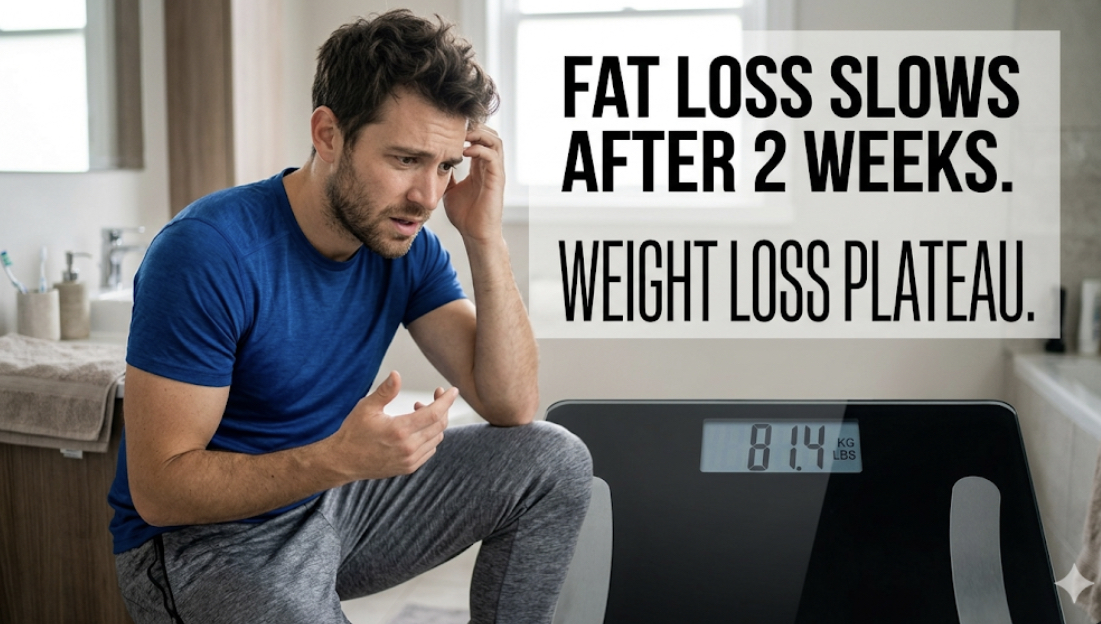
⚡ TL;DR
It's extremely common for fat loss to slow down after 2 weeks of dieting. This happens because of three main factors: initial rapid water loss (glycogen depletion) gives way to slower fat loss, metabolic adaptation reduces your daily energy expenditure, and your body becomes more efficient at using calories . The good news: you can fix it fast with strategic adjustments—reassess calories, increase protein, incorporate refeed days, and add or vary exercise. This guide explains the science and gives you a step-by-step plan to break the plateau.
1. The Frustrating Two-Week Stall: Why It Happens to Everyone
You start a diet with enthusiasm. Week one: you drop 2–3 kg. Week two: another kilo. Then week three arrives—and the scale doesn't budge. You haven't cheated, you're still exercising, but fat loss slows down dramatically. Before you give up, understand that this is a predictable physiological response, not a failure of willpower.
Why does fat loss slow down after starting a diet?
Fat loss slows down after 2 weeks due to a combination of factors: 1) Initial water loss—when you cut calories, your body depletes glycogen stores, and each gram of glycogen is stored with 3–4 grams of water. This rapid water loss accounts for the first week's dramatic drop. 2) Metabolic adaptation—your body senses a calorie deficit and reduces resting metabolic rate to conserve energy . 3) Lower calorie needs—as you lose weight, your smaller body requires fewer calories to function, narrowing your deficit . Understanding these mechanisms is the first step to breaking the plateau.

2. The Science: Why Your Body Fights Fat Loss
2.1. Glycogen Depletion and Water Weight
When you reduce carbohydrate intake or total calories, your body taps into glycogen stores in muscles and liver. Glycogen is stored with water—about 3–4 grams of water per gram of glycogen . Depleting 500g of glycogen releases up to 2 kg of water weight, which explains the rapid loss in week one. Once glycogen is stabilized, fat loss proceeds at a slower, steadier pace (about 0.5–1 kg per week) .
2.2. Metabolic Adaptation: The Body's Defense Mechanism
Metabolic adaptation refers to the reduction in resting metabolic rate (RMR) beyond what's expected from weight loss alone. A landmark study from the Minnesota Starvation Experiment showed that after 24 weeks of semi-starvation, participants' metabolic rates dropped 40% more than predicted by their weight loss . Modern research confirms that even modest calorie restriction can lower RMR by 5–15% within weeks . This is your body's attempt to preserve energy and prevent starvation.
2.3. Hormonal Changes: Leptin and Ghrelin
Leptin (the satiety hormone) decreases rapidly during calorie restriction, while ghrelin (the hunger hormone) increases. These hormonal shifts make you feel hungrier and more prone to cravings, which can sabotage adherence . After 2–3 weeks, these changes peak, making the diet feel harder and weight loss slower.

3. How to Break the Plateau and Restart Fat Loss
3.1. Reassess Your Calorie Intake
As you lose weight, your maintenance calories decrease. A person who initially maintained on 2,500 kcal may now maintain on 2,300 kcal after losing 5 kg. If you're still eating the same deficit calories, your deficit may have shrunk or disappeared. Recalculate your needs using an updated weight-based formula (e.g., 25–30 kcal/kg for maintenance) and adjust your intake by 100–200 kcal if needed .
3.2. Increase Protein to 1.6–2.2 g/kg
Higher protein intake increases the thermic effect of food (TEF) by 20–30%, preserves lean mass, and enhances satiety. If you're plateauing, bump protein to the upper end of this range. A 2020 meta-analysis found that higher-protein diets significantly reduce weight regain after loss .

3.3. Incorporate Refeed Days or Diet Breaks
Strategic refeed days (1–2 days at maintenance calories, higher in carbs) can replenish glycogen, increase leptin, and temporarily boost metabolic rate. A 2018 study showed that intermittent diet breaks (2 weeks at maintenance) improved weight loss efficiency and reduced metabolic adaptation . For a plateau, try one refeed day per week at maintenance calories.
3.4. Add or Vary Exercise
If you've been doing only cardio, add resistance training to preserve muscle and increase post-exercise oxygen consumption (EPOC). If you're already strength training, increase intensity, volume, or add short high-intensity intervals. NEAT (non-exercise activity) also matters—increase daily steps by 1,000–2,000 .
3.5. Check Sleep and Stress
Poor sleep and high cortisol can promote water retention and insulin resistance, masking fat loss. Aim for 7–9 hours nightly and incorporate stress-reduction practices .
4. Sample Nutrition to Break a Plateau
4.1. Refeed Day Example (2,200 kcal for a 70 kg person)
Maintenance calories estimated at 2,200. This day is higher in carbs to replenish glycogen and boost leptin.
- Breakfast: 3 eggs (18g protein) + 1 cup oatmeal (dry) + 1 banana + 1 tbsp honey (500 kcal, 70g carbs, 20g protein)
- Lunch: 150g grilled chicken + 1 cup cooked brown rice + large salad with vinaigrette (500 kcal, 60g carbs, 35g protein)
- Snack: 200g Greek yogurt + 1 apple + 1 tbsp peanut butter (300 kcal, 30g carbs, 20g protein)
- Dinner: 150g salmon + 1 medium sweet potato + 1 cup roasted broccoli (500 kcal, 40g carbs, 35g protein)
- Evening: 1 cup berries + ½ cup cottage cheese (200 kcal, 20g carbs, 15g protein)
4.2. Standard Plateau-Busting Day (1,800 kcal)
- Breakfast: Protein smoothie: 1 scoop whey/pea protein + 1 cup spinach + ½ banana + 1 tbsp almond butter + water (350 kcal, 30g protein)
- Lunch: 150g turkey breast + 2 cups mixed greens + ½ cup quinoa + 1 tbsp olive oil (450 kcal, 35g protein)
- Snack: 1 hard-boiled egg + 1 apple (150 kcal, 7g protein)
- Dinner: 150g white fish + 2 cups roasted non-starchy veggies (broccoli, cauliflower, peppers) + 1 tbsp olive oil (400 kcal, 30g protein)
- Evening: 150g Greek yogurt + ½ cup berries (200 kcal, 15g protein)
Total: ~1,550 kcal, 117g protein (adjust to your target)
Vegan/Vegetarian Adaptation
- Replace chicken/fish with 200g tempeh, seitan, or extra-firm tofu.
- Use pea or soy protein isolate for shakes.
- Add lentils, chickpeas, and edamame for protein.
Gluten-Free Options
- Use certified gluten-free oats, quinoa, buckwheat, or rice.
- Ensure protein powders are GF.
5. Common Mistakes That Prolong the Plateau
- Mistake #1: Cutting calories too drastically. Dropping below 1,200 kcal (women) or 1,500 kcal (men) can crash metabolism and increase muscle loss. Aim for a modest deficit of 300–500 kcal.
- Mistake #2: Doing the same workout forever. Your body adapts to repetitive exercise. Change intensity, mode, or frequency every 4–6 weeks.
- Mistake #3: Ignoring non-scale victories. The scale may be stuck while you're losing inches. Measure waist and track strength.
- Mistake #4: Under-eating protein. Low protein accelerates muscle loss, which lowers metabolic rate further.
- Mistake #5: Not sleeping enough. Sleep deprivation increases cortisol and ghrelin, making weight loss harder.
- Mistake #6: Giving up too soon. Plateaus are normal—they can last 1–4 weeks. Consistency is key.
6. Frequently Asked Questions
Why does fat loss slow down after 2 weeks?
Because the initial rapid loss is mostly water weight from glycogen depletion. After that, your body undergoes metabolic adaptation (lowered metabolism) and hormonal changes (leptin drops, ghrelin rises), slowing fat loss.
How long does a weight loss plateau last?
Typically 1–4 weeks. If you're in a consistent deficit, fat loss is still happening but masked by water fluctuations. Be patient and consistent.
Should I eat less when I hit a plateau?
Not necessarily. First, recalc your maintenance calories. If you're still in a deficit, try increasing activity or adding a refeed day before cutting calories further.
What is metabolic adaptation?
It's the body's natural response to calorie restriction—it lowers resting metabolic rate to conserve energy, often more than expected based on weight loss alone.
Can a cheat meal break a plateau?
A single higher-calorie, higher-carb meal (not a whole day) can temporarily boost leptin and glycogen, sometimes helping to break a plateau. Use strategically, not emotionally.
How much protein do I need to preserve muscle during a plateau?
Aim for 1.6–2.2 g per kg of body weight daily. This supports muscle retention and has a higher thermic effect.
Does exercise help break a fat loss plateau?
Yes—especially if you increase intensity or add resistance training. It boosts metabolism, preserves muscle, and improves insulin sensitivity.
7. Related Resources
- Low-Intensity Walking for Fat Loss: Simple Strategy to Burn More Fat
- How to Handle Hunger Pangs During a Strict Cutting Phase (Athlete’s Guide)
- Intermittent Fasting for Bodybuilders: Pros, Cons, and Muscle-Building Truth
- How to Lose Belly Fat Without Losing Muscle (Science-Based Guide)
- Why You’re Not Losing Fat Despite Eating Clean (7 Science-Backed Reasons)
8. Scientific References
- Keys, A., et al. (1950). The Biology of Human Starvation. University of Minnesota Press. PubMed
- Müller, M. J., et al. (2015). Metabolic adaptation to calorie restriction. International Journal of Obesity, 39(6), 921–927. PubMed
- Leibel, R. L., et al. (1995). Changes in energy expenditure resulting from altered body weight. New England Journal of Medicine, 332(10), 621–628. PubMed
- Hall, K. D., et al. (2016). Energy balance and body composition changes during weight loss. Journal of Clinical Investigation, 126(6), 2218–2225. PubMed
- Westerterp-Plantenga, M. S., et al. (2012). Dietary protein, metabolism, and body-weight regulation. American Journal of Clinical Nutrition, 95(2), 297–304. PubMed
- Byrne, N. M., et al. (2018). Intermittent energy restriction improves weight loss efficiency in obese women. Obesity Research & Clinical Practice, 12(2), 123–132. PubMed
- Trexler, E. T., et al. (2014). Metabolic adaptation and weight regain. Journal of the International Society of Sports Nutrition, 11(1), 24. PubMed
- Nedeltcheva, A. V., et al. (2010). Insufficient sleep undermines dietary efforts to reduce adiposity. Annals of Internal Medicine, 153(7), 435–441. PubMed
- ACSM. (2022). Weight Loss and Plateaus. American College of Sports Medicine. View Source
Join the conversation